
You may know what ought to be protected and still be unsure how hard to push. This is where appeals to dharma can become dangerously convenient: one person uses restraint to excuse inaction, while another gives anger a sacred name.
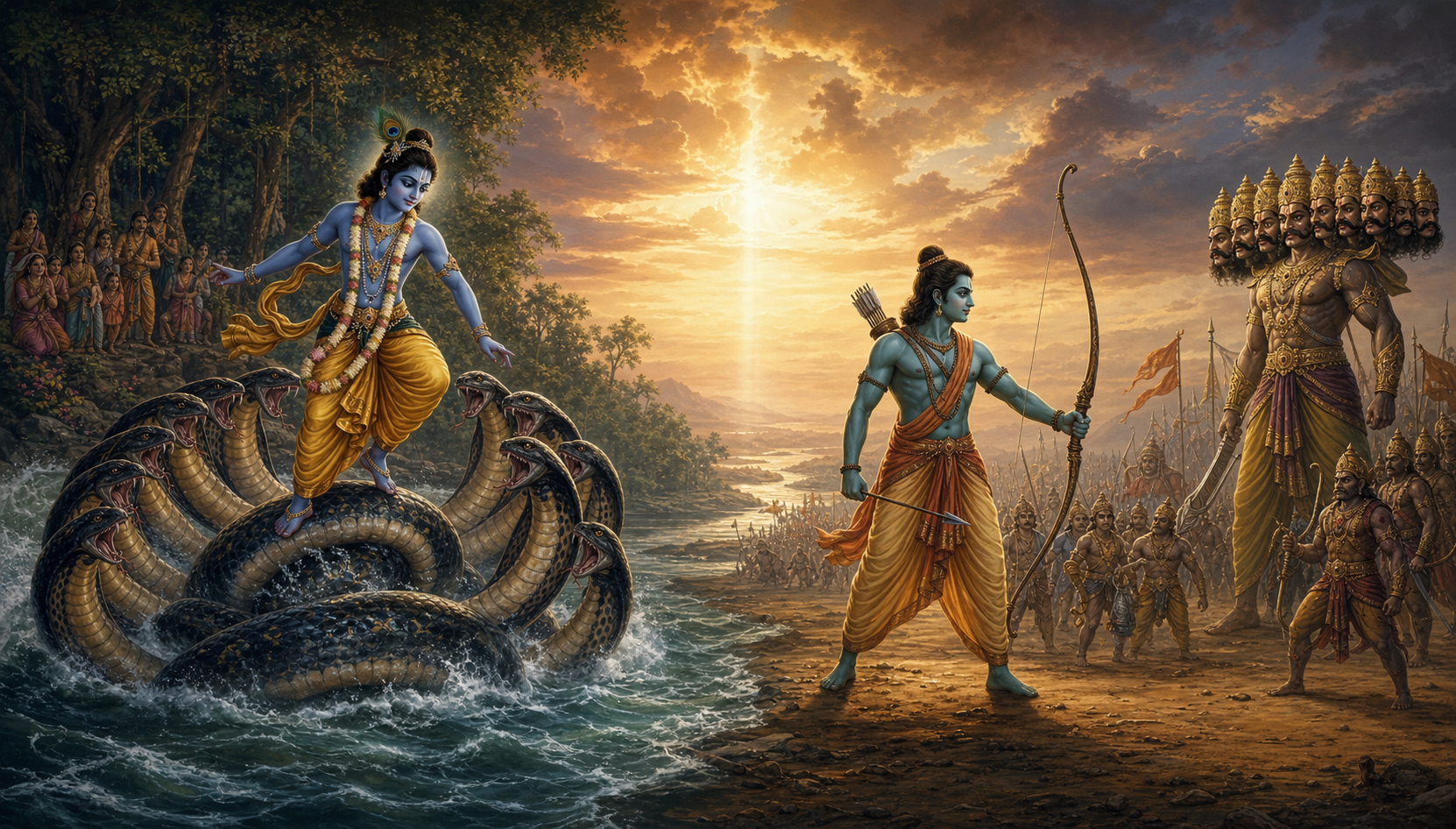
Krishna at Gokul and Rama before Ravana offer two distinct models of protective power. Krishna changes a dangerous situation before it consumes a community. Rama confronts an armed aggressor without letting battle lose its moral limits. Their example gives you a practical way to judge authority by its purpose, proportionality, boundaries, and stopping point.
Protection, not possession, is the first test of power
Power becomes dharmic when it is answerable to a good beyond the ruler’s ego. The first question is therefore not whether an action appears gentle or forceful. It is: whom and what does this action protect?
At Gokul, Krishna acts amid accumulating danger to a vulnerable pastoral community. Counsel has not produced the needed movement, so he creates an unmistakable crisis that drives the settlement across the Yamuna to Vrindavan. The result is not Krishna’s acquisition of territory or prestige. It is the continued safety of people, cattle, livelihoods, and pastoral life.
Rama exercises power in a different setting. Sita has been abducted, a bridge has been built to Lanka, and Ravana meets Rama in a final armed contest. Ravana possesses extraordinary weapons, mobility, and royal magnificence, but capability cannot make his cause just. Rama’s force answers a grave transgression and brings an adharma-aligned reign to a decisive end.
In each case, power serves restoration. Krishna makes continued communal life possible in a more suitable place. Rama removes the power sustaining a violation of dharma. Neither model makes an opponent’s suffering the desired outcome.
You can apply this beneficiary test before exercising authority:
- Name the protected good in one sentence: a person, community, livelihood, sacred obligation, ecological limit, or just order.
- Name the concrete harm likely to follow if you do nothing.
- Name what you personally stand to gain, especially status, revenge, control, or freedom from criticism.
- Describe the ordinary life that should become possible after the intervention ends.
If you can describe the person you want to defeat more clearly than the good you mean to protect, pause. Your motive may already have shifted from guardianship to possession.
Krishna’s model: create enough urgency to change course
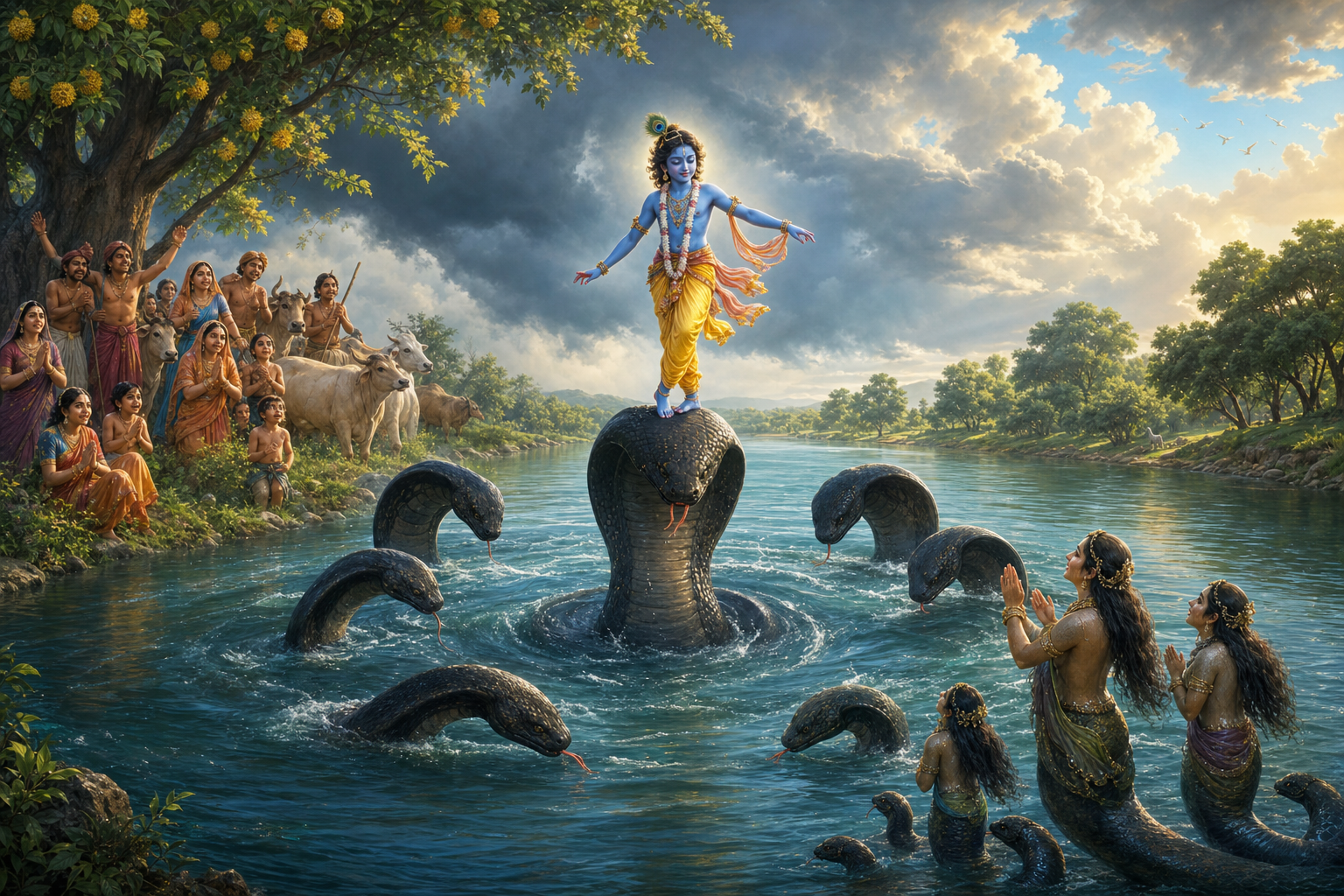
The Harivamsa gives the Gokul migration its most startling form. Krishna produces wolves from the pores of his body, and their terrifying presence compels the community to leave. In many tellings, the wolves function as catalysts rather than instruments of slaughter; once the migration has been achieved, their work is over. The Bhagavata Purana preserves the strategic relocation without this particular motif.
That variation helps identify the stable ethical center of the episode. The point is not the spectacle of supernatural wolves. The point is that dangerous inertia is broken, the community moves, and life continues. Krishna’s power changes behavior without turning punishment into a permanent institution.
This is a demanding form of proportionality. The least forceful intervention is not automatically the most ethical. A warning that everyone can ignore may leave the vulnerable carrying all the risk. Yet overwhelming force is not justified merely because it would work quickly. The relevant standard is the least harmful measure that can reliably secure the protected good.
Four checks keep that standard concrete:
- Reality: the danger must be specific enough to test. General anxiety or dislike is not a sufficient basis for coercion.
- Efficacy: the measure must address the mechanism of harm. Pressure that only displays authority is ethically empty.
- Reversibility: where possible, begin with a measure that can be withdrawn if the facts change or the danger passes.
- Termination: everyone affected should be able to identify what makes the pressure stop.
Krishna’s intervention also corrects a common mistake in thinking about leadership. Not every crisis has an enemy who must be defeated. Sometimes the arrangement itself has become unsafe. A pastoral settlement depends on water, seasonal fodder, grazing commons, floodplain conditions, and manageable pressure on the land. When those conditions can no longer support life securely, attachment to the present location is not courage.
The practical move is to separate the good from its current form. People, worship, relationships, and livelihoods may be non-negotiable; a particular location, schedule, procedure, or institutional arrangement may not be. The movement from Gokul to Vrindavan protects the community precisely because it does not confuse fidelity with immobility.
There is also a necessary warning. A divine act in sacred narrative is not a blank cheque for an ordinary leader to manufacture fear. You do not possess Krishna’s knowledge, and staged panic can easily become manipulation. Translate the function of the act rather than copying its dramatic surface: disclose the evidence you can disclose, permit challenge, prefer reversible constraints, and state the ending condition before pressure begins.
Rama’s model: confront aggression without becoming unbounded
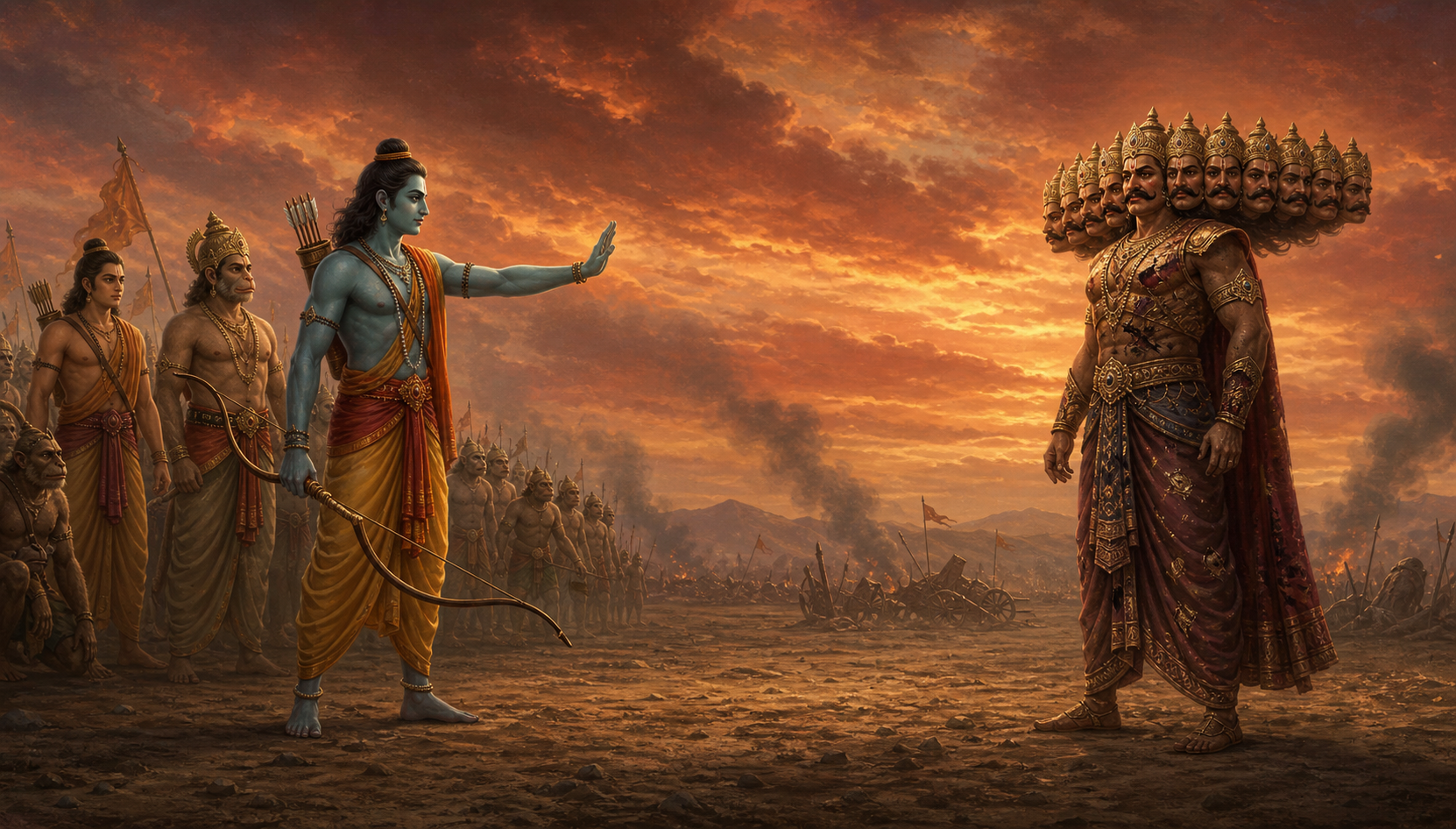
Rama’s final battle addresses a danger that cannot be solved merely by moving away from it. Ravana is an accountable aggressor with continuing military power. Confrontation is therefore direct, but directness does not mean moral abandonment.
Indra sends Rama a celestial chariot driven by Matali, giving him a platform equal to Ravana’s. The duel unfolds through maneuver, counter-weapons, attacks on military capability, and disciplined timing. Even at the battle’s apex, restraints remain legible: the unarmed are not to be struck, rearmament can be allowed after dislodgment, and valor is distinguished from treachery.
These limits matter precisely because they can cost an immediate advantage. A rule observed only when convenient is not restraint. Dharma-Yuddha makes the warrior accountable while anger, fear, and urgency are at their strongest.
The final brahma-weapon ends a threat that lesser weapons have not ended. Its severity does not have to be confused with cruelty. Severity is the degree of action required to stop grave harm. Cruelty makes humiliation, suffering, or excess part of the purpose. Rama’s model permits decisive closure while refusing to make limitless destruction the meaning of victory.
You can recognize disciplined force through four visible boundaries:
- Target: action remains focused on the responsible aggressor or harmful capability rather than spreading guilt to everyone nearby.
- Means: the intervention is related to stopping the threat, not satisfying accumulated hatred.
- Rules: some actions remain forbidden even when breaking the rules would be advantageous.
- Stopping point: force ends when the protective task has been secured; it does not search for new enemies to justify its continuation.
The chariot makes self-command visible. In the Katha Upanishad’s well-known chariot image, the intellect is the charioteer, the mind supplies the reins, and the senses are the horses. The same moral architecture scales outward in Rama’s battle: immense power remains useful only when judgment can steer it.
Before an irreversible decision, identify your own horses, reins, charioteer, and destination. The horses are fear, anger, loyalty, and ambition. The reins are the procedures, vows, laws, and limits that keep impulse from determining action. The charioteer is sober judgment, strengthened by counsel. The destination is the just condition you mean to restore. If you cannot name that destination, momentum may already be driving you.
A five-part dharmic test for using authority

Use this test on a real decision: removing someone from responsibility, imposing a restriction, relocating a project, cancelling an unsafe activity, confronting abuse, or defending a community. Write one clear answer to each step before acting.
- Define your duty. State the person, community, institution, ecological good, or principle you are responsible for protecting. Do not begin with what you want to do to an opponent.
- Establish the danger. Record what is happening, who bears the cost, and what delay is likely to worsen. Separate observed harm from rumor, wounded pride, and predictions you cannot support.
- Choose the right mode. Use the Krishna pattern when the danger is systemic, environmental, or positional and safety can be achieved by relocation, reconfiguration, or controlled urgency. Use the Rama pattern when a responsible aggressor is actively sustaining grave harm and focused confrontation is necessary. In ordinary civic, family, and institutional life, the Rama pattern usually means due process, removal from authority, enforcement, or lawful defensive action, not private violence.
- Select the least harmful effective measure. Do not confuse symbolic action with sufficient action, and do not confuse maximum pressure with strength. Explain why a milder option would fail or why a harsher one is unnecessary.
- Fix boundaries, accountability, and exit. State who may act, what remains prohibited, how the decision can be reviewed, what triggers reassessment, and exactly what brings the intervention to an end.
A quick distinction can prevent many errors. If vulnerable people can be protected by moving, sheltering, redesigning, or reducing exposure, secure them first. If an aggressor will continue harming others unless authority confronts that conduct, use a focused and accountable process. When both conditions exist, the models can be sequenced: move those at risk, then address the aggressor without turning emergency power into a permanent exception.
Watch for two opposite failures. Coercion is drifting toward domination when nobody can say when it ends, when criticism is treated as disloyalty, or when your claimed purity replaces verifiable reasons. Inaction is drifting toward complicity when warnings have repeatedly failed, harm continues to accumulate, and your reluctance leaves other people paying for your clean hands.
The intended result is abhaya: freedom from fear because danger has been reduced, not obedience produced by fear of the protector. After action, ask what can resume, which extraordinary powers can be surrendered, what repair is owed, and whether those protected can once again make ordinary choices without depending on your command.
A short FAQ on dharmic power
Does dharma require nonviolence in every conflict?
Krishna and Rama resist a simple choice between passivity and violence. Ahimsa disciplines power against avoidable injury, but it does not make indifference to preventable harm virtuous. Krishna minimizes injury by changing the community’s situation. Rama uses focused force when a grave aggressor must be stopped. In both cases, protection, necessity, restraint, and closure remain essential.
Is indirect pressure more ethical than direct confrontation?
Not automatically. Indirect pressure can reduce injury, but it can also hide responsibility and manipulate consent. Direct confrontation can be severe, yet more honest and accountable. Judge either method by the reality of the danger, the harm imposed, the opportunity for review, and whether pressure stops after its protective purpose has been achieved.
Which model should a fallible human leader use first?
Protect the vulnerable first and prefer a reversible adaptation when it can genuinely work. Escalate only when the threat remains active and lesser measures cannot secure the protected good. This is not a mechanical sequence guaranteed by scripture. It is a prudent safeguard for human beings who lack divine knowledge and can mistake attachment, fear, or vengeance for duty.
At your next difficult decision, do not ask which epic hero makes you feel justified. Put the five answers in writing. If your action protects a specific good, uses the least harmful effective means, accepts real limits, and stops at restoration, you have begun to place power under dharma. If those answers remain vague, change course before authority hardens into appetite.
References
- DharmaRenaissance Blog – When Wolves Rose from Krishna’s Pores: Decoding Harivamsa’s Eco-Dharma and Land Ethics
- DharmaRenaissance Blog – Ravana’s Celestial Chariots Decoded: Sacred Power and Terrible Splendor in Lanka’s Final War
