
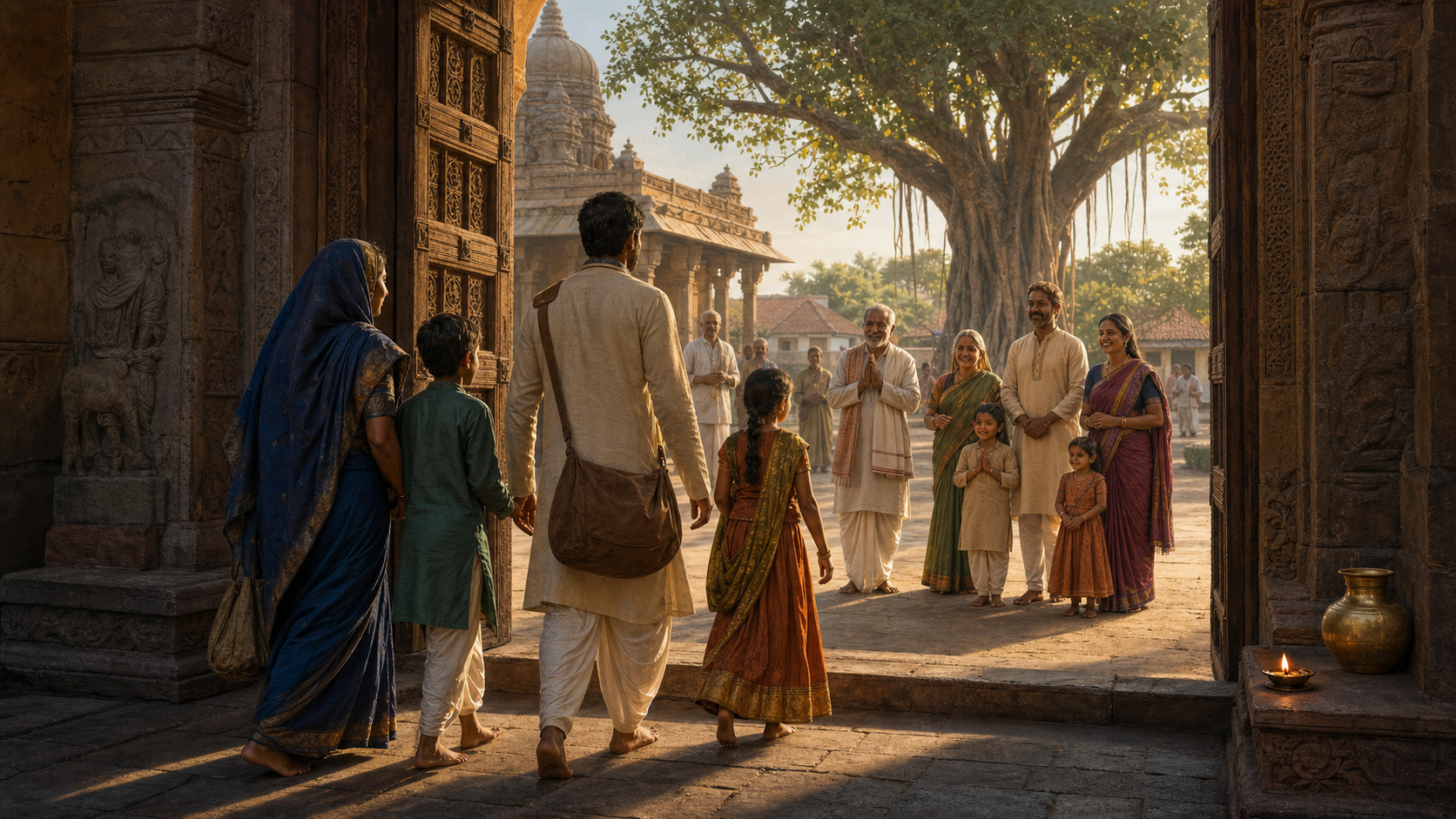
If you are trying to decide whether Ghar-Wapsi is an old Hindu practice or merely a modern political slogan, don’t begin with today’s shouting. Begin with the harder question: could Hindu society historically receive back someone separated from it by force, fear, fraud, or circumstance? The record preserved in Dharmashastra, statecraft, philosophical literature, and organised reform answers yes, although that answer was not applied evenly.
This distinction matters because a genuine homecoming is more demanding than a ceremony. It requires consent from the person returning, a legitimate religious path, social acceptance after the ritual, and a community willing to remove the barriers that once turned separation into permanent exile.
Key takeaways
- Ghar-Wapsi is the modern popular name for an older family of practices described as paravartana, shuddhi, and prayaschitta.
- Dharmashastra did not establish an absolute rule that a person separated from Hindu society could never return. Several texts explicitly considered readmission after coercion.
- Vijayanagara and Maratha examples indicate that return was not confined to theory; rulers and religious authorities sometimes created institutional procedures for it.
- Literature preserved the idea of homecoming by presenting identity as something deeper than an externally imposed label.
- A ritual without social acceptance is incomplete. Jati gatekeeping, humiliation, publicity without consent, or abandonment after the ceremony can turn an apparent welcome into another rejection.
- Ghar-Wapsi is dharmic only when it is voluntary, truthful, dignified, and followed by durable belonging.
Paravartana was a door, not an irreversible sentence
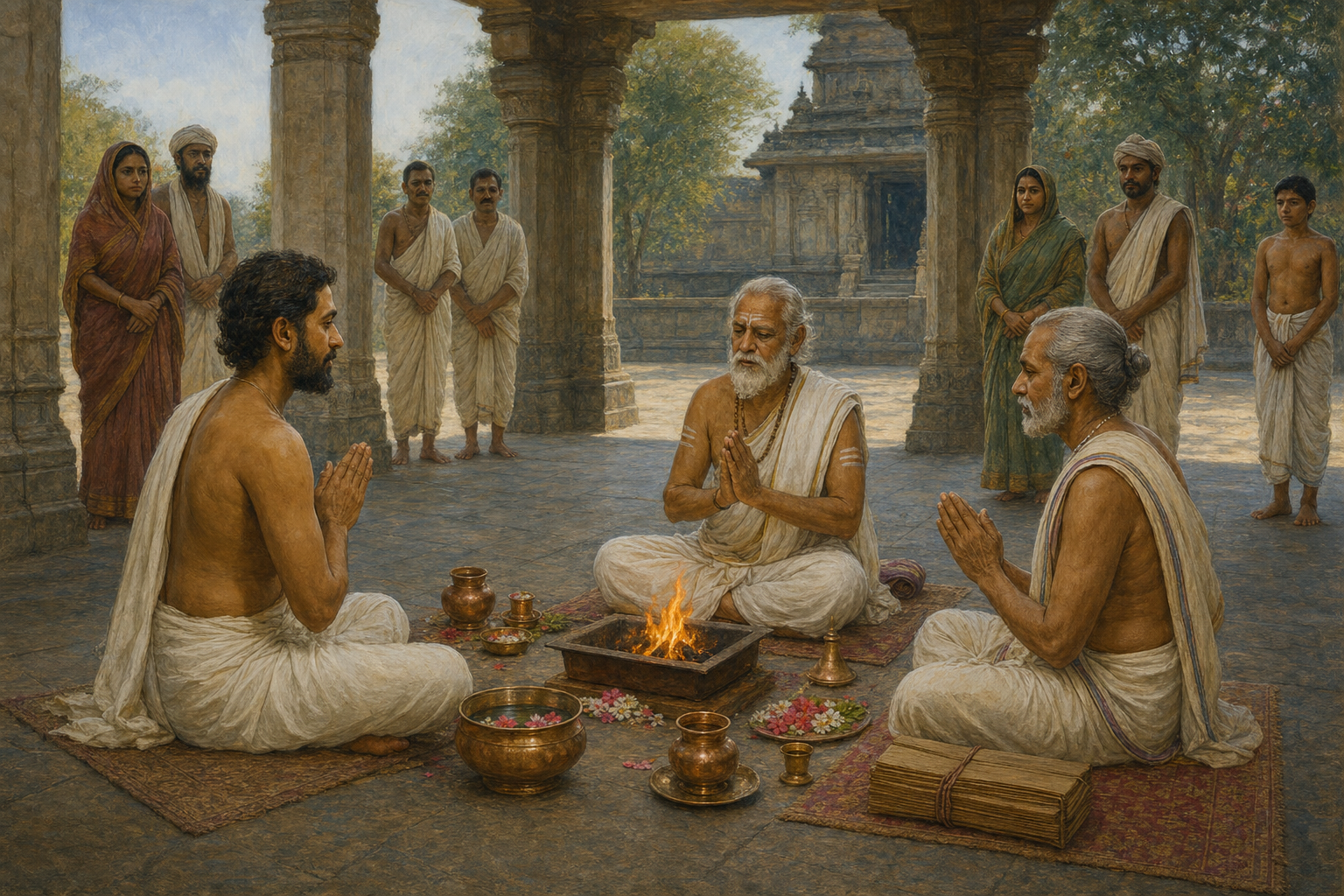
Three terms need to be separated. Paravartana means a turning or return. Shuddhi names a process of ritual purification or regularisation. Prayaschitta is a restorative or expiatory observance prescribed after a rupture. Ghar-Wapsi, meaning homecoming, is the accessible modern expression. The terms overlap, but they are not interchangeable in every setting.
The language of purification can sound harsh to a modern reader, especially when the affected person was a victim of violence. In the relevant historical setting, however, the practical purpose of shuddhi was not necessarily to condemn that person. It could provide the formal bridge by which society recognised that coercion had not erased the person’s prior belonging.
The mlecchita-shuddhi material associated with the Devala-Smriti addressed restoration after contact or captivity outside accepted social boundaries. Related provisions are associated with the Atri-Smriti and Atri-Samhita. Their presence matters because it disproves the sweeping claim that Hindu tradition knew only permanent exclusion.
The principle became even clearer in the twelfth century. Vijnaneshvara’s commentary on the Yajnavalkya-Smriti considered the readmission of Hindu women who had endured sexual violence and pregnancy under coercive circumstances. That is a severe historical case, but it reveals the decisive point: a person grievously injured by an aggressor did not have to be punished a second time through lifelong rejection by her own society.
These passages are prescriptive evidence. They show that learned authorities articulated a route of return; they do not prove that every village, jati, ruler, or period applied it consistently. That difference between an available dharmic principle and uneven social conduct is essential. Hindu society sometimes possessed the remedy but failed to use it.
The contrary belief that one can only be born a Hindu, and that anyone who leaves can never come back, hardened under conditions of prolonged insecurity and increasingly intricate social boundaries. By the time such thinking became entrenched, varna, jati, sub-jati, kula, and local custom could form a dense web of gatekeeping. A rule intended to preserve a community could then prevent the community from recovering its own people.
When you hear someone declare that Hindu Dharma has no concept of return, ask a precise question: are they describing the complete textual tradition, or only a later social attitude? The two are not the same.
Vijayanagara, the Marathas, and the organised Shuddhi movement
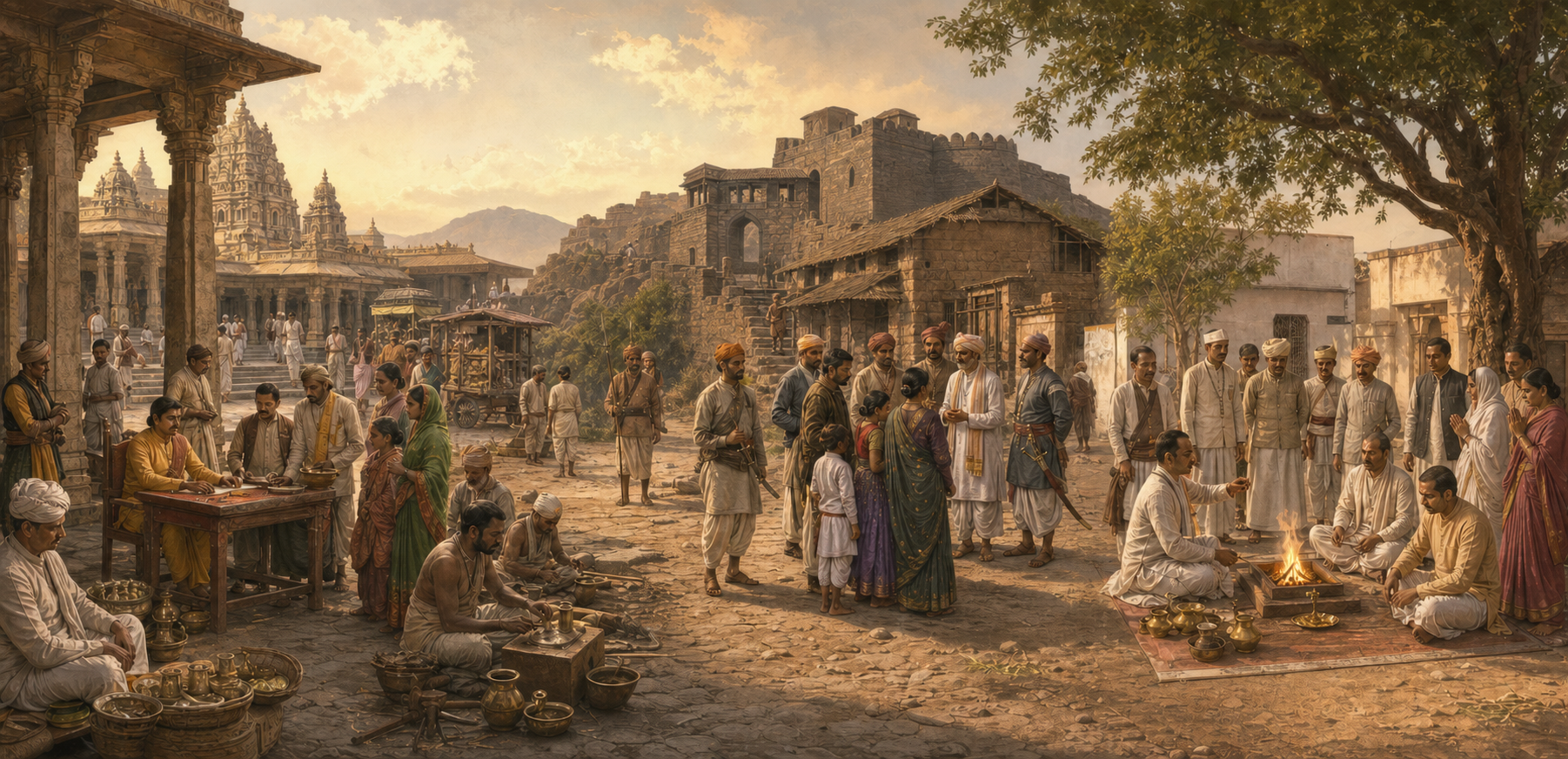
The historical record becomes most useful when we distinguish a scriptural permission from an institution capable of implementing it. A household may want to welcome someone back, but a large community also needs recognised authorities, a procedure, and public assurance that the returnee will not be ostracised afterward.
A striking example is associated with the Bahmani-Vijayanagara conflict that ended in 1398. Thousands of Hindus are described as having been captured, forcibly converted, and held as hostages. Harihara II secured their release through a treaty involving a payment of ten lakh honnu, after which a mass shuddhi restored the released men and women to Hindu society. The episode is important not simply because of the scale claimed for it, but because restoration followed rescue. Political recovery and social recovery were treated as parts of the same duty.
The Maratha system supplies a different kind of evidence. Under Chhatrapati Shivaji Maharaj, the Panditrao’s jurisdiction extended to religious matters. Surviving letters described meetings of learned Brahmanas who approved prayaschitta for Hindus forcibly converted under Muslim power and authorised their restoration to their communities. Authorities at Paithan, Nasik, Karad, Sankeshwara, and Karavira could be consulted in such cases.
This was not a casual announcement from a ruler. It was an administrative mechanism connecting royal authority, learned deliberation, ritual action, and social recognition. The lesson for you is concrete: if homecoming is left to an isolated family facing hostile gatekeepers, it can fail even when Dharma permits it. Institutions must be willing to stand behind their decision.
In the modern period, Swami Dayananda Saraswati gave shuddhi a renewed public role through the Arya Samaj. Swami Shraddhananda then transformed that principle into organised activity across northern India. The Malkana Rajput campaign became especially significant. A July 1933 account by D.R. Bhandarkar described village after village of Malkana Rajputs returning to Hindu society; these communities were said to have been converted under compulsion while retaining substantial Hindu customs.
Shraddhananda was later murdered in his own home. The killing had consequences beyond the loss of one leader: it demonstrated the personal danger attached to a mass movement and discouraged potential successors. Yet the larger historical fact remains that the Arya Samaj showed how a dispersed religious principle could be turned into organisation, teaching, ceremony, and community-scale action.
The contrasting Meo and Mewati trajectory shows why delay matters. When ancestral memory, inherited customs, and social bridges weaken over generations, a theoretical right of return becomes progressively harder to exercise. Loss of ancestral memory is therefore not a minor cultural detail. It changes what later generations imagine to be possible.
| Kind of evidence | What it can establish | What it cannot establish by itself |
|---|---|---|
| Dharmashastra provisions | A recognised doctrinal path for readmission existed. | That every community followed the path consistently. |
| Royal letters and offices | Some states created procedures to authorise restoration. | That prejudice disappeared after authorisation. |
| Mass shuddhi campaigns | Organised return could operate across entire communities. | That a ceremony alone created lasting belonging. |
| Literary and philosophical use | Homecoming remained intelligible within cultural memory. | That every literary scene records a historical event. |
Use these categories whenever you encounter a dramatic claim about Ghar-Wapsi. A smriti passage, a court record, a mass campaign, and a literary metaphor answer different questions. Treating one as proof of everything produces bad history; reading them together reveals how an idea moved from principle to practice.
Literature preserved the inner meaning of homecoming

History can tell you that a ceremony occurred. Literature asks what returning meant to the person and to the society receiving that person. That is why Ghar-Wapsi belongs in literary discussion as well as political and religious history.
Vidyaranya Swami offers a revealing example in the Panchadasi. He compares the Atman’s freedom from identification with the body to a Brahmana captured by outsiders who, after appropriate prayaschitta, returns to his former standing. The analogy assumes that imposed captivity does not permanently transform essential identity. Social status may be disrupted, but the deeper person is not reducible to the label imposed by force.
This philosophical use is more than a passing ritual reference. A metaphor works only when its movement is intelligible to its audience. Capture, separation, corrective observance, and return form a recognisable sequence. Homecoming therefore existed not only as a technical possibility in a rule book but as an image through which a major teacher could explain the distinction between the Self and its external conditions.
In later public culture, the motif continued through speeches, literary writing, activism, and celebrations of communal return. The literary function is important: a community remembers not only through dates and decrees but through stories about exile, recognition, courage, betrayal, restoration, and welcome.
When you read a poem, novel, biography, speech, or historical narrative involving religious return, examine four things.
- Who possesses agency? A homecoming chosen by the person is morally different from one arranged for political display or imposed by relatives.
- What is being restored? The answer may involve worship, family memory, community standing, ancestral customs, or all four. A change of label alone is narratively thin and socially incomplete.
- Who controls the threshold? Priests, jati leaders, relatives, rulers, and reform organisations may open or close the door. Their conduct reveals what the work believes society owes the returnee.
- Where does the story end? If it ends at the ritual fire, it may be celebrating an event. If it continues into ordinary family and community life, it is testing whether the promised home actually exists.
This method keeps literature from being used as disguised archival proof. It also prevents the opposite mistake of treating cultural imagination as irrelevant. Literature records the moral possibilities a society can still envision. When the returnee can be portrayed with dignity, the door remains present in collective memory. When the only available character is a permanent outcast, exclusion has already colonised the imagination.
A dharmic homecoming must continue after the ceremony
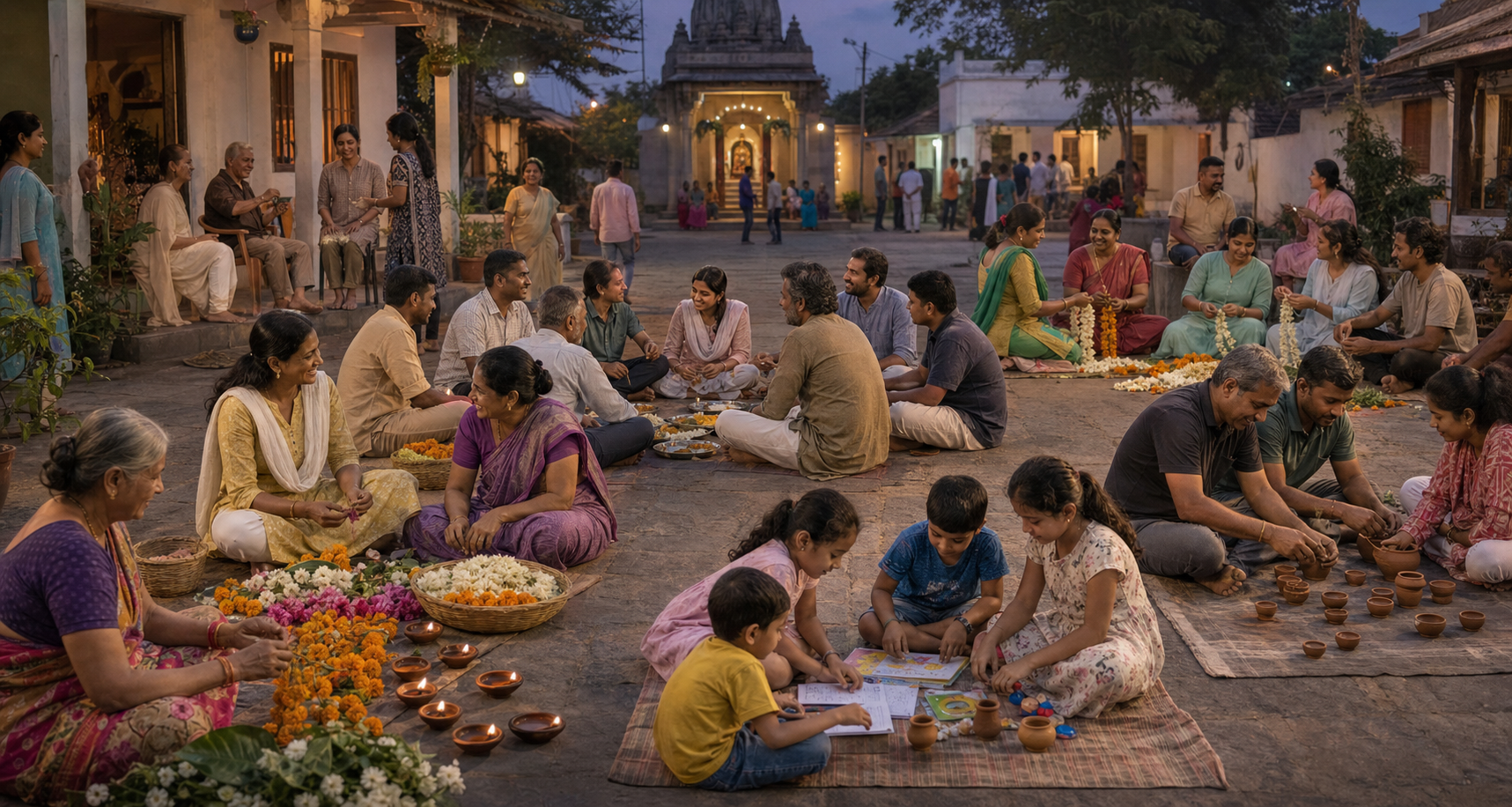
Some contemporary Hindu advocacy presents Ghar-Wapsi as a response to conversion and civilisational erosion. Even within that argument, homecoming is acknowledged to be only a partial remedy. A ceremony cannot substitute for a living family, access to spiritual instruction, functioning temples, cultural confidence, and communities that practise what they say they want to preserve.
The first responsibility is therefore internal. Hindu society cannot call people home while keeping the door chained through jati rigidity, inherited stigma, or suspicion of anyone whose life does not fit a familiar template. Historical Maratha cases sometimes focused on restoring a person to caste because caste standing governed everyday social life. In the present setting, jati may remain part of family identity, but it must not become a veto over someone’s access to Sanatana Dharma.
The following standard helps a family, mandir, matha, samaj, or cultural organisation distinguish genuine paravartana from a publicity exercise.
- Listen before applying a label. Let the person describe the journey in private. A descendant exploring ancestral customs, a former Hindu wishing to return, and a newcomer embracing a Hindu sampradaya may require different language and pastoral care. Do not presume someone’s ancestry or announce an identity on that person’s behalf.
- Confirm free and informed consent. The participant must be able to ask questions, decline publicity, postpone the ceremony, or stop altogether. Threats, material pressure, deception, and fear are incompatible with a dharmic homecoming.
- Choose a legitimate spiritual path. There is no single mechanical ritual that can represent every Hindu tradition. A recognised acharya, purohita, or responsible sampradaya should explain what observance is appropriate, what commitments it expresses, and what it does not do.
- Remove social vetoes before the ritual. Resolve predictable objections from relatives, temple managers, or community leaders in advance. It is cruel to conduct a public shuddhi and then allow the returnee to be refused ordinary worship, meals, festivals, or fellowship.
- Create a plan for belonging. Give the person a named community contact. Make introductions to a local mandir and teacher. Invite the family to the next festival, study circle, seva activity, or shared meal. Check privately afterward instead of assuming that a photograph proves acceptance.
- Protect dignity and privacy. Obtain clear permission before publishing names, images, family history, or claims about numbers. Do not require the participant to denounce former neighbours or repeat hostile slogans. If the step could affect civil records or legal rights, obtain current local legal advice before filing paperwork; a religious ceremony is not a substitute for accurate legal guidance.
The correct measure of success is durable belonging, not a headline or headcount. Can the returning person worship without being stared at? Is there a teacher available when questions arise? Will families share food and festivals? Will the community defend the person’s dignity when challenged? If the answer is no, the homecoming remains unfinished.
Historical coercion should not be erased. Forced conversion, sexual violence, abduction, intimidation, and the destruction of ancestral memory must be named where the evidence supports them. But naming those wrongs does not require collective contempt for Muslims, Christians, or any other present-day community. A returnee should not be turned into an instrument of hatred. The wrong of coercion is answered by restored agency, not a new coercion in the opposite direction.
Nor are descendants the property of an ancestral community. Ancestry can open a door, preserve a memory, and offer an invitation; it cannot replace personal conviction. Ghar-Wapsi retains its moral meaning only when the person crossing the threshold genuinely wishes to do so.
If you serve a mandir, matha, samaj, or cultural body, take one practical step: write a one-page welcome protocol containing a consent check, a trusted ritual contact, a community sponsor, a privacy rule, and a plan for continued inclusion. If you are a relative, begin more simply. Listen without interrogation, share a meal, and offer a place in living practice. That is how paravartana stops being a slogan and becomes a homecoming.
References
- Dharma Dispatch — The Scary Finale: Ghar-Wapsi in a Time of Rapid Erosion and Existential Crisis
- Dharma Dispatch — How Ghar-Wapsi was Celebrated in Contemporary Indian Literature
- Dharma Dispatch — Ghar-Wapsi in the Vijayanagara and Maratha Empires
- Dharma Dispatch — Meos, Malkana Rajputs and a Saga of Missed Opportunities for Ghar-Wapsi
