Punjab’s eighteenth-century transformation was not a simple transfer of power from one empire to another. It unfolded through the erosion of Mughal authority, repeated contests between Maratha and Durrani forces, and the ability of the Sikh Misls to survive upheaval and turn unstable conditions into durable local power.
The most useful way to understand Maratha influence is therefore neither to credit the Marathas with creating the Sikh political order nor to treat their northern campaigns as irrelevant after their reverses. The supplied DharmaRenaissance account supports a more precise conclusion: Maratha pressure weakened competing structures and disrupted the networks through which distant powers sought to control Punjab, while Sikh institutions supplied the agency, resilience, and legitimacy that ultimately determined the region’s political future.
Influence without authorship: the essential distinction
The Sikh Empire’s rise had preconditions, but those preconditions should not be confused with its causes in the narrowest sense. DharmaRenaissance explicitly argues that the Marathas neither created the Sikh Misls nor decided their political destiny. The Sikh confederacies emerged from their own traditions of armed resistance, community defence, local authority, and mobile warfare. Their eventual consolidation under Maharaja Ranjit Singh was a Sikh political achievement.
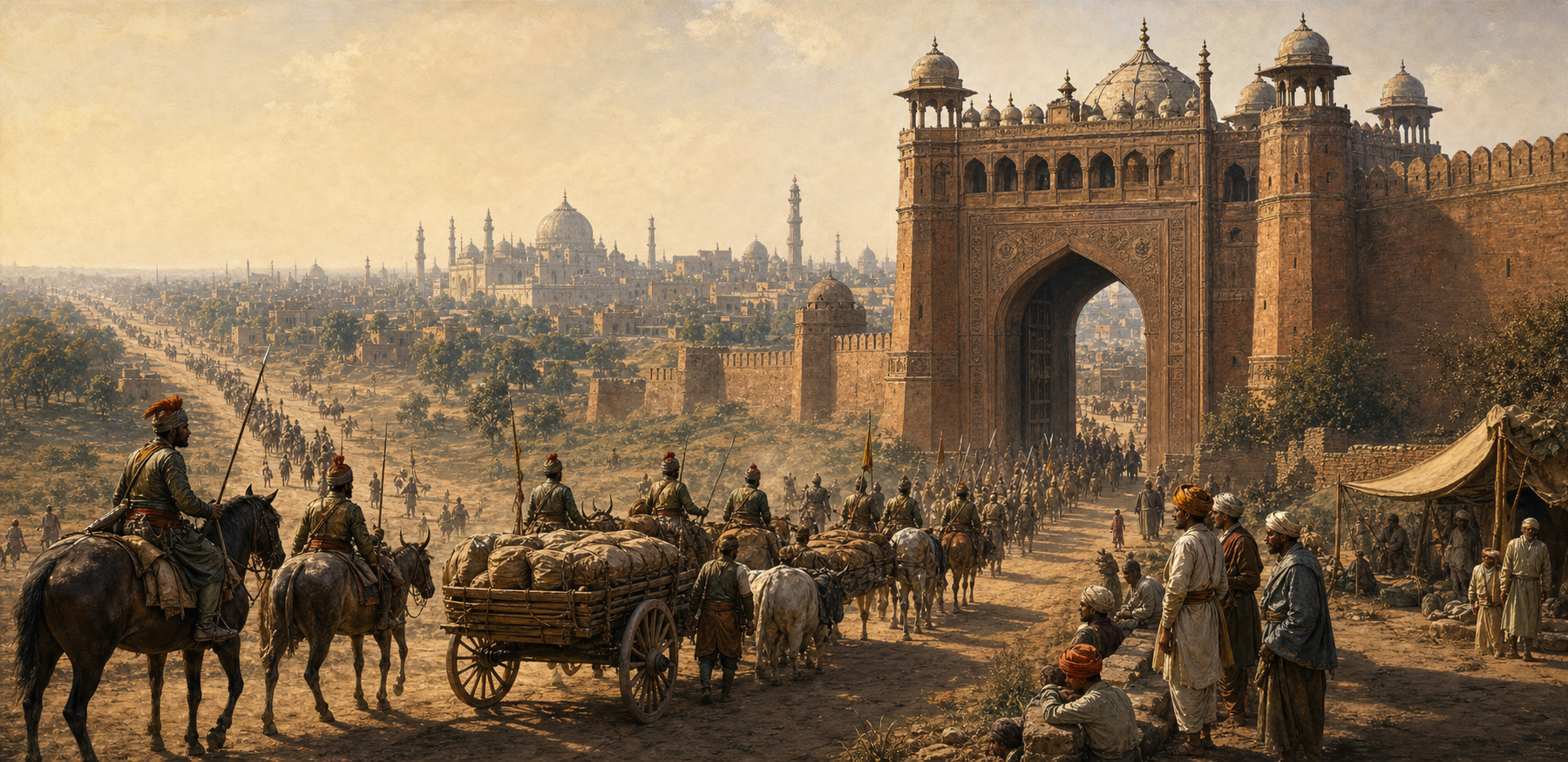
Maratha influence operated at a different level. According to the source account, Maratha expansion from the Deccan into Malwa, Gujarat, Bundelkhand, Rajasthan, Delhi, and eventually Punjab challenged the Mughal system across several revenue-producing and strategically important regions. As provincial governors became more autonomous and imperial revenue collection grew less effective, the Mughal emperor retained symbolic importance without possessing the former capacity to impose a stable order across distant provinces.
This distinction clarifies the causal chain. Maratha action contributed to the loss of Mughal administrative control; conflict between the Marathas and Ahmad Shah Abdali’s Durrani power prevented a straightforward Afghan succession to that control; and the Sikh Misls used the resulting fragmentation to deepen authority on the ground. The Marathas helped make the opening. The Sikh confederacies learned how to occupy it.
The 1758 campaign made Punjab visibly contestable
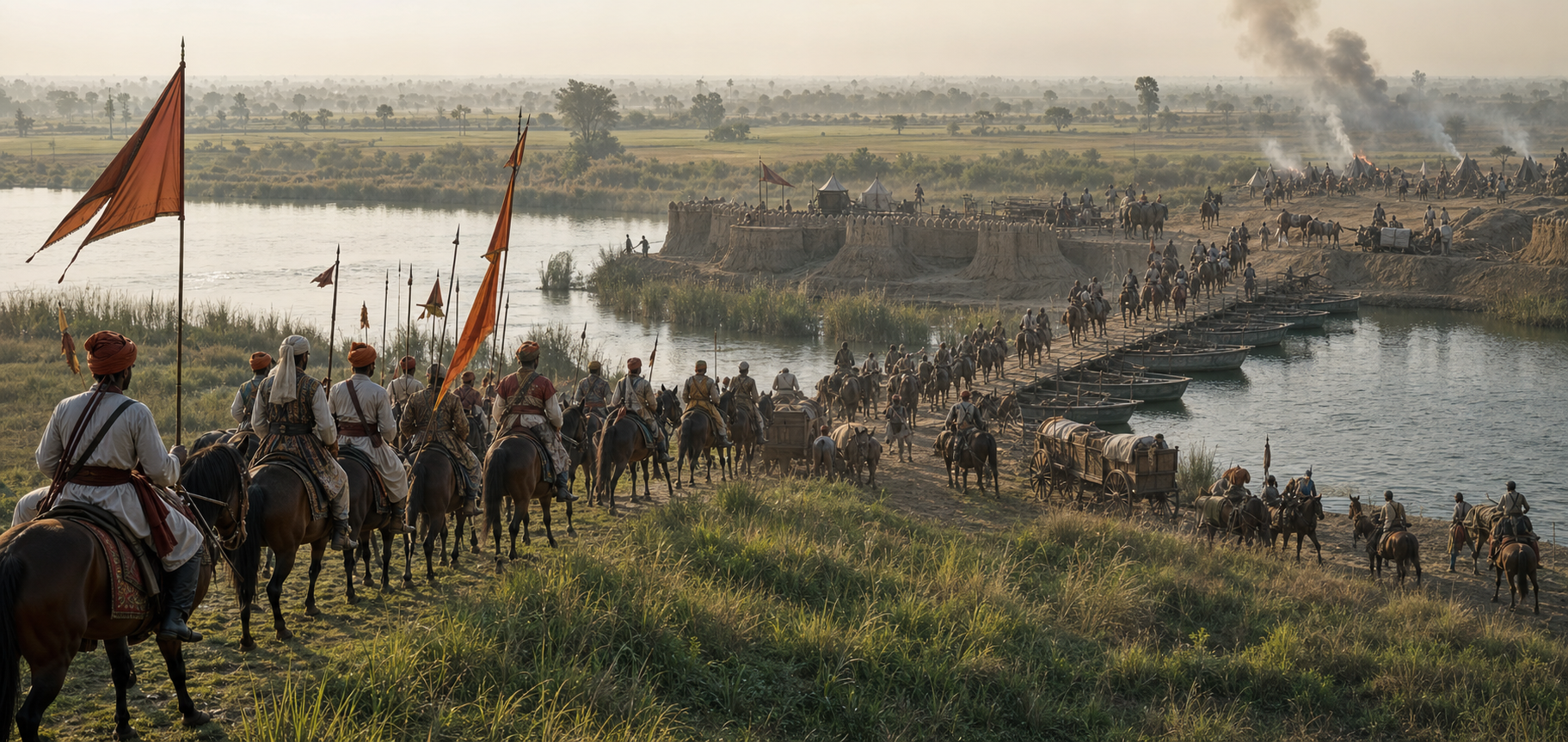
DharmaRenaissance identifies the Maratha advance into Punjab in 1758 as a critical demonstration of changing power. Working with local allies, Maratha forces entered Lahore and reached Attock on the Indus. The occupation did not by itself establish a permanent Maratha state in Punjab, but permanence was not its only historical significance.
The campaign showed that Lahore and the routes towards the Indus were no longer secure possessions of either the declining Mughal establishment or the Durrani rulers. The source describes Lahore, Sirhind, Multan, and the wider corridor as an arena in which Maratha expeditions, Sikh forces, Afghan governors, Mughal-aligned elites, and local allies competed. Sovereignty was becoming negotiable, fragmented, and dependent on actual control rather than inherited imperial claims.
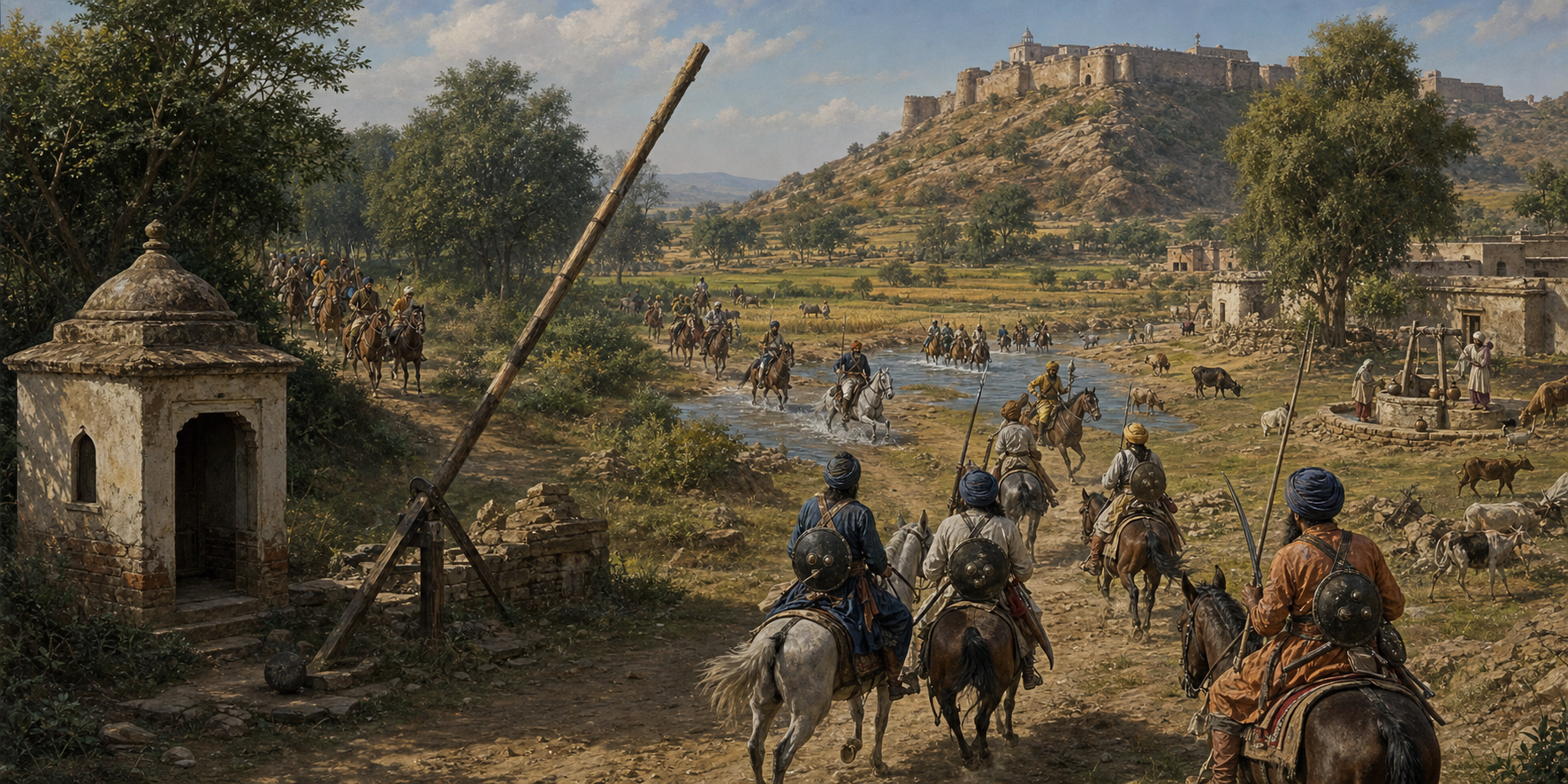
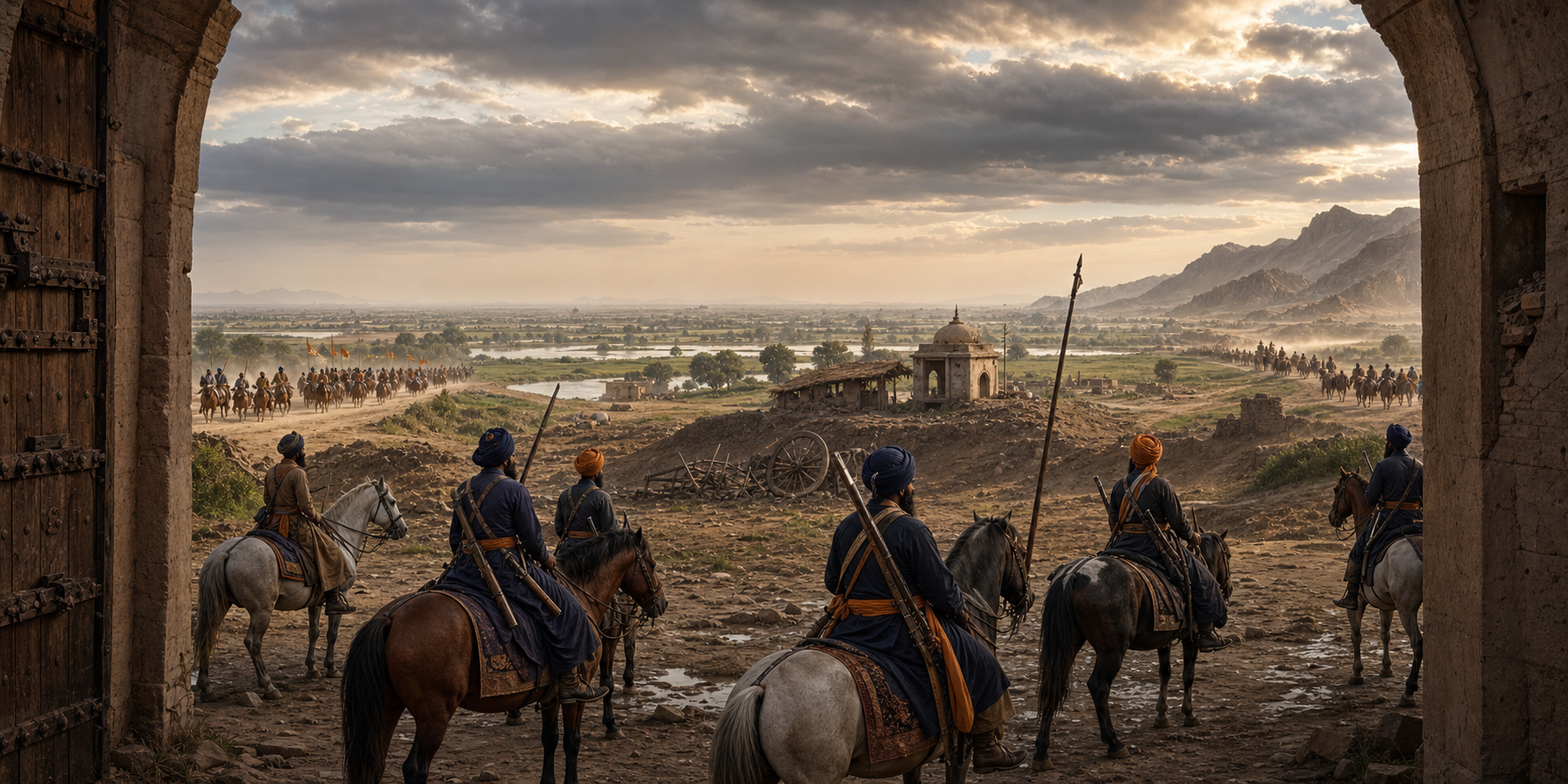
That environment particularly favoured political formations able to function without continuous control of a single imperial capital. As presented in the source, the Sikh Misls could disperse under pressure, reassemble when conditions changed, attack vulnerable routes, defend community centres, and extend authority incrementally across villages and districts. A temporary Maratha occupation could recede, but the exposure of imperial weakness was harder to reverse.
The relationship was consequently indirect but consequential. The 1758 campaign did not hand Punjab to the Misls. It helped demonstrate that the powers claiming the province could be displaced and that control of its cities and corridors would have to be repeatedly defended.
Panipat was a Maratha defeat without an Afghan settlement
The Third Battle of Panipat on 14 January 1761 appears at first to interrupt this interpretation. DharmaRenaissance reports immense Maratha losses and a major political shock after Abdali’s victory. If influence is measured only by immediate territorial possession, the battle seems to mark the end of the Maratha contribution to Punjab’s reordering.
The source instead distinguishes battlefield success from the construction of a functioning state. It argues that Abdali’s victory was costly, that his forces had operated across extended supply lines, and that Afghan influence in the plains depended on allies whose interests did not always match those of Kabul. Abdali defeated the Maratha army but did not turn that result into stable rule over the entire space between Delhi and Punjab.
Panipat thus removed the immediate Maratha challenge without restoring Mughal capacity or producing an equally comprehensive Durrani administration. On the account’s reading, the aftermath was a vacuum rather than a settlement: the Mughals remained prestigious but weak, the Marathas withdrew to recover, and Afghan authority remained dependent on governors and regional partners.
The Sikh Misls possessed advantages suited to precisely this unsettled environment. The source portrays them as decentralised, mobile, and supported by local networks. Rather than consistently accept pitched battles against larger invading armies, they could target detachments, supplies, and exposed routes before dispersing and regrouping. Severe reverses could inflict suffering without necessarily destroying the political and community institutions from which Sikh resistance drew its strength.
This is the central Panipat paradox. The battle checked Maratha expansion, but the winning side did not establish an uncontested replacement order. The absence of such an order gave locally rooted forces more room to recover and expand than a simple victor-and-vanquished narrative suggests.
Maratha recovery weakened the wider corridor of Afghan power
The interpretation also depends on what happened after 1761. DharmaRenaissance reports that Maratha power recovered in North India within roughly a decade. Under leaders including Mahadji Shinde, the Marathas again became influential in Delhi and restored Shah Alam II to the Mughal throne in 1771. Panipat had caused a devastating interruption, not permanent political extinction.
The renewed campaigns mattered to Punjab even when they occurred outside it. The source highlights Maratha pressure on the Rohillas in the Gangetic plain during the 1770s. It describes the Rohillas as Afghan- or Pashtun-origin military elites who had participated in the anti-Maratha coalition at Panipat and formed part of the regional support environment on which intervention from beyond the Indus could rely.
This widens the analysis beyond battles and occupied capitals. Sustained military projection generally requires provisions, transport, intelligence, credit, guides, political partners, and protected routes. The source’s argument is that Maratha action against Afghan-aligned networks made those supporting conditions less dependable. It does not establish that Maratha campaigns alone ended Durrani influence, but it presents them as one pressure that made repeated eastward intervention more difficult to sustain.
The Sikh benefit was again structural rather than contractual. Nothing in the supplied account suggests a coordinated Maratha plan to create a future Sikh empire. Instead, Maratha recovery kept rival power centres under pressure while Sikh forces continued building local authority in Punjab. The outcome arose from intersecting interests, not from a single alliance or blueprint.
Key takeaways for interpreting the Sikh Empire’s rise
- Maratha influence was enabling, not founding. The Misls were products of Sikh resistance, organisation, and community authority rather than creations of Maratha policy.
- The weakening of Mughal capacity preceded Sikh consolidation. Maratha expansion helped reduce the ability of the old imperial system to govern Punjab effectively.
- The 1758 campaign mattered beyond its duration. The entry into Lahore and advance to Attock demonstrated that Punjab’s claimed rulers could be displaced.
- Panipat produced no durable northern settlement. The Maratha defeat did not restore Mughal government or give Abdali a stable administrative order across North India.
- Post-Panipat pressure mattered beyond Punjab. Maratha action against Afghan-aligned networks weakened some of the regional support structures on which distant intervention depended.
This layered interpretation leaves Sikh agency at the centre while placing it within the subcontinent-wide breakdown of imperial power. Further study of the period can sharpen the picture by comparing Punjab’s local records with accounts of Maratha administration, Afghan campaigning, and the regional alliances connecting Delhi, Rohilkhand, Lahore, and the Indus. That broader frame is more likely to explain the Sikh Empire’s emergence than any history confined to one battle or one dynasty.