
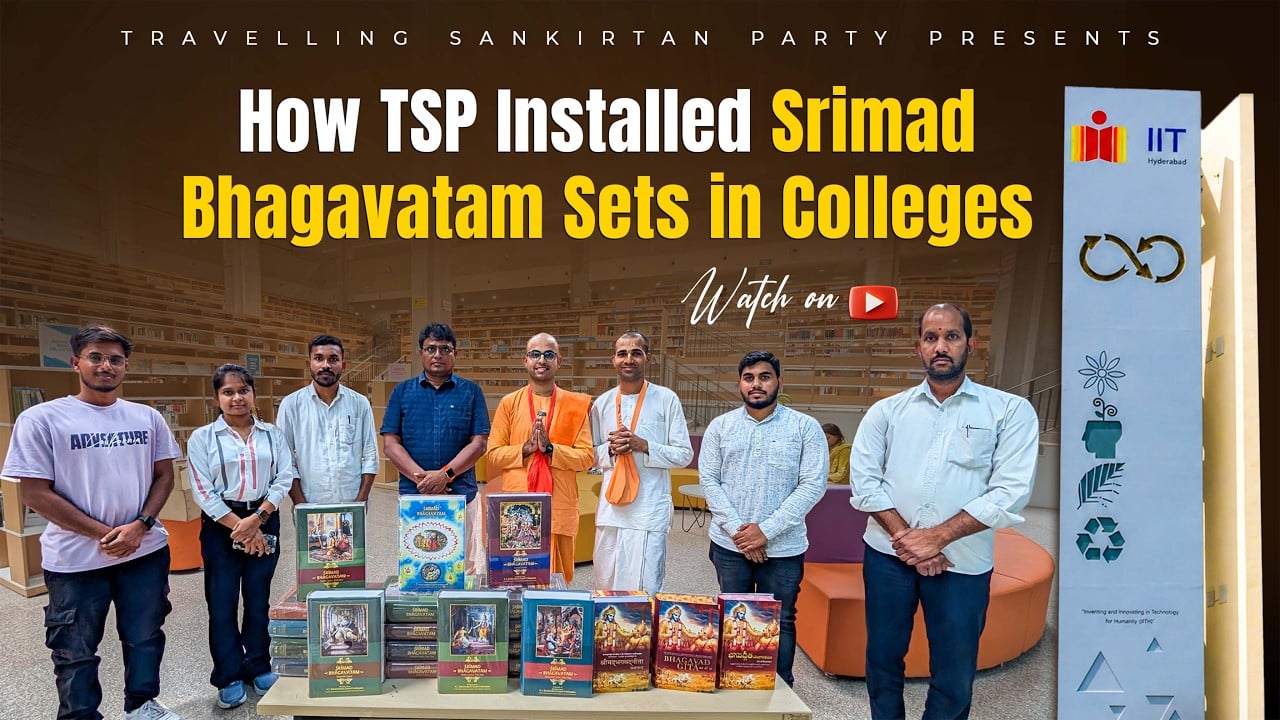
Integrating classical dharmic wisdom into modern higher education requires a methodical, policy-aligned, and student-centric approach. The Traveling Sankirtan Party (TSP) advanced such an approach by installing complete sets of Srimad Bhagavatam in college libraries and campus lounges, strengthening ethical inquiry, cultural literacy, and reflective learning within universities.
The initiative demonstrates how time-tested spiritual literature can be respectfully placed in secular academic environments without proselytization, and with clear attention to collection development policies, library science standards, and inclusive programming. Faculty and administrators across disciplines engaged with the project as a resource that enhances critical thinking, civilizational understanding, and value-based education.
Srimad Bhagavatam, also known as the Bhagavata Purana, is a foundational Sanskrit text comprising twelve cantos that systematizes core themes of dharma, devotion, aesthetics, and metaphysics. Its narrative arcs and philosophical arguments address ontology, cosmology, virtue ethics, social responsibility, and contemplative practice, making it relevant to courses in philosophy, literature, religious studies, and Indian Knowledge Systems.
Widely used in academic contexts is the multi-volume Bhaktivedanta Book Trust edition, featuring translation and purports by A. C. Bhaktivedanta Swami Prabhupada and editorially completed by his disciples for later portions. This edition offers students both the primary text and an informed exegetical framework, while remaining a reliable reference for comparative studies, textual analysis, and historiography of Indian intellectual traditions.
The model aligns with the spirit of India’s National Education Policy 2020 and its emphasis on Indian Knowledge Systems, ethical reasoning, and multidisciplinary learning. It also supports outcomes associated with student well-being and civic responsibility that are commonly highlighted in university accreditation frameworks and value-added learning modules.
At the operational level, TSP utilized a replicable blueprint grounded in higher education governance. First, stakeholder mapping identified librarians, heads of departments in relevant disciplines, and academic deans as primary decision-makers. Early consultations clarified institutional priorities, shelf space realities, and engagement possibilities, ensuring consent-based collaboration.
Second, compliance with library acquisitions and gift policies was treated as non-negotiable. Teams followed standard gift-in-kind procedures, documented itemized inventories, and respected collection development criteria that prioritize curricular relevance, linguistic accessibility, and durability. This ensured that every set entered holdings through transparent and auditable processes.
Third, discoverability was optimized through robust metadata. Librarians were supported with authoritative bibliographic information, ISBNs for each volume, and catalog-ready descriptions. MARC21 fields, subject headings, and authority control terms were applied to integrate the set into the Online Public Access Catalog, with classification under Hinduism in the Dewey Decimal system and appropriate cutters to facilitate shelf browsing.
Fourth, physical processing and longevity were addressed. Volumes were supplied in library-friendly bindings when feasible, with attention to paper quality, spine labeling, and secure shelving. For lounges and reading corners, sets were accompanied by simple orientation cards, reading guides, and handling notes to preserve condition while inviting casual exploration.
Fifth, placement strategy balanced reference access with approachability. Libraries that preferred a reference-only policy located the set within religion, philosophy, or Indian studies sections; others enabled circulation with standard loan periods. In campus lounges, curated reading nooks foregrounded sample passages and thematic overviews to draw first-time readers.
Sixth, inclusive programming bridged scholarship and student life. Faculty colloquia, student reading circles, and interdepartmental dialogues connected the text to coursework in ethics, aesthetics, history, and linguistics. Co-curricular events offered opportunities for reflective discussion, encouraging critical yet empathetic engagement with primary sources.
Seventh, the project foregrounded unity among dharmic traditions. Installations were framed as part of a plural learning ecosystem that also welcomed texts such as the Dhammapada, selections from the Jain Agamas, and introductions to Guru Granth Sahib, as determined by institutional interest and collection scope. This ensured that students encountered a tapestry of Hindu, Buddhist, Jain, and Sikh wisdom in a complementary and respectful manner.
Monitoring and evaluation relied on standard academic indicators: catalog visibility, shelf-use observations, circulation and reference queries, attendance at dialogues, and qualitative feedback from students and faculty. Where feasible, faculty reported course linkages and student reflections, allowing continuous improvement of engagement formats.
Faculty and administrators frequently highlighted the set’s interdisciplinary value. In philosophy departments, discussions centered on epistemology, ethics, and metaphysics; in literature programs, narrative structure and poetics drew attention; in cultural heritage courses, the set functioned as a gateway to classical aesthetics and civilizational memory. Librarians emphasized its role as a durable primary source in an otherwise fragmented landscape of online excerpts.
Student responses reflected curiosity and a search for grounded perspectives. Many described a sense of recognition in encountering a canonical work of the subcontinent within a neutral scholarly space. Others appreciated the availability of bilingual or annotated editions that made complex concepts approachable, thus lowering barriers to primary text study.
Case vignettes included engineering and management institutions that placed the set adjacent to ethics and humanities sections, thereby linking technical education to courses on professional values. Liberal arts campuses often curated themed weeks around aesthetics, leadership, or environmental consciousness, drawing on passages that explore stewardship, compassion, and responsibility.
Attention to logistics and quality control underpinned scalability. Teams coordinated secure transport, moisture-resistant packaging, and inventory checks upon receipt. Communication with library staff clarified any accessioning backlogs, ensuring smooth integration without burdening existing workflows.
Governance and ethics remained central. Clear gift letters avoided donor-imposed restrictions and affirmed academic freedom and content neutrality. Volunteer training emphasized respectful conduct, policy adherence, and a firmly non-proselytizing posture, recognizing that universities are plural communities governed by codes of conduct.
Digital augmentation complemented print holdings. Brief orientation guides, reading maps for first-time learners, and QR-accessible syllabi suggestions were made available for instructors who wished to design seminars or independent studies. This blended approach connected the contemplative pace of physical reading with the discoverability benefits of digital pointers.
Language accessibility strengthened reach. Where institutions requested, sets included Sanskrit with roman transliteration and English translation; in some locations, regional language versions were considered to match student demographics. Large-type options and audio resources were explored to improve accessibility for diverse learners.
The resulting model is scalable across universities and adaptable to different governance contexts. Its strength lies in strict policy compliance, librarian partnership, curricular relevance, inclusive programming across dharmic traditions, and continual measurement of impact. By rooting the installation in academic norms, the project transforms the question of access into a durable, campus-owned asset.
Ultimately, placing Srimad Bhagavatam in libraries and lounges does not merely add books to shelves; it adds vantage points for rigorous dialogue and shared ethical reflection. In a multidisciplinary ecosystem, such primary sources help students examine duty, empathy, leadership, and meaning through the lens of the subcontinent’s intellectual heritage, while honoring the unity and diversity of Hindu, Buddhist, Jain, and Sikh wisdom traditions.
Inspired by this post on Dandavats.
