
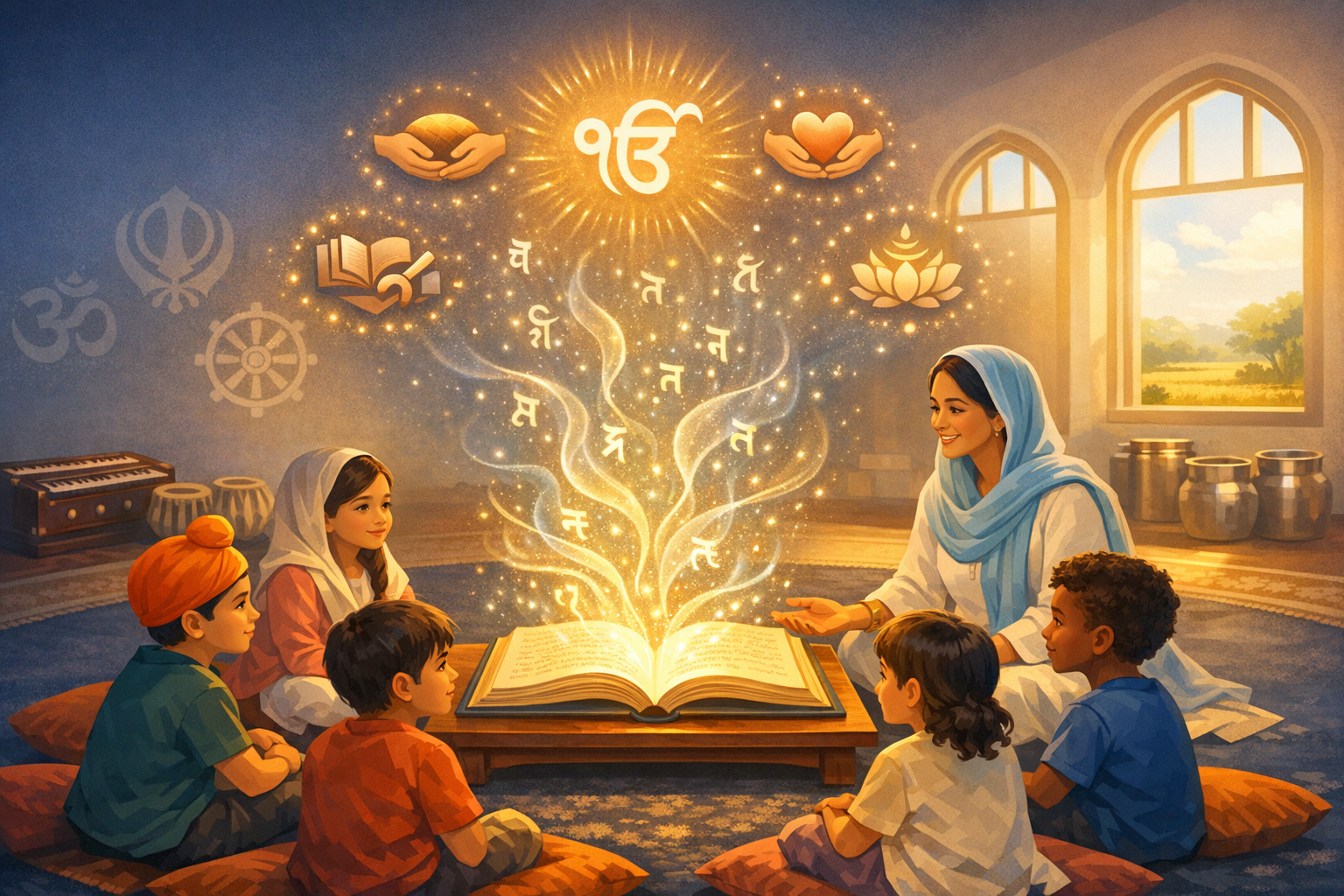
This message from the SikhNet Stories team distills an editorial philosophy for Sikh children’s storytelling: to transmit Gurmat‑aligned values through rigorous, age‑appropriate narratives while honoring Sikh maryada and encouraging unity across the dharmic family of Hinduism, Buddhism, Jainism, and Sikhism. The approach treats stories as a living pedagogy that strengthens identity, nurtures compassion, and bridges diverse communities without proselytization or polemics.
Positioned within a tradition of katha and sangat‑based learning, the initiative centers formative practices of SikhiNaam Japna, Kirat Karni, Vand Chhakna, Seva, and Simranwhile cultivating the spirit of Sarbat da bhala. The focus is on shaping dispositions such as truthfulness, humility, courage, and empathy, rather than merely conveying information or spectacle.
The theological frame is explicitly rooted in Gurmat. The Guru Granth Sahib, structured by raag and inclusive of the bani of the Sikh Gurus alongside Bhagats such as Kabir, Ravidas, Namdev, and Sheikh Farid, exemplifies a capacious spiritual dialogue that transcends narrow boundaries. Stories are crafted to contextualize shabad meanings for young listeners without displacing the primacy of scripture. The vision outlined in the Mool MantarIk Oankar Satnam Karta Purakh Nirbhau Nirvair Akal Murat Ajooni Saibhang Gurprasadguides the tone toward universality, fearlessness, and compassion.
Historically, Sikh pedagogy has relied on janamsakhis, katha, and the interpretive insights of Bhai Gurdas. Contemporary retellings continue that lineage while being transparent about genre: inspirational sakhis illustrate virtues and historical sensibilities, whereas specific empirical claims defer to recognized sources and scholarly consensus. This clarity helps listeners appreciate the difference between devotional inspiration and verifiable historiography.
Research in educational psychology supports this method. Narrative transportation enhances attention and recall; dual‑coding (pairing verbal narration with auditory imagery) strengthens memory; and social learning theory explains how children emulate exemplars such as Guru Nanak and Guru Gobind Singh when virtues are dramatized in relatable dilemmasfrom speaking truth to power to standing for justice at Anandpur Sahib in 1699. Developmentally, concrete, emotionally resonant stories scaffold later abstraction around hukam, seva, justice, and community responsibility.
In practice, editorial guidance privileges clarity, brevity, and resonance. Punjabi‑Gurmukhi terms like sangat, simran, seva, and rehat are retained with gentle contextual glosses to keep cultural meaning intact, and pronunciations are selected for intelligibility across the global Sikh diaspora without flattening regional nuance. The result is a lexicon that becomes familiar through repeated exposure, enabling children to connect vocabulary with lived experience.
Integrity standards guard against sensationalism and anachronism. Miraculous motifs, when drawn from well‑known sakhis, are framed to emphasize Naam, humility, and ethical action rather than spectacle. Depictions of the Gurus avoid caricature and modern idiom, and conflicts resolve in ways consistent with Sikh virtues and the Khalsa ethos. For example, Guru Arjan Sahib’s serenityTera Kiya Meetha Lageis presented as inner strength born of Naam and acceptance of hukam.
Cultural sensitivity is non‑negotiable. Narratives avoid casteist and gender stereotypes, respect gurdwara maryada, and present women and men alike as agents of seva and leadership. When sensitive episodes arisesuch as persecution or social injusticethe tone remains dignified and age‑appropriate, emphasizing courage, resilience, and protection of others, as seen in reflections on Guru Tegh Bahadur’s principled defense of freedom of conscience.
The initiative is dialogical across dharmic traditions. Sikh storytelling is situated alongside resonances with Hindu itihasa and Puranic exemplars of dharma, Buddhist Jataka teachings on compassion and mindful intention, and Jain contemplations including Anekantavada and the 12 bhavana. The shared ethical groundtruthfulness, self‑discipline, service, non‑harm, and reverence for lifebuilds an ecology of respect in which plural paths are honored without dilution of doctrinal integrity.
Sound design and language are treated as pedagogical tools. Rhythm and refrain mirror the mnemonic power of kirtan; careful pacing and contemplative pauses create space for reflection akin to simran; and subtle ambient cues evoke Punjab’s landscapes and gurdwara soundscapes without overwhelming young listeners. When shabad excerpts are referenced, distinctions among translation, transcreation, and commentary are made explicit to preserve theological clarity.
Accessibility considerations include transcripts, vocabulary notes for emerging bilinguals, and distribution formats that function reliably in low‑bandwidth environments. These practices broaden participation across regions and socioeconomic contexts, aligning with Sarbat da bhala as an ethic of educational equity. Families report that shared listeningduring commutes or eveningsstrengthens intergenerational dialogue around Sikhi.
Evaluation is formative and ethical. Qualitative reflections from parents, educators, and children are synthesized with simple, age‑appropriate comprehension checks, avoiding intrusive data practices. Feedback informs iterative improvements to narrative clarity, theological fidelity, and cultural resonance, while maintaining a child‑safe learning environment.
A principled stance is taken on the relationship between history and inspiration. Sakhis function as moral pedagogy; where multiple versions circulate, stories acknowledge variation and emphasize virtues over disputation. When episodes involve contested details, humility and transparency take precedence over prescriptive certainty, encouraging learners to appreciate both devotion and critical inquiry.
A concise glossary accompanying each narrative clarifies core termsIk Oankar, Naam, Hukam, Seva, Simran, Sangat, Rehat, and Khalsaso that meaning accumulates across episodes. Transliteration practices favor consistency (for example, Vaheguru) to minimize confusion, while honoring established community usage and the phonetic logic of Gurmukhi.
The result is an evidence‑informed, tradition‑faithful approach to Sikh children’s stories that invites curiosity rather than coercion, and belonging rather than boundary‑policing. In affirming Ik Oankar and the dignity of all paths oriented toward truth and compassion, the work contributes to unity in diversity across the dharmic world. This is story as seva: a practice that deepens love for Sikhi while building bridges of understanding with Hinduism, Buddhism, and Jainism.
For families and educators, the practical outcomes are concrete: consistent exposure to high‑quality narratives expands a child’s emotional vocabulary for Sikhi, normalizes seva in daily life, and builds cognitive habits required to engage Gurbani with reverence over time. When children recognize their place in sangat as listeners, questioners, and helperscarrying values from story to practicethe stories have succeeded.
Inspired by this post on SikhNet – News.
