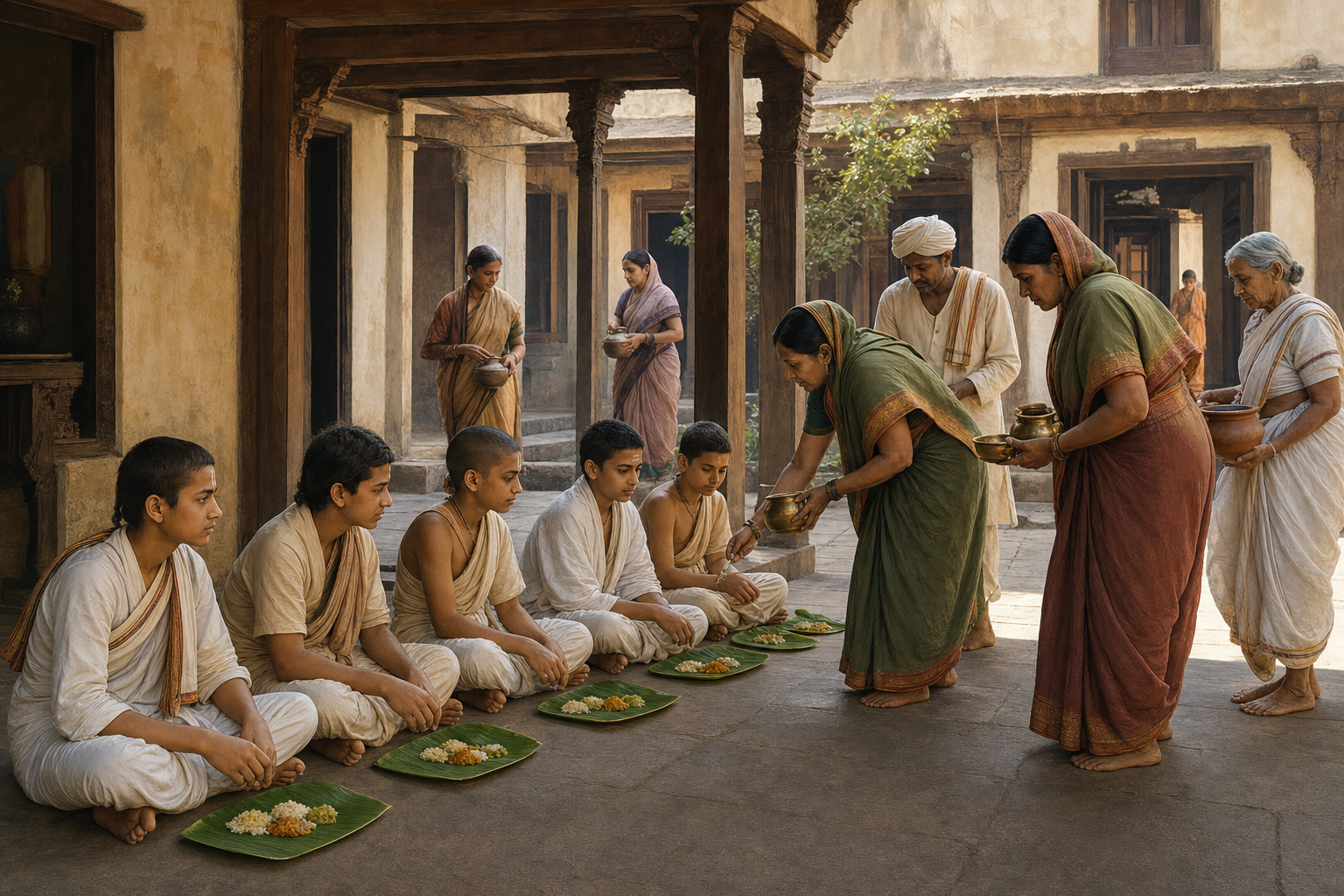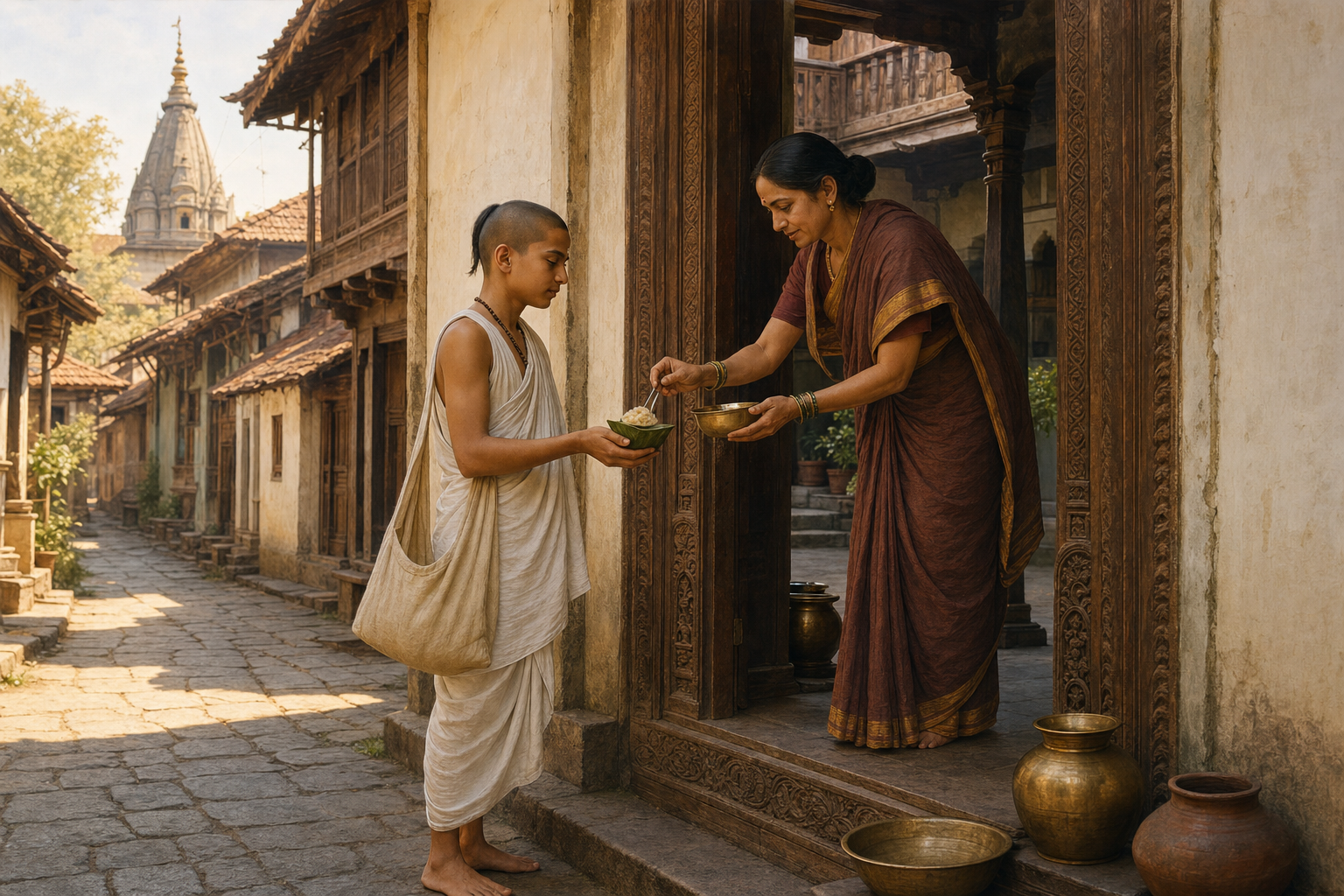
If you came here wondering why a Brahmana student in old Poona would go from door to door for food, the shortest answer is this: the doorstep was part of his education. Madhukari supported the body, but it was also intended to discipline the person who would receive knowledge.
Calling it merely “begging” misses that educational purpose. Romanticising hardship misses it too. To understand Madhukari, you have to see three things together: the Brahmachari’s dependence on the community, the household’s duty toward learning, and the deliberate reduction of the student’s ego.
What the Brahmachari actually did
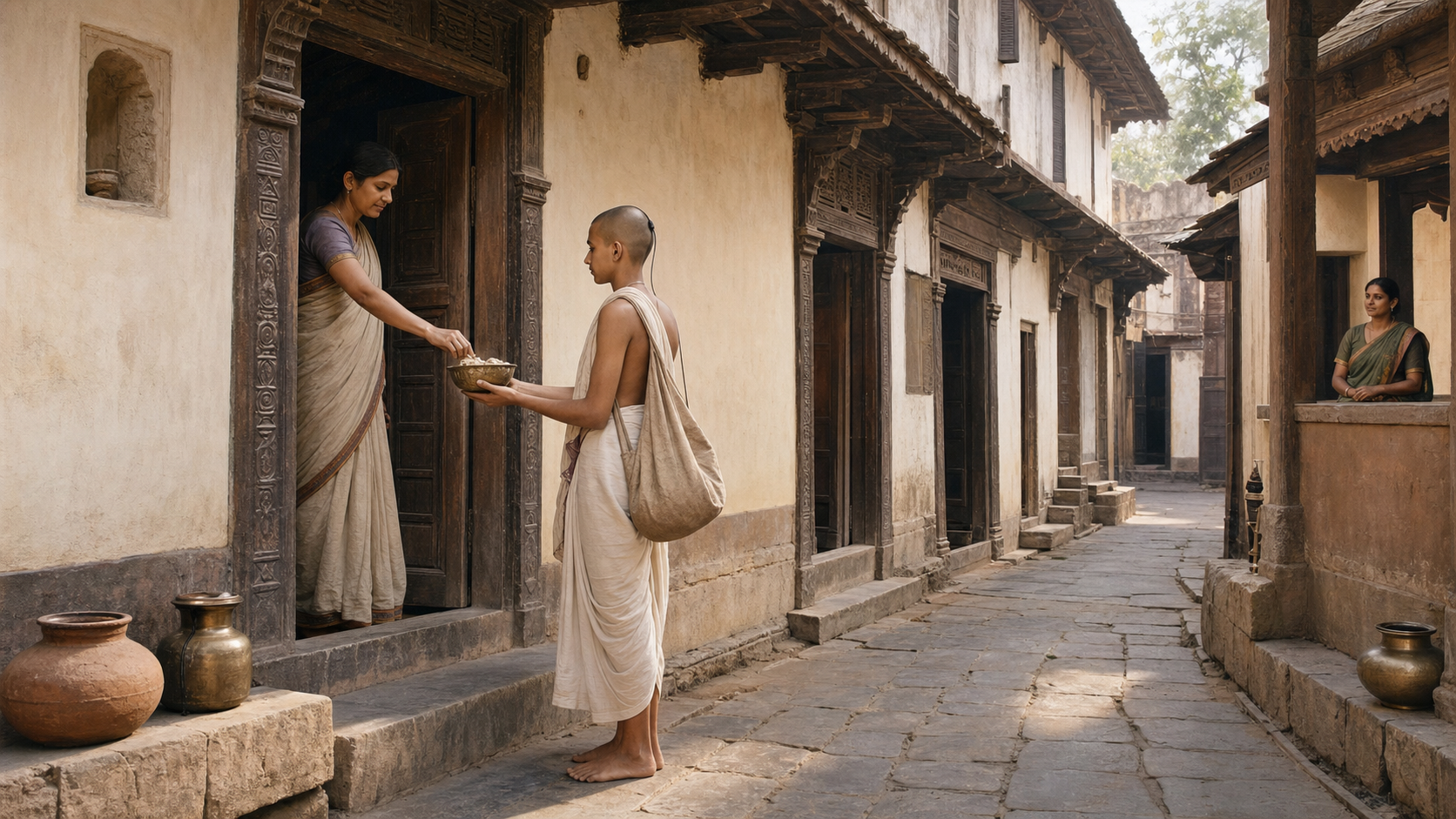
Madhukari takes its name from the image of a bee gathering nectar from different flowers. In the same way, the student obtained food from multiple households rather than treating one family as his permanent patron. Within the traditional discipline, this was not an occasional supplement: alms gathered from various homes were the Brahmachari’s means of obtaining his food.
The familiar appeal was Bhavati bhikṣāṃ dehi—a respectful request that the lady of the household give alms. Its wording matters. The student asked; he did not purchase, demand, or claim a meal as payment for academic performance.
- Brahmacharya identifies the disciplined student stage in which learning and character formation belonged together.
- Bhikṣā is the alms requested and received.
- Madhukari describes the bee-like manner of gathering small support across different homes.
This distinction helps you recognise the practice accurately. Receiving a meal from one generous host may be hospitality. A public collection may be fundraising. Madhukari, in its educational setting, joined distributed alms to the discipline of Brahmacharya.
The traditional obligation was associated specifically with Brahmacharya and Sannyasa. That pairing is revealing. The student and the renunciate stood at different points in life, but neither was meant to build his identity around possession, comfort, or social display.
Why obtaining food was part of the lesson
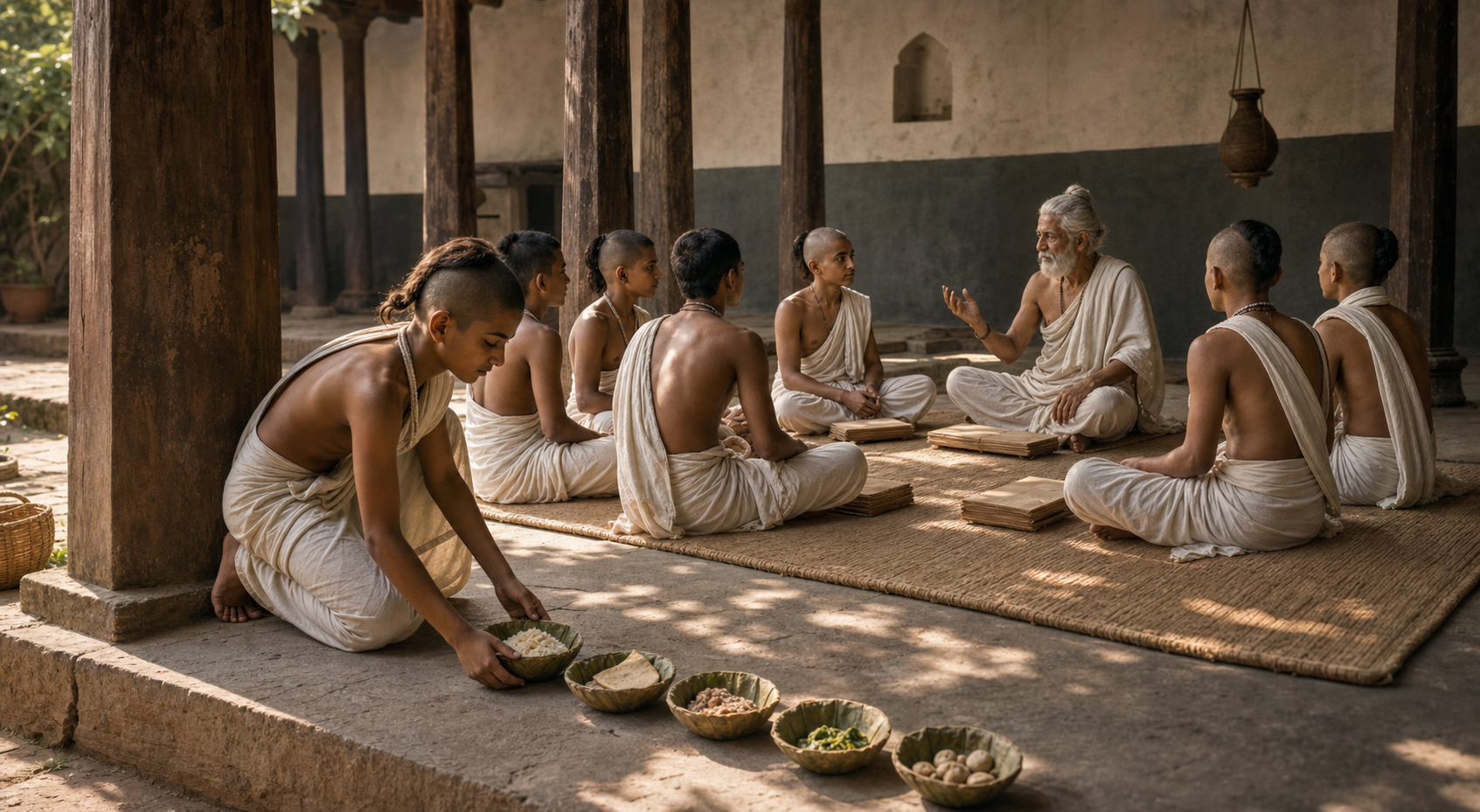
Madhukari began teaching before formal instruction began. A student who had to ask for his meal could not easily imagine that learning made him self-sufficient. His food depended on other people, his education rested within a larger social order, and knowledge could not honestly be treated as a private ornament.
The governing idea was that voluntary surrender of ego prepared the mind to receive knowledge. This was not an argument against intelligence, confidence, or rigorous debate. It was an argument against approaching knowledge with the conceit that the student already possessed everything worth possessing.
That is the difference between humility and humiliation. Humility is the willing recognition that you depend on teachers, householders, inherited knowledge, and a discipline greater than your preferences. Humiliation is degradation imposed to diminish a person. Madhukari’s educational logic depends on the former; if the practice becomes coercion, contempt, or spectacle, its inner purpose has already been lost.
The meal also changed the student’s relationship to learning. A consumer can believe that payment makes the teacher answerable to every preference. A Brahmachari receiving sustenance through Madhukari was trained to understand education as obligation: the community maintained him so that he could become worthy of knowledge, not merely acquire credentials or status.
You can apply that distinction even if you never reproduce the old custom. Ask what your educational routine rewards. Does it train attention, restraint, gratitude, and responsibility, or only accumulation? Madhukari’s enduring challenge lies in that question, not in the outward drama of knocking on a door.
What old Poona’s meal system reveals—and what it does not
Structurally, gathering food from several homes distributed the support of a student across the community. No single household had to represent the whole social commitment to learning. The student also encountered support as a shared duty rather than the favour of one exclusive patron.
This arrangement made education visible outside the place of instruction. A household’s contribution might be materially small, yet it connected ordinary domestic life with the preservation of learning. The community did not merely praise knowledge in the abstract; it helped feed the person undertaking its discipline.
But Madhukari should not be made to prove more than it can. It explains a method of sustenance and character formation. By itself, it does not tell you which texts were taught, how a teacher organised lessons, how long a course lasted, or how every student in Poona lived. Nor should the experience of Brahmana boys in this setting be silently expanded into a universal account of education for every community in the city.
If you are evaluating a family memory, local history, or present-day claim about Madhukari, use a precise checklist:
- Look for distributed collection. Support from different households is central to the bee-like meaning of the term.
- Identify the life-stage context. A Brahmachari gathering food for his student life is not identical to a Sannyasi living by alms.
- Separate support from syllabus. Evidence of Madhukari does not automatically establish what was studied or how it was taught.
- Ask whether the discipline was voluntary. Poverty can force dependence, but the stated educational purpose of Madhukari rests on consciously accepted restraint.
- Keep the claim bounded. A practice documented in old Poona should not become a claim that every place, period, or Dharmic community followed one uniform system.
These checks let you honour the tradition without turning reverence into vagueness. Precision is not hostility to heritage. It is how heritage remains intelligible.
How to preserve the principle without staging poverty

As an uninterrupted cultural practice, Madhukari had largely disappeared by the early 1970s. That loss deserves attention, but disappearance does not make every literal reconstruction wise. In a changed social setting, sending students—especially children—to solicit food can produce shame, publicity, or unsafe dependence instead of disciplined humility.
A temple, pāṭhaśālā, family network, or study circle can carry forward the educational principle through a protected community-meal arrangement. If you are designing one, the following safeguards keep the purpose clear:
- Name the aim before choosing the ritual. Decide whether you are teaching gratitude, simplicity, community responsibility, or dependence on Dharma. If the real aim is fundraising or publicity, do not present it as Madhukari.
- Secure the student’s basic nourishment. Hunger is not a teaching technique. The meal should be dependable even while its communal origin remains visible.
- Distribute support. Invite participating households to contribute modestly through a rotating or pooled arrangement, preserving the principle that learning is sustained by many rather than controlled by one patron.
- Remove donor leverage. A contributor should not gain authority over admissions, teaching, or an individual student merely by providing food.
- Protect dignity and privacy. Do not turn receiving food into a photograph, performance, or test of a child’s willingness to endure embarrassment.
- Include reciprocal duty. Students can help serve, clean, study conscientiously, or later support another learner. This is not payment for the meal; it makes responsibility accompany gratitude.
- Teach the meaning explicitly. Without reflection on ego, dependence, and receptivity, a communal meal remains valuable hospitality but does not reproduce Madhukari’s pedagogical purpose.
- Describe adaptations honestly. If no one gathers alms from several homes, call the programme “inspired by Madhukari” rather than claiming an exact revival.
The strongest revival may therefore look less dramatic than a historical reenactment. It may be a student eating a simple meal supported by several families, knowing who made his study possible, accepting that support without entitlement, and preparing to carry the same duty forward.
Key takeaways
- Madhukari was a distributed way of obtaining food: like a bee visiting different flowers, the Brahmachari approached multiple households.
- The practice belonged to education because it trained receptivity, reduced entitlement, and made dependence on the community visible.
- Humility was essential to its purpose; humiliation, coercion, or public spectacle would contradict that purpose.
- Madhukari explains how a student was sustained and formed, not the complete curriculum or the experience of every community in Poona.
- A modern adaptation should guarantee nourishment, protect dignity, disperse patronage, and be described as an adaptation rather than an exact revival.
If you want to recover something from Madhukari, begin with the relationship it created: the student owes seriousness to learning, the householder owes support to knowledge, and neither should turn the exchange into status. Build that relationship first. The outward form should follow only where it serves the same discipline.