
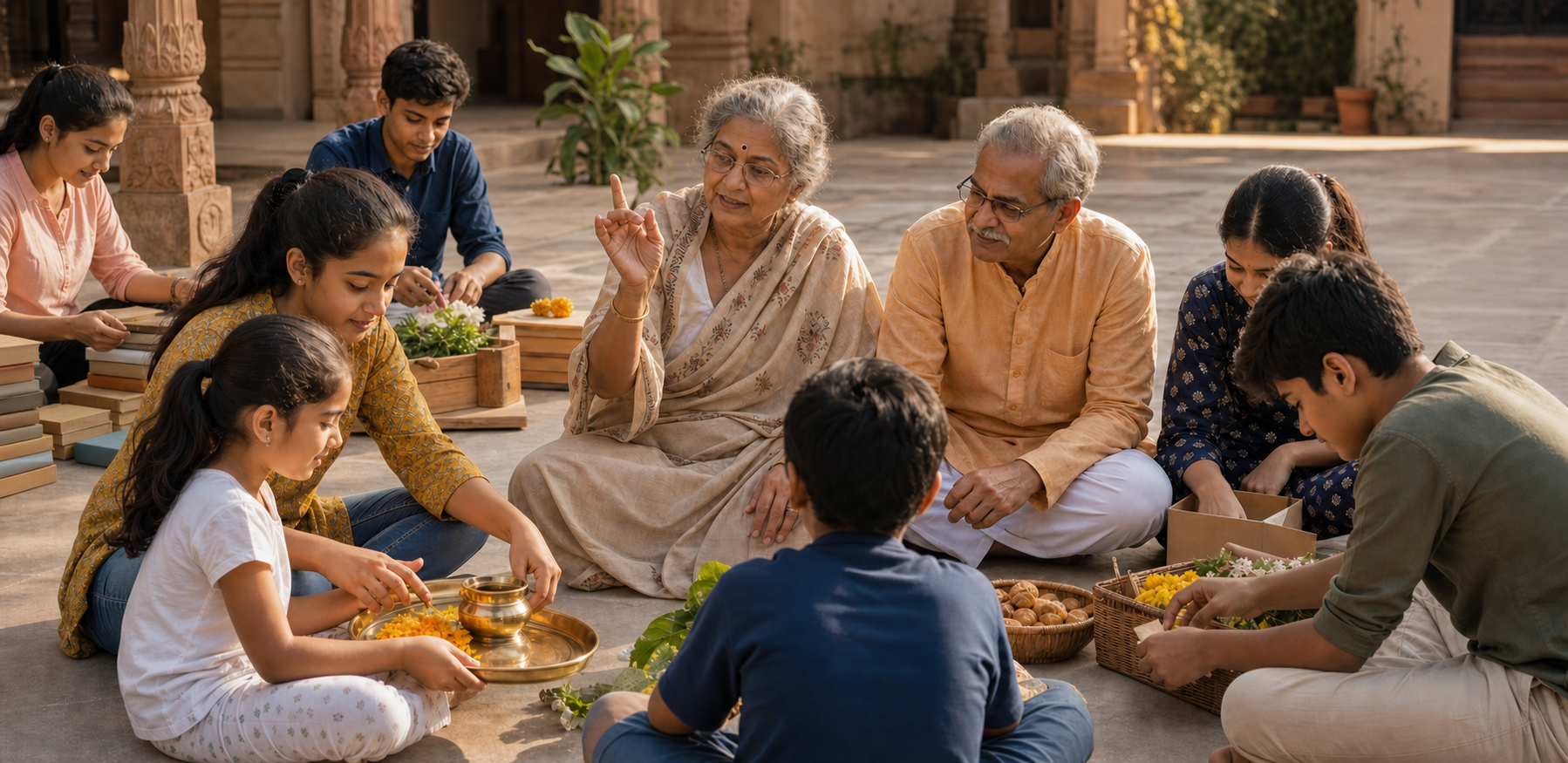
You may be wondering why a young person can recite at a festival yet show little interest the next morning, or why a child who asks honest questions about tradition is treated as less dharmic than one who memorises silently. The missing piece may not be material. It may be the chain connecting language, conduct, belonging, and responsibility.
Your aim is not to manufacture a performance of culture. It is to help a young person understand a word, practise the value it names, contribute beside people they trust, and return willingly. Sanskar and Sanskrit reinforce each other only when that whole chain is present.
Build transmission around study, practice, service, and community
Sanskar includes both formative rites and the sustained cultivation of ethical dispositions. It is not merely information about good conduct. It is what repeated, value-aligned action gradually makes natural.
That distinction changes how you teach. If satya appears only in a worksheet, a learner may define truthfulness without rehearsing it when a mistake is embarrassing. If seva remains a slogan, it does not become a dependable responsibility. If a shloka is memorised without meaning, Sanskrit becomes a performance rather than a way into dharmic thought.
Sanskrit matters because it preserves exact civilisational vocabulary and opens a path toward foundational texts and commentarial traditions. It has served as a bridge across Hindu, Buddhist, and Jain scholarship, while also helping readers clarify older Indic concepts encountered in Sikh exegesis. That role does not make every Dharmic text a Sanskrit text, nor does it erase the authority of Pali, Prakrit, Punjabi, regional languages, or the language spoken at home.
A durable learning rhythm has four connected parts: adhyayan, sadhana, seva, and sangha.
- Adhyayan, or study: Take up a clear question, concept, or short passage. Ask what it means, where it belongs, and what misunderstanding it corrects.
- Sadhana, or embodied practice: Recite, contemplate, breathe quietly, perform simran, or follow the discipline appropriate to your path. The learner should do something, not merely hear about it.
- Seva, or service: Attach the lesson to a real contribution. Care for a shared space, help an elder, mentor a younger learner, support a community task, or participate in responsible care for a place of pilgrimage.
- Sangha, or community: Return to people who know what you are practising. A recurring circle supplies encouragement, correction, examples, and accountability that a solitary burst of enthusiasm cannot provide.
Keep the parts connected. Study without practice can become verbal cleverness. Practice without study can lose meaning. Service without reflection can become a chore. Community without purpose can become another social gathering. The complete rhythm lets a young person understand, embody, contribute, and return.
Teach Sanskar as visible conduct rather than moral vocabulary
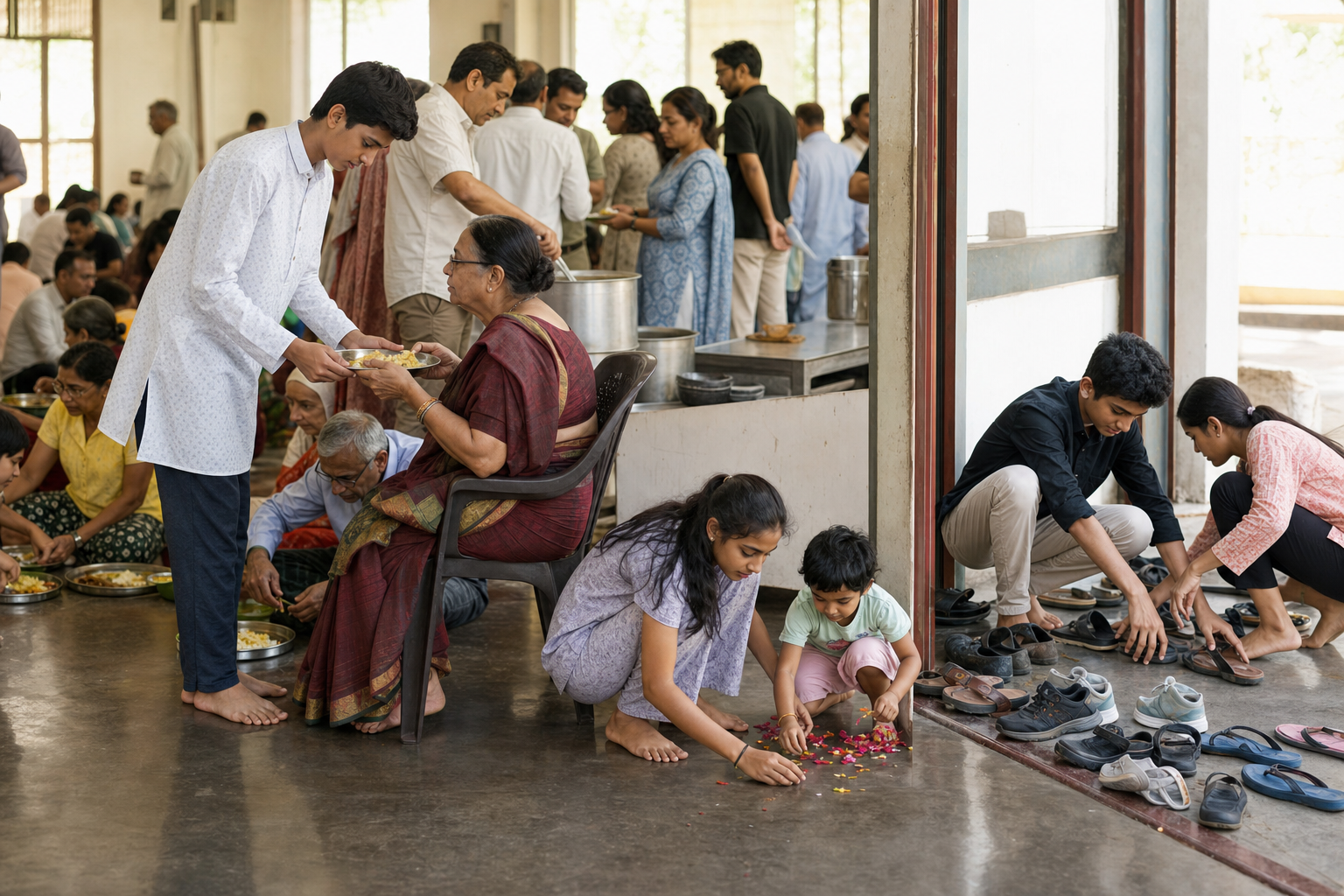
Choose a value and make it observable in the life of the household, class, or youth circle. A young person should be able to notice what the value asks of adults as well as children. Adult example is part of the curriculum.
- Satya: Correct your own error before demanding honesty from the learner. Discuss how to tell the truth without using truth as a weapon.
- Ahimsa: Remove ridicule from disagreement. When harm occurs, require acknowledgement, repair, and a better response at the next opportunity.
- Dana: Let the learner contribute time, attention, knowledge, or material support. Giving should involve a conscious relinquishment, not merely an adult handing over something on the child’s behalf.
- Seva: Give the learner a dependable responsibility whose completion matters to somebody else. Rotate prestigious and unglamorous work so service does not become a stage.
At the end of a gathering, ask: What did we understand? What did we practise? Whom did it help? What will continue after we leave? Those questions expose the gap between a pleasant cultural event and actual formation.
Shared Dharmic ground should not flatten different traditions. Ahimsa, satya, dana, seva, disciplined intention, self-restraint, and remembrance offer points of encounter, but Hindu, Buddhist, Jain, and Sikh families do not have to describe every practice in the same way. A Hindu learner may connect conduct to a shloka and the idea of dharma. A Buddhist learner may examine intention and mental formation. A Jain learner may work through an age-appropriate vrata or restraint. A Sikh learner may connect simran with seva and social responsibility.
Respectful inclusion means giving each path enough precision to remain recognisable. Use a comparative selection such as the Bhagavad-Gita, Dhammapada, extracts from the Tattvartha Sutra, and Sikh teachings on seva and simran when a mixed group is ready for it. Name the original language and context of each selection. Never present the entire collection as Sanskrit literature simply because Sanskrit is part of the curriculum.
Make Sanskrit usable before making it difficult
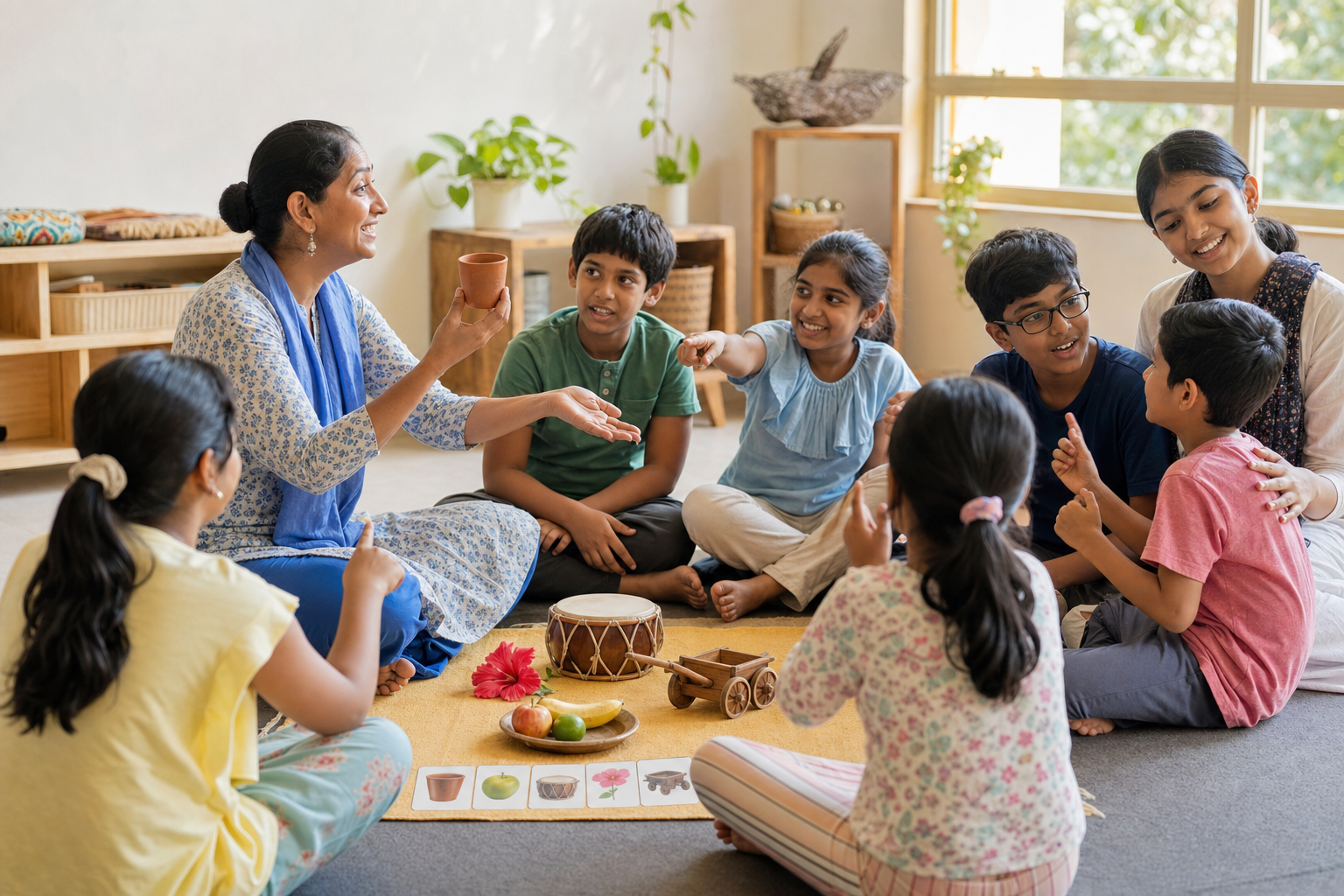
A young person does not need to defeat a wall of grammar before Sanskrit becomes meaningful. Begin with sound, meaning, and use. Formal structure can deepen learning once the learner has something familiar to examine.
Teach a short selection through a stable sequence:
- Let the learner hear a careful recitation and repeat it without being mocked for an imperfect first attempt.
- Separate difficult sounds and correct them precisely but gently. Accuracy should be a reachable standard, not a device for displaying the teacher’s superiority.
- Ask the learner to paraphrase the meaning in the mother tongue. A memorised translation is less useful than a clear explanation in the learner’s own words.
- Choose a key term and connect it to conduct. If the term is seva, the lesson should lead into service; if it is satya, bring it into a real decision about honesty.
- Return to the same selection and notice its structure, metre, vocabulary, or grammatical pattern. Familiarity gives technical explanation somewhere to attach.
Accurate pronunciation and metre can give a learner confidence because progress can be heard. Recitation also gives attention and working memory a definite task. Neither benefit should be inflated into a claim that chanting automatically produces virtue. Language becomes formative when meaning and conduct accompany sound.
For an advanced learner who enjoys formal systems, Paninian grammar can be presented as a precise, rule-governed intellectual discipline rather than an intimidating heap of labels. For a beginner, success may mean recognising sounds, explaining a term, and reciting a short passage with growing accuracy. Scaffold the work by readiness instead of forcing every participant through the same material.
The soundest language policy is additive. Mother tongue, Sanskrit basics, English for research access, and a regional or national link language where needed can perform different jobs without competing for cultural legitimacy.
| Language | Primary role | Teaching guardrail |
|---|---|---|
| Mother tongue | Explanation, family memory, emotional and cultural context | Never shame the language in which the learner can think most clearly |
| Sanskrit basics | Pronunciation, civilisational vocabulary, short texts, and later grammar | Do not reduce it to ceremonial display or begin with unnecessary difficulty |
| English | Wider research access and communication | Do not let convenience make it the automatic language of every explanation |
| Regional or national link language | Participation across families and communities | Add it where it serves a real social need rather than as a substitute for the mother tongue |
This approach removes a false choice. Supporting Sanskrit does not require weakening Marathi, Tamil, Bengali, Gujarati, Hindi, Punjabi, Kannada, Telugu, Malayalam, Odia, or another home language. The mother tongue carries meaning close to life; Sanskrit extends access to a larger civilisational vocabulary.
Turn camps and tirthas into a continuing local rhythm
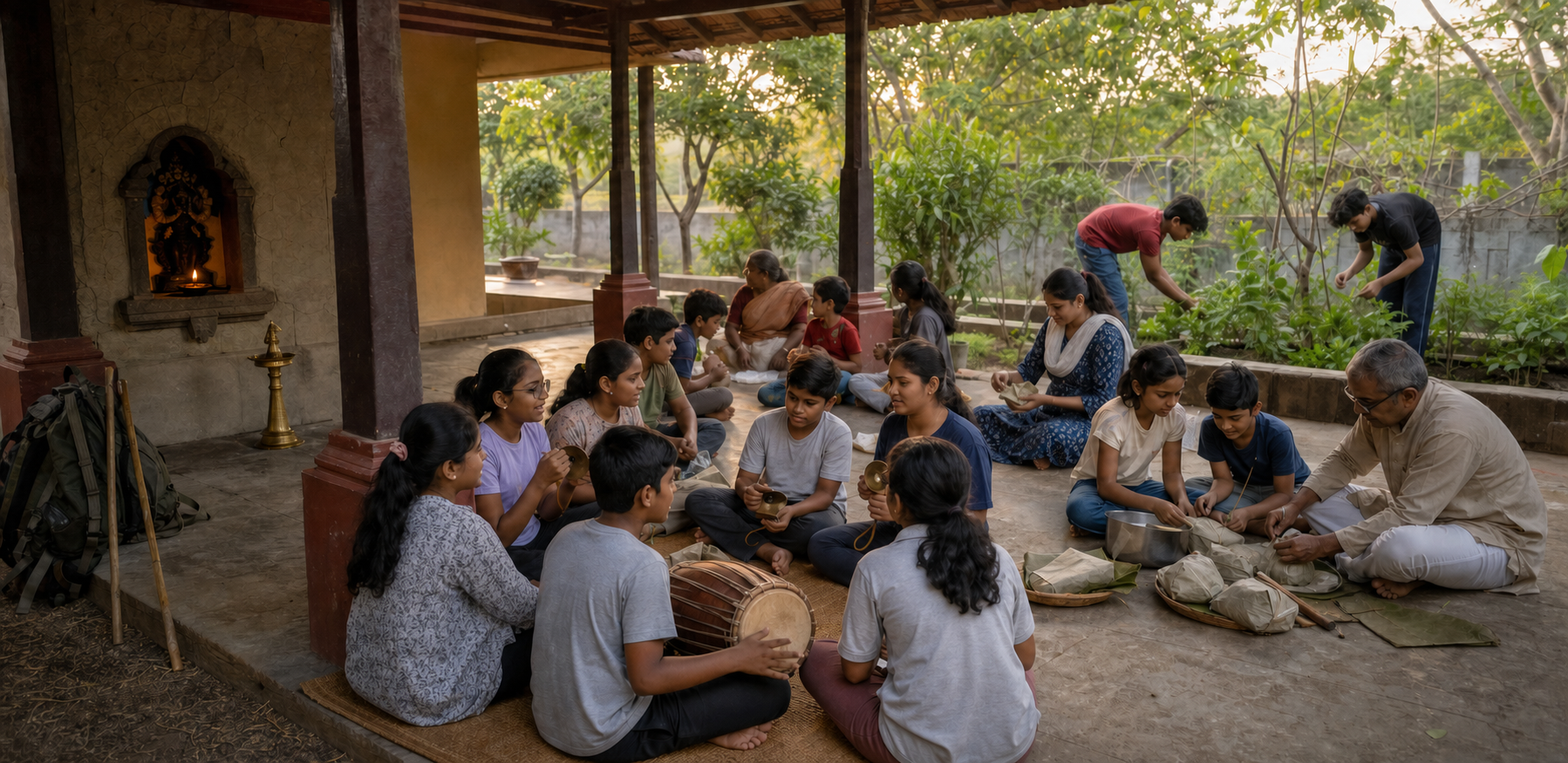
A camp can concentrate attention, friendship, and emotion. Transmission depends on what survives after that concentration ends. If attendance is strong but the next local circle is empty, the event may have succeeded as an event without yet succeeding as cultural transmission.
A tirtha offers more than scenery. Narrative memory, ritual discipline, living tradition, and opportunities for service meet in the same place. Use that setting as a classroom: explain why the place matters, practise responsible pilgrimage, and connect reverence with care for the site and its surroundings.
- Before the gathering: Find out what participants can already explain, recite, and practise. Let each learner choose a realistic learning or service goal.
- During the gathering: Combine place-based narrative, Sanskrit sound work, meaning in accessible language, contemplative practice, and visible service. Riverbank cleanliness, heritage care, and assistance with responsible pilgrimage turn stewardship into lived dharma.
- Before participants leave: Fix the next recurring circle, identify peer mentors, select the passage to revisit, and assign the continuing seva responsibility. Follow-through should be part of the gathering itself, not an invitation sent after momentum has faded.
Evaluate what you actually want to transmit. A short knowledge check before and after instruction can show whether concepts became clearer. A pronunciation sample can reveal progress in sound and metre. A journal entry or small-group dialogue can capture changes in understanding that a quiz misses. Seva hours, completed responsibilities, and peer mentoring show whether values reached action. Simple attention or memory tasks and resilience self-assessments may be useful when a programme explicitly aims to develop those capacities.
Use these measures to improve the learning design, not to rank personal devotion. A high recitation score does not prove compassion. A quiet participant may be growing without displaying it publicly. Look across knowledge, practice, service, and continuity, and never turn intimate spiritual reflection into a contest.
Youth ownership is also measurable. Notice whether participants select passages, ask questions, lead part of the practice, propose service work, help beginners, and return without constant adult pursuit. These behaviours reveal whether the programme is producing dependants on an organiser or future carriers of the tradition.
Key takeaways for your next gathering
- Pair every Sanskrit selection with meaning, a practice, and a visible form of conduct.
- Keep adhyayan, sadhana, seva, and sangha in the same recurring rhythm.
- Use the mother tongue for comprehension while adding Sanskrit as access to civilisational vocabulary and texts.
- Build unity around shared values without pretending Hindu, Buddhist, Jain, and Sikh disciplines are interchangeable.
- Judge continuity by what young people can explain, practise, contribute, teach, and willingly return to do.
If you are a parent, begin with a familiar prayer, explain it in the language used at home, and connect its central value to a real household duty. If you teach, track sound, meaning, and conduct rather than completed pages alone. If you organise a shibir, put the follow-up meeting, mentor, passage, and seva responsibility in place before everyone disperses.
The next generation does not inherit Sanskar and Sanskrit merely because we admire them. Transmission becomes visible when young people can understand, embody, serve, teach, and return. Build that chain at the next gathering, then keep it unbroken.