
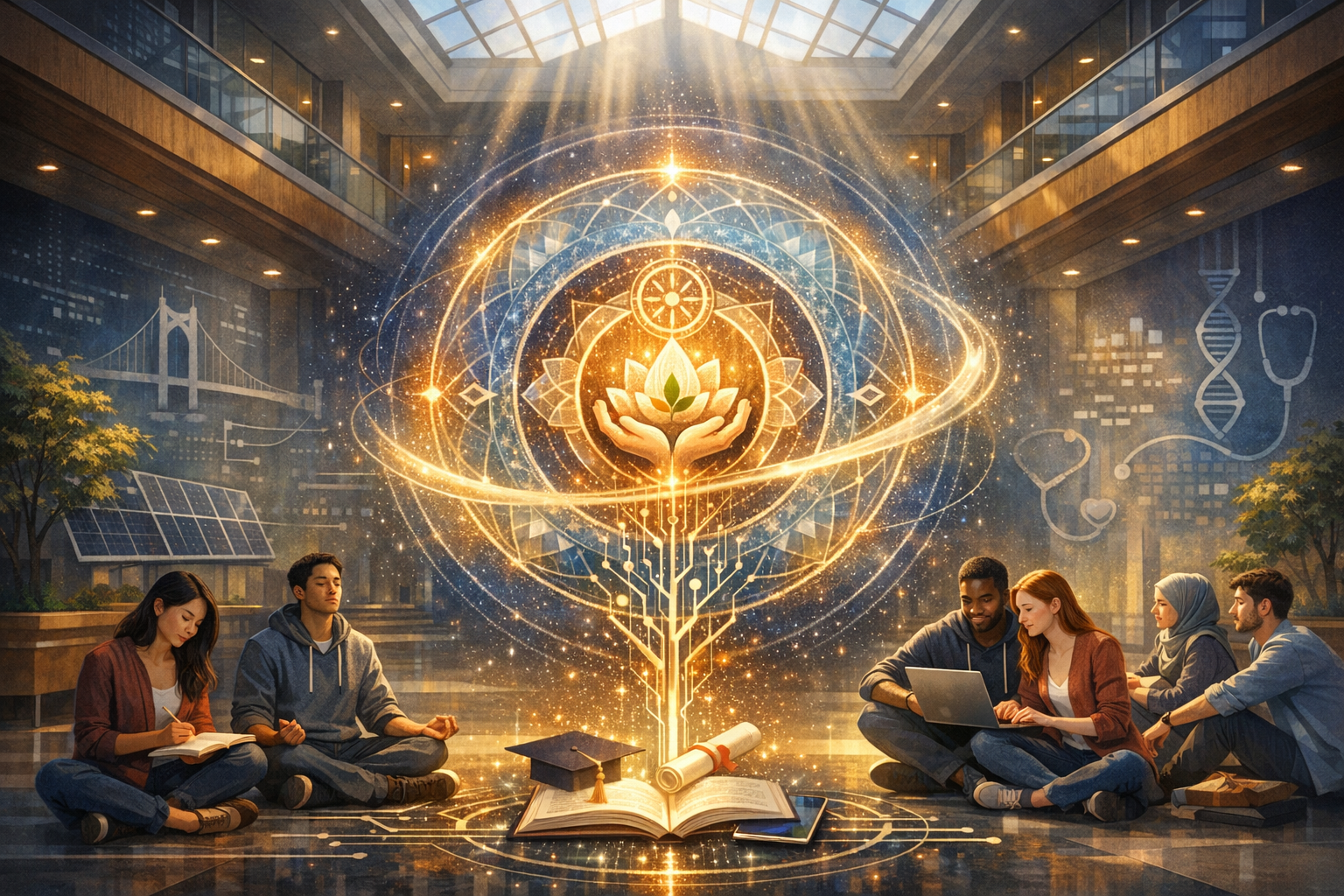
Contemporary societies often prize scientific education above all else, celebrating engineers, doctors, telecommunication engineers, and IT professionals as the architects of progress. Such material education is undeniably important; it builds infrastructure, cures disease, and connects the world. Yet when knowledge and skill are detached from a deeper understanding of meaning, duty, and inner freedom, education risks becoming a sophisticated instrument for consumption rather than a pathway to wisdom. In this light, the purpose of education must be re-examined: not to diminish science, but to raise it into service of a higher, integrative vision of human flourishing.
Education that neglects life’s most important dutyclarifying why one learns, lives, and servescan devolve into a race for credentials without character. Across the dharmic traditions of Hinduism, Buddhism, Jainism, and Sikhism, knowledge has historically been valued when it liberates, heals, and harmonizes. The shared insight is clear: technical excellence without ethical clarity and inner steadiness can be misdirected. Integrating higher dimensions of knowledge into contemporary curricula does not oppose modernity; it completes it.
An academically grounded definition of spiritual identity is essential for clarity. In a dharmic and plural context, spiritual identity can be described as the cultivation of self-transcending awareness, ethical purpose, and compassionate action rooted in contemplative insight. Hindu thought articulates this through atma-jñāna and dharma; Buddhist traditions emphasize anattā with luminous awareness and karuṇā; Jain philosophy centers on ahiṁsā and aparigraha with anekāntavāda; Sikh teachings foreground naam, seva, and truthful living. Across these nuanced differences, spiritual identity consistently points to freedom from narrow self-centeredness and alignment with the good of all.
The classical vision of education in Bharata encapsulates this ideal succinctly: sa vidyā yā vimuktayeknowledge is that which liberates. Liberation here is not an abstract detachment from the world; it is freedom from ignorance, greed, and fear so that one can act wisely and responsibly. The famous convocation counsel, Satyam vada; dharmam chara, makes truthfulness and ethical conduct the first outcomes of learning. The gurukul ideal, when translated for modern institutions, suggests mentorship, character formation, and lived responsibility alongside rigorous scholarship.
Parallel currents appear across the dharmic spectrum. Buddhist education unfolds through the three trainingssīla (ethical conduct), samādhi (stability of mind), and paññā (wisdom)and the Noble Eightfold Path, providing an explicitly educational architecture for cultivating discernment. Jain learning orients itself around the Ratnatraya of samyak darśana, samyak jñāna, and samyak cāritra, supported by anekāntavāda to nurture intellectual humility. Sikh pedagogy advances through gurmat, where naam simran, kirat karo, vand chhako, and seva translate directly into daily disciplines of remembrance, honest work, sharing, and service. These pedagogies are not sectarian impositions; they are universalizable frameworks for cultivating integrity, focus, empathy, and responsibility.
Modern educational philosophy echoes this synthesis. UNESCO’s “learning to know, to do, to be, and to live together” aligns with value-based education and holistic learning. India’s National Education Policy (NEP) 2020 similarly emphasizes multidisciplinary study, Indian Knowledge Systems (IKS), and character formation. When read alongside dharmic insights, these contemporary frameworks suggest a practical and plural roadmap: keep scientific rigor intact while expanding education to include depth of purpose, contemplative steadiness, and ethical action at scale.
A robust schema for integrative education can be guided by the pañcakośa model from the Taittirīya Upaniṣad: annamaya (physical), prāṇamaya (vital), manomaya (mental-emotional), vijñānamaya (discernment), and ānandamaya (well-being/fulfillment). In curricular terms, this implies cultivating bodily health and energy regulation, emotional literacy and resilience, critical and ethical reasoning, and a stable sense of meaning that sustains prosocial behavior. This layered approach respects scientific evidence on learning and well-being while drawing on time-tested contemplative knowledge.
Another complementary design lens organizes educational outcomes into knowledge, skill, character, and consciousness. Knowledge safeguards accuracy; skill ensures practicality; character anchors ethics; consciousness steadies attention and widens empathy. Together, they prevent the drift toward cleverness without conscience. In practice, this layered design can be operationalized without proselytization by offering contemplative and ethical exercises as optional, inclusive, and evidence-informed learning tools.
Pedagogically, contemplative methods can be framed in secular, plural, and research-aligned ways. Breath awareness and pranayama enhance self-regulation and attention. Mindfulness, including elements akin to ānāpānasati, supports metacognition and stress reduction. Loving-kindness meditations echoing mettā cultivate compassion. Reflective journaling develops moral imagination and growth mindset. Service-learning (seva), environmental stewardship inspired by ahiṁsā, and dialogue methods modeling anekāntavāda train students to see multiple perspectives without moral relativism.
Daily classroom routines can be subtle and inclusive. Two minutes of quiet breathing at the start of lectures improves focus. Short reflective prompts at the end of labs connect technical outcomes to social responsibility. Weekly circles for perspective-sharing normalize disagreement without animosity. Case reflections on dilemmas in data privacy, medical triage, or climate engineering develop ethical muscles. None of these require a single creed; they require a shared commitment to human dignity and wise action.
Assessment must match aims. Beyond exams and projects, integrative rubrics can evaluate clarity of ethical reasoning, evidence of perspective-taking, depth of reflection, quality of teamwork, and civic contribution. Portfolios can include research outputs alongside reflective memos and community-impact documentation. Institutions can track well-being indices, civic engagement hours, academic integrity data, and longitudinal employability to confirm that purpose-driven education advancesnot hindersconventional success metrics.
Faculty formation is decisive. In contemporary terms, the spirit of the guru–śiṣya relationship becomes mentorship cultures that privilege modeling over mere instruction. Teacher development can include contemplative hygiene, bias awareness, trauma-informed practices, dialogic facilitation, and design for belonging. When educators embody steadiness and fairness, students internalize both scientific rigor and ethical gravity.
Professional education benefits immediately from this synthesis. An engineer trained in dharma-informed ethics will design for safety, sustainability, and equity, not merely performance benchmarks. A physician who pairs biomedical excellence with compassion practices communicates difficult news with care and designs community clinics that reduce access barriers. An IT professional grounded in responsibility will approach AI, cybersecurity, and data governance with humility and foresight rather than superficial disruption narratives.
Program blueprints can be concrete. A weekly “Consciousness and Character Lab” can teach attention training, emotional regulation, and ethical reasoning using plural sourcesincluding Yoga and mindfulness research, anekāntavāda for intellectual humility, and seva frameworks from Sikh traditiontranslated into secular instructional language. Capstones in “Technology, Dharma, and Society” can integrate case studies on algorithmic bias, environmental externalities, and privacy by design, culminating in community-impact prototypes. Credit-bearing service projects can realize Vasudhaiva Kutumbakam not as a slogan but as lived interdependence.
Institutional safeguards ensure pluralism. Participation in contemplative exercises should be invitational, with equivalent alternatives for those who opt out. Curricula must present multiple pathwaysYoga-based practices, mindfulness-based approaches, reflective ethics seminars, or arts-based contemplationso no tradition is privileged. Faculty should be trained to avoid doctrinal language and to foreground universal virtues: honesty, non-harm, compassion, responsibility, and respect for diversity. This aligns with constitutional secularity and deepens social cohesion.
Parents and communities often observe immediate, relatable benefits when learning is re-anchored in purpose. Students report steadier attention before exams, calmer responses to conflict, and renewed motivation to connect coursework with service. Alumni note that clarity of dharma reduces burnout and short-termism at work. Teams built on trust and perspective-taking innovate more responsibly. When schools and universities become ecosystems for character and consciousness as well as knowledge and skill, society gains both competence and conscience.
Technology should be an ally, not a master. Digital hygiene modules can help learners balance productivity with well-being. Contemplation apps can support daily practice while safeguarding privacy. E-portfolios can capture the evolution of ethical reasoning and community engagement. Analytics must be used ethically, with transparency and consent, to foster reflection rather than surveillance.
Policy alignment is feasible. Accreditation bodies can recognize measurable objectives in value-based education, ethical reasoning, and community impact without mandating religious content. NEP 2020’s emphasis on multidisciplinary learning and Indian Knowledge Systems can be operationalized through electives on Upanishads, Bhagavad Gita, Sufi and Bhakti literature, Buddhist philosophical logic, Jain epistemology, and Sikh history of sevataught critically and comparatively to highlight shared human concerns.
The inclusive thread uniting these proposals is simple and ancient: Vasudhaiva Kutumbakam. When education helps learners experience the world as one interdependent family, differences become sources of learning rather than fracture. Unity in spiritual diversity does not erase distinct doctrines; it translates them into shared virtues and collaborative action for the common good.
Reclaiming the purpose of education, therefore, is not a nostalgic return to the past but a strategic advance toward a wise future. Material education remains vital, yet it finds its highest dignity when attuned to deeper knowledgeknowledge that steadies attention, clarifies duty, cultivates compassion, and orients action toward freedom from harm. In this synthesis, scientific civilization regains a heart, professional success gains a conscience, and learners discover that the most important duty of life is not separate from learning itself but is its organizing center.
When knowledge liberates, skill serves, character anchors, and consciousness illuminates, education fulfills its reason for being. That is how the scientific, the ethical, and the spiritual can move togethergrounded in dharma, enriched by diverse dharmic traditions, and directed toward the flourishing of all.
Inspired by this post on Dandavats.
