
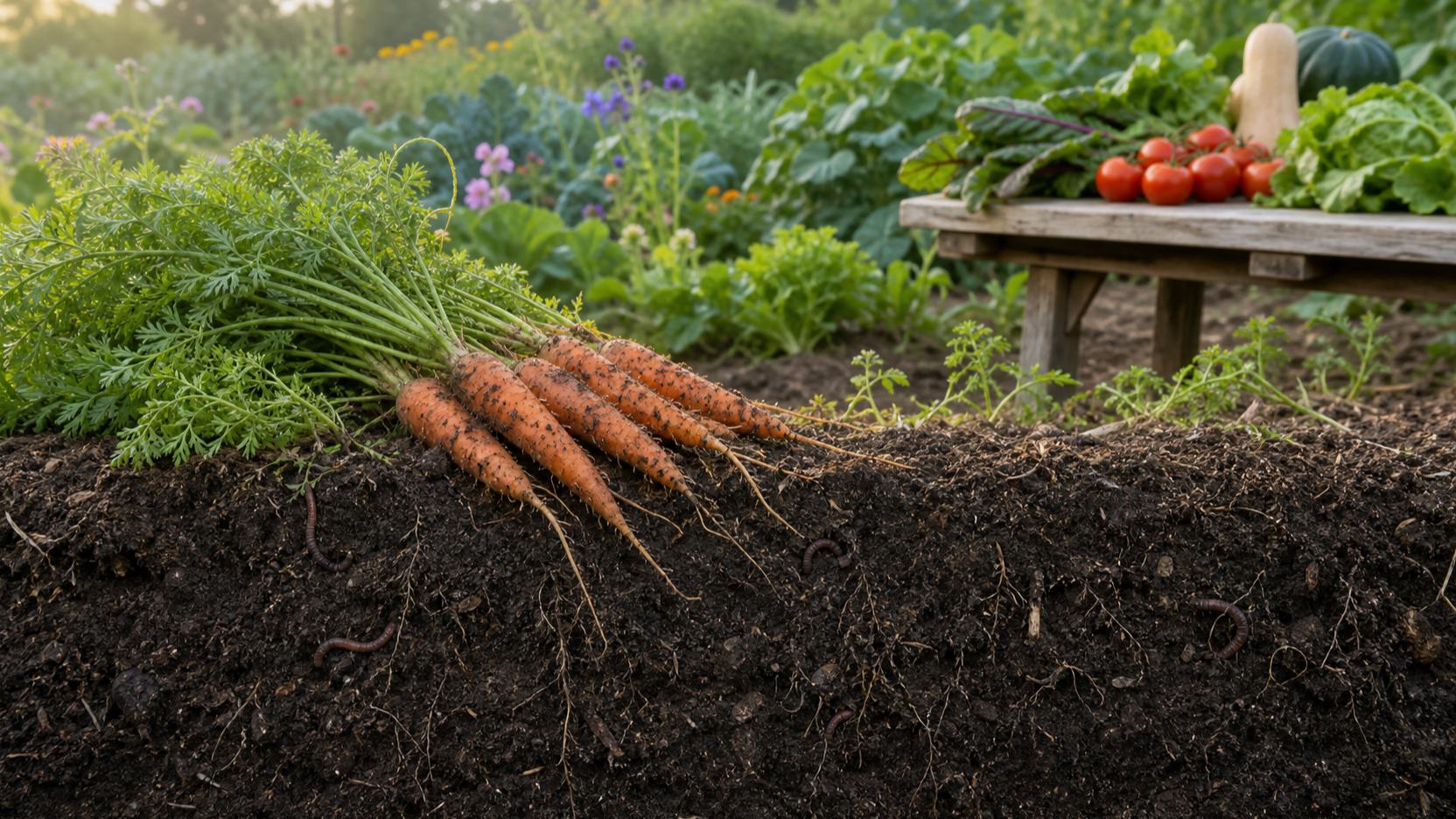
You want produce that tastes alive, nourishes your household and does not quietly degrade the land that grew it. Yet the usual shortcuts – a supermarket shelf, an organic sticker or an attractive farm stand – cannot answer the most important question: what happened in the field?
You do not need to become a soil scientist to make a better choice. You need to understand what healthy soil can change, what it cannot guarantee, and which questions reveal more than the marketing language on a packet.
Soil health matters, but it does not decide every bite
Food quality begins on a farm, even when you encounter the food under fluorescent lights. Sadhguru captured this distinction neatly: “No food comes from a supermarket. Both are from farms.” The useful question is therefore not simply whether you bought a tomato locally or commercially. It is how the tomato was grown, which variety it is, when it was picked and what happened between harvest and your kitchen.
Healthy soil gives a crop a better functioning root environment. It can hold and move water, buffer nutrients, maintain pore space and support organisms that break down residues and cycle nutrients. Those functions improve the conditions in which a plant grows. They can also help a field withstand dry periods, heavy rain and erosion. That makes soil health fundamental to agricultural resilience.
Fundamental does not mean all-powerful. Soil organic matter does not map directly to sweetness, vitamin content or a superior meal. A ripe tomato bred for flavour and eaten soon after harvest may outperform a poorly chosen variety from a well-managed field. Genetics, maturity, temperature, transport and storage can all overwhelm the farming-method effect in a single taste comparison.
This is why the claim that regeneratively grown food must always taste better is too strong. Evidence around organic produce is mixed but encouraging rather than absolute: lower pesticide residues appear as one recurring difference, while some comparisons find modestly higher concentrations of certain phytochemicals, including phenolics. Those compounds can contribute to flavour and antioxidant capacity, but no label removes the influence of variety, ripeness and handling.
Use taste as a reason to investigate, not as a laboratory test. A vivid carrot can tell you that the variety, harvest stage and handling worked well together. It cannot, by itself, tell you the percentage of organic matter in the field or provide a complete nutritional analysis.
What regenerative farming changes below ground
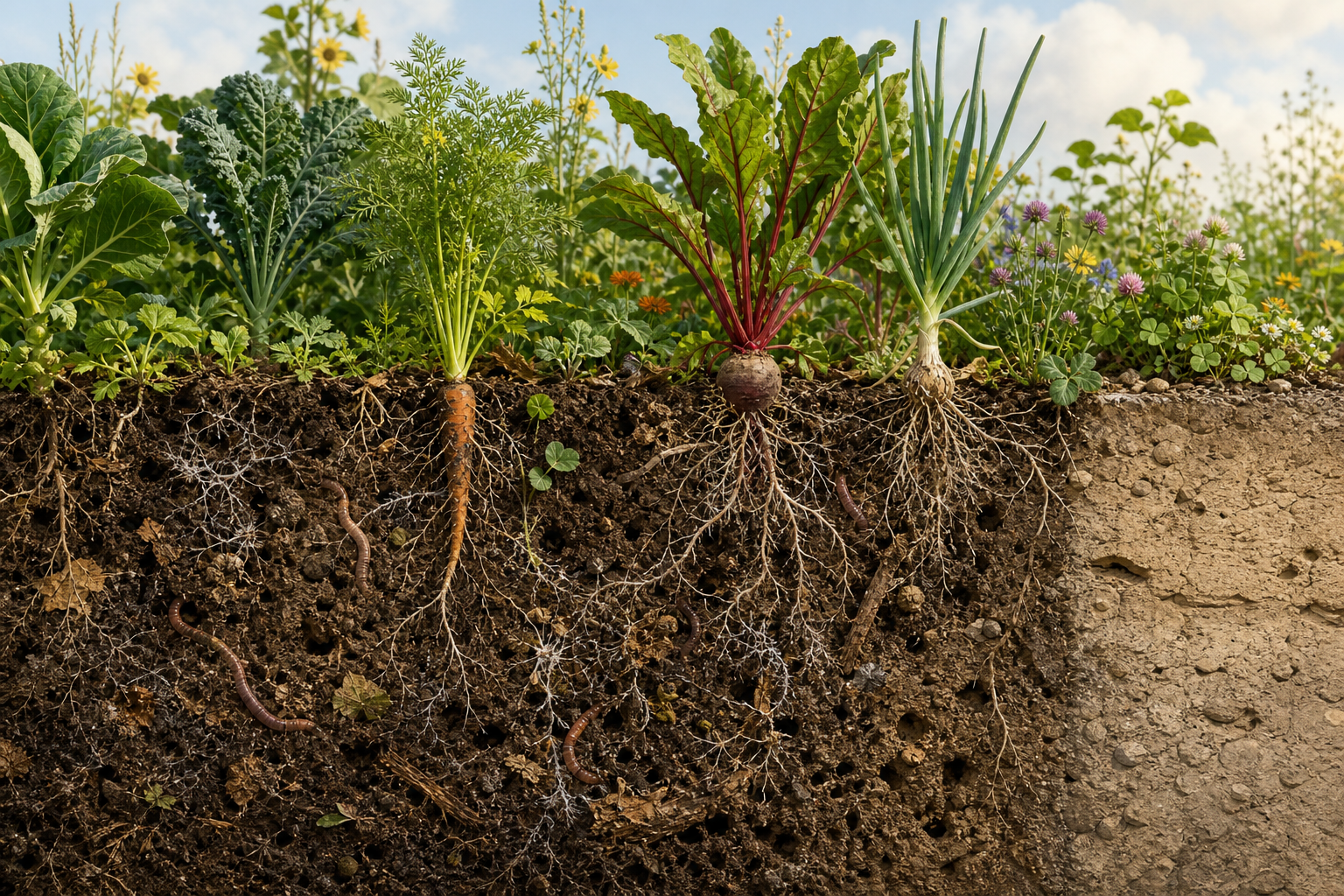
Soil health combines physical, chemical and biological qualities. Physical health includes structure, stable aggregates, pore space and the ability to absorb water. Chemical health includes nutrient availability and the capacity to hold nutrients instead of losing them rapidly. Biological health includes roots, fungi, bacteria and other organisms participating in decomposition and nutrient cycling.
Soil organic matter connects these dimensions. It consists of carbon-rich materials derived from decomposing plants, organisms and their residues. It can improve aggregate stability, water infiltration, water-holding capacity, nutrient buffering and biological activity. Many temperate agricultural soils fall within a broad range of roughly 1% to 6% soil organic matter, but that is a descriptive range, not a universal target. Soil type, climate and management history determine what is realistic. A farmer working with a naturally sandy soil should not be judged against a field with a different mineral base and climate.
Regenerative agriculture is best understood as a direction of management rather than a magic input. The farmer tries to rebuild the soil’s capacity to function as a living system. The relevant practices commonly include:
- Reducing unnecessary tillage so that soil aggregates, fungal networks and pore structure are disturbed less often.
- Keeping soil covered with crop residues, mulch or cover crops to reduce erosion and protect the surface from heat and forceful rain.
- Maintaining living roots for more of the year so that plants continue feeding the soil ecosystem.
- Rotating crops and using greater plant diversity instead of repeatedly placing the same biological demands on the field.
- Adding suitable composts, manures or other organic amendments to return material to the soil.
- Integrating grazing thoughtfully where the land, animals and management capacity make it appropriate.
No single practice proves that a farm is regenerative. A cover crop cannot compensate automatically for severe compaction, excessive disturbance or badly timed grazing. Compost is not a licence to ignore erosion. Minimal tillage may also require adaptation to the crop, weed pressure, soil and climate. What matters is whether the practices work together over time to improve soil cover, root activity, water movement, organic matter and biological habitat.
The labels “organic,” “regenerative” and “conventional” should not be treated as descriptions of three uniform farming systems. Farms within each category differ, and many growers combine methods pragmatically. Organic status can answer an important production question, but it does not tell you the variety, harvest date, length of storage or whether the field has living roots between cash crops. Regenerative language can signal serious soil-building work, but the word alone is not evidence. Ask what the grower actually does.
Key takeaways
- Healthy soil supports water management, nutrient cycling, structure and biological activity; it enables crop quality but does not guarantee a particular flavour or nutrient result.
- Freshness, ripeness and crop variety can matter as much as the farming label when you judge the food on your plate.
- Regenerative farming is a coordinated pattern: less disturbance, more soil cover, living roots, diversity and appropriate organic inputs.
- A broad soil-organic-matter percentage is not a universal score. Local soil, climate and management history determine the meaningful baseline.
- The best purchasing question is not “Is this regenerative?” but “What do you do to keep the soil covered, rooted and improving?”
A five-question buying method that works in the real world
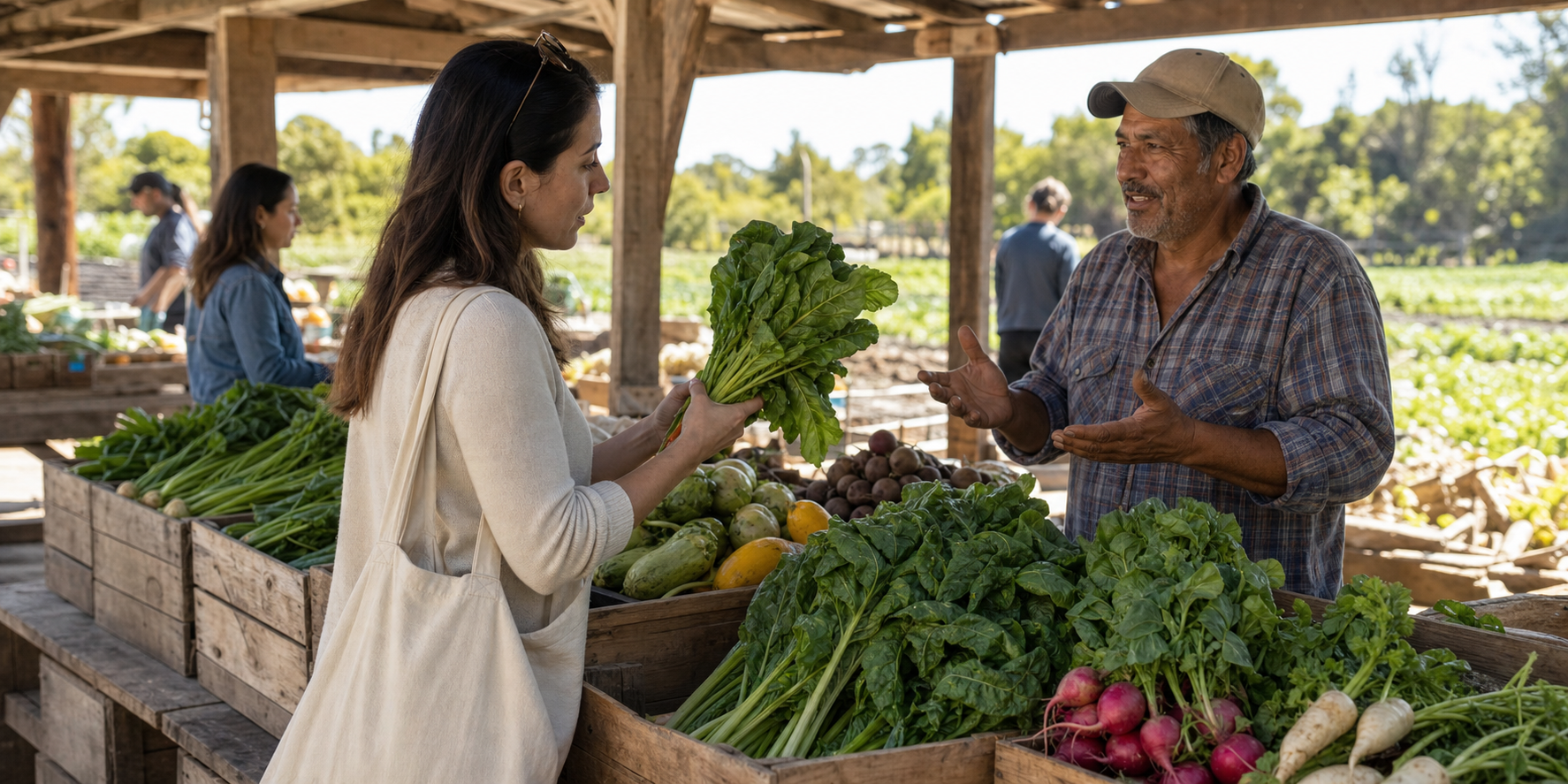
You may not be able to inspect a field or obtain a laboratory report. You can still learn a great deal from a grower, market seller, community-supported agriculture scheme or shop that knows its suppliers. Ask concrete questions in ordinary language.
- What variety is this? A seller who can name the cultivar can help you choose for sweetness, acidity, texture, cooking or storage. Variety also prevents you from attributing every flavour difference to soil management.
- When was it harvested? This is often the most useful question for immediate eating quality. Delicate aromas and textures can decline during a long supply chain, so a shorter interval may matter more to tonight’s meal than a broad claim on a sign.
- What grows here between main crops? Listen for cover crops, rotations, pasture phases or another credible way of maintaining roots and cover. Bare ground for long periods is different from a field kept biologically active.
- How do you protect and build the soil? The answer may include reduced tillage, mulch, compost, manure, diverse rotations or carefully managed grazing. You are listening for an integrated method, not one fashionable term.
- What has changed in the field? A thoughtful grower may mention easier infiltration, less runoff, better aggregation, improved moisture retention, more biological activity or reduced erosion. These observations do not replace measurement, but they show whether the claim refers to field function rather than branding.
Do not turn the conversation into an interrogation. Farmers work under different rainfall patterns, soil constraints, labour conditions and market pressures. A credible answer may include setbacks and compromises. In fact, a grower who explains why one practice works on one field but not another is giving you more useful information than someone promising that one input solves everything.
Run a fair kitchen comparison
If you want to compare produce, make the exercise informative. Buy the same type of crop at a similar stage of ripeness. Use the same preparation, serving temperature and time after purchase. Conceal the source labels, change the serving order and ask tasters to note aroma, sweetness, acidity, bitterness, texture and aftertaste before discussing their preferences.
Repeat the comparison across more than one purchase. A single punnet of berries or batch of carrots can reflect one variety, one harvest day and one storage history. A rigorous sensory comparison needs replication, consistent ripeness, blinding, randomisation and enough tasters. Your kitchen version will not prove a general rule, but it can reveal which grower and variety reliably deliver the qualities your household values.
Keep the buying decision proportional to the evidence. If one source tastes consistently better and the grower can explain credible soil-building practices, you have a practical reason to return. If the flavour is disappointing, ask about variety and harvest timing before concluding that the entire farming approach has failed.
Turn a food preference into dharmic stewardship

A dharmic relationship with food is not confined to choosing a purity label. Hindu, Buddhist, Jain and Sikh communities contain varied dietary disciplines; they should not be collapsed into one rule. Yet restraint, gratitude and non-harm offer a shared ethical vocabulary for considering how a meal reaches us.
Ahimsa becomes materially relevant when you ask whether cultivation protects or steadily exhausts the living basis of future harvests. Gratitude becomes more than a spoken sentiment when it changes how much food you waste and whose farming you sustain. Restraint matters when convenience invites you to treat soil, water, plants, animals and farm labour as invisible parts of a transaction.
This does not require an overnight replacement of your entire food basket. Choose one item you buy often – perhaps tomatoes, carrots, berries or a local staple – and trace it back one step. Find out its variety, harvest timing and the grower’s soil practices. Buy seasonally when feasible, compare quality over several purchases and reward the supplier who can show a serious commitment to living roots, soil cover, diversity and organic matter.
Then reduce the waste that would cancel part of that effort. Plan how you will use the food before buying it, store it appropriately and direct unavoidable plant scraps into a composting system where one is available and suitable. Supporting better cultivation while discarding edible produce is an incomplete form of stewardship.
Your next meal cannot repair a watershed by itself. It can, however, strengthen a relationship with a grower who is rebuilding the land. Start with one recurring purchase and one honest question about the field. That is small enough to sustain and concrete enough to matter.
References
