
If you are trying to decide whether war, social disorder, or rapid technological change proves that Kali Yuga is ending, begin with a harder question: which yuga chronology is being used? A prediction can sound scriptural while quietly switching between incompatible systems.
You can test most claims by separating three things: the Purāṇic arithmetic, the meaning of a yuga transition, and the ethical purpose of the teaching. Once those are kept distinct, Hindu cosmic chronology becomes much clearer—and far less useful to date-setters.
Begin with the complete catur-yuga, not a predicted end date

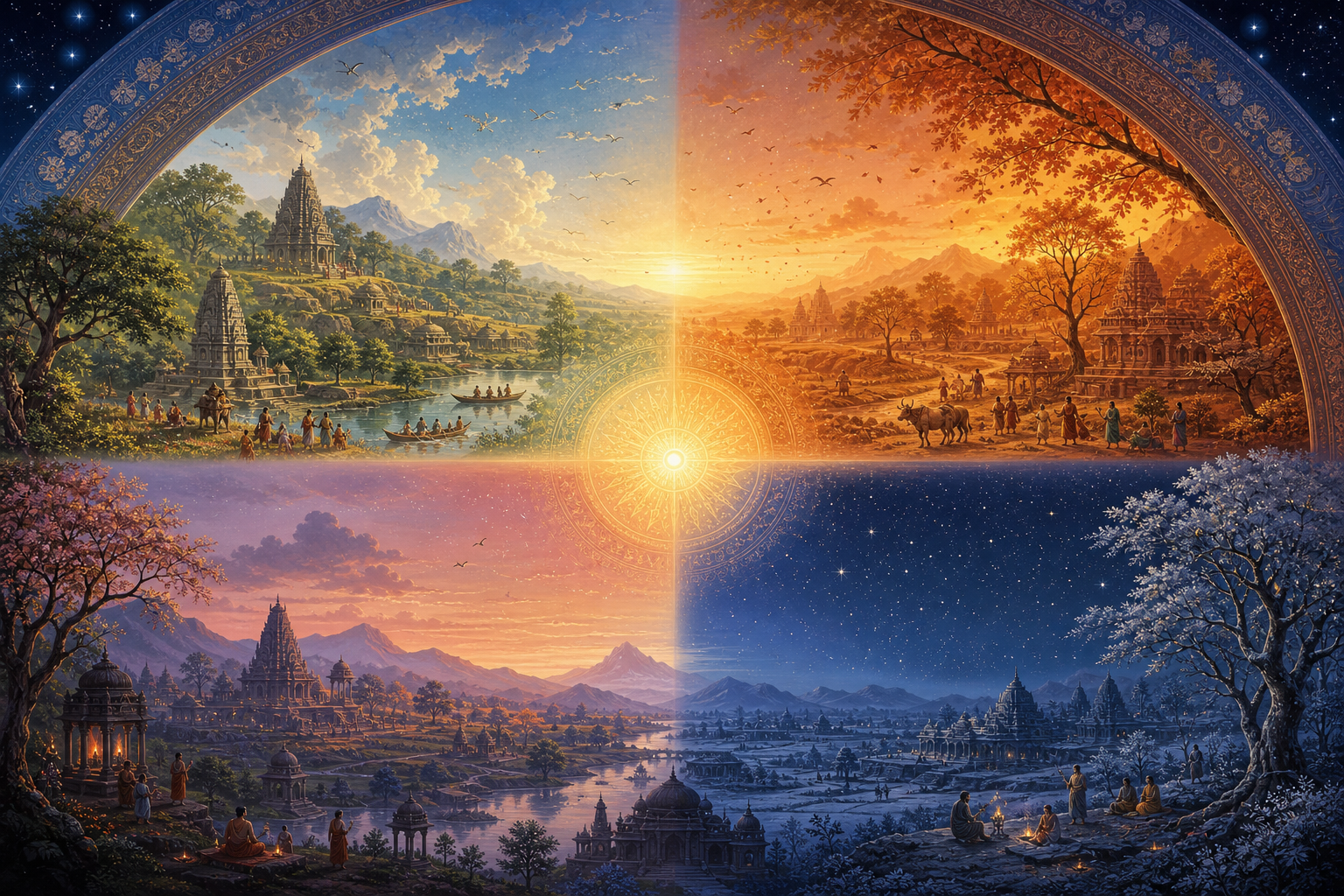
The basic unit is the catur-yuga, also called a mahā-yuga: Satya or Kṛta, Tretā, Dvāpara, and Kali in sequence. In classical Purāṇic reckoning, the four together last 4,320,000 human years. Their total durations follow a 4:3:2:1 proportion.
The calculations are often first stated in divine years, with one divine year equal to 360 human years. Each yuga contains three parts: an opening sandhyā, a central span, and a closing sandhyāṁśa. The familiar totals of 4,800, 3,600, 2,400, and 1,200 divine years already include both twilight portions.
| Yuga | Dawn sandhyā | Central span | Dusk sandhyāṁśa | Total human years |
|---|---|---|---|---|
| Satya (Kṛta) | 144,000 | 1,440,000 | 144,000 | 1,728,000 |
| Tretā | 108,000 | 1,080,000 | 108,000 | 1,296,000 |
| Dvāpara | 72,000 | 720,000 | 72,000 | 864,000 |
| Kali | 36,000 | 360,000 | 36,000 | 432,000 |
There is an important arithmetic check here. In every row, the two twilight portions together are one-fifth of the central span, but one-sixth of the complete yuga. For Kali, for example, 36,000 + 36,000 gives 72,000 twilight years; 72,000 is one-fifth of the 360,000-year core and one-sixth of the 432,000-year total. Across the entire mahā-yuga, all eight twilight portions add up to 720,000 human years.
This distinction matters whenever someone adds a sandhyā period to the standard yuga total. If the calculation begins with 432,000 years for Kali, its dawn and dusk have already been counted. Adding them again produces a different chronology.
The same cyclic architecture continues at larger scales. A kalpa, the day of Brahmā, contains one thousand catur-yugas, while manvantara-sandhyās mark junctions associated with the reigns of successive Manus. Hindu cosmology therefore treats transition as a recurring feature of time, not as an anomaly appearing only at the end of Kali.
Key takeaways
- A mahā-yuga contains Satya, Tretā, Dvāpara, and Kali and lasts 4,320,000 human years in classical Purāṇic reckoning.
- Each yuga total includes its opening sandhyā and closing sandhyāṁśa; they are not extra periods to be added afterward.
- The 3102 BCE Kali epoch marks the beginning of the traditional Kali count, not the start of Kali’s final twilight.
- A 24,000-year ascending-and-descending scheme is an alternative model, not a shortened version of the classical arithmetic.
- Descriptions of social decline can diagnose adharma, but they cannot by themselves calculate a cosmic date.
A yuga transition is a graded interval, not a midnight switch

Sandhyā is the light at a threshold; sandhi is the joining itself. Applied to cosmic time, these terms warn you against imagining that one age disappears and another instantly replaces it. The outgoing pattern weakens while the incoming pattern becomes visible.
The table also makes the terminology more precise. Sandhyā is the dawn belonging to a yuga, and sandhyāṁśa is its dusk. Neither is a fifth, independent age. When someone speaks broadly of the Dvāpara-Kali yuga-sandhi, the phrase may refer to the junction as a whole. An exact chronological claim, however, must say whether it means Dvāpara’s closing twilight, Kali’s opening twilight, or the boundary epoch between them.
This gradual structure explains why mixed conditions are expected. Qualities associated with the previous age may persist after a boundary, while tendencies belonging to the next age can appear beforehand. In theological language, sattva, rajas, and tamas are reweighted. In human terms, institutions, duties, and forms of worship do not all change on the same day.
The Dvāpara-Kali threshold is linked with Śrī Krishna’s withdrawal in the Bhāgavata Purāṇa. The Mahābhārata and Viṣṇu Purāṇa provide related frames for the decline and restoration of dharma, while Kalki is placed at the future renewal following Kali. These narratives make the junction morally decisive, but they do not turn every crisis inside Kali into a new cosmic boundary.
That is the first practical correction to make when reading predictions. Similarity is not chronology. A corrupt ruler, a commercialized teacher, or a hollow ritual may resemble a traditional sign of decline, but resemblance alone does not identify which portion of a 432,000-year cycle you occupy.
What the 3102 BCE Kali epoch establishes—and what it cannot
The widely used Kali Yuga epoch is 3102 BCE in the proleptic Julian calendar. “Proleptic” means that the Julian calendar is extended backward to express a date earlier than the calendar’s historical introduction. Indian astronomical and calendrical traditions have used this epoch as a computational baseline.
A computational epoch answers a specific question: where does a count begin? It does not mean that every ethical, political, or ecological feature of Dvāpara vanished at one instant. The presence of sandhyā in the chronology already anticipates continuity across the boundary.
If you apply the component scheme strictly, 3102 BCE begins Kali’s complete 432,000-human-year span, including its 36,000-year opening twilight. It does not begin the closing 36,000-year sandhyāṁśa. A claim that Satya Yuga must therefore arrive in the near term cannot be derived from the classical totals and the 3102 BCE epoch alone.
This does not make the epoch spiritually empty. It marks the Dvāpara-Kali transition associated with Krishna’s departure and provides a stable temporal reference. It simply does three different jobs only when we keep them separate:
- Calendrical: it supplies a baseline from which the Kali count is made.
- Narrative: it locates Krishna’s withdrawal at the change of ages.
- Ethical: it frames the conditions under which dharma must be practiced during Kali.
Confusion starts when an ethical observation is treated as an astronomical measurement. “This conduct is characteristic of Kali” may be a serious moral judgment. “Therefore Kali ends on this date” is a separate claim requiring a defined chronology and valid arithmetic.
Do not splice the 24,000-year model into Purāṇic arithmetic
Some later and modern interpretations connect the yugas to a 24,000-year cycle with ascending and descending arcs. Such a model can support contemplative or comparative reflection, but it changes the scale and structure of the chronology. The classical Purāṇic catur-yuga of 4,320,000 human years and the 24,000-year proposal are not interchangeable.
You do not have to dismiss one model merely to describe the other accurately. You do have to resist taking a date from one, a yuga ratio from another, and a scriptural image from a third, then presenting the combination as a single inherited calculation.
Before accepting a claim about an approaching yuga transition, ask these five questions:
- Which model is being used? Look for an explicit choice between the 4,320,000-year catur-yuga and an alternative compressed cycle.
- Are the units human years or divine years? If divine years appear, verify whether they have been multiplied by 360.
- Are the twilights already included? The standard totals of 4,800, 3,600, 2,400, and 1,200 divine years include the dawn and dusk portions.
- What does the proposed date mark? It might identify an outgoing dusk, a boundary epoch, an incoming dawn, the start of a central span, or the end of the complete yuga. Those are not the same event.
- What kind of evidence is offered? Arithmetic can test chronology. Social imagery can test conscience. The second cannot substitute for the first.
If a prediction does not answer those questions, you cannot reproduce it. Treat it as a theological interpretation or moral exhortation, not as an established date in Hindu calendrics.
Use cosmic chronology to choose dharma, not surrender agency
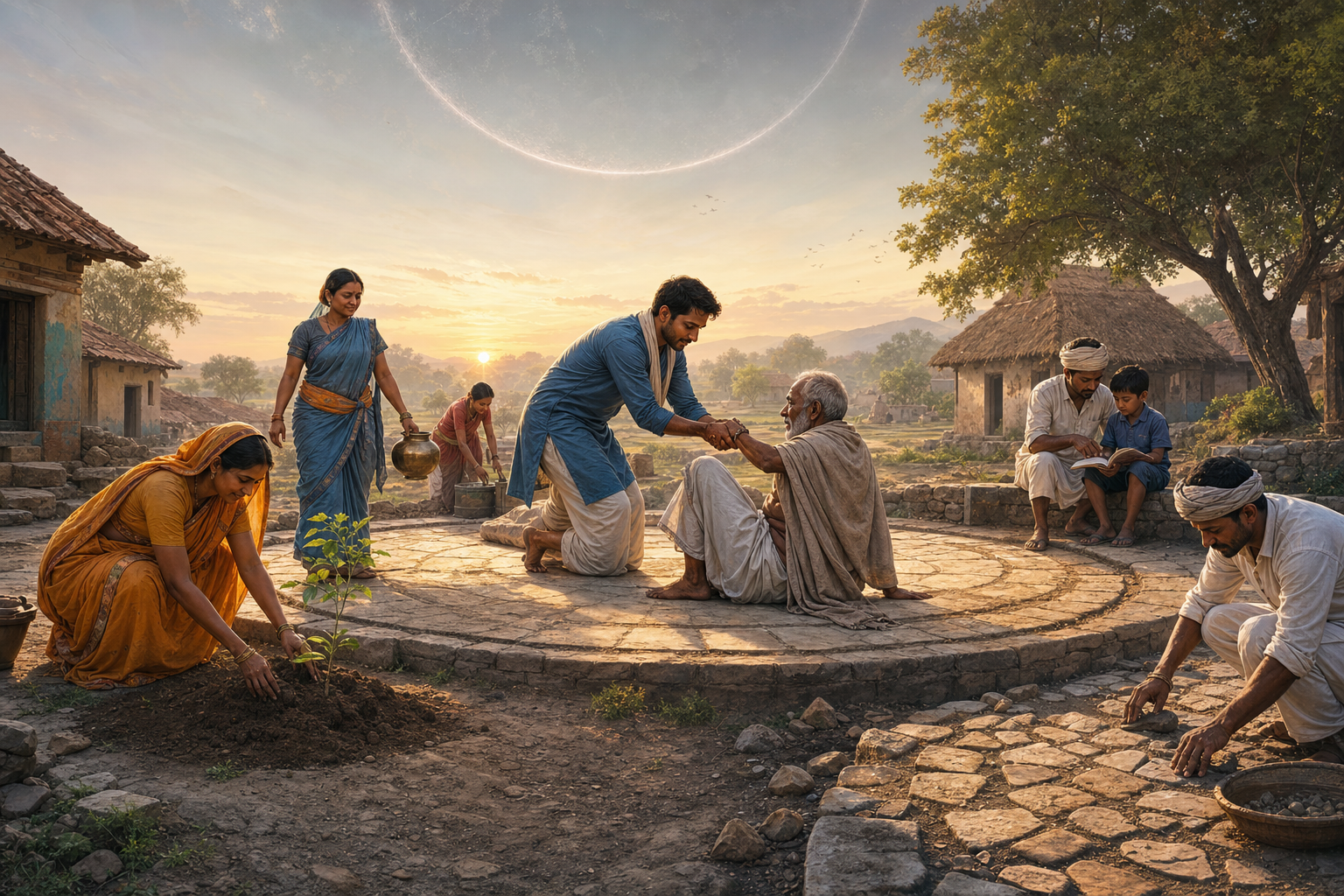
Traditional descriptions of declining conditions are vivid: rulers exploit those they should protect, knowledge becomes merchandise without responsibility, ritual loses its inward purpose, and natural rhythms are disturbed. You may read such images as prophecy, moral diagnosis, or both. In none of those readings does recognition excuse passivity.
The practical response associated with difficult times is a return to essentials: vrata, dāna, satya, ahiṃsā, svādhyāya, bhakti, remembrance of the Divine Name, and nāma-saṅkīrtana. These disciplines are useful precisely because they convert a vast cosmic teaching into conduct that remains available to an ordinary person.
You can make that response concrete without claiming to know a hidden end date:
- Keep a real twilight practice. If sandhyā-vandana belongs to your received practice, protect its place at dawn and dusk. Otherwise, use those thresholds for the prayer, japa, study, or recollection proper to your tradition.
- Name one form of adharma within your reach. Correct a falsehood, an exploitative habit, a neglected duty, or a breach of ahiṃsā before using cosmic decline to judge an entire civilization.
- Pair inward practice with service. Dāna and responsibility prevent spirituality from becoming an escape from the very conditions it is meant to transform.
- Study before forwarding a date. Check the model, units, twilight definitions, and epoch. If the calculation mixes systems, do not repeat it as settled chronology.
- Let uncertainty strengthen practice. Dharma does not become less binding because the exact placement of a transition is disputed.
The wider Dharmic family expresses a related discipline in different forms. Buddhist kalpas and antara-kalpas place impermanence within immense cycles while directing attention toward mindfulness and mettā. Jaina avasarpiṇī and utsarpiṇī describe descending and ascending conditions while keeping ahiṃsā, samayik, and pratikraman central. Sikh teaching can use the four yugas as moral markers while centering Naam, nitnem, righteous living, and sevā. The cosmologies are not identical, but none makes the moral life depend on possessing a countdown.
The next time you encounter a confident yuga date, put its arithmetic through the five-question test before giving it authority. Then, at the next dawn or dusk, choose one neglected practice and one neglected duty. That is a response to cosmic transition you can begin without pretending to control the cosmic clock.
References
