

You may have been told that the Sun in your second house explains family tension, unstable savings, or a voice that sounds harsher than you intend. Before you buy a talisman or begin a severe fast, slow down. This placement identifies an area for disciplined attention; it does not pronounce a fixed fate.
The most useful response is a small, repeatable remedy plan. In Lal Kitab practice, Surya in Dhana Bhava brings solar qualities such as authority, dignity, clarity, and heat into wealth, family lineage, speech, food, teeth, and eyesight. Your task is to make those qualities illuminating rather than scorching.
First identify what actually needs a remedy

Do not manufacture a problem simply because an astrologer or software has identified the placement. A well-supported Sun in the second house can accompany persuasive speech, principled handling of wealth, and stable self-respect. Even then, its confidence may need softness so that conviction does not become domination.
Look for a recurring pattern in ordinary life. The relevant questions are concrete:
- Do disagreements about savings, inheritance, taxes, property, or shared expenses repeatedly damage family trust?
- Do people react to your tone even when the substance of what you say is correct?
- Do pride and authority make it difficult to apologise, accept advice, or share financial control?
- Have duties toward your father, parents, elders, guardians, or mentors been neglected?
- Does anxiety about scarcity lead you to conceal information, postpone dues, or control the household through money?
If none of these patterns is present, use the gentle devotional and ethical practices below without treating yourself as afflicted. If one pattern is obvious, make it the focus of your remedy. A remedy aimed at everything usually changes nothing.
Technical context also matters. For a Pisces ascendant, the second house is Aries, where the Sun is exalted. The concern may therefore be excessive force rather than lack of solar strength: speak with less heat and leave room for other family members. For a Virgo ascendant, the second house is Libra, where the Sun is debilitated. Consistency, financial transparency, and a calm Sunday discipline become more important than displays of status.
Traditional planetary relationships refine the reading further: the Sun is friendly toward the Moon, Mars, and Jupiter; neutral toward Mercury; and inimical toward Venus and Saturn. Mercury can sharpen calculation, trade, and expression, while Saturn’s involvement can intensify responsibility, severity, or fear of scarcity. The sign, dispositor, conjunctions, aspects, nakshatra, and current dasha-bhukti can change the practical meaning. Surya Mahadasha or Antardasha may make the placement more noticeable, but an isolated second-house Sun is still not enough to justify an expensive or severe intervention.
Put the remedy where the second house is under strain
For money: replace opacity with clean accounts
The central financial remedy is not a lucky object. It is dharmic stewardship. Keep a clear record of savings, debts, taxes, family loans, and jointly owned assets. Pay dues when they are owed. If property or inheritance is disputed, put the figures and proposed division in writing before the family discussion begins.
This matters because the Sun can turn a financial disagreement into a contest over rank: who decides, who deserves respect, and whose contribution counts. A written account moves the discussion away from status and back toward facts. If substantial assets or legal rights are involved, use a qualified financial or legal professional; an astrological practice cannot protect you from an unclear deed, an unpaid tax, or an unfair agreement.
For speech: make truth useful, not merely forceful
With this placement, the content of your statement may be sound while its delivery causes the damage. Before giving a correction, ask three questions: Is it true? Is it necessary now? Can it be said without humiliating the listener? This is not an instruction to become evasive. It is a way to separate truthful speech from the pleasure of having the final word.
Choose one recurring situation for practice: a household expense discussion, a call with a parent, or a meal at which arguments usually begin. Lower your pace, do not interrupt, and state the decision without a verdict on anyone’s character. If you speak harshly, correct it the same day. A prompt apology is more remedial than another ritual performed while pride remains untouched.
This discipline has a recognisably Dharmic foundation. Hindu traditions honour satya joined to non-hurtful conduct; Buddhist practice cultivates truthful and skilful speech; Jain dharma extends ahimsa to words and intentions; and Sikh teaching joins truthful living with humility. For this placement, the shared principle is exact: let your voice carry light without becoming a weapon.
For family: practise respect as a duty, not a performance
Service to a father, guardian, senior teacher, or fatherly mentor is a traditional Surya remedy. Make it tangible. Return a call, accompany an elder to an appointment, complete a neglected responsibility, or acknowledge guidance without turning the exchange into a debate.
Balance that solar emphasis with warmth toward your mother and other nurturing figures. Shared meals are especially useful because the second house includes both family and food. Prepare fresh, sattvic food when practical, sit together without rushing, and keep property grievances away from the dining space. The point is not dietary perfection. It is to prevent nourishment from becoming another arena for control.
Use a simple daily and Sunday remedy routine
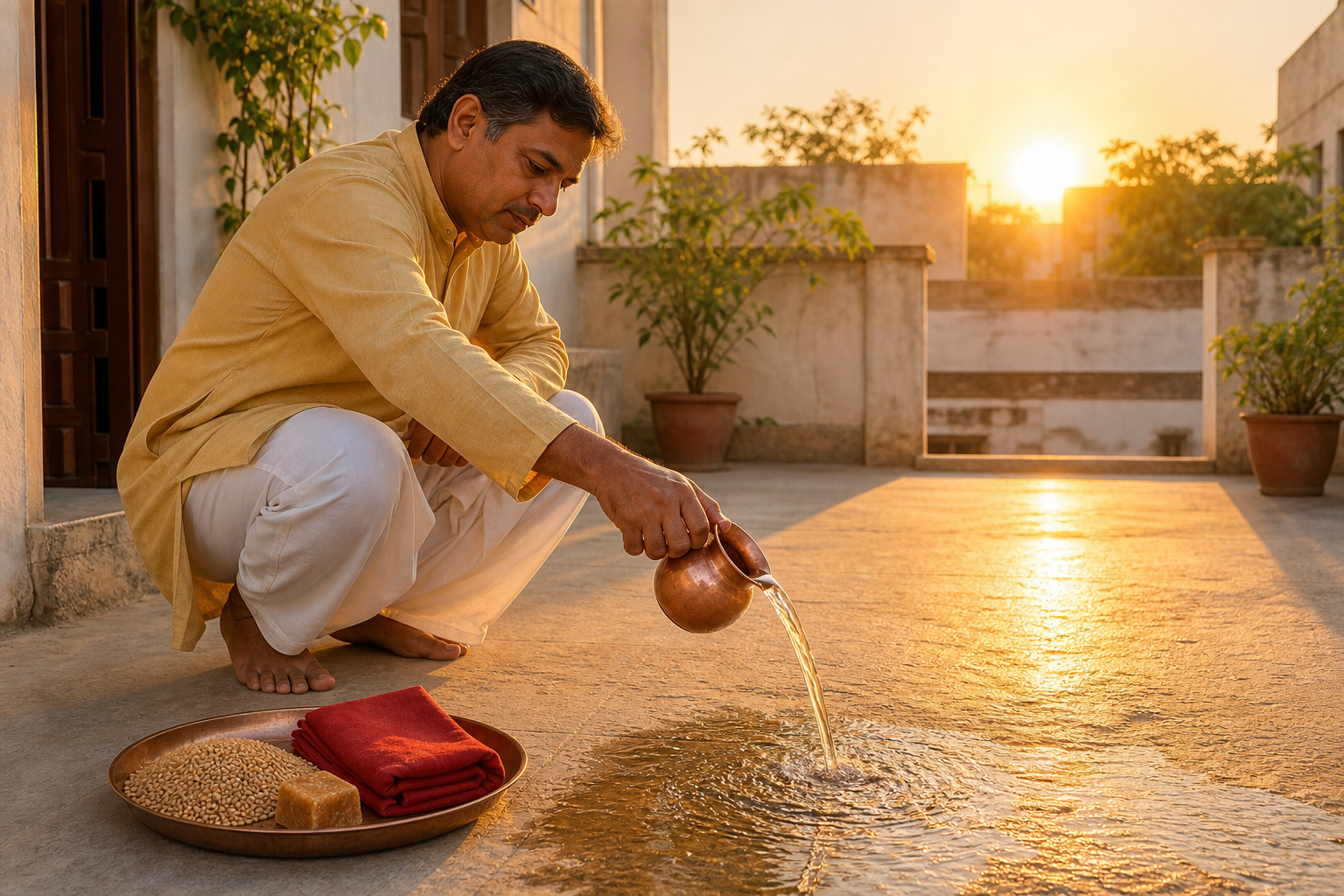
A workable routine has two layers: a brief daily act that trains attention and a Sunday practice that joins devotion, charity, and restraint. Start modestly enough that you can remain consistent.
- Offer Surya Arghya at sunrise. Face east and offer clean water with gratitude. Recite “Om Suryaya Namah” while offering the water. Treat the act as a daily commitment to clarity, not as a bargain for immediate wealth.
- Choose one recitation practice. You may continue with the Surya mantra, recite Aditya Hridayam, or use the Gayatri Mantra according to your tradition and guidance. One steady practice is better than collecting several recitations that you cannot sustain.
- Connect prayer to the day’s speech. After the offering, name the conversation in which you most need restraint. This turns the ritual toward the actual second-house issue instead of leaving it at the altar.
- Observe proportionate restraint on Sunday. A Sunday vrata may mean fasting for someone whose health and tradition permit it. It can also mean simpler food, less excess, and avoidance of heavy or stale meals. Do not undertake a fast that conflicts with a medical condition, prescribed medication, pregnancy, age-related needs, or a history of disordered eating; ask an appropriate health professional when there is any doubt.
- Give Surya-aligned dana. Wheat, jaggery, copper, or red or saffron cloth may be offered on Sunday to an elder, teacher, or person in genuine need. Give usable goods respectfully. Charity should relieve another person’s difficulty rather than display your piety.
- Add service where it is practical. Feeding a cow a small amount of wheat and jaggery is a traditional option when it can be done safely and responsibly. Service to parents, elders, and people experiencing scarcity is equally important because it engages the relationships and duties implicated by the placement.
- Keep symbols modest. A clean copper vessel for the morning offering, a small copper coin or square kept as a reminder, or dignified warm colours on Sunday is sufficient. The symbol should recall steadiness and integrity; it need not become an expensive object.
Gentle Surya Namaskara at dawn can support the same rhythm if it suits your body and level of mobility. Assistance to community eye or dental care also connects charity with traditional second-house significations. Neither astrology nor charity diagnoses or treats a problem with your teeth or vision. Pain, injury, infection, or a change in eyesight belongs with a qualified dentist, optometrist, or physician.
Avoid remedies that leave the real conduct unchanged

Lal Kitab upayas are most coherent when conduct, devotion, and service point in the same direction. A donation made on Sunday does not compensate for concealing a debt on Monday. Arghya does not repair a family bond if you continue using money or speech to overpower the household.
- Do not treat the placement as a guarantee of poverty or conflict. It can also support articulate speech, self-respect, and principled wealth management.
- Do not strengthen the Sun blindly. An exalted, forceful, or otherwise well-supported Sun may require refinement of pride and tone rather than more intensity.
- Do not prescribe one remedy to everyone with this placement. The ascendant, sign, dispositor, other planets, and planetary periods can materially change the interpretation.
- Do not use ritual to avoid professional help. Legal disputes, investment decisions, tax obligations, dental pain, and changes in vision require the appropriate qualified professional.
- Do not turn fasting into punishment. Health and life stage take priority over an optional austerity.
- Do not assume that cost proves potency. The traditional measures described here are simple. An isolated chart placement is not a sound reason to buy costly gemstones, metals, or ceremonial packages.
- Do not weaponise the reading. Telling a relative that your Sun makes you the natural authority simply repeats the very pattern the remedy is meant to soften.
You can judge whether the practice is working without pretending that astrology supplies guaranteed outcomes. Look for observable changes: accounts are current, shared expenses are disclosed, arguments cool sooner, apologies come more easily, elders receive dependable care, and your religious observance makes you less domineering rather than more so. Those are meaningful signs of alignment even when an external financial result takes time or remains outside your control.
Key takeaways for your remedy plan
- Confirm the whole-chart context before calling the Sun afflicted or trying to strengthen it.
- Choose the actual pressure point: money, speech, family duty, or a combination of them.
- Make sunrise Arghya and one stable mantra your devotional foundation.
- Use Sunday for health-appropriate restraint, humble dana, and practical service.
- Treat transparent finances, timely dues, gentle truth, and respect for elders as primary remedies rather than optional moral additions.
- Keep copper, colour, and other symbols simple; they should remind you of right conduct, not replace it.
Begin with the next sunrise and one unresolved second-house responsibility. Offer the water, then take the corresponding action: disclose the figure, pay the due, soften the sentence, share the meal, or serve the elder. That union of worship and conduct is where the remedy becomes real.
References
