
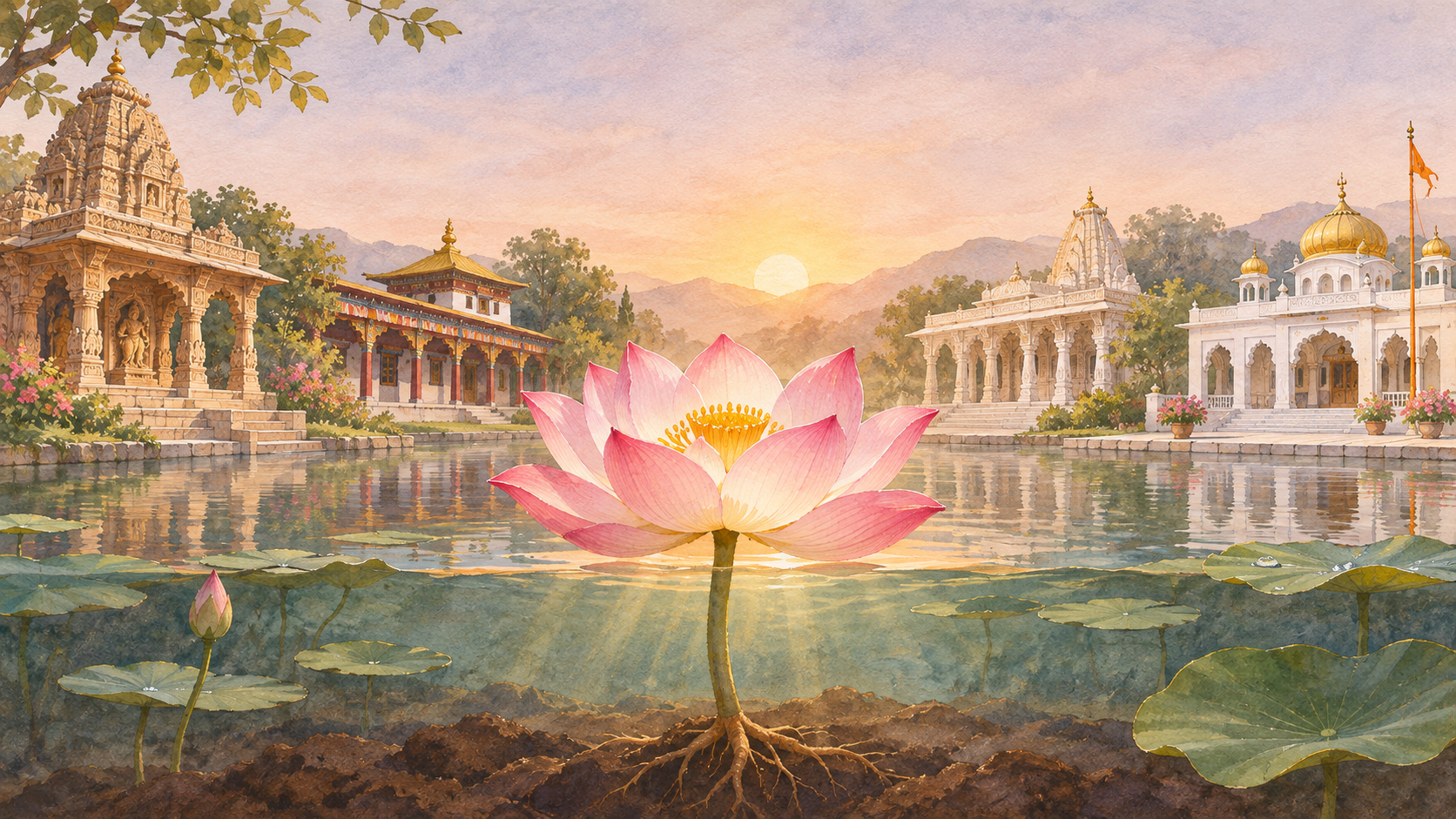
You see a lotus beneath Lakshmi, under a Buddha or Jina, and in a Sikh teaching about how to live in the world. The flower looks familiar each time, but should you read it as the same symbol?
The useful answer is both yes and no. The lotus gives the Dharmic traditions a shared visual language of purity, spiritual possibility and freedom from limiting conditions. Yet Hindu, Buddhist, Jain and Sikh settings make that language do different work. If you look at who is present, what the flower is doing and whether it is an image, offering or metaphor, you can recognise the kinship without flattening the distinctions.
Why the lotus travels so well across Dharmic traditions
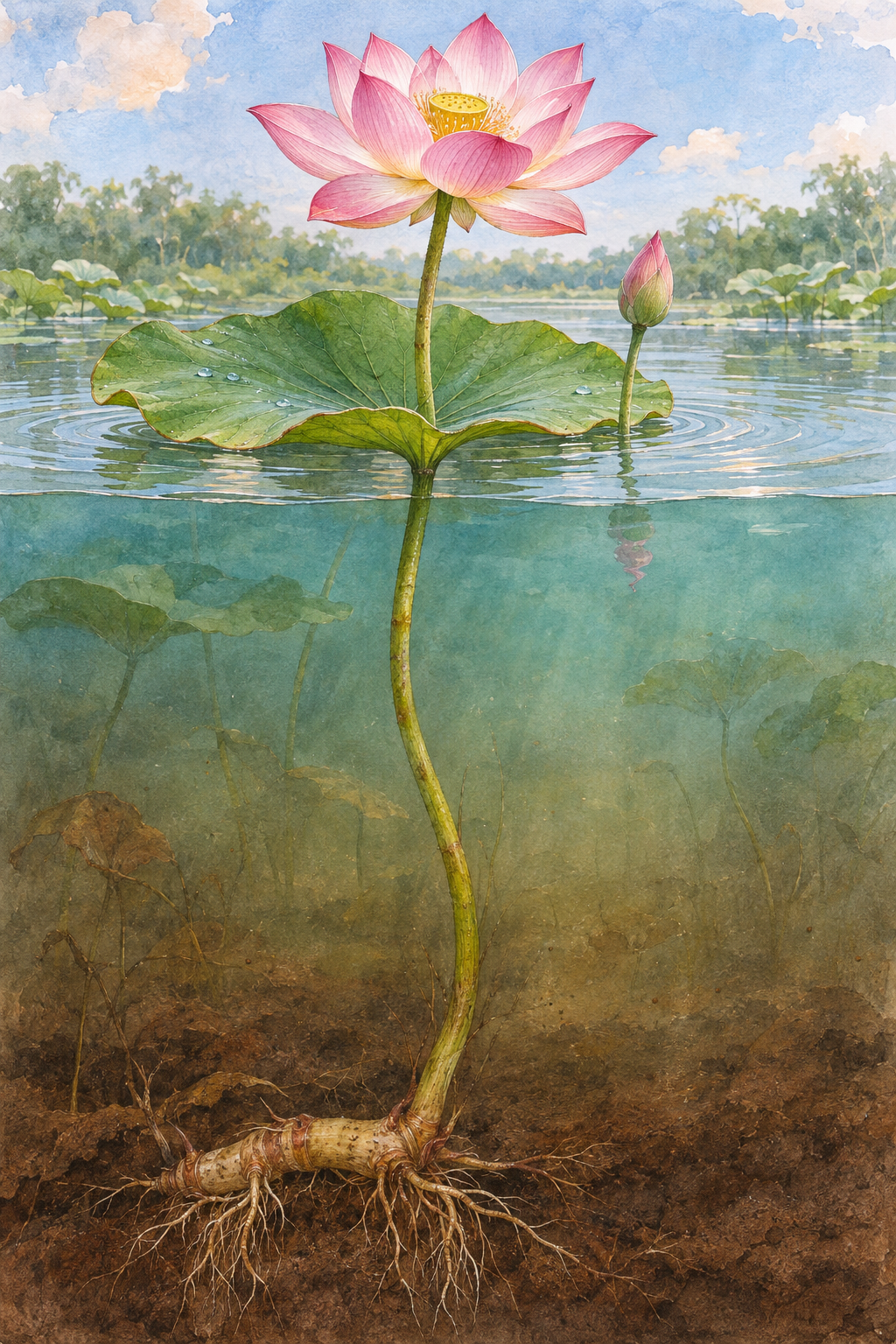
The flower has an established place in Hinduism, Buddhism, Sikhism and Jainism. Its natural form supplies an unusually clear spiritual grammar: it is rooted below the surface, passes through water and opens above it. The surrounding conditions are real, but they do not dictate the flower’s final appearance.
That gives you three connected ideas. The root suggests embodied or worldly conditions. The upward movement suggests discipline, transformation or awakening. The open flower suggests the disclosure of a quality that was possible all along. A reliable first reading is therefore not escape from existence, but freedom from being inwardly ruled by one’s circumstances.
Do not force every part of the plant into a rigid code. Mud does not automatically mean moral evil, and water does not carry one universal definition. Depending on the tradition and passage, the surrounding condition may point to attachment, ignorance, karmic bondage, worldly distraction or simply the ordinary environment in which spiritual life must be lived.
This is the lotus’s Dharmic family resemblance: growth without denial of where growth begins. The traditions agree that human beings need not remain confined by their present condition. They differ over how liberation is understood, how it is realised and what the flower represents in a particular sacred setting.
Four traditions give the shared flower four distinct accents
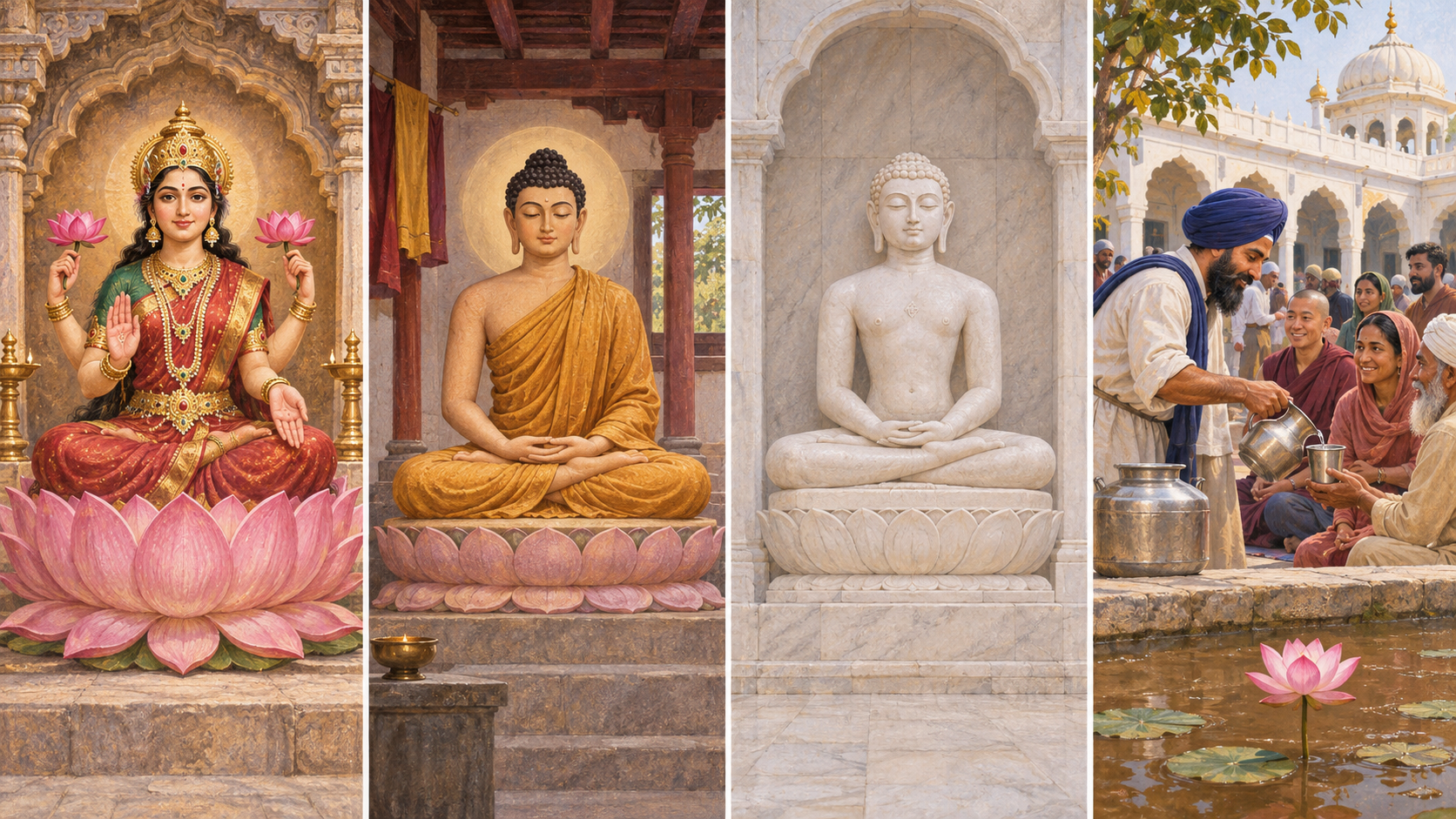
The surrounding figure or teaching matters more than the flower by itself. Start with the tradition-specific context, then use the shared symbolism as a second layer.
Hinduism: divine presence, auspiciousness and abundance
In Hindu sacred art and worship, the lotus often marks divine beauty, purity, auspiciousness and the ordered abundance of life. Padma and kamala are familiar Sanskrit names for the flower, and lotus imagery is especially closely associated with Lakshmi. Her lotus seat presents prosperity as something sacred and properly ordered, not merely the accumulation of possessions.
The flower is also used in puja to Vishnu and Lakshmi. That ritual role changes the grammar of the symbol. A lotus beneath a deity functions as a seat or sacred ground. A lotus held by a divine figure presents a quality or power through iconography. A lotus offered by a devotee turns the flower into an act of reverence. These are useful reading cues, though they are not mechanical equations that override a temple’s lineage or local practice.
If you encounter Lakshmi on a lotus, do not reduce the image to a promise of money. Look for the larger claim: abundance should arise with purity, generosity, beauty and dharmic order. That reading is more faithful to the sacred setting than treating the flower as a decorative sign of good luck.
Buddhism: awakening amid the conditions of samsara
In Buddhist contexts, the emphasis commonly shifts toward awakening and the possibility of an undefiled mind. A Buddha or bodhisattva seated on a lotus is not simply being decorated with a beautiful Indian flower. The seat helps distinguish awakened presence from the confusion and grasping that ordinarily govern experience.
The movement from submerged root to open blossom also lends itself to the development of wisdom and compassion. The point is not that an awakened person has never encountered difficult conditions. It is that those conditions no longer determine the quality of awareness in the same way.
Colours, stages of bloom and particular lotus-bearing figures may carry more specific meanings within a school or artistic tradition. Do not assign a universal code from appearance alone. First identify the figure, lineage and accompanying attributes. A lotus tells you that awakened purity is in view; the rest of the image tells you how that idea is being expressed.
Jainism: liberation from karmic attachment
Jain use of the lotus fits a spiritual path centred on conquering the passions, ending karmic bondage and realising the liberated condition of the soul. A lotus associated with a Jina can therefore suggest purity and nonattachment achieved through disciplined transformation.
The most important safeguard is theological. A Jina is a liberated teacher and victor over inner bondage, not a creator deity comparable to a Hindu deva. Similar lotus seats can create visual resemblance across Hindu, Buddhist and Jain art, but the identity and status of the seated figure are not interchangeable.
When reading a Jain image, begin with the meditative figure, posture and identifying context. Then understand the lotus as supporting a vision of perfected awareness, auspicious purity or liberation. This order prevents a shared artistic convention from erasing Jainism’s distinctive account of the soul, karma and self-conquest.
Sikhism: inward freedom while living in the world
In Sikh teaching, the lotus is especially useful as an ethical and spiritual analogy. The flower lives in water without surrendering its identity to the water around it. In the same way, a person can participate fully in family and society without being mastered by attachment, ego or distraction.
This is not a command to withdraw from responsible life. The force of the image lies in engaged nonattachment: remain present, work, serve and fulfil your duties while orienting the mind toward the Divine. In a scriptural or explanatory setting, the lotus often asks how you are living amid the world, not how far you have managed to move away from it.
Do not assume that the appearance of a lotus makes it an independent object of Sikh worship. Read the surrounding words. Ask what threatens to cling to the person, what inward discipline prevents that clinging and what kind of conduct follows from such freedom.
A quick comparison for interpreting an unfamiliar lotus
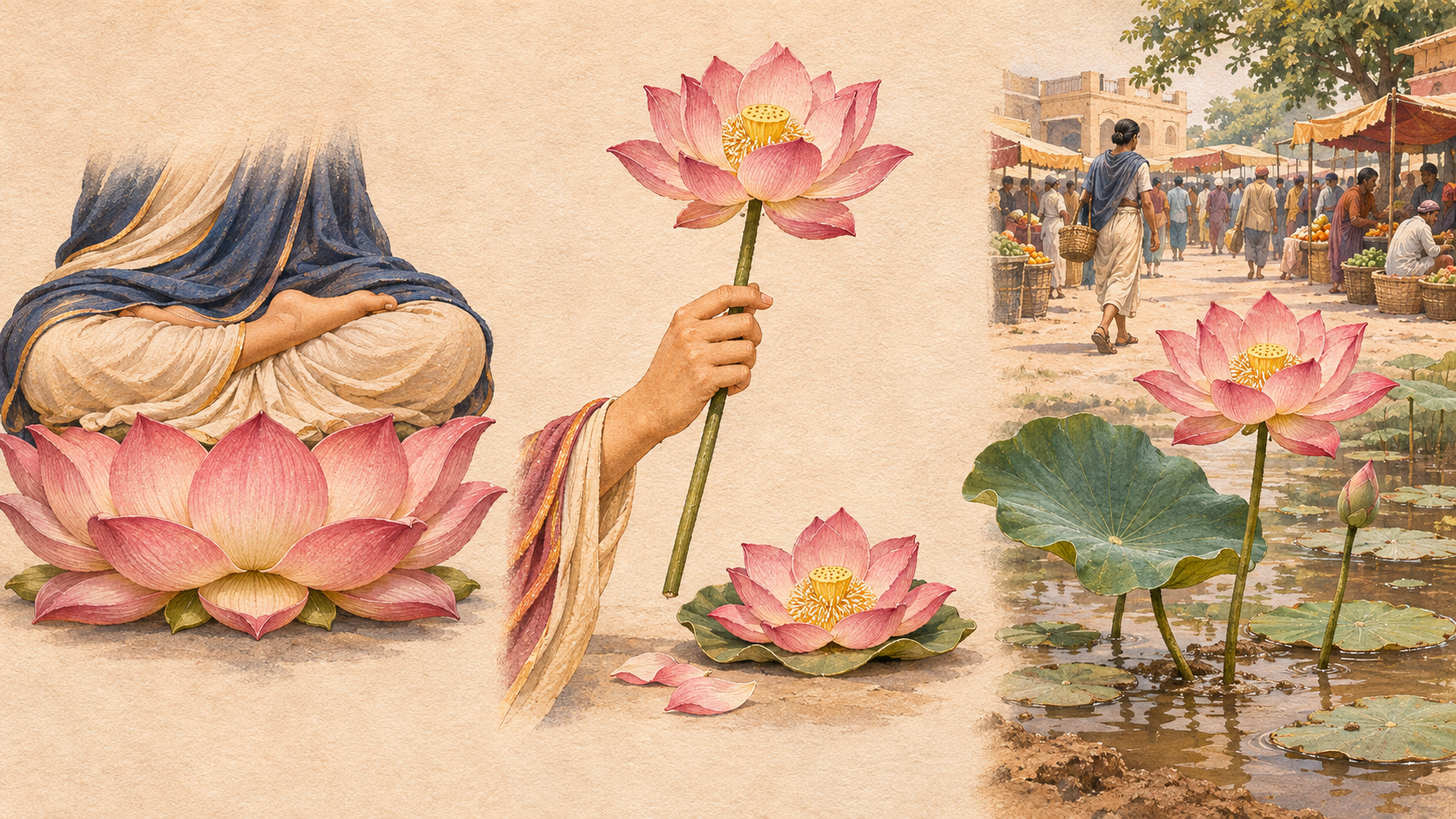
The table gives you a sound first reading, not an exhaustive definition. Lineage, text, region, artistic period and ritual setting can all add detail.
| Context | Safest first reading | What to examine next | What not to assume |
|---|---|---|---|
| Hindu | Divine purity, auspiciousness, beauty or abundance | Which deity is shown, and whether the lotus is a seat, attribute or offering | That every lotus refers only to material wealth or to the same deity |
| Buddhist | Awakening and purity amid the conditions of samsara | The identity of the Buddha or bodhisattva, the lineage and other attributes | That colour or petal count has one meaning in every Buddhist school |
| Jain | Liberation, auspicious purity and freedom from karmic attachment | The Jina, posture, emblematic context and surrounding sacred art | That a lotus-seated Jina is a creator deity |
| Sikh | Nonattachment and divine orientation while living responsibly in the world | The surrounding passage, analogy and ethical instruction | That the flower is necessarily an independent object of worship |
Notice that purity is present in every row, but it is not doing identical work. It may qualify divine presence, awakened awareness, liberation from karma or the conduct of a person who remains spiritually centred in ordinary life. Saying only that the lotus means purity is not wrong; it is simply unfinished.
How to read or use the lotus without flattening its meanings
Use the following sequence when you encounter a lotus in a temple, manuscript, painting, verse, tattoo, logo or interfaith display.
- Name the flower’s role before assigning a meaning. Is it a seat, a handheld attribute, a physical offering, a decorative border or a verbal analogy? Those are different symbolic actions.
- Identify the figure or voice. A lotus beneath Lakshmi, beneath a Buddha and beneath a Jina cannot be interpreted responsibly by ignoring who is seated there. In a Sikh passage, the speaker’s instruction and surrounding analogy supply the context that an icon would otherwise provide.
- Look for the spiritual problem being addressed. Is the setting concerned with abundance governed by dharma, ignorance, karmic bondage, attachment or responsible life amid worldly pressures? The problem helps reveal what the lotus is overcoming or transforming.
- Separate the shared layer from the specific layer. Begin with purity, emergence or freedom from limiting conditions. Then state how the particular tradition develops that idea.
- Treat colours, petal counts and geometric arrangements cautiously. They may be precise within a particular ritual, text or artistic system, but visual similarity does not prove a universal Dharmic code. Check the lineage-specific context before making a detailed claim.
- Stop at the level of certainty the evidence permits. If the figure, text or community is unknown, describe the lotus as a broadly Dharmic image rather than confidently assigning it to one doctrine.
If you are writing a caption, teaching a class or preparing an interfaith display, avoid the vague formula that the lotus means purity in all Eastern religions. A stronger explanation has two layers: the lotus is a shared Dharmic image of spiritual emergence; in this particular setting, it points to divine auspiciousness, awakening, liberation or engaged nonattachment.
If you are choosing the lotus for devotional art, an event emblem or a permanent personal design, decide which layer you intend. A general lotus can express broad Dharmic affinity. Adding a deity, Jina, Buddha, scriptural words or another sacred emblem makes a more particular claim. You should be able to name that claim before combining the elements.
For ritual use, follow the practice of the relevant temple, gurdwara, lineage, teacher or community. A symbol that travels across traditions does not make rituals interchangeable. Shared heritage is best honoured through careful recognition, not through improvised sameness.
Key takeaways
- The lotus is a shared Dharmic symbol, but it does not carry one fixed theology.
- Its broad visual grammar joins difficult conditions, spiritual transformation and the opening of a purer possibility.
- Hindu settings often stress divine presence and auspicious abundance; Buddhist settings, awakening; Jain settings, liberation from karmic bondage; and Sikh teaching, nonattachment while living responsibly in the world.
- The flower’s role matters: a lotus seat, held attribute, ritual offering and scriptural analogy should not be interpreted in the same way.
- Colours, petal counts and decorative forms require lineage-specific context; do not invent a universal code from appearance alone.
- A good explanation names both the shared Dharmic layer and the tradition-specific meaning.
The next time a lotus appears, make three passes. Identify the context, describe what the flower is doing and then name the spiritual work it performs in that tradition. That small discipline lets you see a genuine Dharmic kinship while preserving the differences that make the symbol worth understanding.
References

Leave a Reply
You must be logged in to post a comment.