
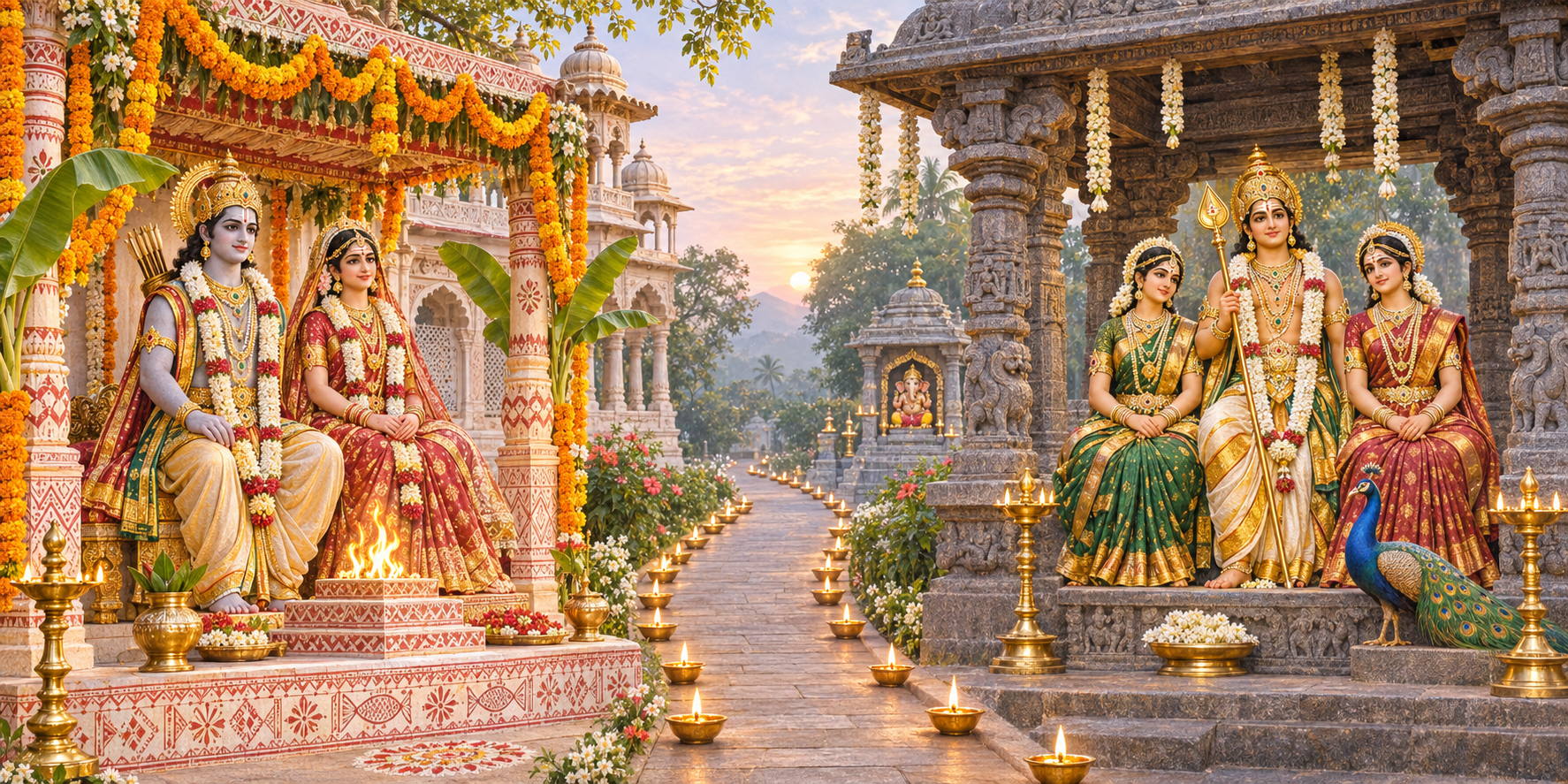
If you are deciding whether a divine-marriage festival belongs in your household calendar, the useful question is not simply, “Do we stage a wedding?” Ask instead: “Which sacred relationship, place and form of dharma are we being asked to remember?” That question keeps a beautiful observance from becoming generic pageantry.
Vivah Panchami and the marriages of Subrahmanya offer two distinct ways to approach that question. One places Sita and Rama’s marriage on the ritual calendar. The other brings Devasena, Valli, Subrahmanya and Ganapathi into a story of love, kinship and different social worlds. Understanding those differences will help you plan an observance that is accurate, reverent and useful to your family or community.
A divine marriage is a relationship teaching
A divine marriage festival does more than recall that two deities were married. It places relationships inside sacred memory. The couple matters, but so do parents, siblings, communities, landscapes and the responsibilities that connect them. When the story returns on the calendar, worshippers are invited to notice how those relationships embody dharma.
This does not mean every divine marriage carries one interchangeable message. A festival associated with Sita and Rama should not be stripped of its own names, setting and calendar context. Subrahmanya’s marriages should not be reduced to a generic tale about romance. The first discipline of observance is therefore precision: identify the particular union before deciding what it means.
Use three questions when you encounter a divine-marriage tradition:
- Whose marriage is being remembered, and which other figures have an essential role?
- Which region or community has preserved the observance most prominently?
- What conduct should the remembrance awaken in you: fidelity, mutual responsibility, family cooperation, hospitality or respect for a community different from your own?
The third question should follow the first two, not replace them. If you begin with a moral slogan and then force every narrative into it, you lose the tradition’s texture. Begin with the names and relationships. Draw the personal lesson only after you have heard the story carefully.
Two marriage traditions carry different religious textures
Vivah Panchami places Sita-Rama Vivaha on the calendar
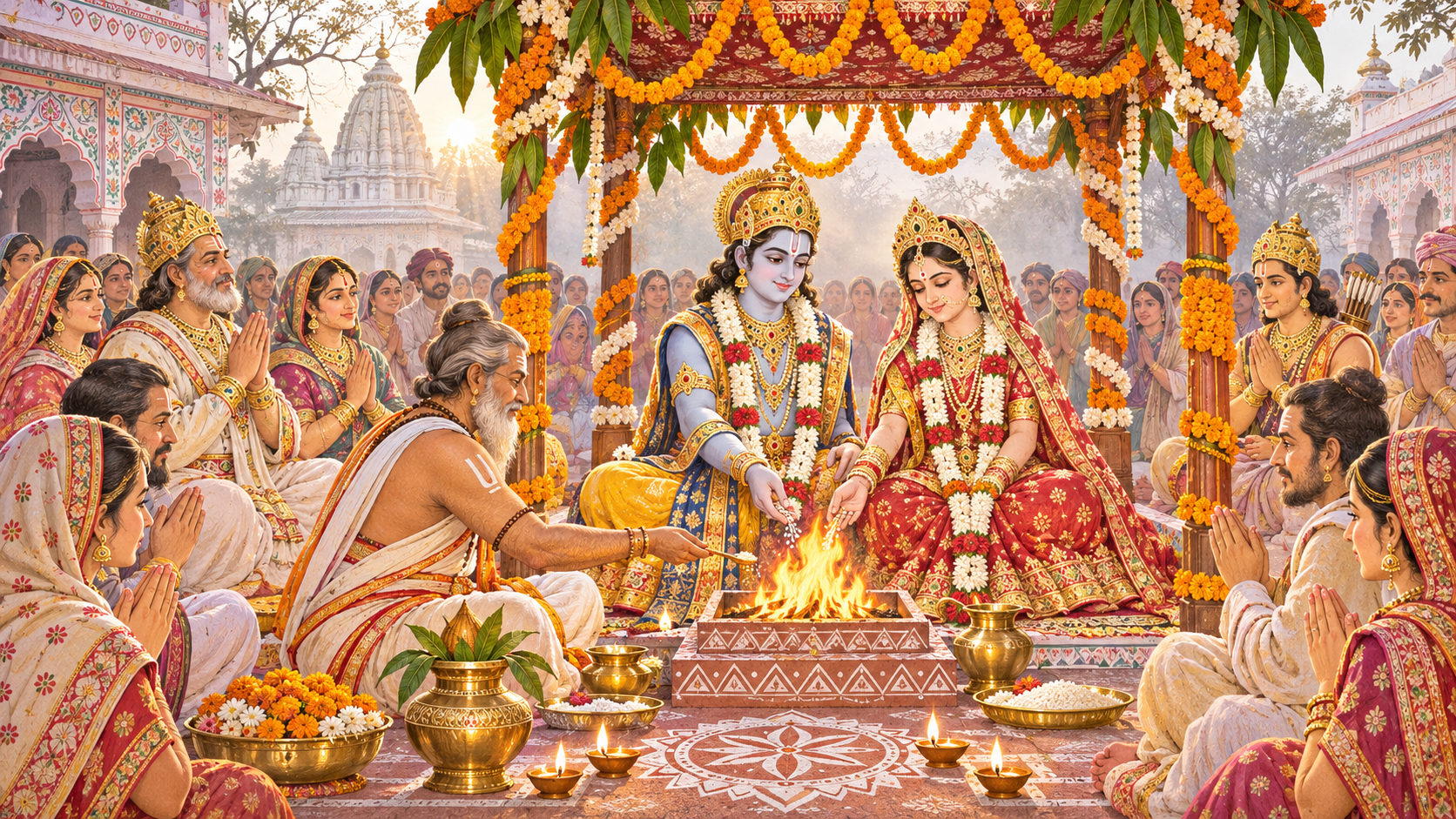
Vivah Panchami celebrates the marriage of Lord Ram and Sita. It falls on the fifth day of the bright fortnight, Shukla Paksha, in the month of Margashirsha. In 2026, the stated civil-calendar date is December 14.
If you are putting the festival into a family or community calendar, record both descriptions: “December 14, 2026” and “Margashirsha Shukla Panchami.” The civil date makes planning easier; the tithi preserves the religious logic of the observance. Before arranging travel, a temple programme or a public gathering, confirm the timing and programme with the temple or tradition you will actually follow.
The celebration is especially associated with Mithilanchal, parts of North India and Janakpur in Nepal. That regional identity should remain visible even when the festival is observed elsewhere. A diaspora gathering, for example, can explain why Mithila and Janakpur matter instead of presenting the day as a placeless “Hindu wedding festival.” Place is part of the memory.
For a simple educational observance, make the marriage of Sita and Rama the clear centre. State the festival’s name, tithi and regional connection. Then ask participants what it means to remember a sacred union as a community rather than treating marriage solely as a private event. That question moves the programme from costume and decoration toward responsibility.
Subrahmanya’s marriages reveal a wider divine household
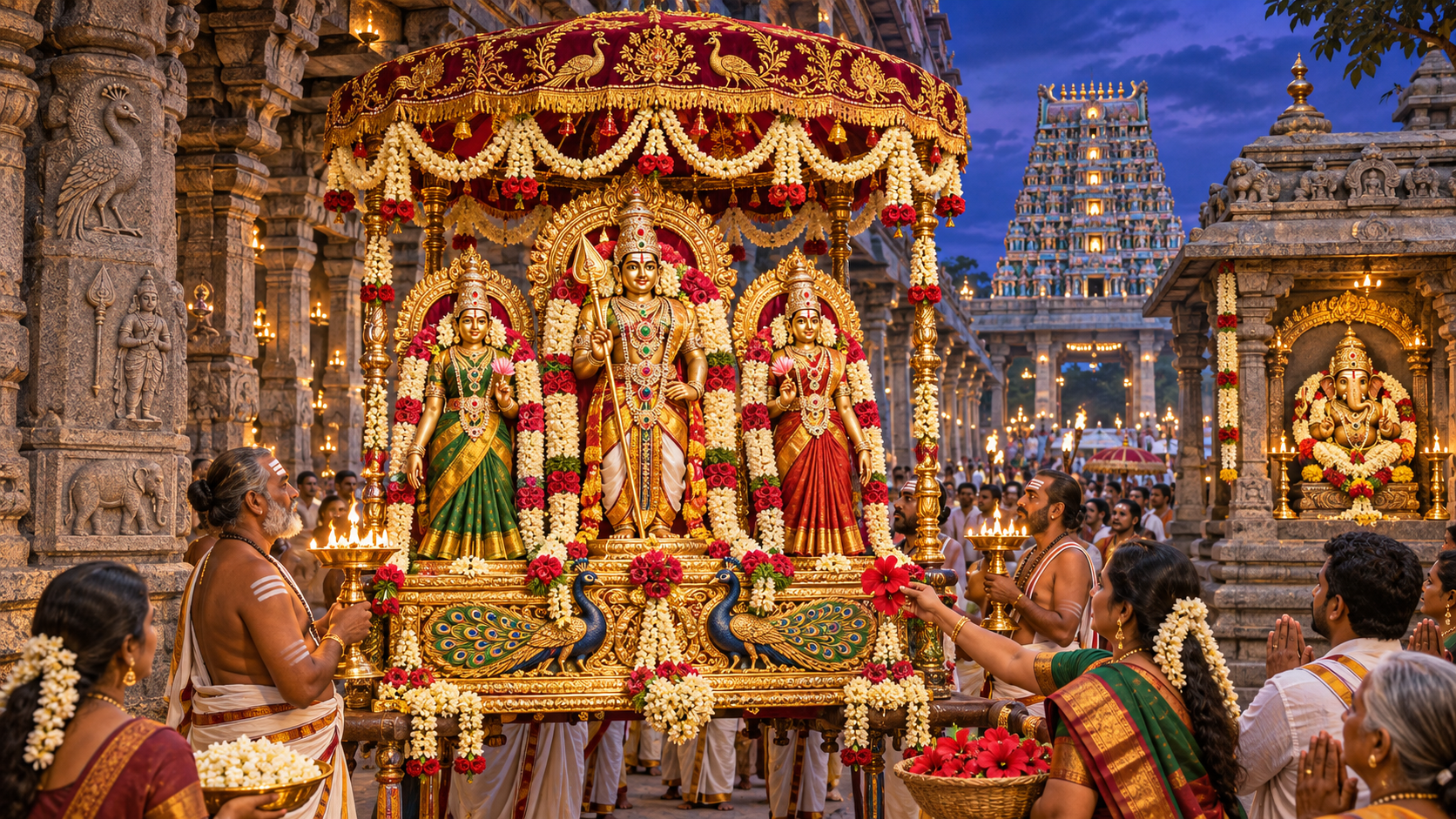
Subrahmanya first married Devasena, the daughter of Indra. Later, during his travels in the south, he fell in love with Valli, who is identified as a tribal princess, and Valli loved him. Ganapathi helped his brother marry Valli.
Those relationships give you the essential structure of the telling. Devasena is not a nameless first wife, Valli is not merely a second bride, and Ganapathi is not an unrelated figure added for amusement. Devasena’s identity as Indra’s daughter and Valli’s identity as a tribal princess create a deliberate contrast in narrative setting. Ganapathi’s assistance makes sibling cooperation part of the marriage story.
When teaching this tradition, draw a small relationship map before adding interpretation: Subrahmanya at the centre; Devasena and Valli named separately; Indra connected as Devasena’s father; Ganapathi connected as Subrahmanya’s brother and helper. This takes only a minute, but it prevents the women and the family relationships from disappearing behind the name of the male deity.
Preserve Valli’s tribal identity when retelling the story. Do not silently replace it with the vague label “princess,” because the more specific identity is part of what distinguishes her narrative setting. At the same time, do not turn one detail into an unsupported claim about social history. The careful formulation is simple: the tradition identifies Valli as a tribal princess and places her meeting with Subrahmanya during his travels in the south.
Build an observance around accuracy, worship and conduct
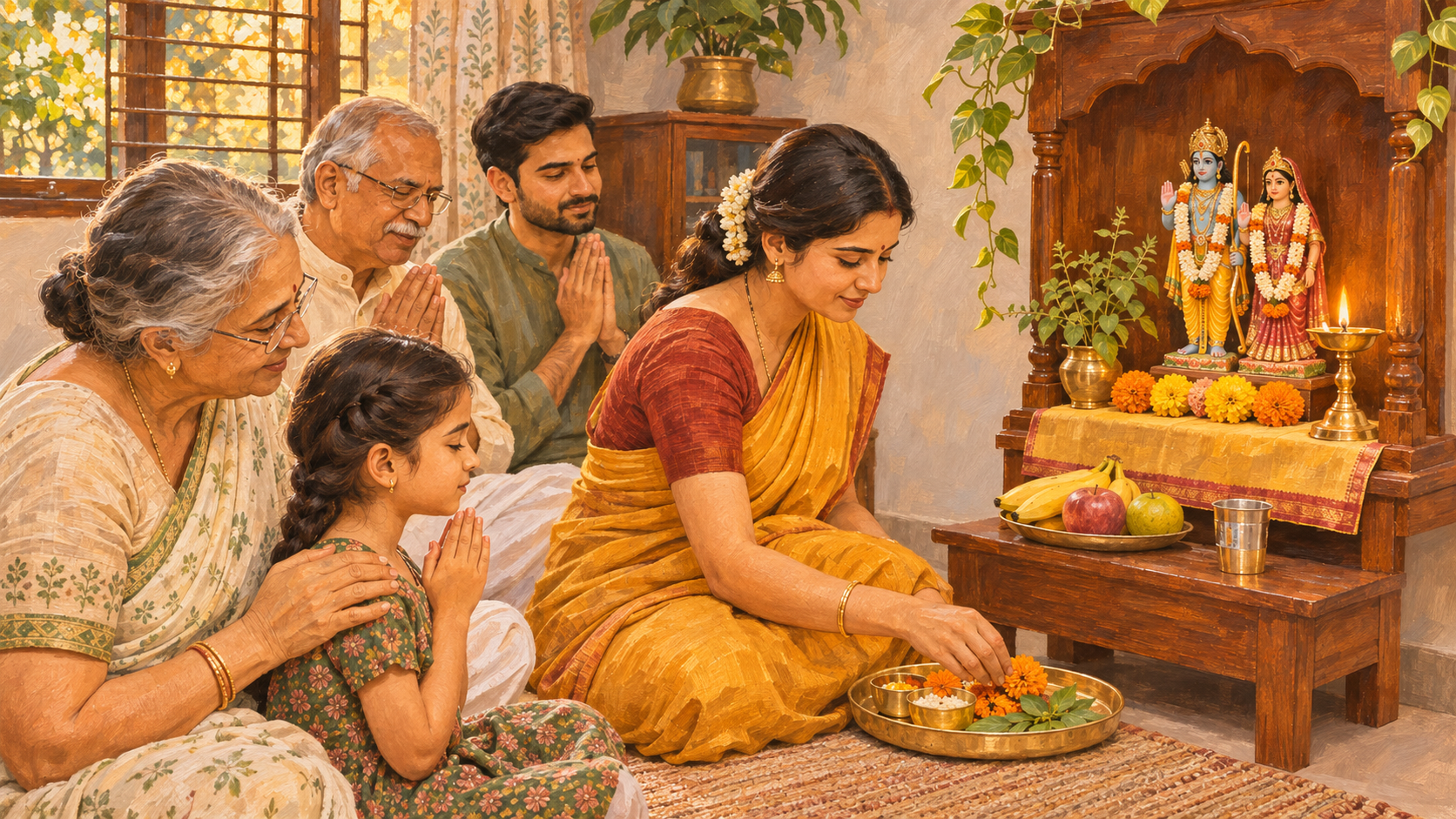
You do not need a lavish wedding recreation to observe a divine marriage meaningfully. You need a clearly identified tradition, a faithful retelling and a form of worship appropriate to your household or temple. Use the following sequence.
- Name the exact observance. Write “Vivah Panchami” or “the marriage tradition of Valli, Devasena and Subrahmanya,” not merely “divine wedding.” Precision tells participants what they are about to honour.
- Record the calendar correctly. For Vivah Panchami in 2026, note December 14 together with Margashirsha Shukla Panchami. Confirm local worship times before announcing a programme.
- Use the practice your community recognises. If your family has an established puja paddhati, follow it. If it does not, seek guidance from the temple hosting the observance. Do not advertise a newly assembled sequence as a universal requirement.
- Prepare a short, factual narration. For Vivah Panchami, identify Sita and Rama, the tithi and the festival’s regional association. For Subrahmanya’s marriage tradition, name Devasena, Valli, Indra and Ganapathi, and explain how each is related.
- Keep optional home worship modest. A clean worship space, a lamp, flowers, remembrance of the divine names, a short narration and prayer can support the day when they accord with your household practice. The point is attentive devotion, not imitation of a full temple ceremony without the knowledge to conduct one.
- Add one act of relational dharma. A married couple might discuss one neglected responsibility. A family might assist relatives preparing for marriage, reconcile a strained relationship or offer practical help to a household under pressure. Choose a concrete act that can be completed, not a vague promise to “value family.”
- Give children a role-based question. Ask who helped, who travelled, which communities are named and why every person should be remembered. In the Valli narrative, asking what Ganapathi did immediately reveals that divine kinship involves action.
If you are organising a public event, put the explanatory narration before any dramatic presentation. Once an audience has seen a colourful enactment, visual details tend to become the remembered version of the tradition. A brief factual introduction lets people distinguish the narrative core from the artistic choices made for the stage.
Avoid the shortcuts that flatten the tradition
The first shortcut is calling a divine-marriage festival a Hindu equivalent of a modern romance day. That comparison makes the subject quickly recognisable, but it removes the religious relationships that give the observance its depth. Divine marriages involve worship, sacred time, kinship and community memory. Romance may be present, but it is not an adequate container for all of them.
The second shortcut is assuming that one script fits every divine wedding. Vivah Panchami has a stated tithi and a strong connection with Mithilanchal and Janakpur. The Valli-Devasena tradition belongs to Subrahmanya’s marriage narratives and includes Ganapathi’s intervention. Combining them into a generic ceremony may look inclusive while actually making both less intelligible.
The third shortcut is turning contrast into rivalry. Nothing in the essential outline requires you to portray Valli and Devasena as competitors. If a play, talk or children’s lesson introduces jealousy merely to create drama, the invention can overtake the sacred relationships you intended to teach. Keep interpretation separate from the facts you can responsibly narrate.
The fourth shortcut is embellishing an unfamiliar episode with details you cannot verify. If you know only that Ganapathi helped Subrahmanya marry Valli, say exactly that. You can then consult the version recognised by your temple or family before describing how the assistance unfolded. Saying “this telling presents it this way” is more responsible than blending several remembered versions and calling the result definitive.
Finally, do not let decoration displace the people in the story. A stage can be covered in wedding symbols while Valli’s tribal identity, Devasena’s parentage and Ganapathi’s sibling role go unmentioned. Test your programme by asking a simple question: after the event, could a listener name the central relationships without looking at the backdrop?
Key takeaways for your observance
- Begin with the particular divine couple and narrative, not with a generic idea of sacred romance.
- For Vivah Panchami in 2026, record December 14 and Margashirsha Shukla Panchami, then confirm the local programme before making plans.
- Retain Vivah Panchami’s connection with Mithilanchal and Janakpur when explaining the festival outside that region.
- In Subrahmanya’s marriage tradition, name Devasena as Indra’s daughter, Valli as a tribal princess and Ganapathi as the brother who helped.
- Pair worship with one specific act of relational dharma that your household or community can complete.
- Separate the narrative core from regional variations, dramatic additions and your own interpretation.
Start your preparation with one sheet of paper. Write the festival or marriage tradition at the top, list the people and relationships beneath it, add the date and regional setting where relevant, and finish with one act of dharma your household will undertake. That small discipline will give your observance more substance than elaborate arrangements built on an indistinct story.
References

Leave a Reply
You must be logged in to post a comment.