
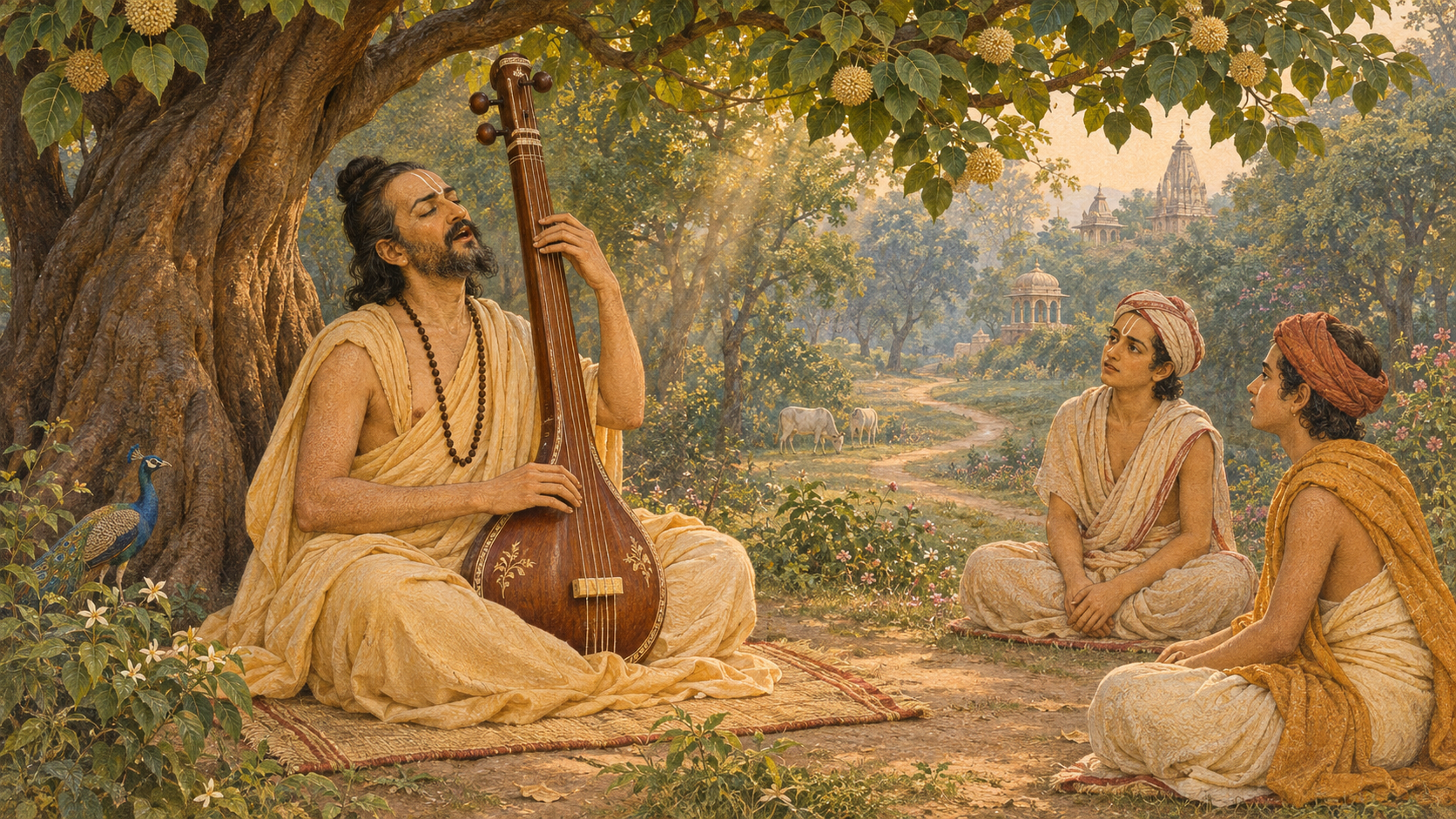
If you know Swami Haridas chiefly as Tansen’s guru, you have found a useful entry point and a misleading stopping point. His importance does not rest only on the fame of his disciple.
To understand what Swami Haridas represents, you have to keep three identities together: saint, musician, and guru. That integrated view also gives you a better way to hear the relationship between bhakti and Hindustani music.
Keep the saint, musician, and guru together
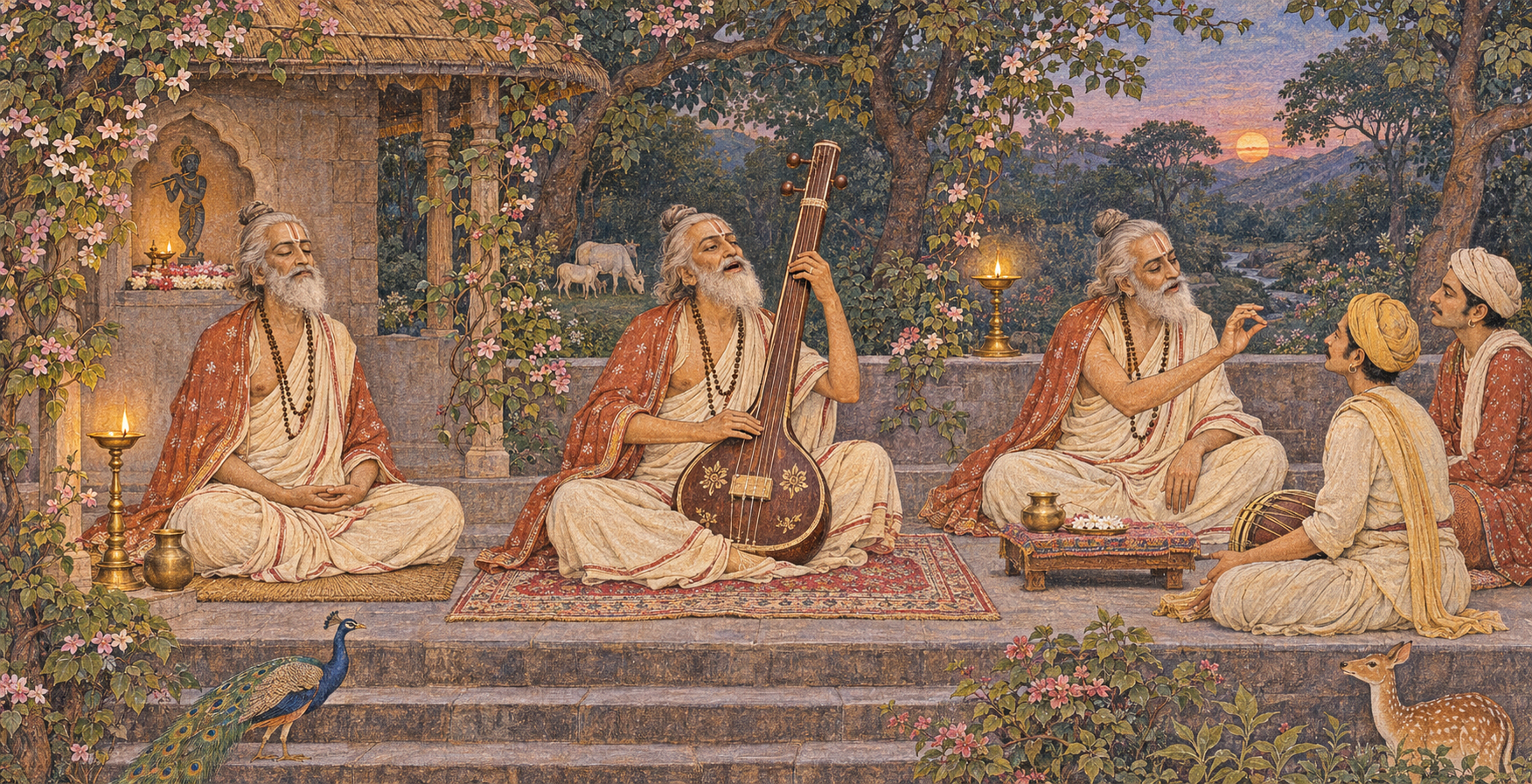
Swami Haridas belonged to the sixteenth-century world of northern India and is remembered as an important figure in both the Bhakti movement and the development of Hindustani classical music. Music, spiritual discipline, and teaching were not separate compartments in that life.
Modern categories can make this difficult to see. If you treat him only as a religious figure, his musical discipline becomes ornamental. If you treat him only as a musician, bhakti becomes biographical decoration. If you remember him only as Tansen’s teacher, he becomes a supporting character in somebody else’s story.
A more useful reading holds three questions together:
- What spiritual end did the music serve?
- What musical discipline gave that devotion a form?
- What was transmitted through the relationship between guru and disciple?
These questions prevent a common mistake: assuming that sacred purpose and artistic sophistication belong on opposite sides of a divide. In the Dharmic setting represented by Swami Haridas, disciplined music could itself be a mode of spiritual attention.
Bhakti gives musical mastery a direction
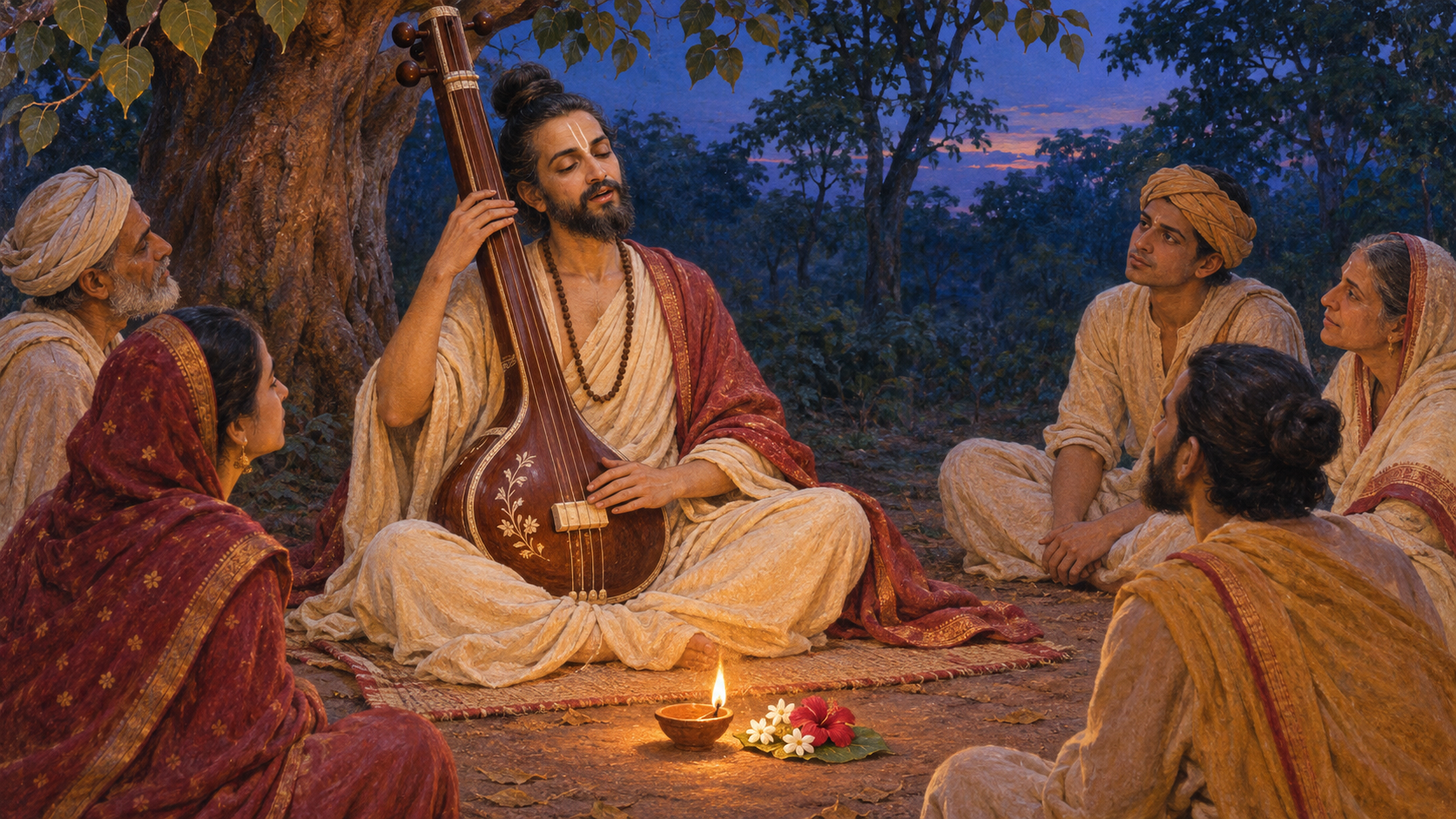
Bhakti is not simply strong emotion, and devotional music is not defined by emotional intensity alone. Bhakti places the practitioner in a relationship with the divine. The important question is therefore not merely whether the sound is impressive, but where the act of singing, listening, or teaching directs the mind.
This does not make technique unimportant. Hindustani music gives melodic thought the discipline of raga, while measured passages unfold through tala. Pitch, timing, memory, breath, phrasing, and attentive listening all require cultivation. Bhakti does not replace that grammar. It gives the grammar a purpose beyond display.
That distinction changes how you evaluate devotional musicianship. Virtuosity asks whether a musician can do something difficult. Bhakti also asks what that difficulty has been placed in service of. Restraint may matter as much as elaboration. Repetition may function as recollection rather than redundancy. Technical control may make the performer less intrusive, allowing the devotional object to remain central.
When you encounter music described as devotional, ask three practical questions. Is the divine the subject, the addressee, or merely the setting? Does the musical form concentrate attention, or does it continually redirect attention to the performer? Does discipline deepen the devotional act, or has devotion become a label attached to a conventional performance?
Those questions will not authenticate a composition or settle a historical claim. They will, however, help you distinguish bhakti as a spiritual orientation from devotional imagery used as presentation.
Tansen’s fame is a doorway, not the measure of Haridas
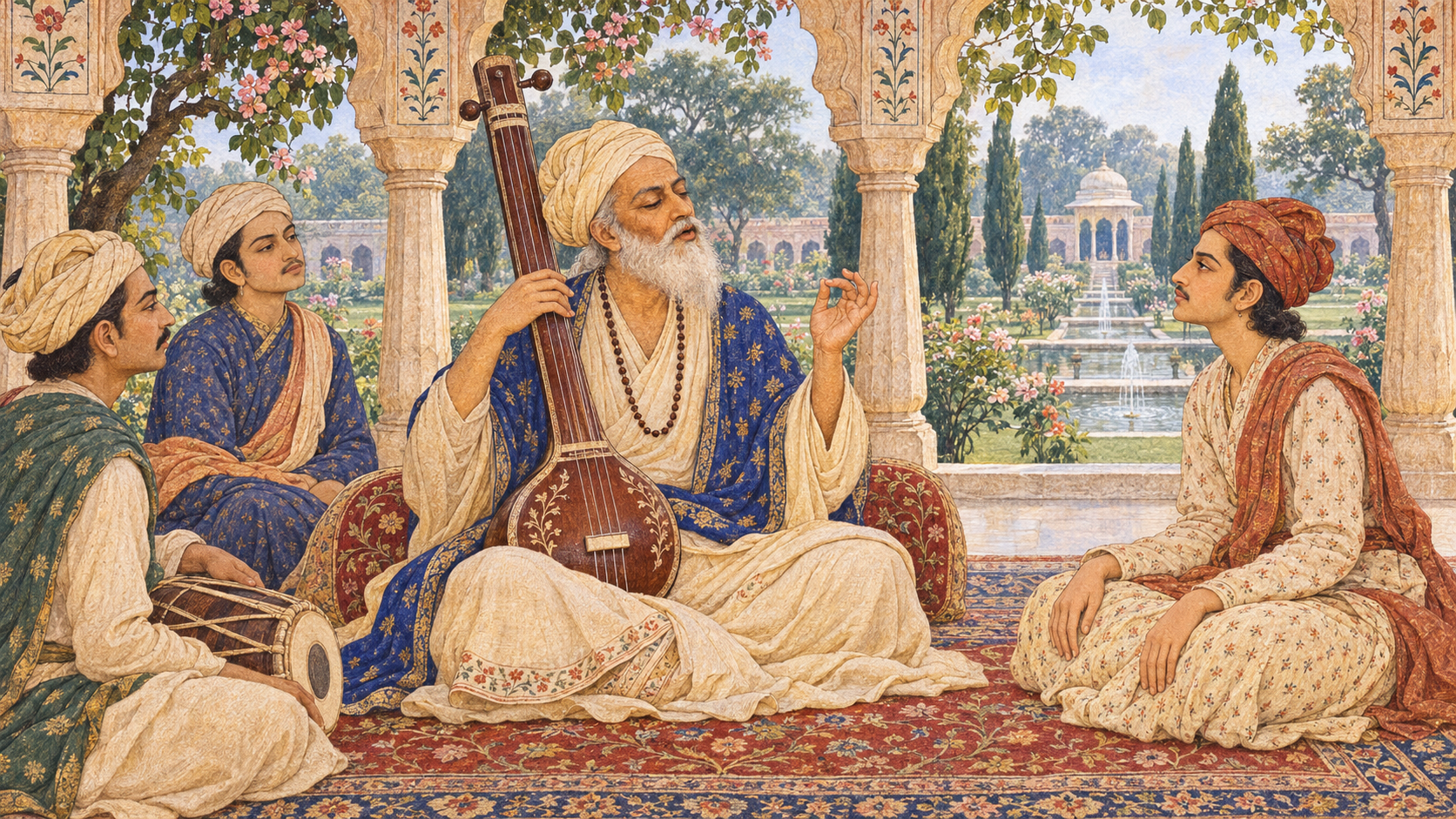
Swami Haridas is remembered as the guru of Tansen, who later became one of the Navaratnas, or Nine Gems, at Emperor Akbar’s court. That connection explains why many readers first meet Haridas through the history of imperial music. It should not determine the limit of what they see.
A guru-shishya relationship is more than a modern credential. Musical knowledge is not transmitted only as information. It also passes through demonstration, correction, repetition, memory, aesthetic judgement, and habits of listening. A disciple learns how to approach the art, not merely what material to reproduce.
We should nevertheless avoid inventing a detailed lesson plan that the available facts do not provide. Knowing that Haridas taught Tansen does not tell us which phrases were taught on which day, which later developments belonged to the disciple, or how every aspect of Tansen’s court career related to his guru.
Two opposite errors follow from ignoring that limit. The first reduces Haridas to a footnote before Tansen’s fame. The second projects Tansen’s imperial setting backward and treats Haridas as though the teacher and pupil occupied the same cultural role. A better approach is to examine how devotional pedagogy could form a musician who later entered courtly renown, while keeping the saint’s vocation distinct from the disciple’s career.
This matters beyond one biography. It shows why the history of Bharatiya music cannot be written only as a succession of courts and celebrated performers. Spiritual communities and guru-shishya transmission were also places where musical discipline acquired meaning and continuity.
A four-step way to listen and read more carefully
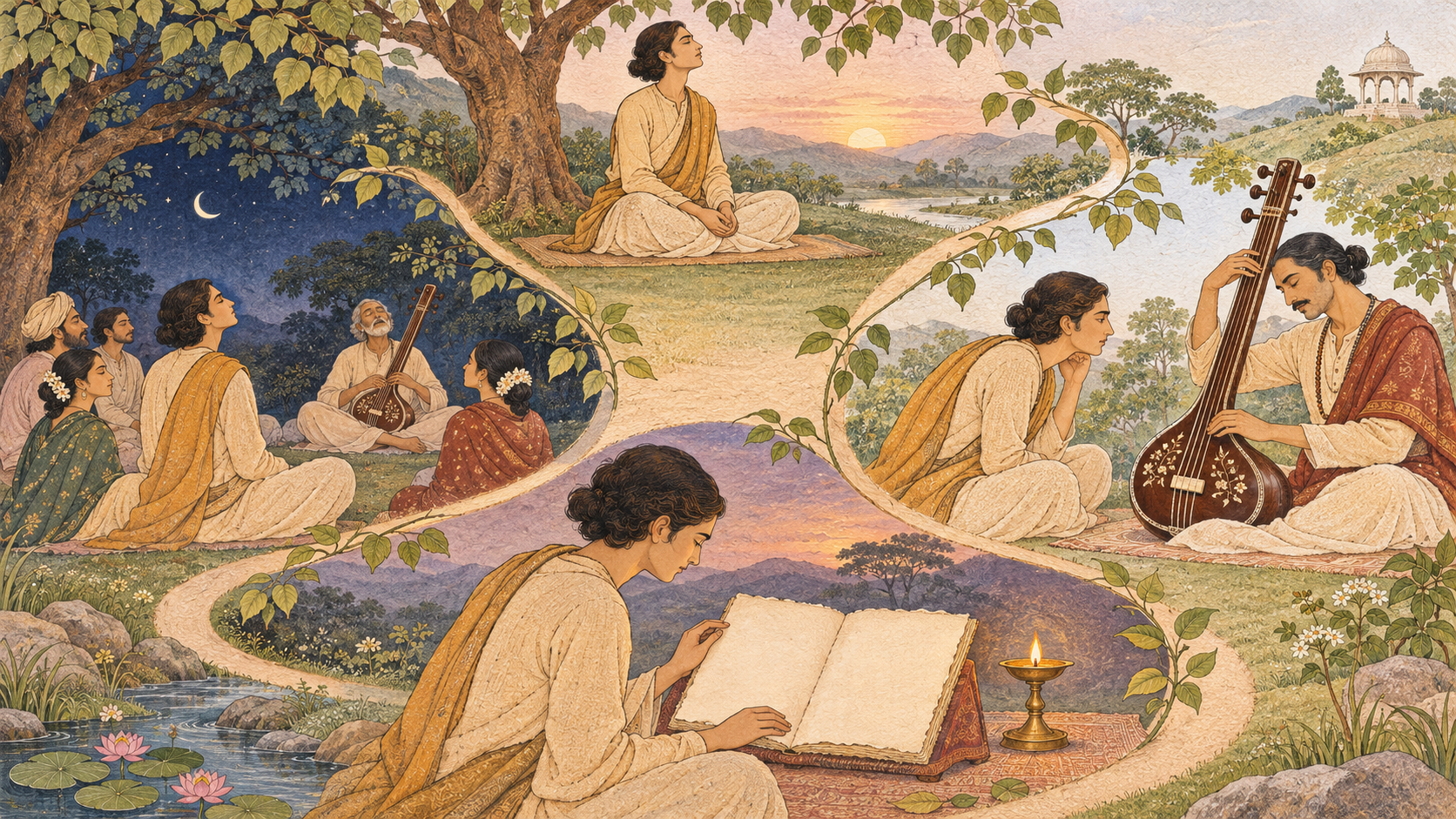
You can use the following method whenever a concert, recording, lecture, or biography invokes Swami Haridas. It separates what is historically claimed from what you can meaningfully notice in the music.
- Establish the factual floor. Begin with the limited claims you can support: Haridas was a sixteenth-century saint, musician, spiritual teacher, participant in the northern Bhakti world, contributor to Hindustani musical culture, and guru of Tansen. Treat additional details as claims requiring their own evidence rather than letting familiarity make them seem certain.
- Identify the kind of connection being asserted. A composition attributed to a person, a style associated with a lineage, a devotional tradition preserving a memory, and a later performance offered in tribute are not equivalent. Ask which one is actually meant.
- Listen on two levels. Notice the musical grammar: melodic development, rhythmic placement where tala is present, phrasing, control, and the treatment of repetition. Then notice the orientation: whether the performance directs attention toward devotion, artistic personality, entertainment, instruction, or some combination of these.
- Trace transmission without turning it into celebrity genealogy. When Tansen’s name appears, ask what the guru-disciple relationship helps explain. Do not assume that the pupil’s later status automatically defines the teacher’s purpose, setting, or achievement.
A careful programme note or biography should distinguish established biographical facts, lineage memory, devotional interpretation, and claims about particular compositions. When those layers are collapsed, reverence can be mistaken for proof or historical caution for disrespect. Keeping them distinct protects both serious scholarship and meaningful devotion.
Key takeaways
- Swami Haridas is best understood by keeping his spiritual, musical, and pedagogical identities together.
- Bhakti does not remove the need for musical technique; it directs technique toward devotional attention.
- His relationship with Tansen matters, but Tansen’s courtly fame should not become the measure of his guru.
- A guru transmits habits of listening and artistic judgement as well as musical material.
- When assessing a claim about Haridas, distinguish biography, lineage, attribution, interpretation, and tribute.
The next time Swami Haridas appears in a concert introduction or a history of Tansen, pause before moving on to the famous disciple. Ask what changes when music is treated not only as an art to master, but as a disciplined form of bhakti. That is where Haridas becomes more than a name in a lineage and starts to clarify a distinctly Dharmic understanding of musical practice.
References

Leave a Reply
You must be logged in to post a comment.