
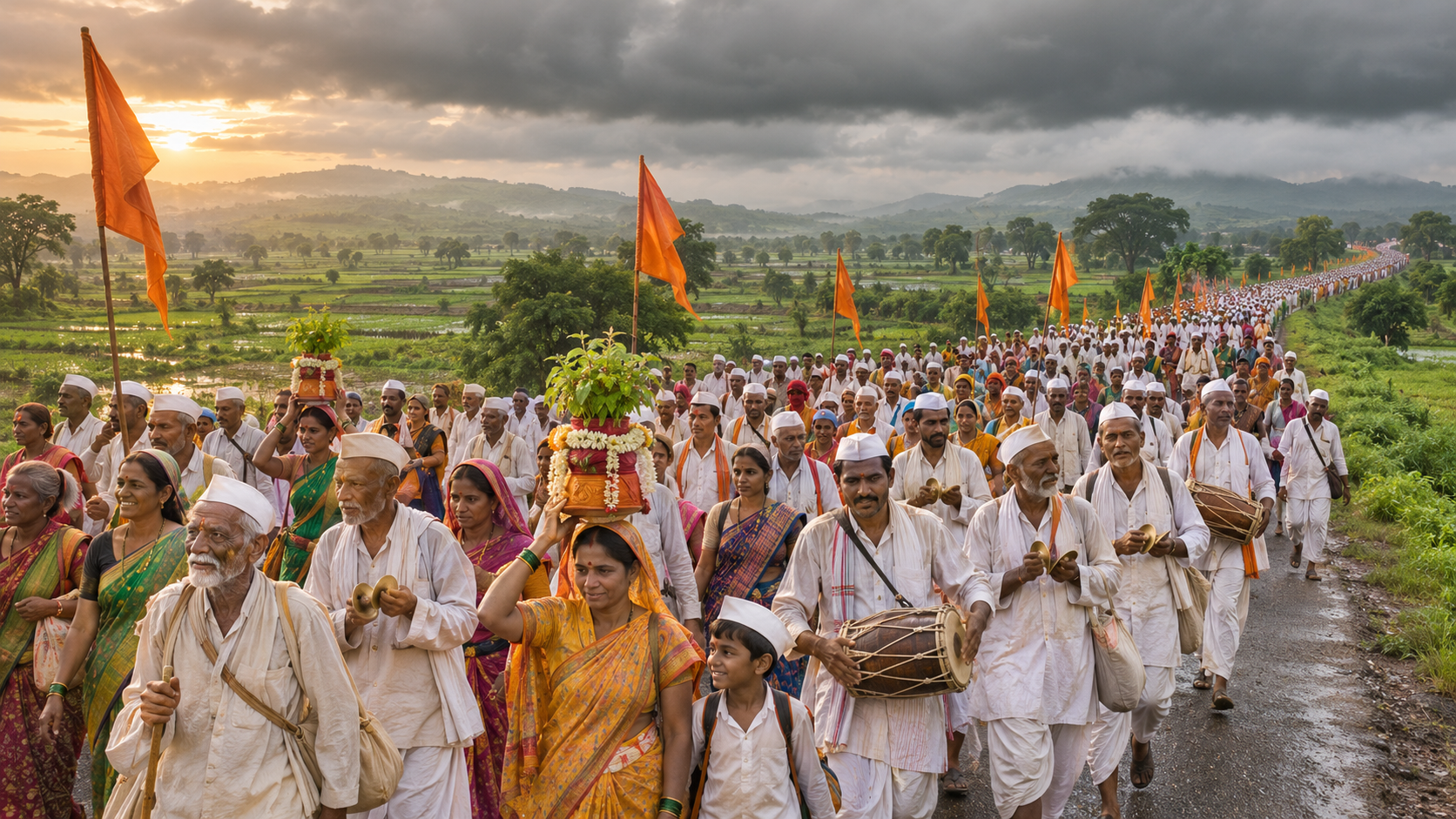
If you are wondering whether the Wari is a pilgrimage, a public festival or simply a very long walk, look at what happens between Alandi and Pandharpur. The destination matters, but the deeper practice is the gradual surrender of private pace, personal comfort and social status to a shared discipline of bhakti.
Each year, lakhs of people undertake an approximately 250-kilometre journey over several weeks, culminating on Ashadhi Ekadashi. They walk with devotion to Sant Dnyaneshwar and Sant Tukaram, chanting the name of Vitthala. If you want to understand the Wari—or participate without reducing it to spectacle—the useful question is not merely how far people walk. It is what walking together asks them to relinquish.
Key takeaways
- The Wari turns bhakti into a sustained bodily practice: walking, chanting, waiting, serving and adjusting to others.
- Dindis give the multitude a devotional structure. They transform a crowd of individuals into groups moving with a common rhythm and purpose.
- Physical difficulty can expose impatience and ego, but pain is not proof of spiritual attainment. Choose a level of participation suited to your capacity.
- The temporary softening of barriers such as wealth, education and caste is meaningful, but it should inspire conduct after the pilgrimage rather than support a romantic claim that inequality has disappeared.
- You can carry the Wari home through regular nama-japa, selfless giving, ethical repair and one concrete change in how you treat other people.
The destination is Pandharpur, but the practice begins at Alandi
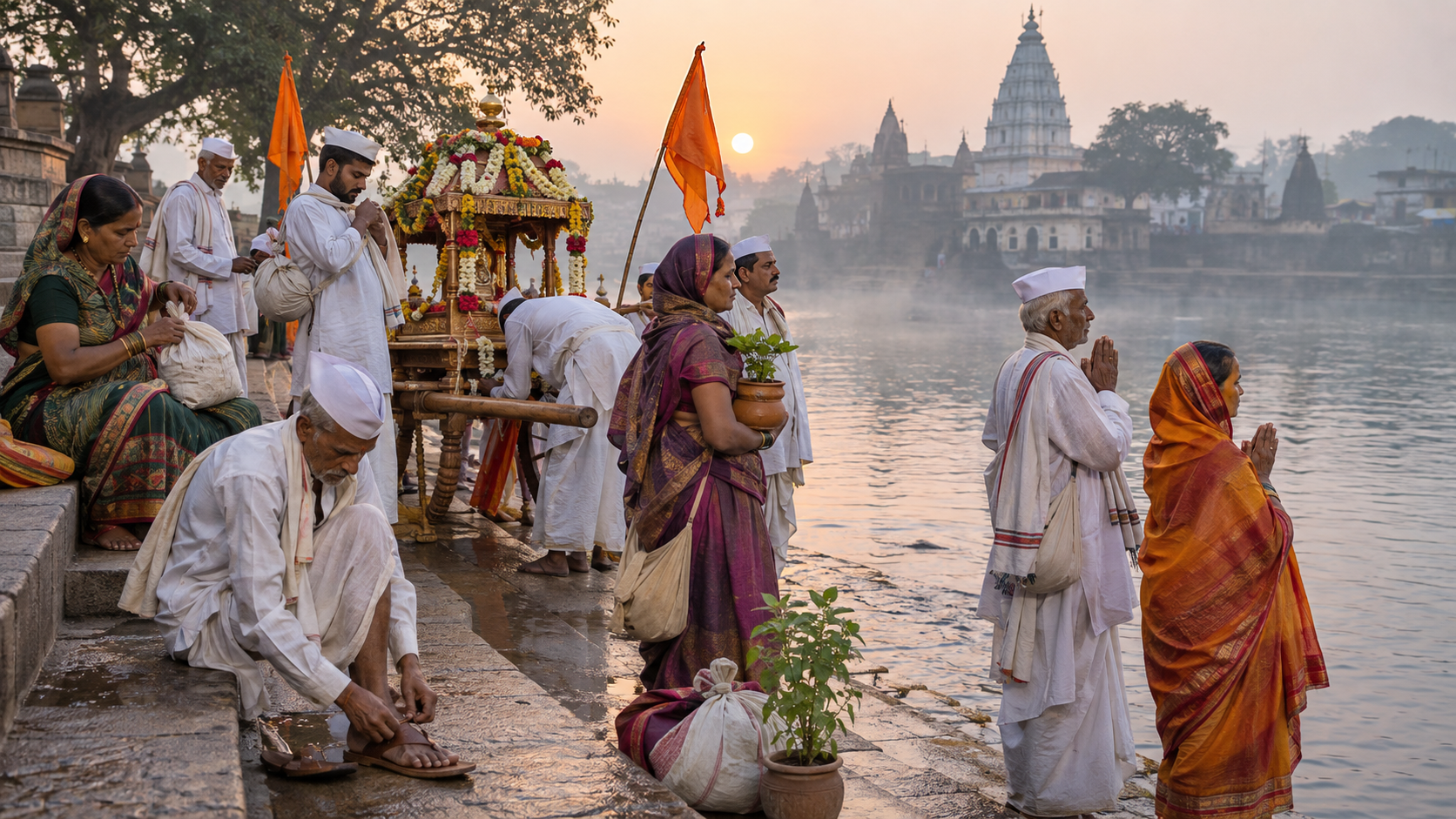
A pilgrimage can be treated as transport: begin at one place, endure the route and reach a sacred destination. The Wari resists that reading. Its duration makes the road itself part of the sadhana. Repetition matters. The same feet keep moving, the same divine name returns, and the individual repeatedly has to accommodate weather, fatigue, crowds and the pace of companions.
This is one reason collective devotion differs from private religious feeling. Feeling may rise and fall without demanding a change in conduct. A shared pilgrimage gives devotion a form that has to be inhabited. You cannot walk as though nobody else exists. You must notice the people ahead of you, avoid obstructing those behind you and accept that your preferred pace is not the only pace.
The chant “Jai Hari Vitthala” is therefore more than an expression of enthusiasm. Repeated across the route, the divine name gives attention somewhere to return when the mind becomes distracted by discomfort, irritation or self-importance. It also prevents devotion from becoming wholly private: your voice joins a sound that no single pilgrim owns.
Chapter 14 of the Bhagavad Gita describes the aspiration to become gunatita—to pass beyond the binding influence of sattva, rajas and tamas. Bhakti is one path toward that higher condition. The Wari should not be presented as an automatic guarantee of transcendence, as though completing a distance produces moksha. Its value lies in the conditions it creates for practice: sustained remembrance, humility, restraint and refuge in the divine.
A contemplative reading of the names Nivritti, Jnaneshwar, Sopana and Muktabai offers a memorable spiritual sequence: renunciation, knowledge, ascent and liberation. It is a beautiful framework for reflection, but not historical proof that the names were arranged to encode those stages. Use the sequence as a question for your own practice: What must you relinquish? What must you understand? What step must you climb? What would freedom from the present attachment actually require?
That sequence also guards against a common misunderstanding of devotion. Bhakti is not a shortcut around responsibility. Regret, or paschatapa, becomes spiritually serious when it leads to an act of repair, or prayaschitta. Dharmic traditions give that repair many forms, including fasting, japa, tapas, dana and ritual disciplines such as yajna and homa. The governing principle is simple: sorrow about a wrong must eventually change what you do.
If you enter the Wari carrying guilt or a desire for renewal, do not turn the pilgrimage into a private transaction in which discomfort purchases the cancellation of past conduct. Ask what restitution, apology, restraint or selfless act should accompany your prayer. Refuge in Vitthala should make ethical action more possible, not less necessary.
A dindi turns a multitude into a devotional body
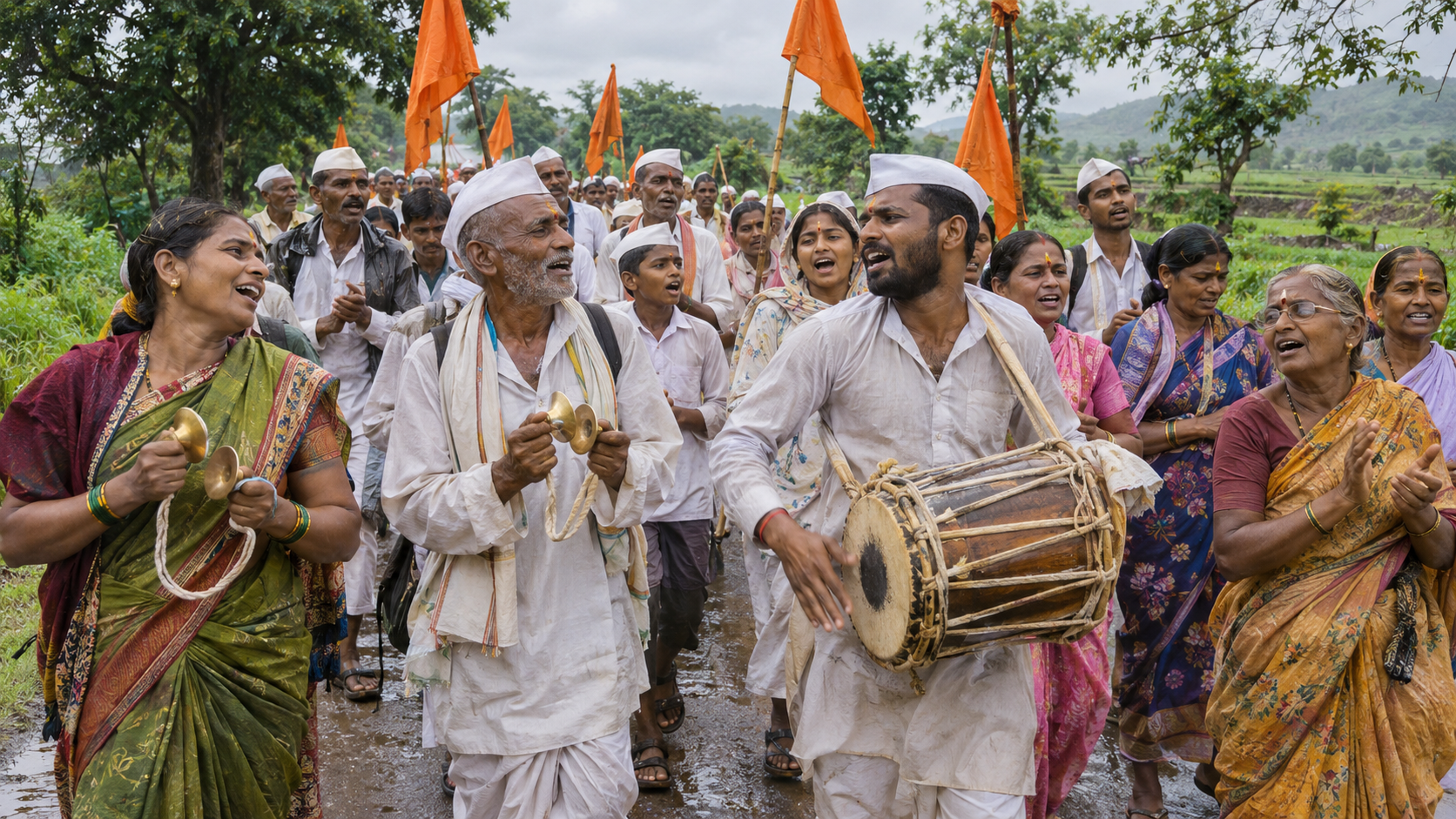
Seen from a distance, any large procession can look like an undifferentiated mass. That view misses the Wari’s working unit. Pilgrims move in organized groups called dindis, chanting praise of Sant Dnyaneshwar and Lord Vitthala. The order of the dindi matters because collective devotion needs a container. Without one, numbers alone produce congestion. With shared discipline, the same numbers can sustain rhythm, memory and mutual attention.
Four features help explain how that transformation occurs:
- A common destination redirects attention. Pilgrims do not have to invent an individual purpose at every step. Pandharpur supplies the direction, while Vitthala supplies the centre of devotion.
- Repetition carries people through fluctuating emotion. A chant does not depend on every participant feeling equally inspired at every moment. The group continues when one person’s energy falls.
- Organization converts proximity into participation. Walking near other people is not yet community. Keeping pace, chanting together and respecting group order require adjustment to them.
- Visible diversity widens the image of the devotee. Children, elders, people walking barefoot, people using sticks and women carrying Tulsi plants all appear along the way. No single age or social presentation can claim ownership of bhakti.
This also explains why the Wari should not be understood through crowd size alone. A packed commuter route and a pilgrimage may contain comparable human density, yet operate through different intentions. In ordinary transit, each person is trying to reach a private destination. In the Wari, the destination is shared, the sacred name is shared and at least part of the inconvenience is accepted as part of a common undertaking.
The effect is not the permanent abolition of social hierarchy. For the duration of the pilgrimage, distinctions of wealth, education and caste can recede as people walk toward the same deity. “Recede” is the honest word. A sacred gathering does not prove that injustice outside it has vanished. Its stronger claim is normative: it lets participants experience a community in which status is not supposed to determine access to devotion.
When you return home, that temporary experience presents an uncomfortable test. Do you continue to recognize dignity in people whose education, occupation or wealth differs from yours? Do you carry the Wari’s humility into the household and workplace, where nobody is chanting around you? Collective bhakti becomes socially meaningful only when the equality enacted before Vitthala alters ordinary behaviour.
The Wari’s survival across centuries also reveals how tradition is carried. Oral transmission is not merely the preservation of sentences. It is embodied repetition: names sung, routes walked, groups organized and practices learned by entering them. If you want a younger person to understand the tradition, explanation has a place, but participation makes the memory durable. Teach the chant, explain whom it addresses and let the learner experience some form of disciplined service rather than handing over information alone.
Hardship can expose ego, but pain is not a merit badge
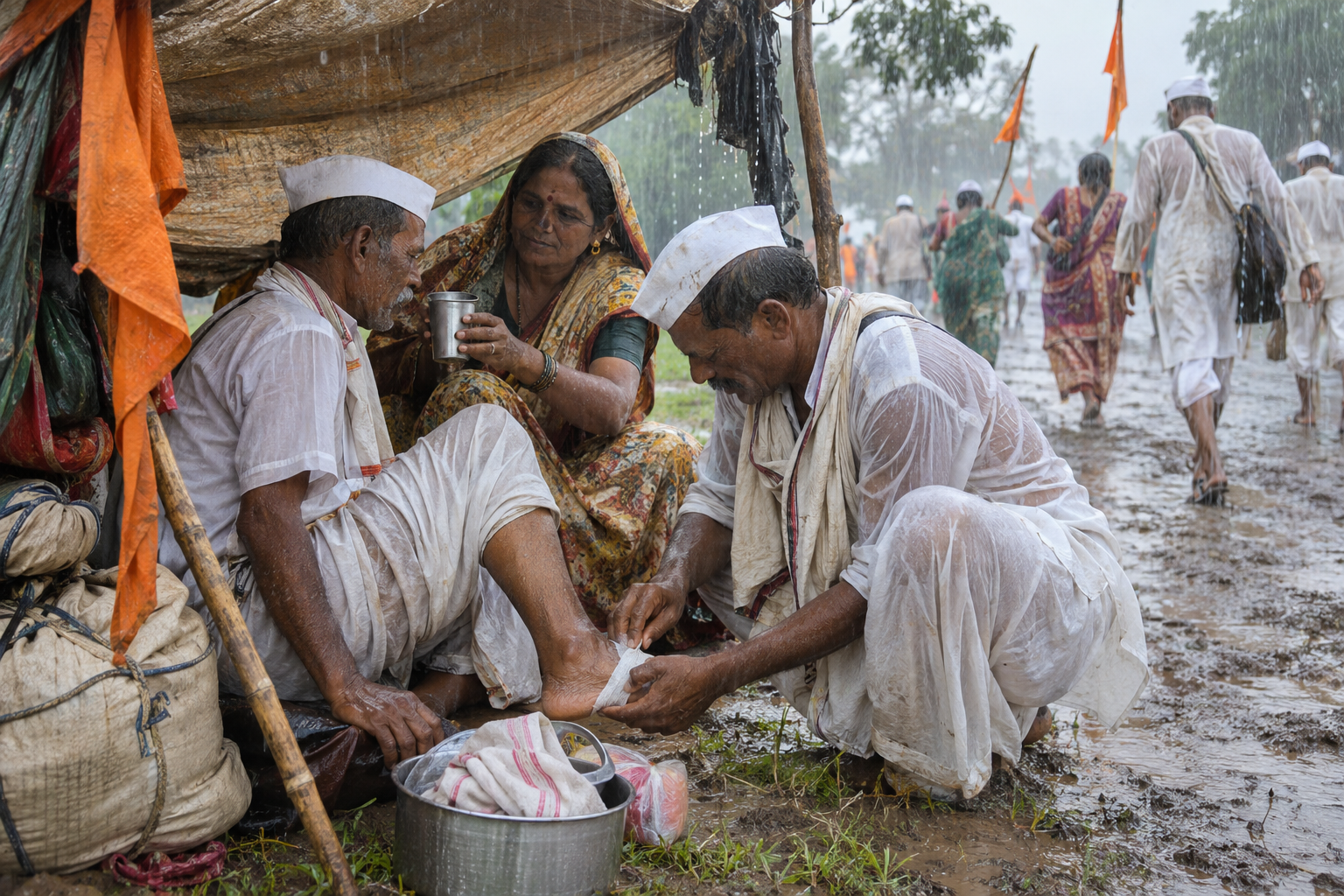
Walking approximately 250 kilometres over several weeks is physically demanding. The difficulty is not incidental, because inconvenience removes many of the controls on which the ego relies. You cannot make the road shorter by declaring yourself important. Fatigue can reveal impatience, entitlement and the demand that everyone else adapt to you.
Yet hardship must be interpreted carefully. More pain does not necessarily mean more devotion. The presence of barefoot pilgrims or elders using walking sticks is not an instruction to imitate them, and another person’s endurance is not a standard against which you should recklessly test your body. Bhakti is measured poorly when it becomes a competition in suffering.
If you plan to join, choose the scale honestly. Walking the complete route, joining for several days and accompanying a shorter segment are not spiritually interchangeable experiences, but neither should they become ranks in a hierarchy of worth. Your responsibility is to undertake a form you can approach with attention rather than one that turns foreseeable physical distress into a burden for everyone around you.
Health limitations require practical judgment. A sacred intention does not replace medical guidance, and the energy of a crowd can make it easy to ignore warning signs you would respect elsewhere. If you have a condition that affects prolonged walking or participation in dense gatherings, plan with an appropriate health professional and follow current instructions from those managing the pilgrimage. Stopping when necessary is not a failure of faith.
Cleanliness deserves the same seriousness. Hygiene and sanitation remain practical challenges at very large religious gatherings, even as arrangements improve through organized support, donors and sponsors. Do not treat concern for the route, water, waste or shared facilities as somehow less spiritual than chanting. Care for a sacred gathering includes refusing to make its physical environment harder for the next pilgrim.
The useful spiritual question is therefore not “How much discomfort can I survive?” Ask instead, “What does this discomfort reveal, and how should I respond?” Fatigue may reveal anger. Waiting may reveal an obsession with control. Dependence on strangers may reveal how much you prefer receiving help to asking humbly for it—or how readily you accept help without later serving someone else. The road supplies the circumstance; reflection turns it into instruction.
How to join the Wari without turning it into spectacle
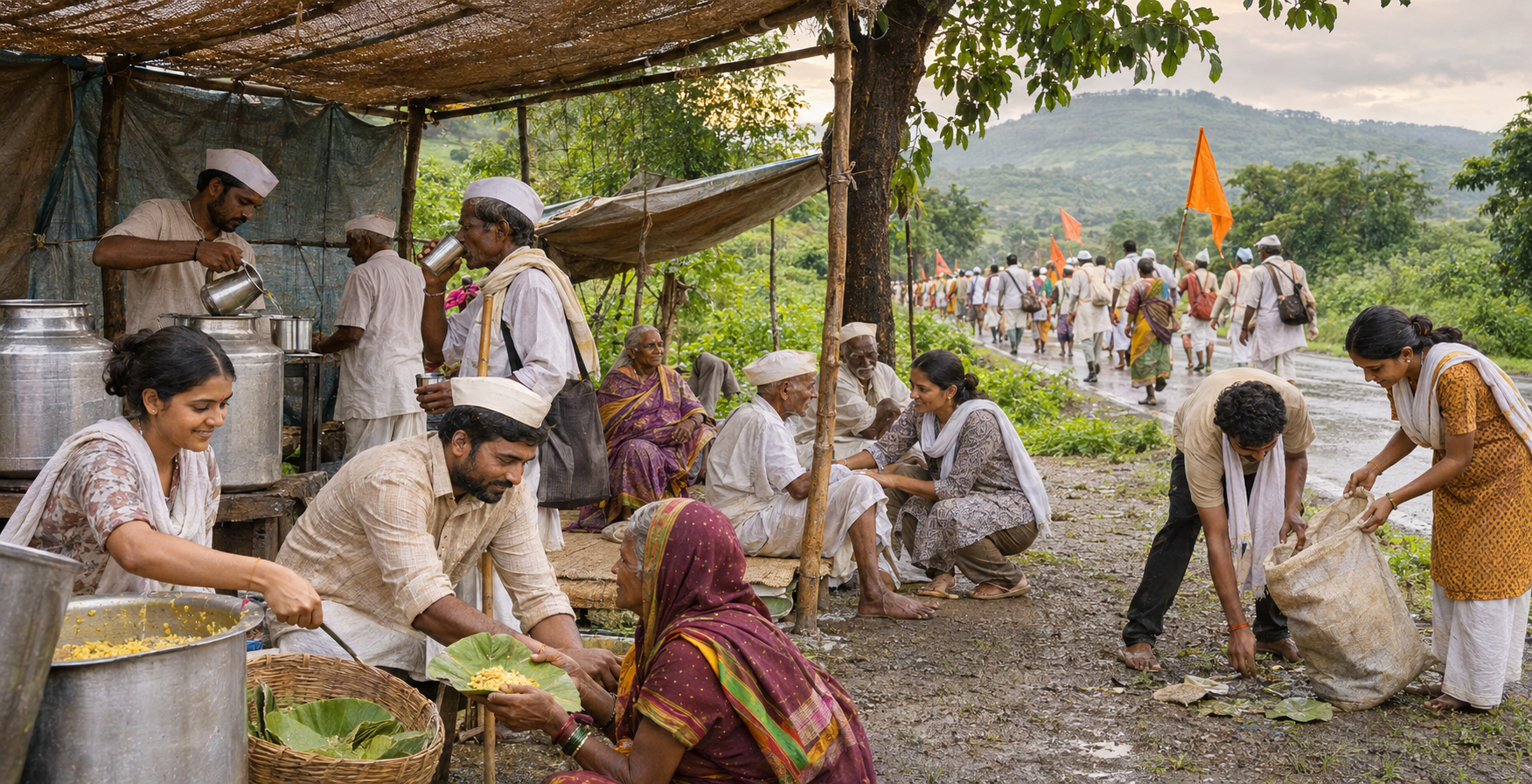
You do not need to make the pilgrimage performative in order to make it meaningful. A clear intention, respect for collective discipline and a plan for what follows are more useful than collecting dramatic images. Before you begin, work through these steps:
- Write one sentence of sankalpa. Name the inner work you are undertaking: remembrance of Vitthala, repentance for a wrong, gratitude, service or the loosening of a particular attachment. Avoid a list so long that nothing governs your conduct.
- Select a form of participation suited to your capacity. Decide whether you can responsibly undertake the full journey, several days or a segment. Do this before the emotion of the gathering tempts you into an unsafe commitment.
- Accept the dindi as a discipline, not a backdrop. If you walk with a group, respect its pace, order and devotional focus. Do not expect an organized pilgrimage to rearrange itself around your private preferences.
- Learn what you are chanting. “Jai Hari Vitthala” invokes the divine centre of the journey. Let the name return your attention when irritation or self-display begins to take over.
- Make cleanliness and consideration part of seva. Follow the arrangements in place, avoid adding unnecessary waste and notice whether your choices create work or obstruction for others.
- Photograph with restraint. Pilgrims are practitioners, not scenery. Do not interrupt worship, stage another person’s devotion or treat visible poverty, age or physical difficulty as material for a dramatic image.
- Choose one act that survives the pilgrimage. Link the Wari to a regular practice of nama-japa, an act of dana, an apology, restitution for a wrong or a specific change in how you treat people of lower social status.
If you cannot travel to Maharashtra, do not claim that a home observance is identical to walking the route. You can still receive its instruction. Set aside a defined period for Vitthala-nama, take a regular walk without entertainment, reduce an indulgence, make a quiet gift and repair one relationship damaged by your conduct. These are not substitutes for the Wari; they are ways to stop admiration of the Wari from remaining passive.
The decisive step comes after the chant has faded. Choose one habit of ego you will stop feeding, one wrong you will begin to repair and one devotional discipline you will keep. Then put the first action on your calendar. Pandharpur is the destination of the pilgrimage, but the proof that you listened to the road will appear in the life to which you return.
References

Leave a Reply
You must be logged in to post a comment.