
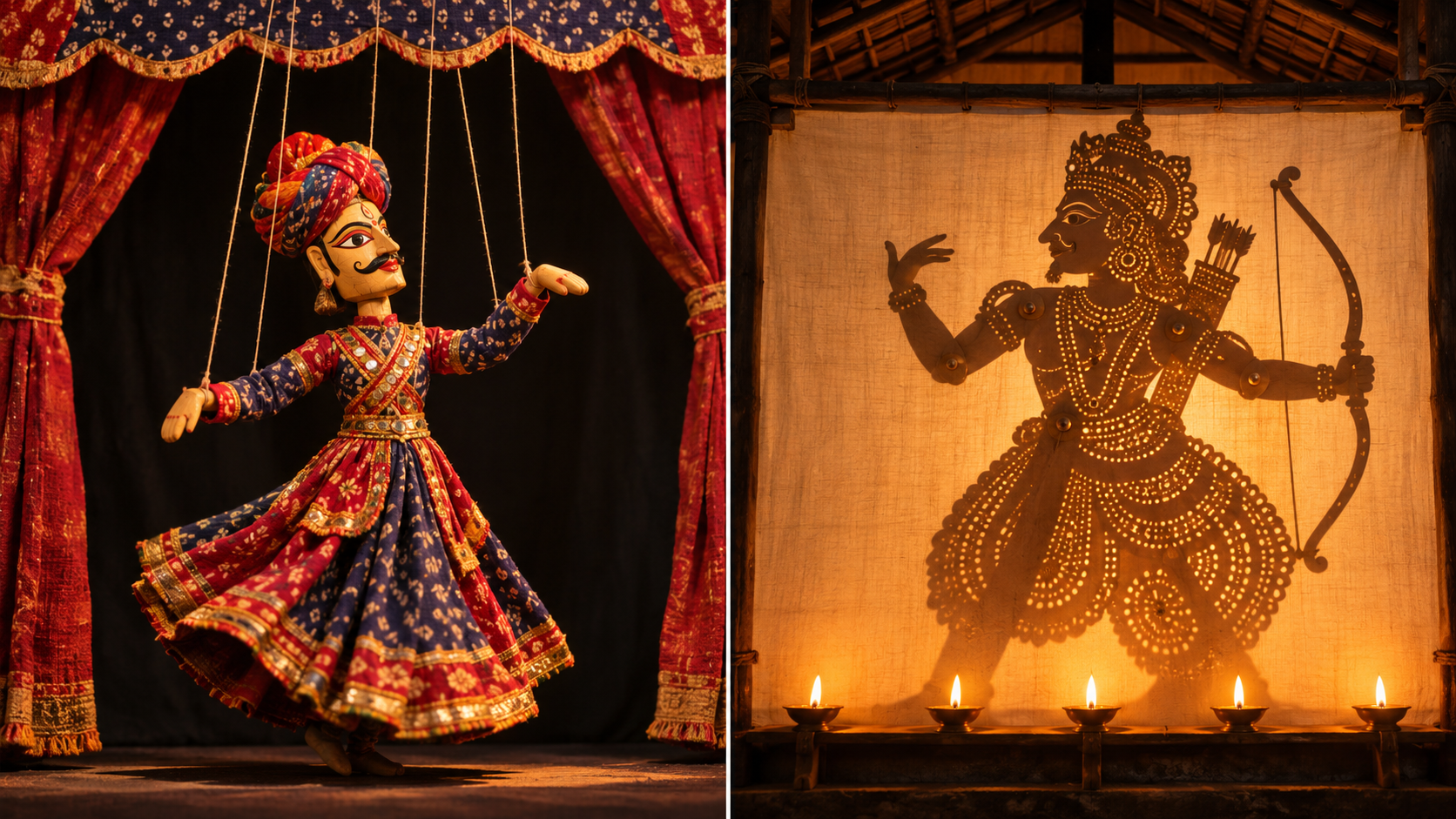
You may know the Ramayana well and still feel unsure about what to watch when puppets take the stage. The usual mistake is to wait for miniature figures to imitate human actors. Kathputli and Tholpavakoothu ask something more interesting of you: learn how strings and shadows create their own languages of presence.
Once you adjust your attention, a turn, pause, outline, entrance, or disappearance can carry as much meaning as a spoken line. You also begin to see why these forms matter to Dharmic cultural memory: they do not simply repeat an epic story but give it a visible body for another generation.
Watch the medium before chasing the plot
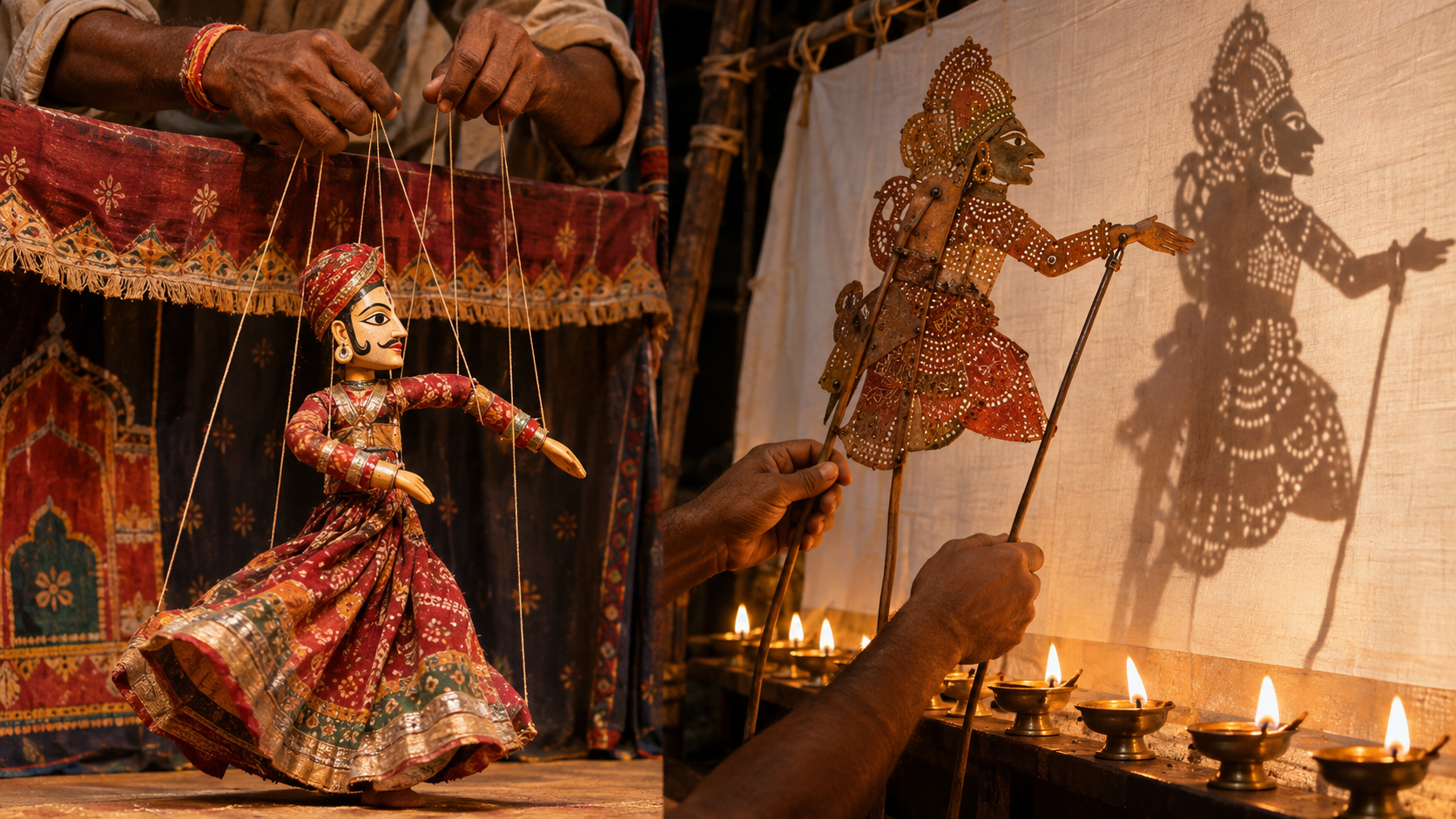
Kathputli works through the movement of a figure controlled by strings. Tholpavakoothu works through shadow. That difference is not a technical footnote. It determines what the performer can emphasize and what your eye must learn to read.
In string puppetry, movement gives the figure its apparent weight and temperament. A puppet may swing, turn, stop, tilt, or change direction. The motion need not resemble an ordinary human gait to be expressive. Its force lies in how the performer turns suspension and balance into character.
Do not dismiss an abrupt movement as crude merely because it is not realistic. Ask what it accomplishes. A sudden turn can redirect attention. A held position can create expectation. Repetition can establish authority, agitation, comedy, or confrontation. The useful question is not, Does this move like a person? It is, What does this movement make me understand?
Shadow theatre removes much of the visible surface and asks you to read outline, contrast, overlap, scale, and disappearance. Reduced detail is not reduced meaning. It shifts expression away from the puppet’s surface and toward the changing image that reaches the screen.
- Notice the first entrance. What do movement, outline, and position tell you before the character is identified?
- Watch the boundary of the performance space. Entering it creates presence; leaving it can become part of the action rather than an empty interval.
- Look for stillness. A pause may mark attention, hesitation, command, transition, or suspense.
- Track repeated gestures or shapes. Repetition often gives you a better clue than a single spectacular movement.
- Observe relationships. Distance, approach, withdrawal, overlap, and opposition can clarify who challenges, follows, protects, or answers whom.
Begin there even if you already know the story. Plot recognition tells you what happens. Attention to the medium shows you how this particular tradition makes the event present.
Let a familiar epic free your attention
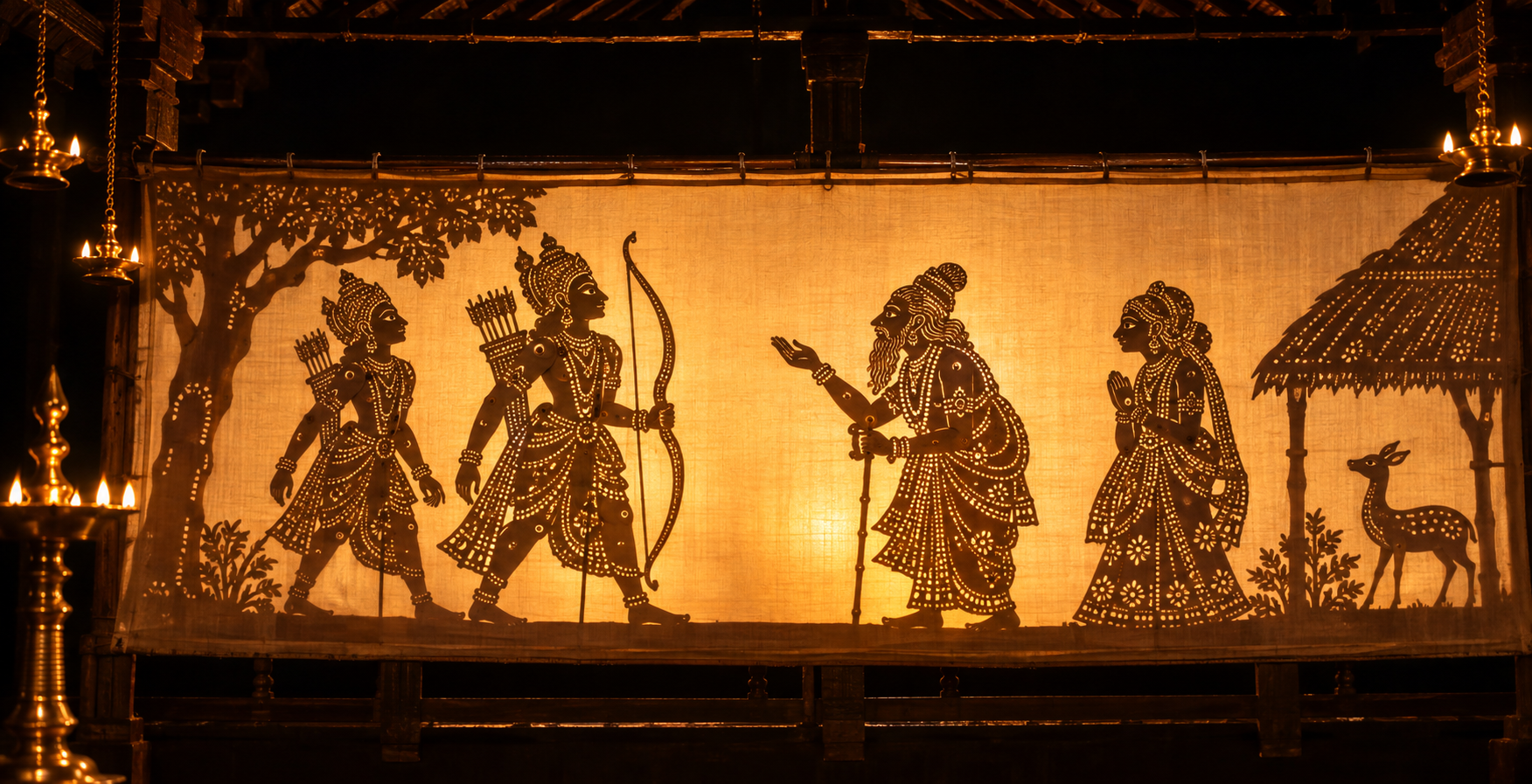
Indian puppetry has carried the Ramayana, the Mahabharata, and accounts of rishis, kings, and devas across generations. Familiarity with those worlds is not an obstacle to enjoying a performance. It releases you from having to chase every plot point.
If you recognize the narrative, resist turning the performance into a test of whether every incident has been reproduced. No performance can place an entire epic before you at once. Selection is therefore part of interpretation. The chosen encounter, emphasized action, delayed entrance, or repeated conflict tells you what the performance wants you to contemplate.
- Which moment has been selected, and what moral or emotional pressure does it contain?
- Who receives the strongest visual emphasis: a ruler, warrior, rishi, deva, adversary, messenger, or witness?
- Does the performance concentrate on duty, loyalty, restraint, courage, pride, consequence, or restoration?
- Which relationship structures the scene: ruler and subject, teacher and disciple, kin and kin, protector and protected, or the human and divine?
- What changes between the character’s entrance and departure?
These questions keep you close to the performance without demanding that it behave like an illustrated book. A puppet tradition does not merely place pictures beside an epic. It reorganizes the narrative through motion, image, timing, and the limits of its chosen medium.
This also explains why entertainment and cultural transmission are not opposites. Delight holds attention; attention makes remembrance possible. A comic passage, striking movement, or dramatic shadow can invite a young viewer into an ethical world before that viewer possesses the vocabulary to analyze it.
Abhinaya continues even when the human actor disappears
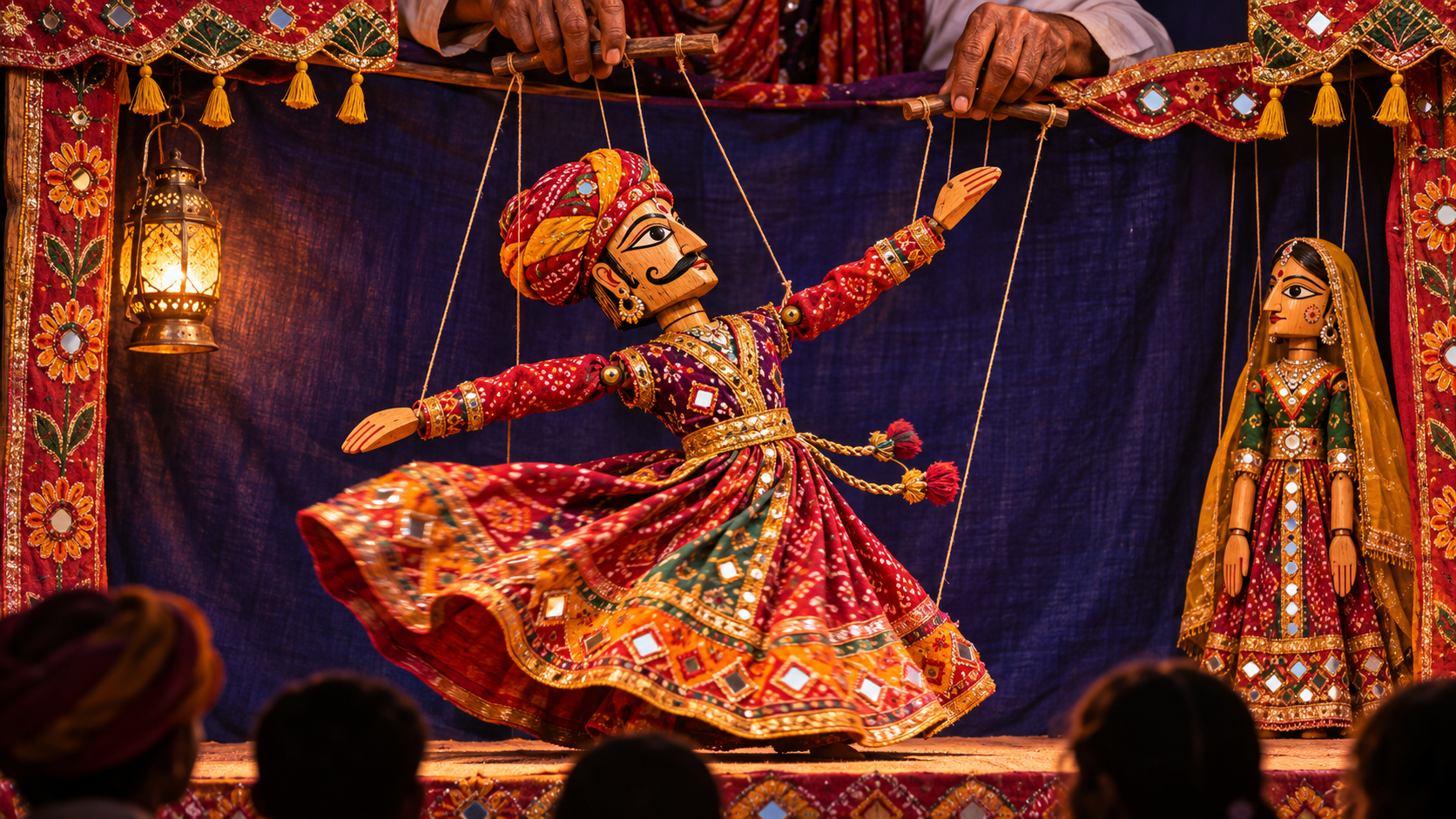
It is tempting to think that expression belongs to a visible human face. Puppetry corrects that assumption. The performer’s body may be hidden or displaced, but expressive action continues through the controlled figure, the projected shape, and the timing that connects one event to the next.
You can use the idea of abhinaya broadly here: meaning is being carried toward an audience. In Kathputli, the carrier is a string-directed figure. In Tholpavakoothu, it is a shadow image. When narration, dialogue, or rhythm accompanies the visual action, listen for whether sound confirms the image, complicates it, or prepares you for a change that has not yet appeared.
A practical way to train your attention is to watch in three passes whenever a recording or repeated performance makes that possible:
- Follow only the image. Ignore your urge to identify every character immediately. Track entrances, turns, pauses, spacing, and changes of direction.
- Follow the narrative cue. Attend to any names, dialogue, narration, or rhythmic signals that accompany the scene. Notice what they reveal that the image alone did not.
- Join the two. Ask where image and narration reinforce one another and where the visual medium adds emphasis of its own.
If you have only one opportunity to watch, use the same method on successive passages rather than trying to process everything at once. Follow movement for one passage, listen closely during the next, and then watch how the channels meet. This is more productive than attempting to memorize every name while missing the performance in front of you.
Children can use a simpler version. Before the performance, give them one task: choose a character and notice how the character moves or appears. Afterwards, ask what changed. A precise prompt works better than asking whether they liked the show, because it teaches them that artistic form is something they can observe and discuss.
Compare the traditions without turning them into rivals
Kathputli and Tholpavakoothu become clearer when placed beside one another, but comparison should sharpen perception rather than produce a winner. Strings and shadows solve different artistic problems. A fair comparison asks what each medium makes possible.
| Viewing question | Kathputli | Tholpavakoothu |
|---|---|---|
| What creates the visible character? | A figure set into motion through strings | A figure apprehended as shadow |
| What should your eye follow? | Balance, swing, turn, pause, direction, and relation between figures | Outline, contrast, overlap, scale, appearance, and disappearance |
| What is an easy misreading? | Assuming non-realistic movement lacks control or expression | Assuming reduced surface detail means reduced expression |
| What is the better question? | How does controlled movement produce character? | How does the changing image produce character? |
We would also avoid judging either form from an isolated image. A still photograph can record costume, shape, or composition, but puppetry exists through change. Movement into a position, duration within it, and movement away from it are part of the meaning. If you must choose between a striking photograph and a modest recording with clear performance context, the recording will usually teach you more about the form.
Your attention also affects how these living traditions of strings and shadows circulate. Sharing a decontextualized clip may display an attractive object while erasing the people, narrative, and discipline that gave it life. A small change in how you watch and share can preserve more meaning.
- Prefer a complete performance or a contextualized recording when one is available.
- Look for the names of the tradition, performers, and narrative episode instead of treating every Indian puppet form as interchangeable.
- When sharing an image or clip, retain the available credit and link back to its performance context.
- Describe what the medium does. Calling the puppets merely cute or decorative hides the narrative work they perform.
- Ask an organizer what the audience should know before the performance. A brief orientation can prevent unfamiliar technique from being mistaken for artistic simplicity.
- Bring younger viewers with a concrete observation prompt, then let them explain what they noticed in their own words.
No single viewing habit can preserve an artistic tradition. It can, however, prevent you from reducing a carrier of Dharmic memory to a detachable souvenir.
Key takeaways
- Kathputli creates character through a figure moved by strings; watch balance, direction, repetition, and pause rather than demanding realistic motion.
- Tholpavakoothu creates character through shadow; watch outline, contrast, overlap, scale, appearance, and disappearance.
- Knowing an epic story lets you concentrate on selection and emphasis instead of spending the entire performance reconstructing the plot.
- Read abhinaya across the whole event: controlled movement, visual form, timing, and any accompanying narrative or rhythmic cues.
- Compare what each medium makes possible, not which one resembles human theatre more closely.
- Support the living form by seeking context, retaining performer credits, and teaching younger viewers how to notice rather than merely consume.
At your next encounter with either tradition, choose one entrance and follow it closely from appearance to departure. That small discipline will show you more than trying to absorb the entire epic at once. The strings or shadows will begin to look less like substitutes for an actor and more like distinct instruments of storytelling.
References

Leave a Reply
You must be logged in to post a comment.