

You may be drawn to the fierce Divine Mother when public life feels morally inverted: cruelty is rewarded, truth is treated as a nuisance, and those responsible for protection look away. Her terrifying form can seem to answer a real need. It declares that violation has consequences.
But that declaration is easy to misuse. The fierce Mother is not a religious decoration for anger, collective blame, or private vengeance. She gives you a harder task: identify what must be protected, confront the disorder without becoming part of it, and help restore the conditions in which life can flourish again.
The Mother’s fierceness begins with what she protects
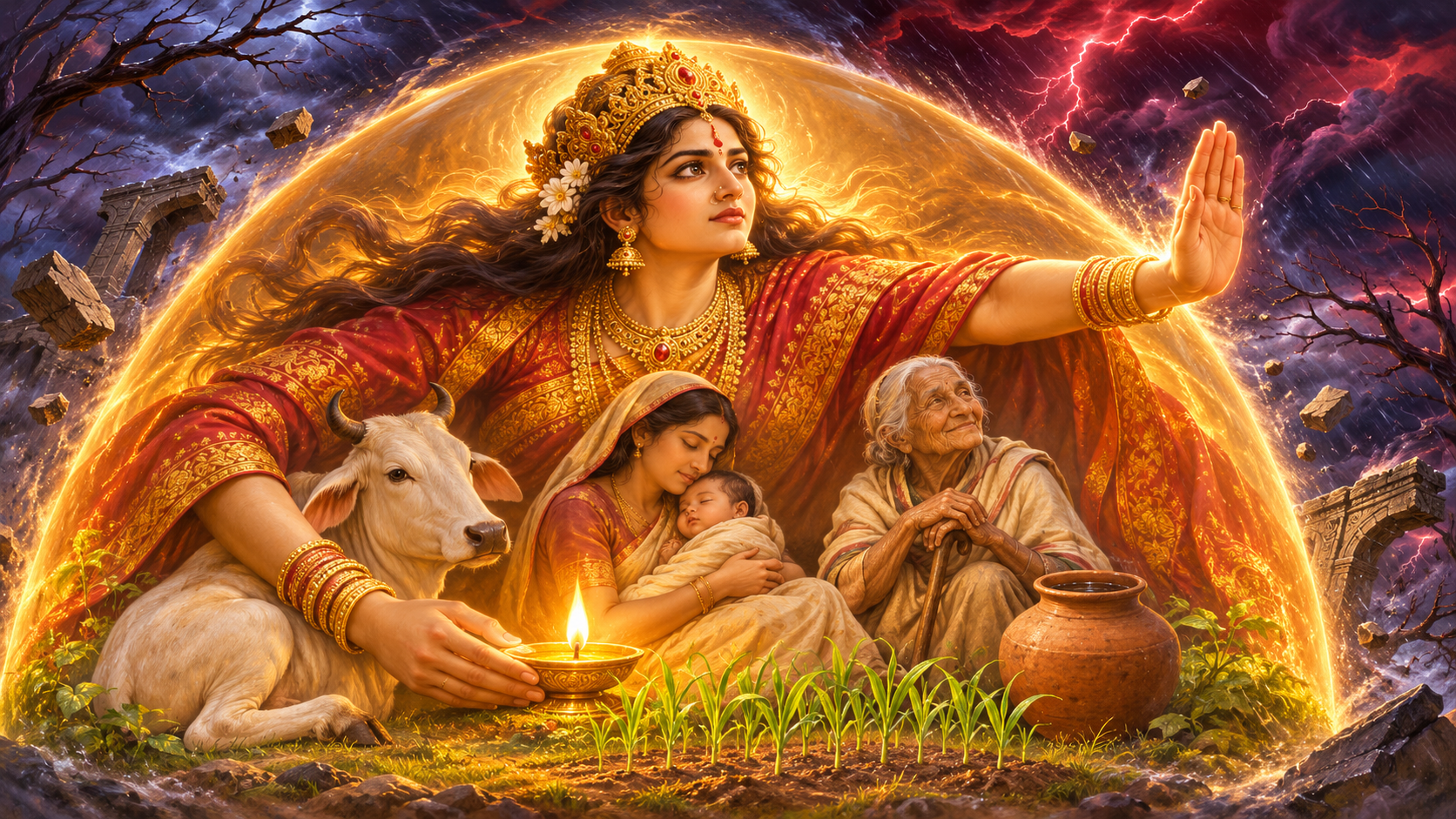
Begin with the Mother, not with the weapon. Shakti is the living power by which existence is sustained and transformed. Her domain includes food, knowledge, prosperity, fertility, protection, peace, compassion, and hope. Her fierce form cannot be understood apart from these gifts.
This changes the meaning of divine wrath. The Mother is not fierce because destruction is intrinsically sacred. She is fierce because something that nourishes life is being violated. Protection becomes sharp when persuasion no longer restrains predation. A boundary appears because a boundary has been crossed.
Nurture and severity are therefore not opposite principles. A mother who feeds a child and a mother who drives danger away act from the same commitment. The action changes because the situation changes. Compassion without a boundary can abandon the victim; force without compassion can create another victim. The fierce Divine Mother holds protection and moral purpose together.
When you encounter frightening sacred imagery, ask first: what life-giving good is under threat? Is it truth, safety, dignity, knowledge, livelihood, community trust, or the freedom to practise dharma? If you cannot name the protected good, the image is probably being used to intensify emotion rather than clarify duty.
Social disorder is more than noise in the streets

A society can look calm while adharma becomes normal. Silence may conceal intimidation. Polite institutions may protect status rather than justice. Conversely, argument and protest do not automatically indicate disorder. A healthy society can tolerate strong disagreement because its members still recognise duties, limits, and a shared standard of truth.
The deeper fracture begins when relationships lose their moral form. Authority demands obedience but rejects responsibility. Wealth takes without sustaining the community that makes wealth possible. Knowledge is used to manipulate rather than illuminate. Strength preys on weakness instead of protecting it. People learn that honesty is costly while intimidation works.
Three signs deserve particular attention:
- A concrete harm is repeatedly excused because acknowledging it would inconvenience a powerful person, faction, or institution.
- Those entrusted with a duty refuse to perform it, while continuing to claim the privileges attached to that duty.
- Ordinary people are pressured to repeat what they know is false, ignore what they know is wrong, or treat a neighbour as less than human.
These signs are more useful than asking whether your side appears strong or whether the public mood feels angry. Dharma is not whatever preserves your comfort, and disorder is not whatever challenges your preference. The relevant question is whether reciprocal duties, truthful judgment, and protection from predation are still operating.
In this sense, society does not manufacture the Divine in a theological sense. Disorder brings a particular aspect of the Divine into urgent focus. When nourishment is secure, the gentle Mother is readily understood. When nourishment itself is attacked, her fierceness becomes intelligible.
Use the fierce image as a discipline before using it as a banner

It is easy to invoke Shakti against an enemy. It is harder to let Shakti judge your own conduct. Before you speak or act in the name of protecting dharma, pass the impulse through six tests.
- Name the harm precisely. Describe an act, policy, omission, or pattern that can be examined. Labels such as evil, corrupt, or anti-Dharmic may express a conclusion, but they do not establish what happened.
- Name the person or good being protected. A response aimed only at humiliating an opponent is not protective merely because it uses sacred language.
- Locate your actual duty. Ask what belongs to your role as a parent, neighbour, citizen, teacher, community member, or office-holder. Do not claim powers that your duty does not give you.
- Choose the least destructive action that can realistically stop the harm. A firm boundary may be sufficient. Serious misconduct may require documentation, public correction, institutional action, or lawful intervention. Greater intensity needs a greater burden of justification.
- Remain answerable for your method. State facts accurately, distinguish evidence from suspicion, and accept scrutiny from people who are not already on your side.
- Define the point at which fierceness ends. The purpose is restored safety and order, not permanent mobilisation. If no possible correction, apology, restraint, or restitution could end your hostility, you are no longer describing protection.
This discipline produces practical differences. If a rumour enrages you, verify it before forwarding it. If someone is being harassed, support the person targeted and preserve an accurate account of the conduct, when it is safe to do so. If an institution neglects its duty, identify the responsible office and seek a specific remedy. If immediate violence is occurring, move yourself and vulnerable people away from danger and contact the appropriate emergency services; do not turn sacred symbolism into a private mandate for confrontation.
The point is not timidity. Restraint is command over energy. The person who can act firmly without exaggeration, cruelty, or intoxication by anger is more formidable than the person who merely displays rage.
Sacred fierceness is not permission for cruelty

The line between righteous protection and destructive rage is crossed when the opponent’s suffering becomes the goal. It is also crossed when guilt is transferred from a wrongdoer to an entire family, caste, sect, religion, ethnicity, or political category. Collective contempt does not restore moral order. It trains the mind in indiscriminate hostility.
Anger may alert you to a violated boundary, but it does not prove your interpretation. Fear can magnify a threat. Group loyalty can hide the misconduct of allies. Repeated exposure to inflammatory claims can make punishment feel necessary before facts are established. Treat strong emotion as a signal to investigate, not as a verdict.
Divine imagery also should not be flattened into a political mascot. A party, movement, or leader may perform strength while neglecting the duties that make strength Dharmic. Test public claims by conduct: Are the vulnerable actually safer? Are facts handled honestly? Are authorities accepting responsibility? Is the proposed remedy proportionate to the stated harm? Will ordinary life be rebuilt after the confrontation?
This last question matters. The Mother’s gentle attributes reveal the purpose of her fierce ones. If a campaign defeats an immediate danger but leaves people unable to trust, learn, work, worship, raise families, or share public life, the work of restoration remains unfinished. Stopping harm is one phase; rebuilding nourishment is the completion of the duty.
You can apply the same standard inwardly. Notice when indignation gives you permission to neglect your own obligations, speak carelessly, or enjoy another person’s humiliation. The fierce Mother should make the devotee more truthful and disciplined, not merely more certain of everyone else’s guilt.
Key takeaways
- The fierce Divine Mother protects the same life that the nurturing Mother sustains; her severity has no independent purpose.
- Social disorder begins when power, knowledge, wealth, or authority are detached from their corresponding duties.
- Dharma requires you to identify a concrete harm and a protected good before escalating a response.
- Protective action must be proportionate, fact-based, accountable, and capable of ending when the danger ends.
- Sacred fierceness never licenses collective blame, dehumanisation, private vengeance, or delight in suffering.
- Restoration is complete only when truth, safety, trust, and the ordinary conditions of nourishment can return.
The next time fierce imagery speaks to your anger, pause before displaying it or directing it at someone else. Name what is threatened, identify your duty, and take one proportionate action that protects without dehumanising. That is how fierceness serves dharma instead of becoming another form of disorder.
References

Leave a Reply
You must be logged in to post a comment.