
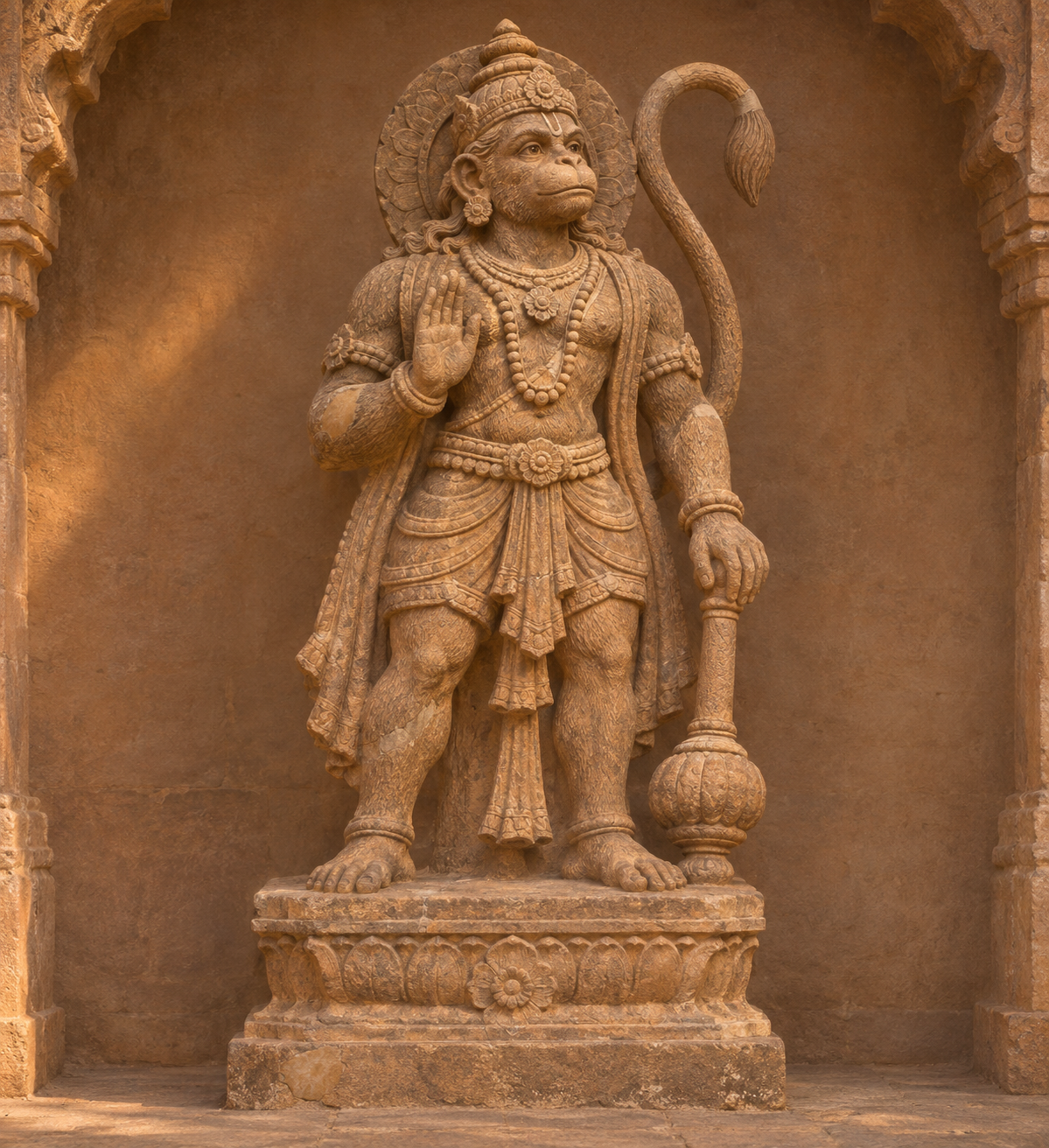
You have found a Hanuman sculpture whose body looks unmistakably simian, yet the label says little more than the deity’s name. Is this simply an unusual local style, or does the image belong to a distinct iconographic form?
The answer lies in the construction of the entire figure, not in one conspicuous feature. If you examine the body, posture, attributes and setting in the right order, you can make a careful identification without forcing the sculpture into a date or category that the surviving evidence cannot support.
What the term Vanarakara identifies
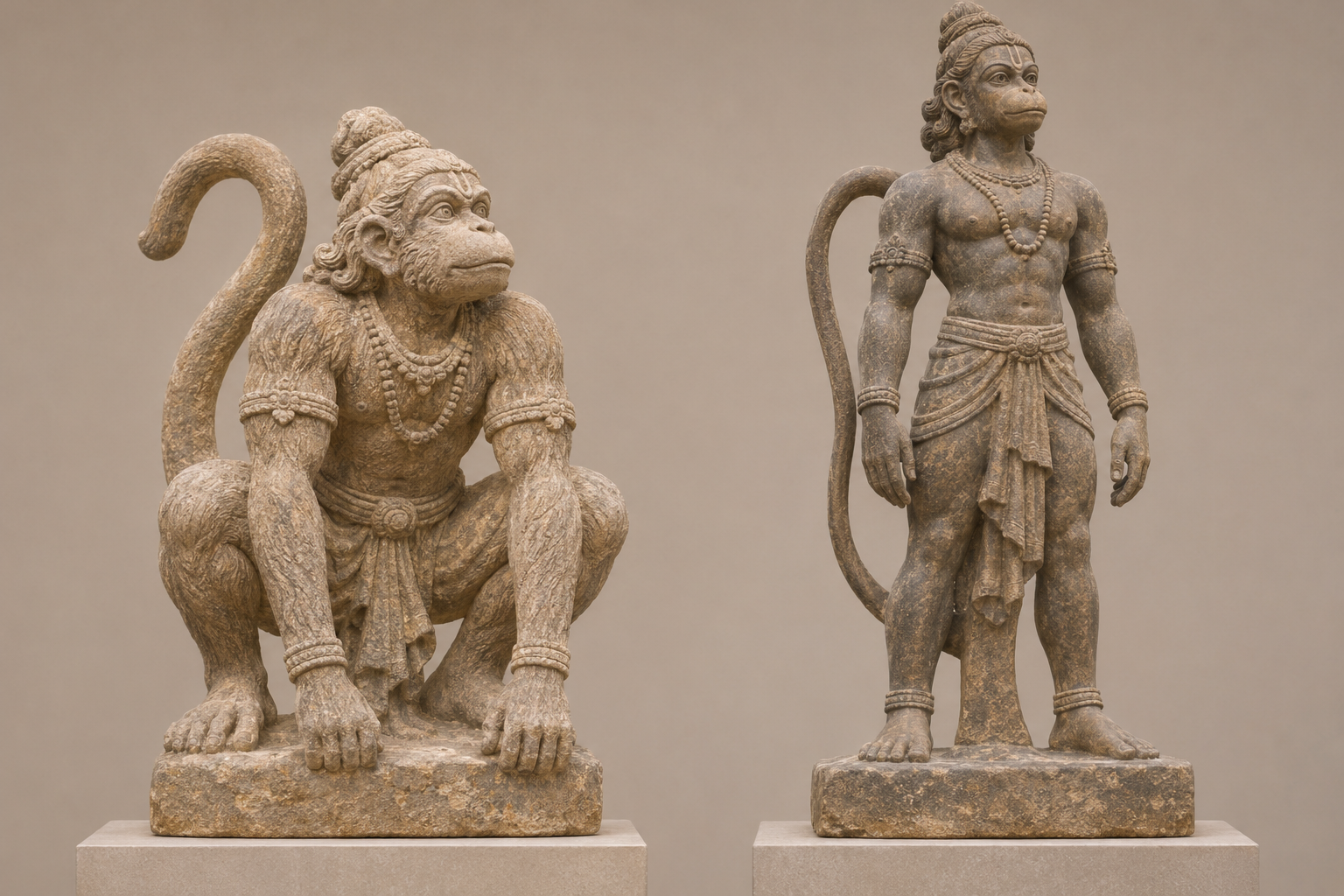
Vanarakara Hanuman is Hanuman represented in a pure vanara, or monkey, form. The term distinguishes this treatment from images that retain Hanuman’s simian face or tail while giving him a predominantly human body, proportions and bearing.
Here, “pure” describes an iconographic choice. It should not be treated as a claim that the sculpture is simple, unsophisticated, unadorned or automatically older than every anthropomorphic image. A richly ornamented figure may still be Vanarakara if its underlying bodily form remains that of a vanara. Conversely, a relatively plain figure is not Vanarakara merely because it lacks royal dress or elaborate jewellery.
Separate two questions before you classify an image:
- Is the figure Hanuman?
- If it is Hanuman, is his bodily form Vanarakara rather than predominantly anthropomorphic?
The first question concerns identity. The second concerns the manner in which that identity has been visualised. Keeping them separate prevents a common error: seeing a monkey-like figure, naming it Hanuman immediately and then treating the same observation as proof of the Vanarakara category.
Read the whole figure in a fixed order
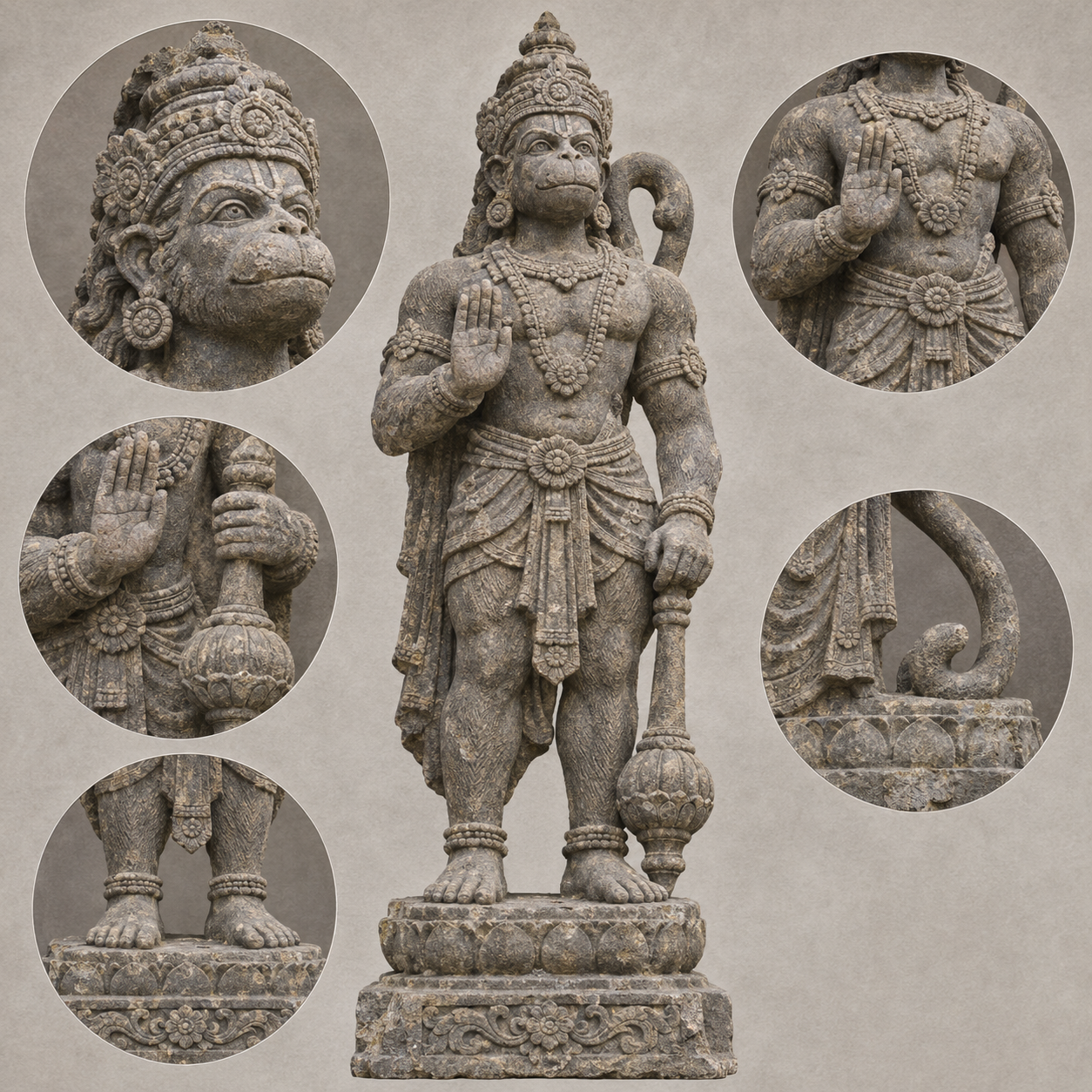
A damaged nose, an enlarged jaw or a visible tail can seize your attention. None should carry the classification alone. Use the same sequence every time you inspect a sculpture, photograph or museum record.
- Begin with the silhouette. Ignore ornament for a moment and trace the head, back, shoulders, pelvis and limbs. Ask whether the figure is organised as a vanara or as an upright human figure to which simian signs have been added.
- Compare the face with the body. A monkey-like face confirms a simian aspect, but the Vanarakara distinction depends on whether that character continues through the torso and limbs. A simian head on an otherwise human heroic body points toward a more anthropomorphic treatment.
- Examine how the limbs carry weight. Record the relationship between arms, legs, trunk and ground rather than searching for one mandatory pose. A Vanarakara figure need not satisfy a modern zoological diagram, and an upright posture does not by itself make the body human.
- Locate the tail, but do not let it decide the category. The tail can help establish Hanuman’s vanara identity. It cannot tell you, on its own, whether the rest of the body has been rendered in Vanarakara form.
- Put dress and adornment back into the analysis. Crowns, necklaces, sacred ornaments or heroic accessories express status and sanctity; they do not erase the bodily construction beneath them. Classify anatomy and ornament as separate layers before considering how they work together.
- Identify attributes, action and companions. These may establish that the figure is Hanuman rather than an unnamed monkey or another vanara within a narrative scene. Context can answer the identity question even when the face or tail is damaged.
- Record what is missing. Broken hands, a lost tail, eroded facial features or a sculpture removed from its original setting should reduce your confidence. Do not silently reconstruct decisive details.
Your note does not need false certainty. A useful record can state: identification as Hanuman is strong because of the narrative setting; classification as Vanarakara is probable because the simian construction extends beyond the face; the missing lower limbs prevent a firm judgment about posture. That tells a curator, devotee or later researcher exactly how the conclusion was reached.
What the form asks you to notice
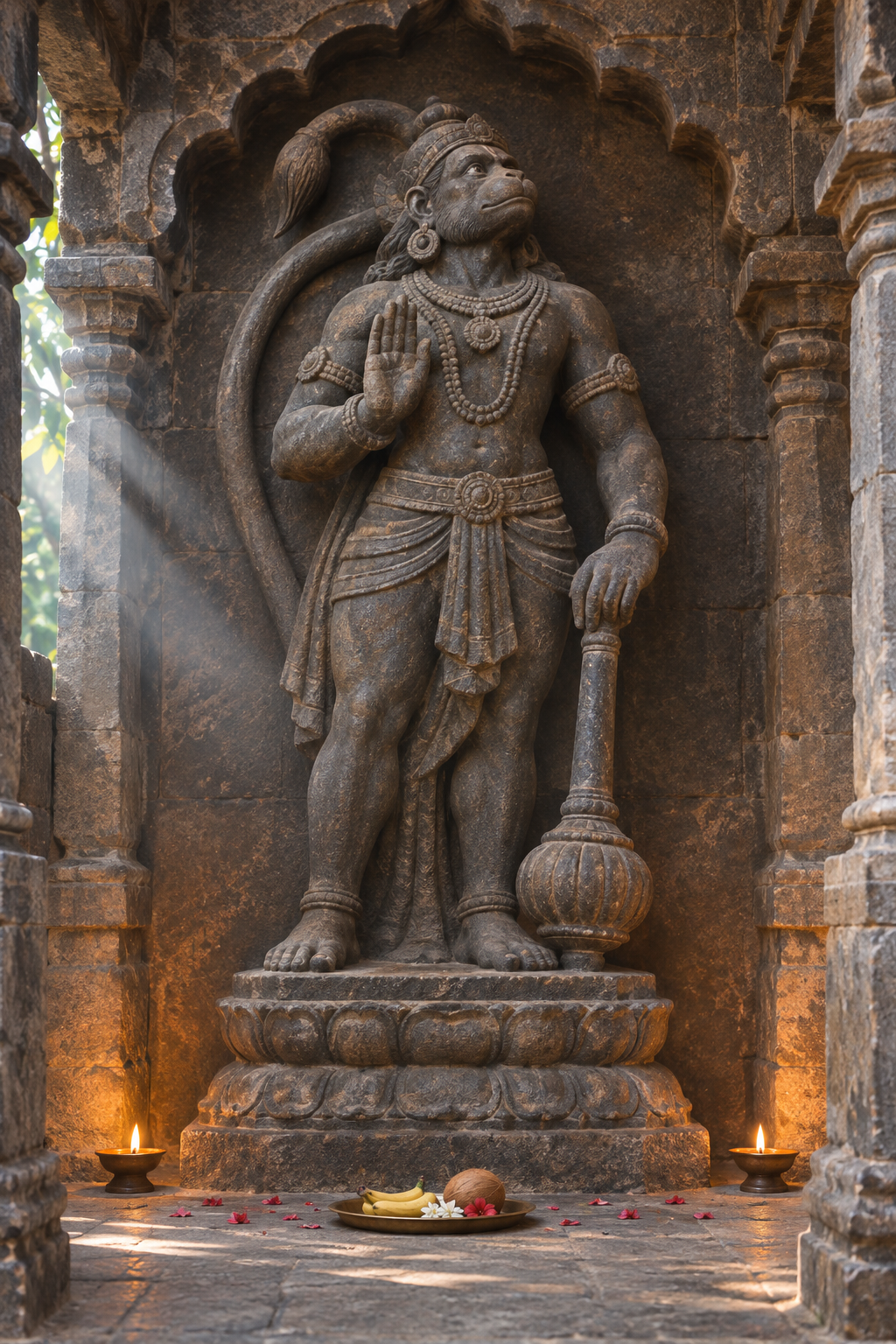
Do not arrange Hanuman images on a scale running from “animal” to “divine.” That imports a hierarchy the iconographic distinction does not require. Vanarakara makes Hanuman’s vanara identity visually comprehensive; it does not diminish his sacred identity, intelligence, agency or devotion.
This matters because a familiar human-bodied Hanuman can train the eye to treat human anatomy as the neutral form and simian anatomy as a deviation. Reverse that assumption when standing before a Vanarakara image. Ask what becomes visible when the artist refuses to make divinity depend upon a human appearance.
Three questions will keep your interpretation grounded in the object:
- Which features establish vanara identity across the whole body, rather than only in the face?
- Which attributes, companions or actions establish that this vanara is Hanuman?
- Does the composition direct attention first to bodily form, devotional action, heroic movement or divine status?
The answers may differ from sculpture to sculpture. That variation is useful. Vanarakara is a category of representation, not a demand that every image repeat one pose, costume or emotional register.
If you are commissioning a murti or preparing an illustration, the word Vanarakara is therefore not a complete brief. Specify the intended bodily proportions, facial construction, stance, hand gestures, tail, dress, attributes and narrative setting. Otherwise, one person may understand “Vanarakara” as a fully simian body while another supplies a conventional human-bodied Hanuman with a monkey face.
Avoid the six most common classification errors
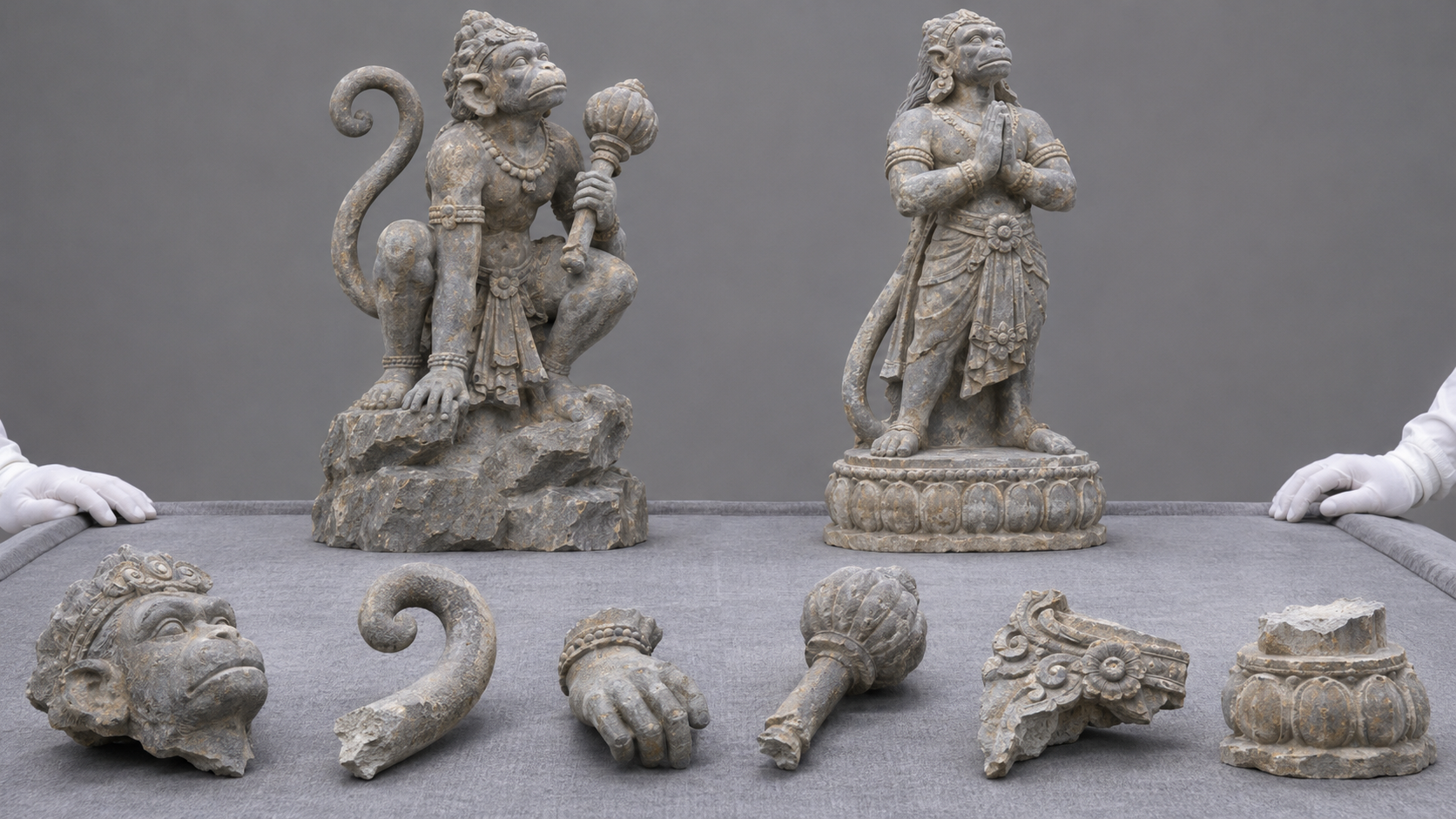
- Do not classify from the face alone. The central question is whether vanara form governs the entire figure.
- Do not require a four-footed pose. Posture contributes evidence, but no single stance should replace examination of the complete body.
- Do not let a crown or jewellery disqualify the image. Ornament and anatomy answer different iconographic questions.
- Do not use “pure” as a synonym for primitive. It names the consistency of the vanara representation, not the quality of the workmanship.
- Do not assign a date from this feature alone. More anthropomorphic representations belong to the wider evolution of Hanuman imagery, but bodily type by itself is not a secure date stamp for an individual object.
- Do not identify every monkey figure as Hanuman. Establish identity from attributes, action, companions, setting or a reliable record before applying a Hanuman subcategory.
The last error is especially easy when a sculpture has been removed from a temple wall, narrative panel or architectural setting. If provenance and identifying features are absent, “vanara figure, possibly Hanuman” is more responsible than an unqualified label. A careful uncertainty is more useful than a confident guess.
Key takeaways
- Vanarakara describes Hanuman in a consistently vanara or monkey bodily form, rather than a mostly human form carrying a few simian markers.
- Identify Hanuman first; classify his mode of representation second.
- Judge the head, torso, limbs, posture and tail together. No single feature proves the category.
- Treat ornaments and attributes as separate from underlying bodily construction.
- Do not translate “pure vanara form” into “less divine,” “primitive” or “automatically early.”
- When damage or missing context affects the decision, state a confidence level and name the absent evidence.
The next time you encounter a possible Vanarakara Hanuman, make a front and profile record if photography is permitted. Note the silhouette, head-body relationship, weight-bearing limbs, tail, ornaments, attributes, companions and damage in that order. You will leave with an identification that another person can inspect and challenge, not merely an impression shaped by the Hanuman image you already expected to see.
References

Leave a Reply
You must be logged in to post a comment.