
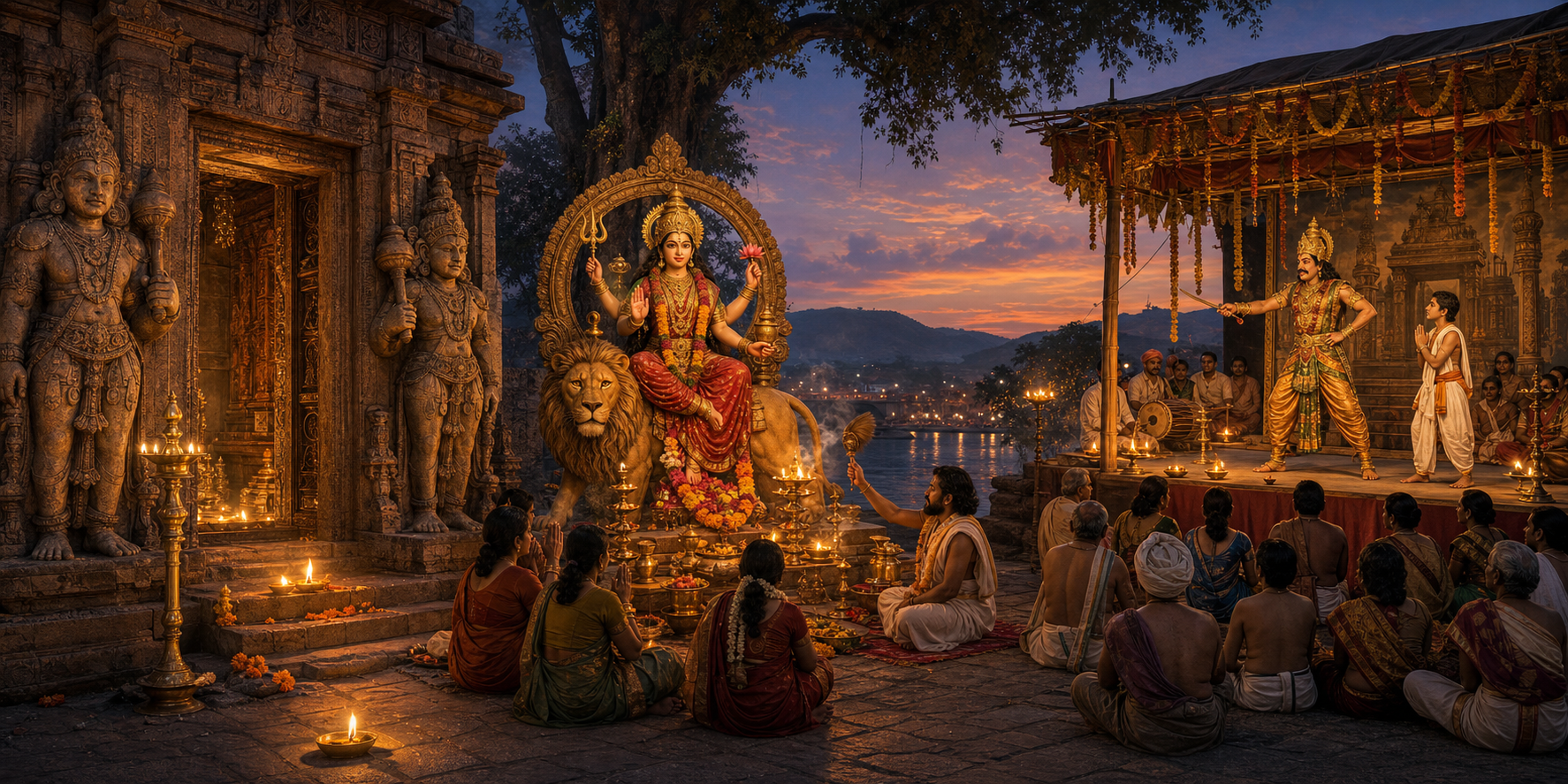
Devotion rooted in Puranic worlds is not transmitted only by reading. It can be encountered as a sculpted body at a temple doorway, a discipline repeated at the junctions of the day, or a drama sustained through music, movement, and collective attention.
Viewed together, the accounts of Jaya and Vijaya, Jagaddhatri worship, and Prahallada Nataka show how sacred traditions organize three dimensions of experience: space, time, and performance. Each medium carries theology differently, and each asks something different of the devotee.
One sacred world, three architectures of attention
Sculpture condenses a narrative into form and placement. Ritual distributes theological meaning across recurring actions. Theatre expands a sacred conflict into voice, gesture, costume, rhythm, and shared duration. These are not interchangeable illustrations of scripture. They are distinct ways of interpreting it.
The three source articles examine different religious settings: Vaishnava guardians at temple thresholds, the Tantric worship of a Shakta goddess at three daily transitions, and Vaishnava musical theatre in southern Odisha. They do not establish a single historical origin or common liturgy. Their connection is functional: all three transform theological ideas into practices of attention.
This distinction matters because a narrative changes when it enters another medium. Stone privileges durable form and spatial order. Daily worship emphasizes repetition and temporal discipline. Theatre depends on bodies, memories, musicians, teachers, and spectators. Meaning is therefore carried not only by what a story says, but also by where, when, and how a community encounters it.
Sculpture turns a doorway into an ethical encounter
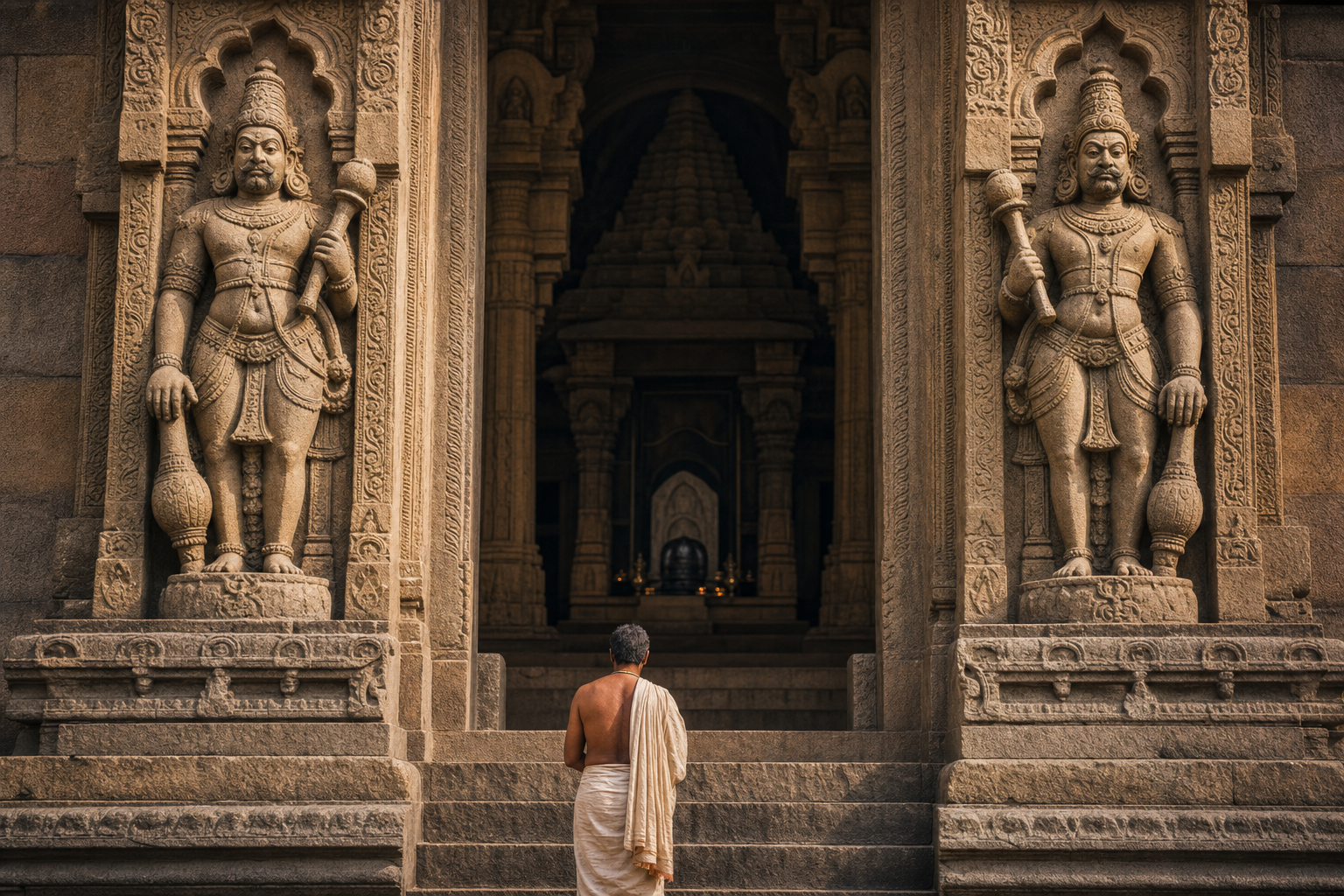
The DharmaRenaissance account of Jaya and Vijaya describes imposing, frequently four-armed guardians at Vaishnava thresholds. Their multiple arms and divine attributes visually associate them with Vishnu, while their position outside or beside the sanctum preserves their identity as attendants. They possess authority, but that authority remains directed toward the deity they serve.
The associated Puranic narrative gives these figures more than a protective function. In the account summarized by the source, the guardians of Vaikuntha prevent the sages Sanaka, Sanandana, Sanatana, and Sanatkumara from advancing because they misjudge the sages’ childlike appearance. The resulting curse sends the guardians into mortal births, where they become formidable opponents of Vishnu before eventually returning.
Placed beside a doorway, that story becomes an examination of authority. Jaya and Vijaya represent vigilance, yet their fall shows how vigilance can become wrongful exclusion. They demonstrate loyalty, but also the danger of loyalty operating without humility or discernment. The devotee approaching the shrine therefore meets both a guard and a warning: proximity to sacred power does not make judgment infallible.
The source also cautions against automatically naming every Vaishnava guardian pair Jaya and Vijaya. Individual identification may depend on location, attributes, inscriptions, ritual manuals, regional conventions, and living temple tradition. This is an important principle for interpreting devotional sculpture. A familiar story can illuminate an image without proving that every similar image represents the same named figures.
Sculpture thus performs two tasks at once. Architecturally, it marks the passage from ordinary surroundings toward concentrated sanctity. Narratively, it places the visitor inside a moral problem about access, responsibility, and rightful service. The threshold is not simply decorated with a Puranic memory; it is made to test the disposition of those who cross it.
Ritual converts cosmic continuity into daily discipline
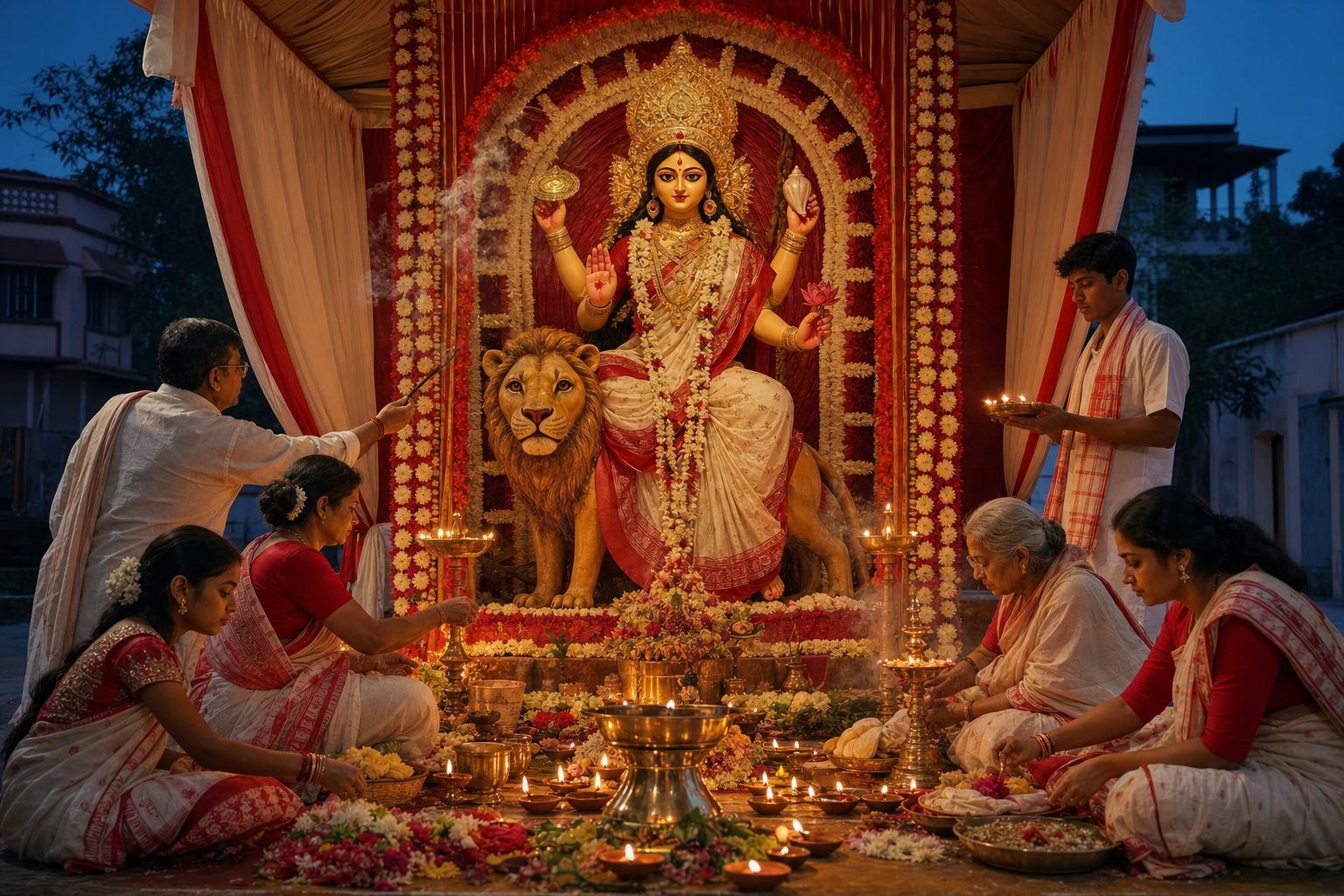
The Jagaddhatri source shifts attention from a narrative episode to a theological function. It presents Jagaddhatri as the Shakti who bears and sustains the moving universe. Maintenance in this account is not passive resistance to change. It is the power that allows transformation to occur without the world losing coherence.
Tri-Sandhya worship locates that sustaining power at morning, midday, and evening. The source interprets these junctions through emergence, fullness, and withdrawal. Dawn evokes awakening and possibility; midday emphasizes nourishment, activity, and responsible action; evening turns awareness toward inwardness and release. The Goddess does not become three unrelated beings. The phases disclose different modalities of one Shakti.
This example broadens the discussion of Puranic devotion because it belongs to a Shakta and Tantric ritual ecology rather than functioning simply as a staged retelling of one story. The source associates Jagaddhatri with multiple texts, ritual digests, regional customs, and transmitted lineages, while warning that their descriptions are not uniformly standardized. The comparison should therefore preserve the difference between Vaishnava narrative, Shakta theology, and lineage-specific ritual practice.
Even with those differences, the underlying devotional process is comparable. Ritual asks practitioners to recognize cosmic meaning within recurring time. Morning intention, midday responsibility, and evening release become more than practical divisions of a schedule. Repetition trains perception until sustaining power is sought within ordinary change rather than only in exceptional sacred events.
The ritual medium also reveals why variation need not imply disorder. Correspondences involving color, form, vehicle, or associated deity may differ by lineage, according to the source. What holds the practice together is not necessarily one universally fixed visual scheme, but the disciplined relation among mantra, visualization, time, theology, and transmitted instruction.
Theatre makes sacred conflict a collective ordeal
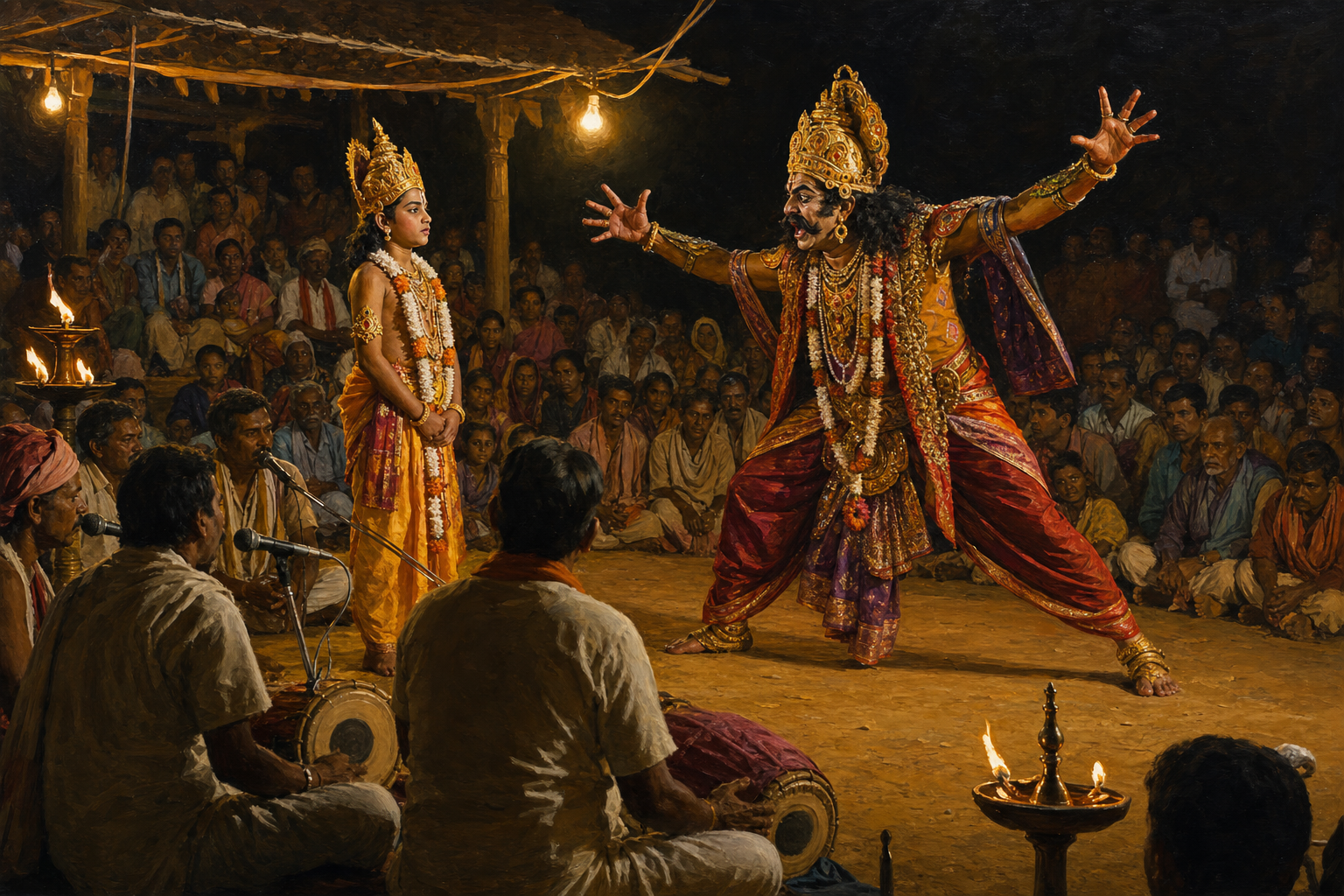
Prahallada Nataka transforms the account of Prahallada, Hiranyakashipu, and Narasimha into an extended encounter among royal command, devotional conscience, and divine intervention. As described in the HinduPost profile, Prahallada’s constancy confronts a father and ruler who cannot compel spiritual submission. Narasimha resolves the conflict through a form that exceeds the categories on which Hiranyakashipu’s apparent security depends.
The theatre does not communicate this opposition through dialogue alone. The source describes an open performance area, a raised structure and throne marking Hiranyakashipu’s authority, visible musicians, elaborate costume, processional movement, and a coordinating singer-director or sutradhar. Spatial arrangement makes power visible before the conflict is fully explained: ruler, devotee, musicians, and audience occupy a shared dramatic field.
Music provides much of the form’s internal structure. The profile reports a commonly documented repertoire of 126 songs using approximately thirty-five ragas and six talas, while also noting that larger totals appear in accounts of extended versions. Those qualifications are important. A living performance tradition may have textual enumerations, local repertoires, and expansive presentations that do not produce one uncontested count.
The source further reports that a complete presentation can continue for much of the night and, in extended form, for approximately twelve hours. Such duration changes spectatorship. The audience does not merely receive a compressed plot; performers and viewers sustain concentration, anticipation, fatigue, music, and devotion together. Puranic conflict becomes a communal vigil.
The profile’s account of Simanchal Patro shows why this medium requires living custodians. It reports that Patro received the Padma Shri in 2026 after nearly eight decades devoted to Prahallada Nataka, including performance, teaching, and support for its akhadas. A written script can preserve verses, but it cannot by itself reproduce breath, melodic phrasing, rhythmic movement, characterization, or the corrections through which a teacher forms a performer.
Theatre therefore preserves sacred narrative through renewable embodiment. Unlike a sculpture, it must be recreated for each gathering. Unlike a daily rite, it distributes roles across a performing community. Its continuity depends on the successful transmission of an integrated grammar of music, movement, language, memory, and devotion.
Key takeaways
- Sculpture gives Puranic theology a durable location, allowing a temple threshold to communicate both protection and moral accountability.
- Ritual places theology within recurring time, training devotees to perceive manifestation, sustenance, and withdrawal as related movements.
- Theatre makes sacred conflict embodied and communal, combining narrative with music, movement, duration, and audience participation.
- Each medium preserves authority differently: sculpture through material form and placement, ritual through lineage and disciplined repetition, and theatre through teachers and performers.
- Responsible interpretation preserves uncertainty, whether identifying guardian figures, comparing lineage-specific worship, or describing variable theatrical repertoires.
Future preservation will be strongest when images, ritual calendars, performance repertoires, and living communities are studied together. Protecting an object while neglecting its interpretation, or recording a script while losing its pedagogy, preserves only part of the devotional world that gave it meaning.
References
- DharmaRenaissance Blog — Jaya and Vijaya Revealed: The Four-Armed Guardians of Vishnu’s Sacred Threshold
- DharmaRenaissance Blog — Tri-Sandhya Shakti: How Jagaddhatri Sustains the Cosmos Through Every Phase of Day
- HinduPost — Padma Shri 2026 Honours Simanchal Patro, Legendary Guardian of Prahallada Nataka