
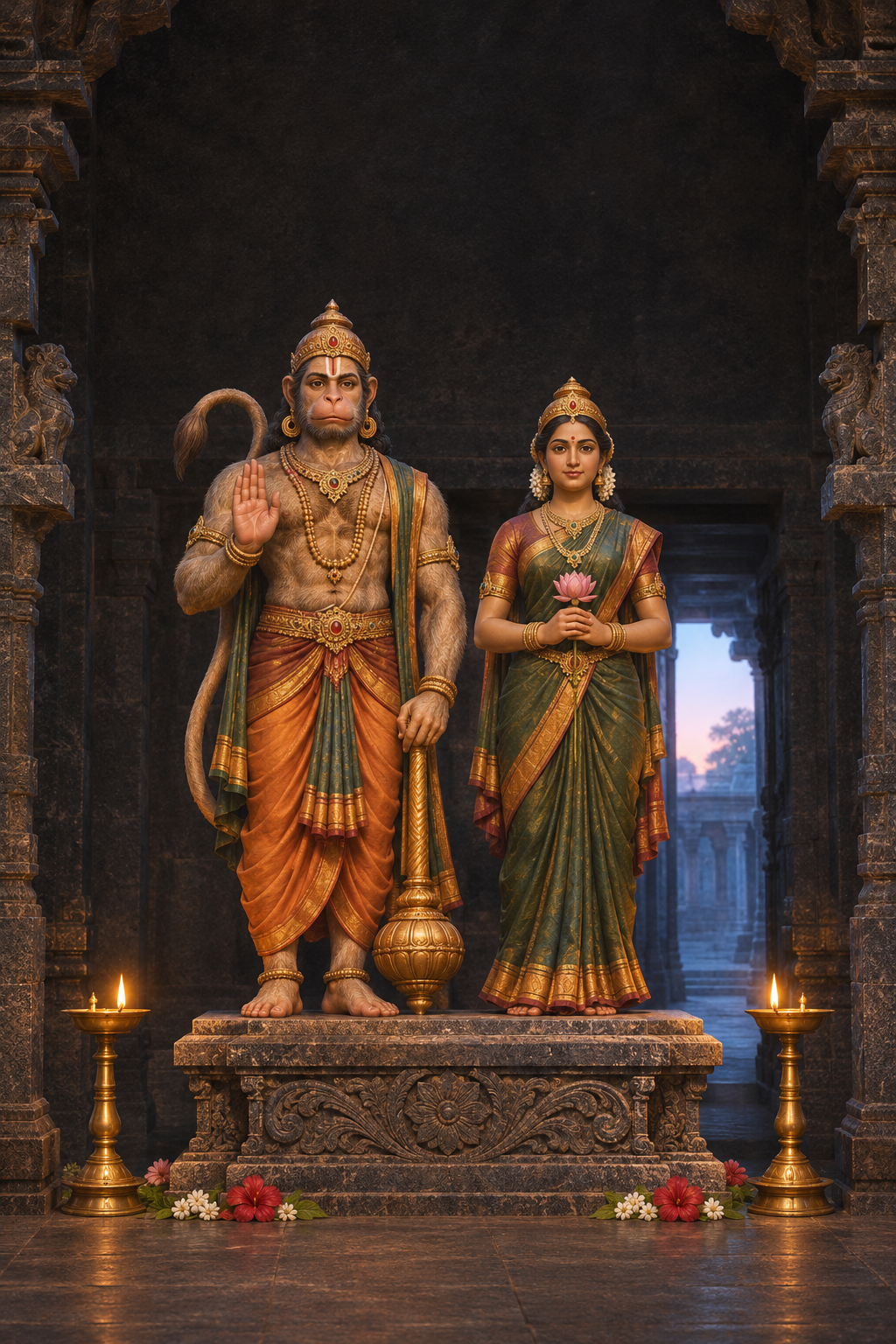
If you have found an image captioned Suvarchala-sameta Hanuman, you may be facing an immediate question: how does a female figure beside Hanuman fit the familiar understanding of him as a brahmachari? Do not try to settle that question from the pairing alone. First establish what the image is; then interpret it within the tradition that preserves it.
Hanuman is most commonly represented as a celibate devotee through visual modes of humility, service, and valor, whereas the Suvarchala-sameta form is exceptionally rare. That rarity makes careful identification more important, not less. Here is how you can examine the image without dismissing it, sensationalizing it, or making it carry more theology than the available evidence allows.
First identify the form, then interpret it
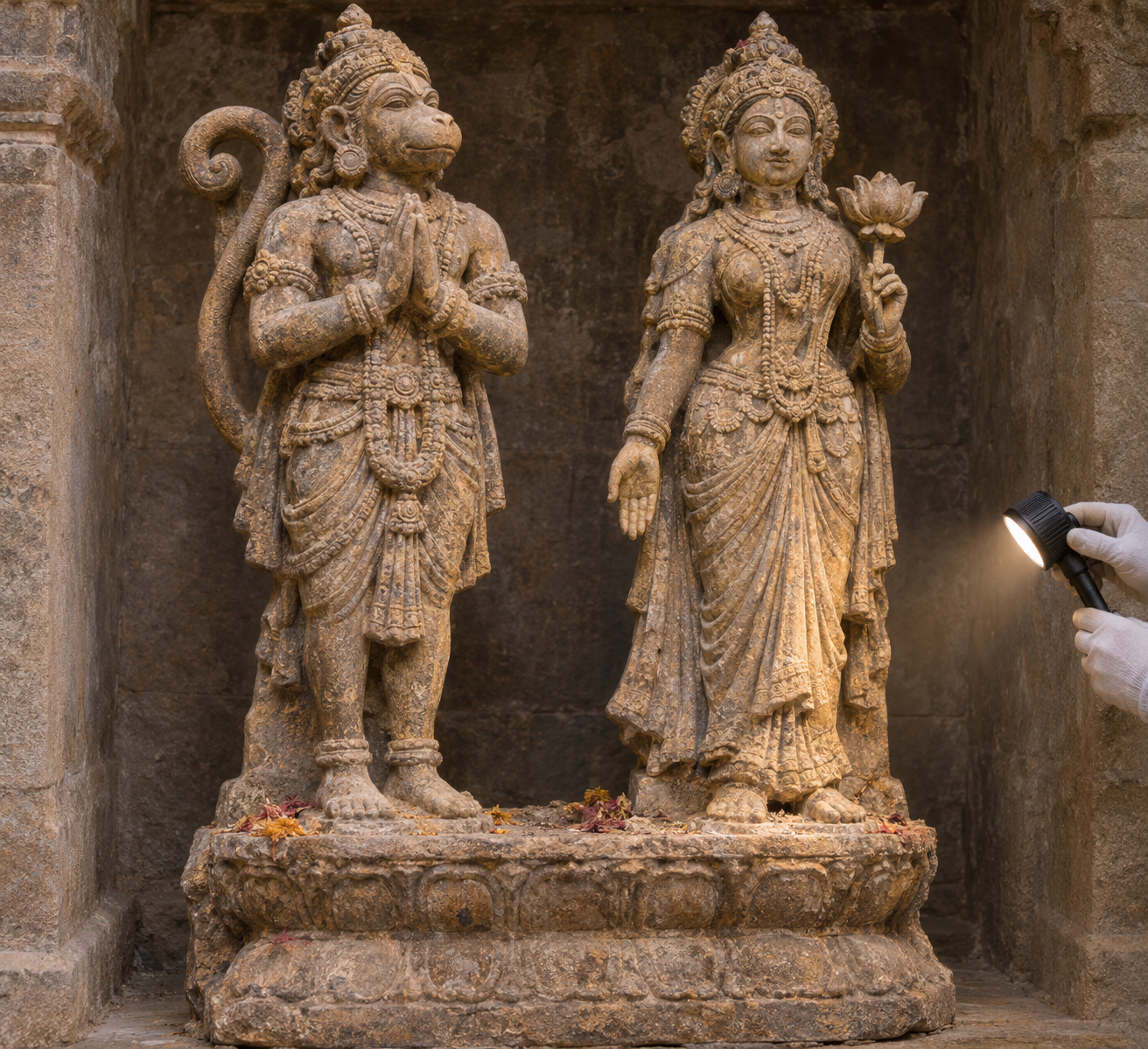
In the compound name Suvarchala-sameta Hanuman, sameta tells you that Hanuman is presented together with Suvarchala. It establishes association within the form-name. It does not, by itself, explain every theological claim that a particular community may attach to the pairing.
A male figure identified as Hanuman beside an unnamed female figure is not enough to confirm the form. Before repeating a caption or building an argument around the image, work through four checks:
- Find the naming evidence. Look for a temple label, inscription, catalogue entry, published description, or explanation from the people responsible for the image. You need evidence identifying both Hanuman and Suvarchala.
- Establish the image’s setting. Record whether it belongs to a functioning temple, a subsidiary shrine, a museum collection, a procession, or a modern devotional display. Context often determines what kind of claim the image can support.
- Examine the complete composition. A cropped photograph can omit a pedestal, attendant, emblem, inscription, or neighboring deity that changes the identification. Seek a frontal view of the whole image and, where permitted, additional views.
- Preserve the local name exactly. Do not silently replace a temple’s ritual name with a more familiar label. Differences in naming may contain the very distinction you are trying to understand.
If the only evidence is an unattributed social-media caption, describe the identification as possible rather than confirmed. That small qualification protects both the reader and the tradition from a confident but ungrounded claim.
The brahmachari image and the paired form need not cancel each other
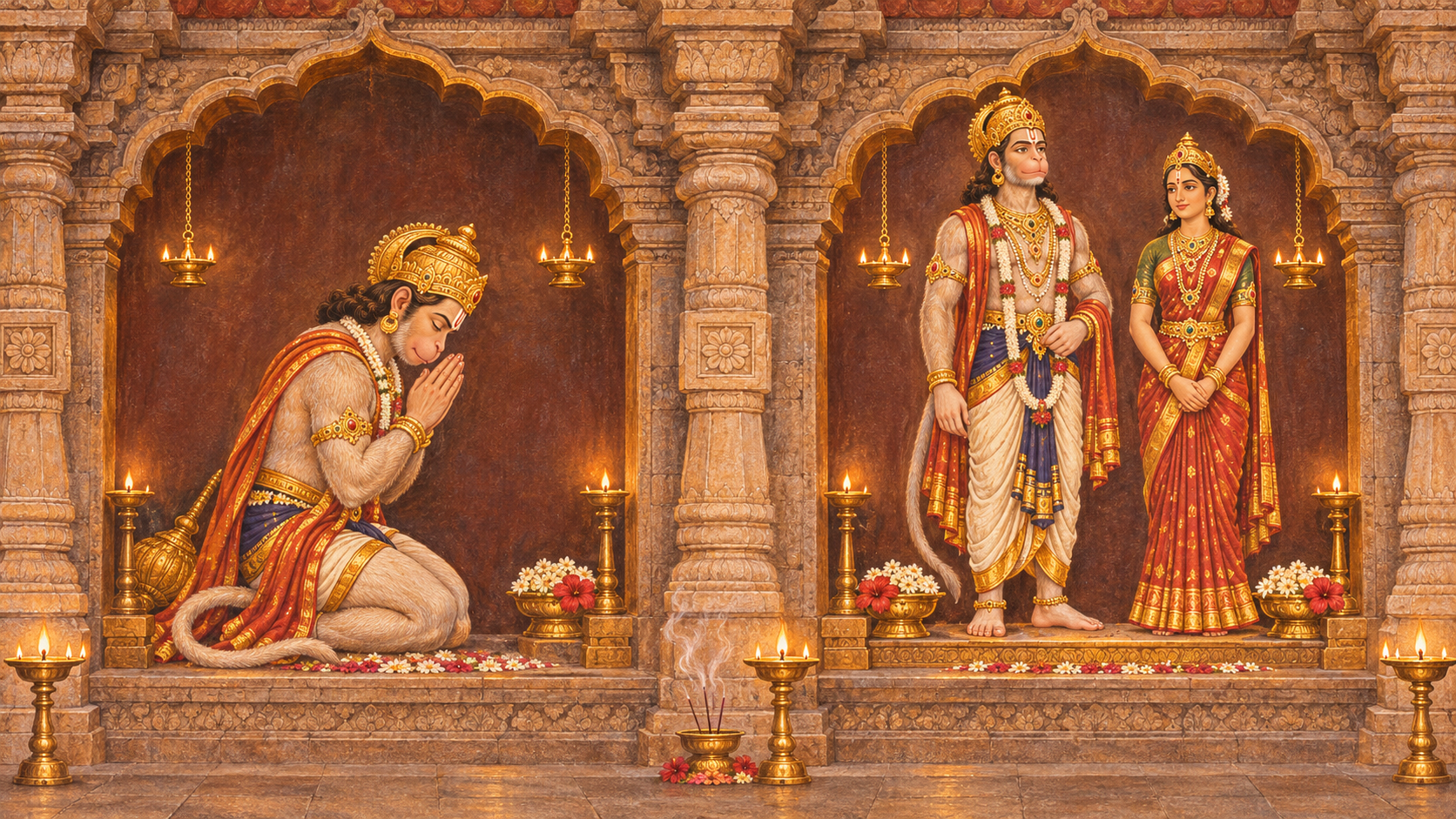
The most common mistake is to treat the most familiar image of a deity as the only permissible one. Hanuman’s brahmachari form remains central to his devotional identity. The existence of a rare paired form does not erase that prominence. Conversely, the dominance of the brahmachari image is not sufficient reason to declare every Suvarchala-sameta image inauthentic.
Sacred iconography is not a modern biographical record. A sculpture can place two sacred figures in a deliberate relationship without supplying, by visual proximity alone, a complete account of how that relationship should be understood. The image may establish that Hanuman and Suvarchala belong together in this particular form, but the exact doctrinal meaning must come from the form’s textual, ritual, and local setting.
Keep three levels of claim separate. Observation tells you that two figures appear together. Identification tells you their names. Interpretation explains why they are together. Confusion begins when someone jumps from the first level directly to the third.
This distinction also prevents a false all-or-nothing debate. You do not have to choose between honoring Hanuman as a brahmachari and acknowledging a tradition that presents him with Suvarchala. The responsible question is narrower: what does this particular tradition intend this particular form to convey?
Read the visual grammar in three passes
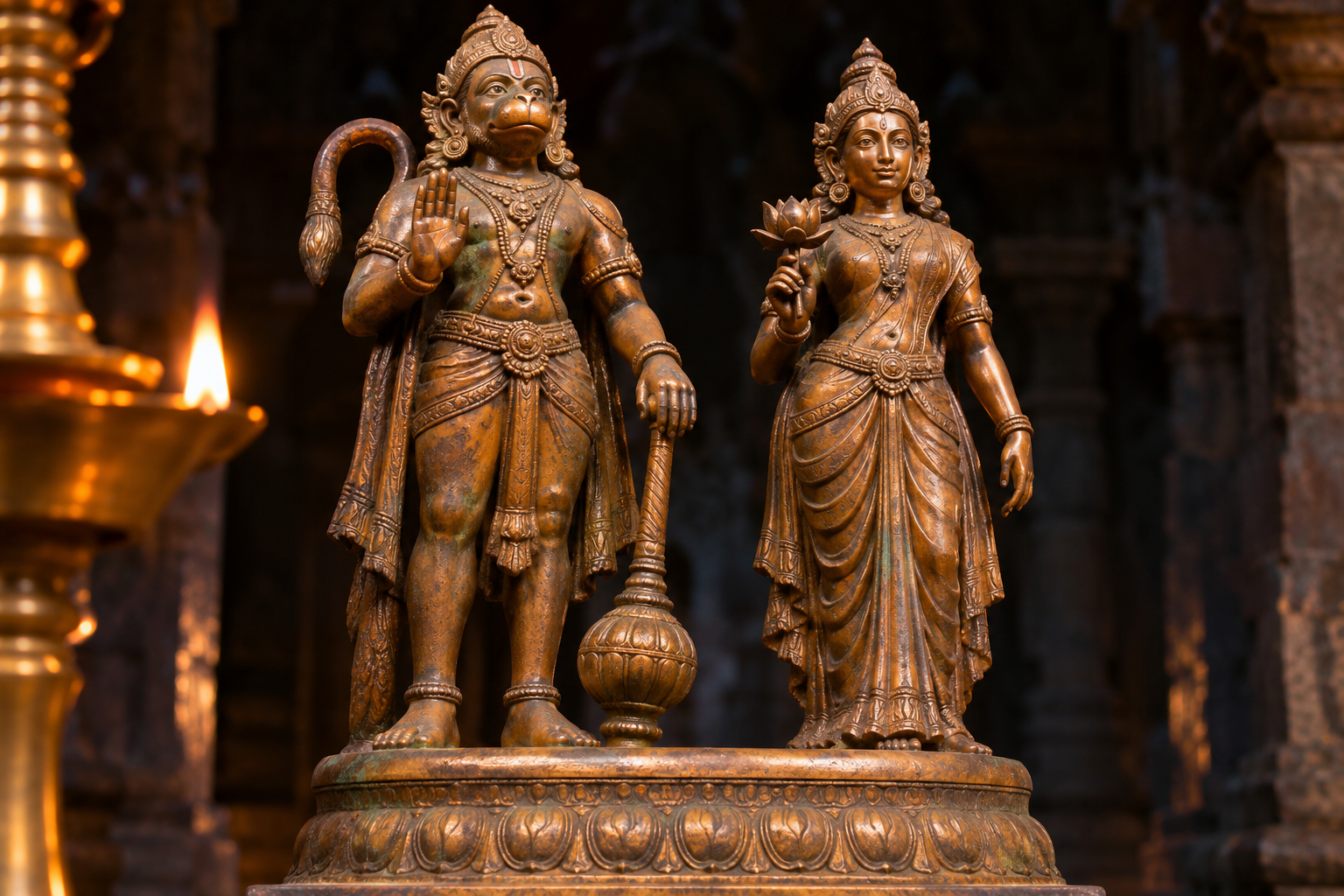
Once the identification is reasonably secure, slow down before assigning symbolism. A useful iconographic reading moves from visible form to contextual meaning in three passes.
- Inventory what is physically present. Note the figures’ relative size, placement, orientation, hand gestures, objects, seats or pedestals, and the distance between them. Record visible damage or later additions. At this stage, describe rather than explain.
- Locate Hanuman’s devotional mode. Familiar Hanuman imagery frequently emphasizes humility, service, or valor. Ask which of those qualities, if any, the posture and composition foreground. Do not assume that the presence of Suvarchala automatically displaces Hanuman’s established devotional character.
- Examine how the composition relates the figures. Are they balanced in scale, arranged hierarchically, oriented toward one another, or joined by a shared central axis? These features help you formulate questions, but they do not independently prove a marriage narrative, philosophical allegory, or ritual doctrine.
Write your observations down before consulting an interpretation. This prevents a memorable explanation from overwriting what the image actually shows. If photography is permitted, include the label and wider shrine setting in your record rather than saving only a close crop of the figures.
Also resist the urge to construct a universal checklist from one example. A rare form can vary across regions, workshops, temples, and periods. One sculpture may help you recognize a possibility; it cannot establish that every valid Suvarchala-sameta image must reproduce all its features.
Ask the local tradition four precise questions
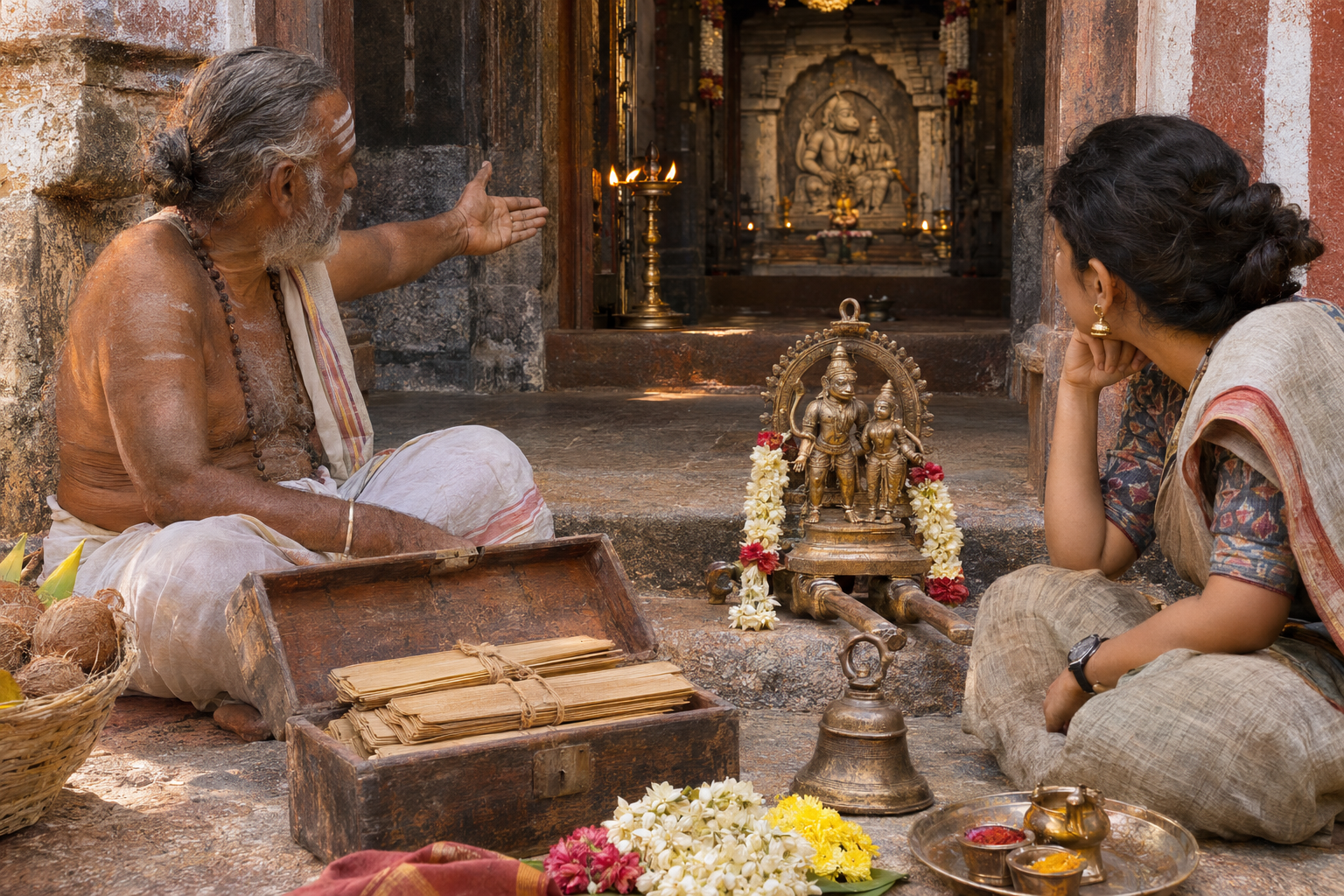
The strongest explanation will usually come from someone responsible for the image’s worship, preservation, or documentation. Broad questions such as whether Hanuman was married tend to invite broad arguments. Ask questions tied to the object in front of you instead:
- What is the full ritual or catalogue name of this form?
- How is the accompanying figure identified as Suvarchala?
- Which narrative, teaching, or worship practice explains why the two figures appear together here?
- How does this community understand Hanuman’s brahmacharya in relation to this image?
Record the answers in the speaker’s own terms. If you publish them, identify the temple, collection, or community whose interpretation you are reporting. A local explanation becomes misleading when it is stripped of its location and presented as the single position of all Hindu traditions.
Your caption should reflect the strength of your evidence. For a verified identification, use a form such as: Suvarchala-sameta Hanuman, identified by [temple or collection], [place]. Add the local interpretation separately and attribute it. If verification is unavailable, write: Possible depiction of Suvarchala-sameta Hanuman; identification unconfirmed.
Key takeaways
- Suvarchala-sameta Hanuman is an exceptionally rare form beside Hanuman’s much more familiar brahmachari imagery.
- The word sameta establishes that the figures are presented together; it does not, on its own, settle the complete theology of their relationship.
- A sound identification requires names, provenance, and the complete composition, not merely the appearance of two adjacent figures.
- The paired image does not automatically negate Hanuman’s celibate devotional identity, and that identity does not justify dismissing the rare form without examination.
- When discussing a specific image, separate what you can see, what can be securely identified, and what the preserving tradition says it means.
The next time you encounter this form, begin with the label, the setting, and the full composition. Then ask the custodians how they name and worship it. That sequence lets you recognize the breadth of Hanuman’s iconography while remaining honest about what one rare sculpture can – and cannot – establish.
References

Leave a Reply
You must be logged in to post a comment.