
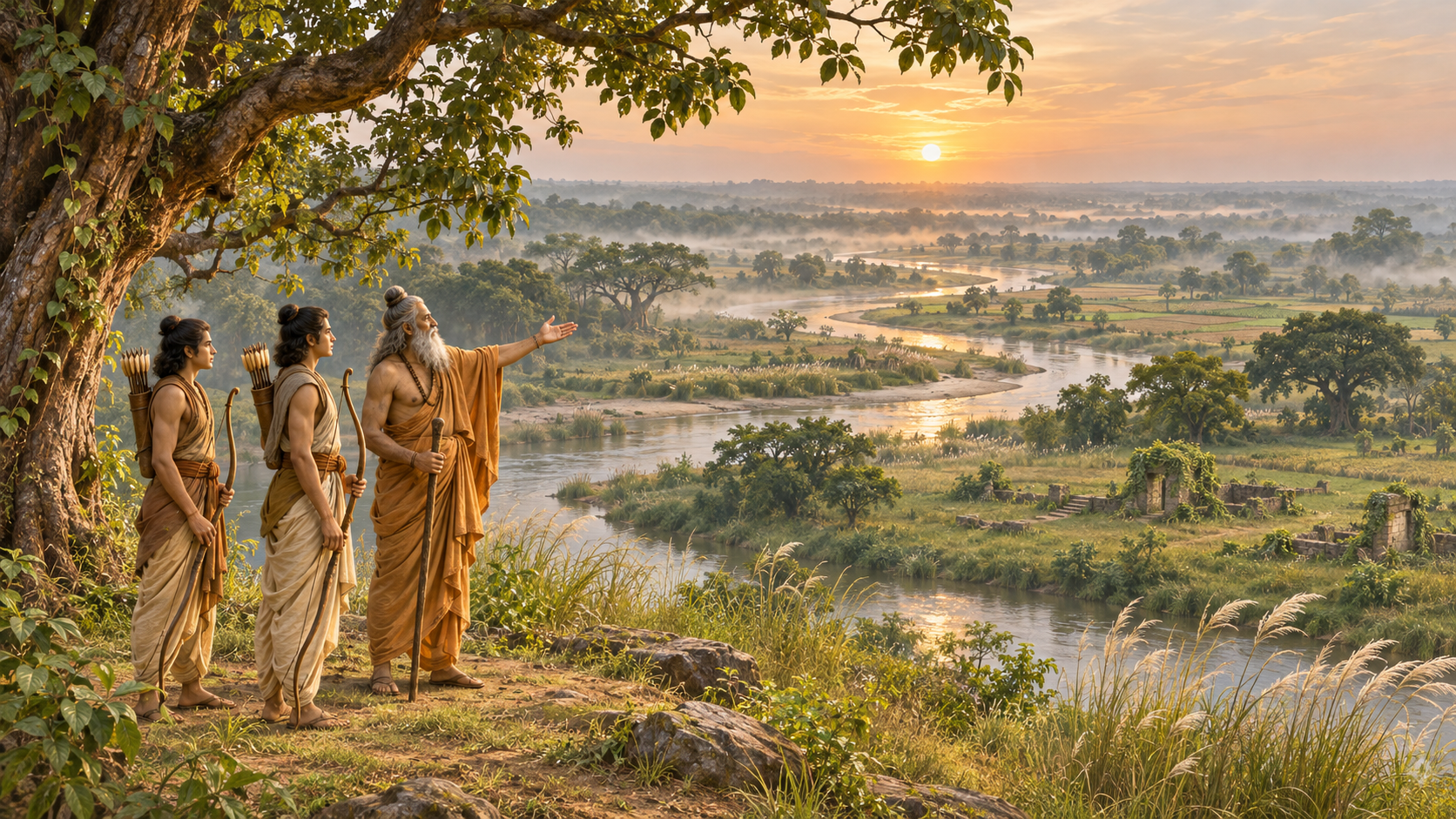
If you have encountered Malada and Karusha while reading the Ramayana, you may have wondered why two little-discussed regions deserve your attention. The useful question is not merely where they were. It is why Vishwamitra pauses a journey to teach Rama and Lakshmana about the past of the land beneath their feet.
That pause changes how you read the episode. Malada and Karusha are not decorative names on an ancient map. Their remembered rise and decline turn geography into a lesson about civilizational continuity: a society inherits order, but it must keep producing the conduct, memory and institutions that sustain that order.
Begin with what the Ramayana actually places before you
The account occurs in Bala Kanda, Chapter 23. Rishi Vishwamitra tells Rama and Lakshmana about Malada and Karusha as they pass through the area. Four elements therefore belong together: a remembered place, a knowledgeable teacher, attentive learners and a journey through the physical landscape.
Those elements give you a disciplined starting point. The episode is not an isolated tale inserted only to explain two names. Vishwamitra is teaching the princes how to see. They must learn that a landscape has a history, that present conditions can have older causes and that responsible leadership requires more than noticing what is visible at the moment.
This also prevents a common mistake. Do not begin by forcing Malada and Karusha into a modern political boundary and then treating the identification as the meaning of the passage. Historical geography is a valid inquiry, but a proposed modern location needs evidence of its own. The narrative function is already clear without pretending that every cartographic question has been settled.
When you meet a place-name elsewhere in an Itihasa, use the same sequence: first identify who is speaking, who is listening and why the history is being told at that moment. Only then move to symbolism or present-day application. This keeps interpretation connected to the text rather than to whatever argument a modern reader hoped to find.
Malada and Karusha make the land a bearer of memory
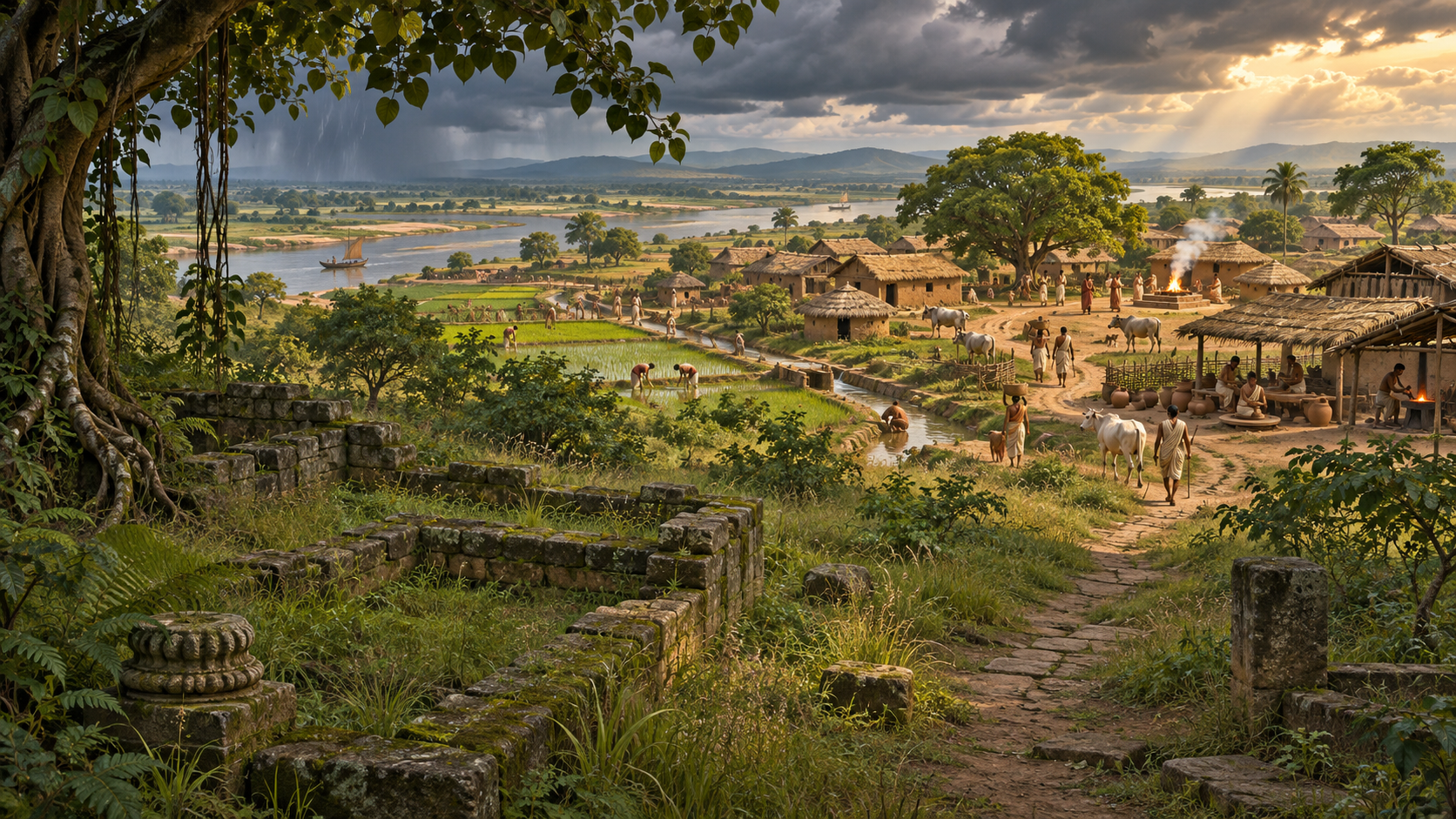
A journey normally pushes the plot forward. Here, movement through space opens a window into time. The travellers do not simply cross terrain; they encounter a region whose present can be understood only by remembering its past. The land becomes a record of civilizational consequence.
That is an important Dharmic way of seeing geography. A place is more than soil available for possession or extraction. Human conduct gives it associations. Communities give it names. Teachers preserve what happened there. Later generations inherit both the place and the memory attached to it.
You can notice four movements in this civilizational lens:
- Identity must be formed. A named region represents more than empty space; it has entered human memory as a distinct place.
- Order can be disturbed. Civilizational standing is not automatically permanent merely because it once existed.
- Consequences can outlast their immediate causes. A later generation may live among conditions produced before its own time.
- Memory can restore moral perception. Vishwamitra’s teaching allows the young princes to understand more than their eyes alone could disclose.
This is why forgetting is not a neutral act. When a community forgets how a sacred site, custom, language or institution was sustained, it also loses the ability to explain why that inheritance is weakening. It sees the result but not the chain of choices behind it.
Memory, however, is not the same as nostalgia. Nostalgia selects a pleasing image of the past and asks you to admire it. Civilizational memory identifies what was built, what preserved it, what damaged it and what responsibility now falls upon the inheritor. The first produces sentiment. The second can guide action.
The warning is against complacency, not confidence
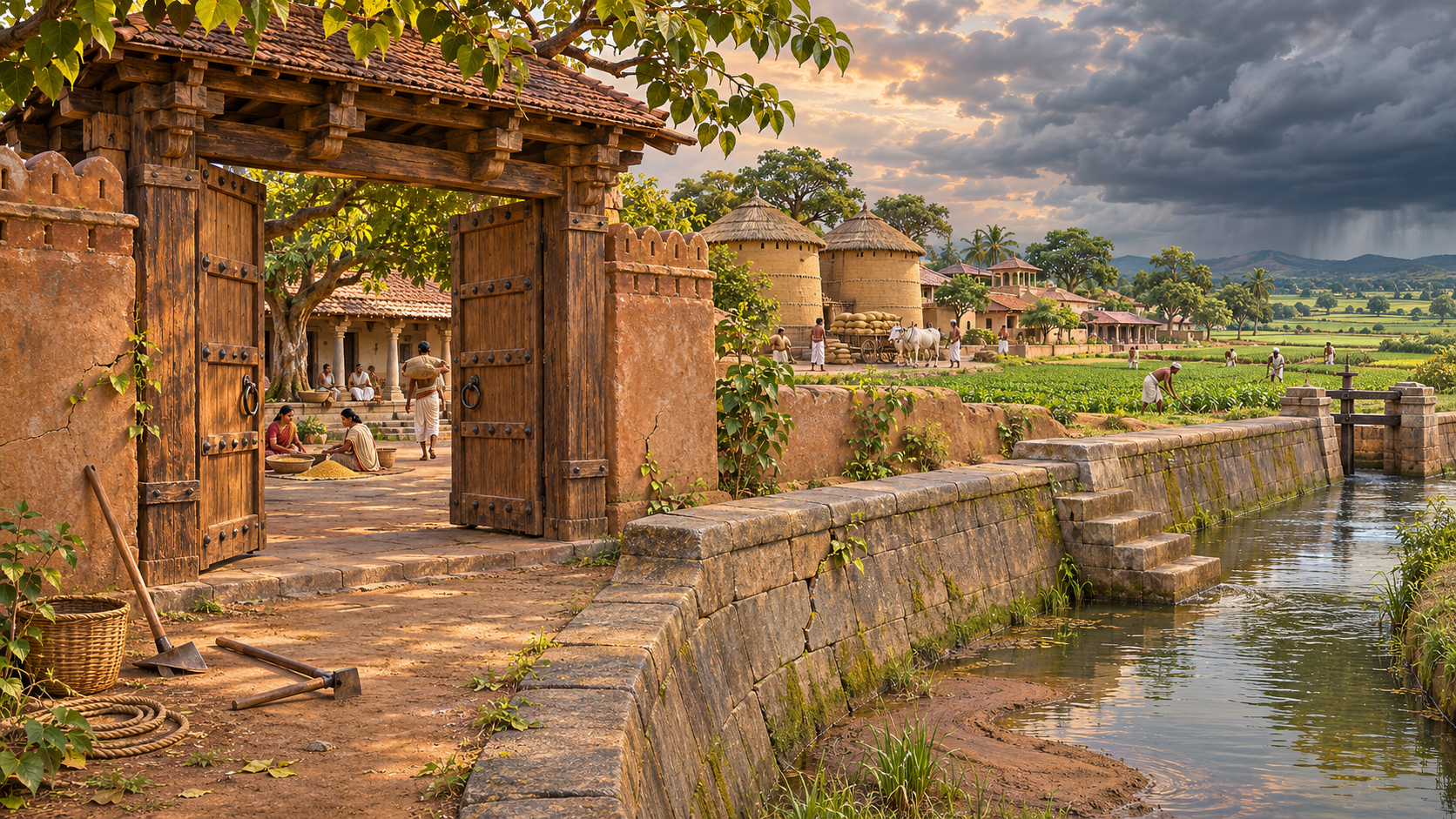
The rise and fall associated with Malada and Karusha should not be turned into a mechanical theory that every civilization must decline on schedule. Nor does it teach that material hardship proves moral failure in every case. Its sharper lesson is that inherited greatness does not exempt a society from the work of preservation.
That distinction matters for anyone who cares about Hindu civilization. Confidence says that an inheritance is valuable and worth carrying forward. Complacency assumes that the inheritance will survive without disciplined transmission. The first can support renewal; the second quietly spends civilizational capital accumulated by earlier generations.
A pro-dharma reading must therefore be willing to examine internal responsibility. It is easy to name an external threat. It is harder, but often more useful, to ask whether families teach the meanings behind their practices, whether temples preserve records, whether institutions prepare successors and whether children encounter a living tradition rather than a collection of slogans.
Three distinctions help you apply the warning without distorting it:
- Continuity is not mere survival. A name can remain while the knowledge, discipline and relationships that gave it substance disappear.
- Renewal is not reenactment. Preserving a principle does not always require copying every historical social arrangement associated with it.
- Accountability is not civilizational self-contempt. Honest diagnosis is an act of loyalty when it identifies something that can still be repaired.
This balance protects you from two weak readings. One reduces the episode to a slogan about lost glory. The other treats decline as proof that inherited traditions had no value. Malada and Karusha support neither shortcut. Their value lies in making continuity conditional upon remembrance, conduct and renewal.
Use the episode as a five-question continuity audit
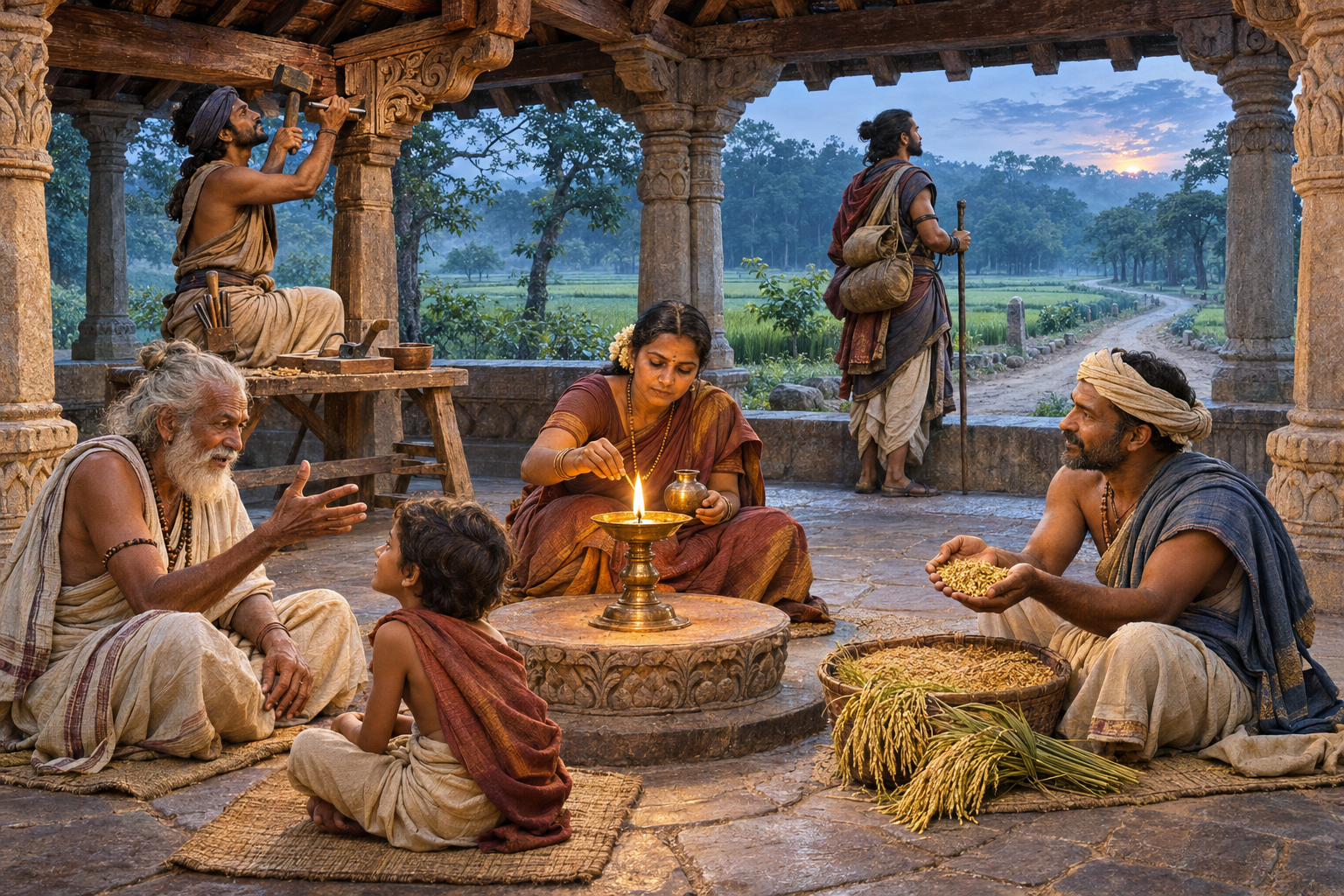
You do not need responsibility for an entire nation before this teaching becomes practical. Apply it to one inheritance within your reach: a family observance, a temple, a language group, a community archive, a teaching lineage or a cultural association. Then answer five questions in writing.
- What exactly have we inherited? Name the practice, body of knowledge, place or institution. Avoid broad answers such as “our culture.”
- Which repeated action keeps it alive? Identify the actual mechanism of transmission: teaching, recitation, maintenance, apprenticeship, documentation, financial support or participation.
- Where is that chain becoming weak? Look for a missing teacher, untranslated material, undocumented procedure, neglected building, ageing volunteer base or practice performed without explanation.
- What evidence of decline is already visible? Choose something observable, such as cancelled observances, lost records, declining participation or dependence on one person who has no successor.
- What can be transferred within the next cycle? Select one concrete handoff: record an oral history, train a second organiser, catalogue documents, teach the meaning of one ritual or establish a maintenance schedule.
The fifth question is the point at which admiration becomes continuity. A tradition survives because somebody knows what to do next, why it matters and how to teach another person. If all three remain inside one elder’s memory, the community possesses knowledge but has not secured transmission.
Use the same audit before invoking civilizational decline in public debate. Ask whether the claim identifies a real mechanism or merely expresses unease. A useful diagnosis names what is being lost, how the loss is occurring and which action could interrupt it. Without those three elements, the language of decline easily becomes theatrical pessimism.
There is another boundary worth keeping. Do not use the episode as a blank cheque for condemning whichever contemporary group you dislike. Vishwamitra’s instruction invites historical and moral attention; it does not remove the need for evidence. A Dharmic argument should become more precise as its consequences grow, not less.
Key takeaways
- Malada and Karusha matter because Vishwamitra uses remembered geography to educate Rama and Lakshmana about more than the surface of a place.
- The passage is best approached through its narrative setting before attempting a modern geographical identification or elaborate allegory.
- Its civilizational warning is not that decline is inevitable, but that inherited order does not preserve itself.
- Memory becomes useful when it identifies the practices and institutions that create continuity; nostalgia stops at admiration.
- You can apply the lesson by choosing one inheritance, locating its weakest point of transmission and arranging one concrete handoff.
The next time you reach Malada and Karusha in the Bala Kanda, pause where Vishwamitra pauses. Choose one piece of Dharma within your own reach and ask who will understand it, practise it and transmit it after the present custodians are gone. Then secure that next link while it is still possible.
References

Leave a Reply
You must be logged in to post a comment.