
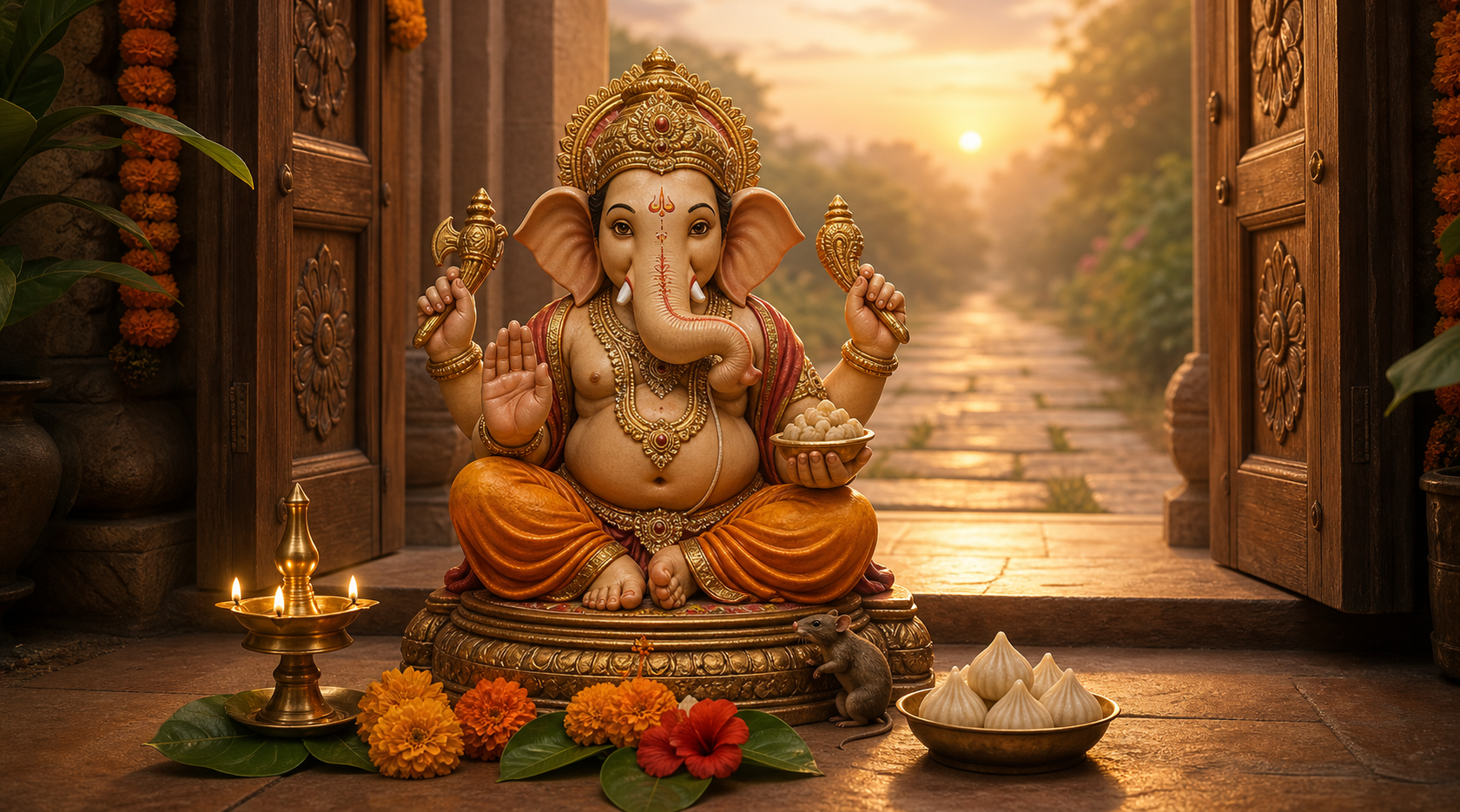
You may be standing before Ganesha because something is about to begin: an examination, a journey, a business, a move, or a difficult conversation. The useful question is not only what his symbols mean. It is how reverence for Ganesha should change the next thing you do.
Start with what you can practice. You do not need to master all thirty-two traditional forms of Ganesha before approaching him. You need a clear intention, a respectful act of worship, and a willingness to let the symbolism correct your conduct.
Begin with the obstacle you can name
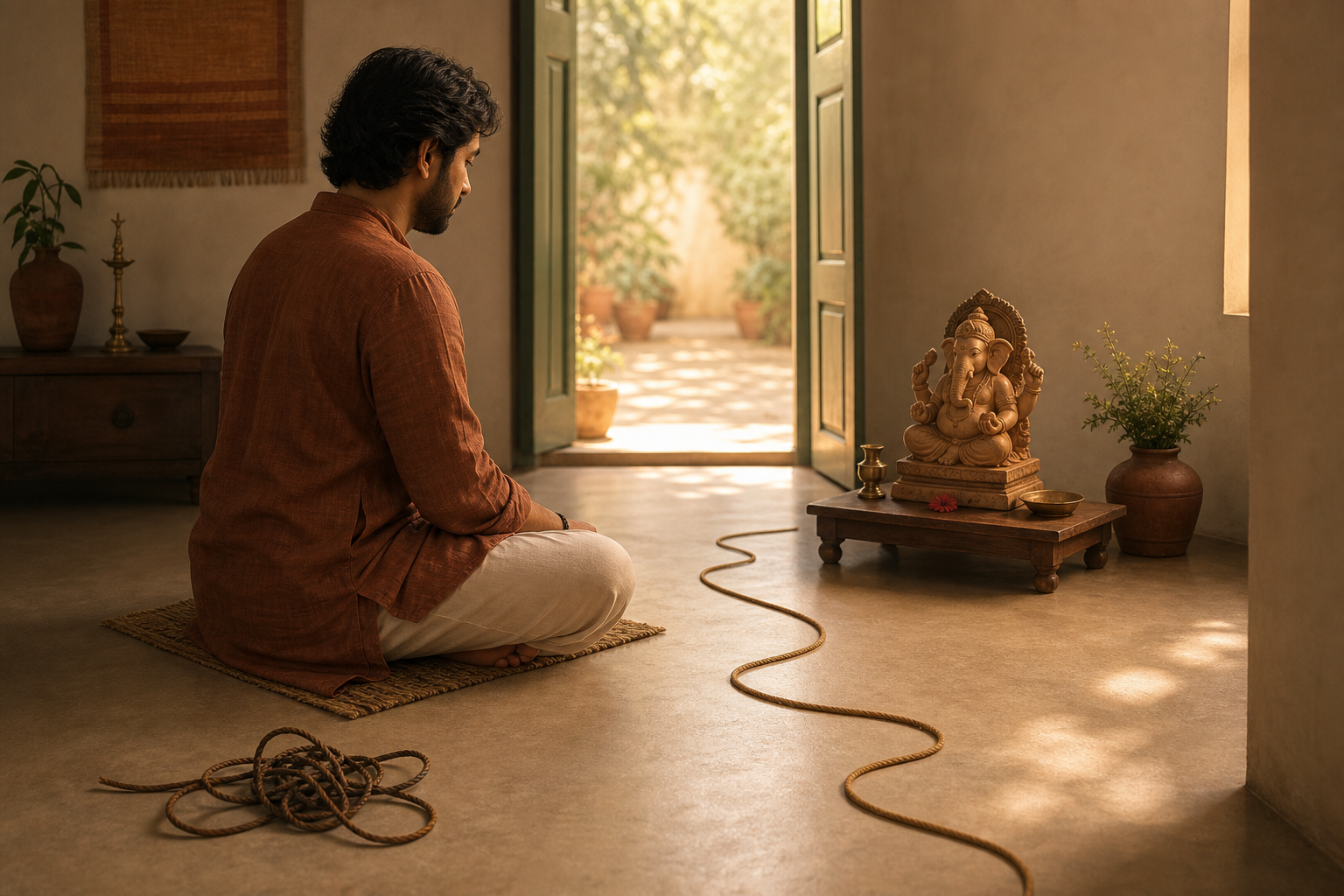
Ganesha is Prathama Pujya, the deity customarily invoked before a major puja, yajna, journey, or undertaking. This precedence contains a practical discipline. Before asking for success, make your intention clear and your mind fit for action.
His names clarify that role. Ganesha is the lord of the ganas, while Ganapati is their chief. Vighneshwara expresses mastery over vighnas, or obstacles. Vinayaka similarly points toward the removal of impediments, while Pillaiyar carries the devotion into Tamil religious life. These are not merely interchangeable labels. Each name helps a devotee approach a particular aspect of Ganesha’s presence.
Before your next invocation, name the undertaking in one sentence. Then distinguish three things: the obstacle outside your control, the habit within your control, and the next rightful action available to you. If you are beginning a course of study, for example, an external obstacle may be limited time, an internal obstacle may be distraction, and the available action may be one uninterrupted hour with the first chapter.
This prevents devotion from becoming a request for difficulty to vanish while responsibility remains untouched. Ganesha’s associations with Buddhi, Siddhi, and Riddhi connect wisdom, accomplishment, and prosperity. Read together, they reject the shortcut model of success: intelligence, ethical intention, and sustained effort must accompany the blessing being sought.
The Ganapati Atharvashirsha carries this understanding beyond good fortune and into non-dual philosophy. Ganesha stands at the threshold not only of an event, but also of a better way of seeing the self, the world, and the action that joins them.
Read the murti as a discipline for the mind
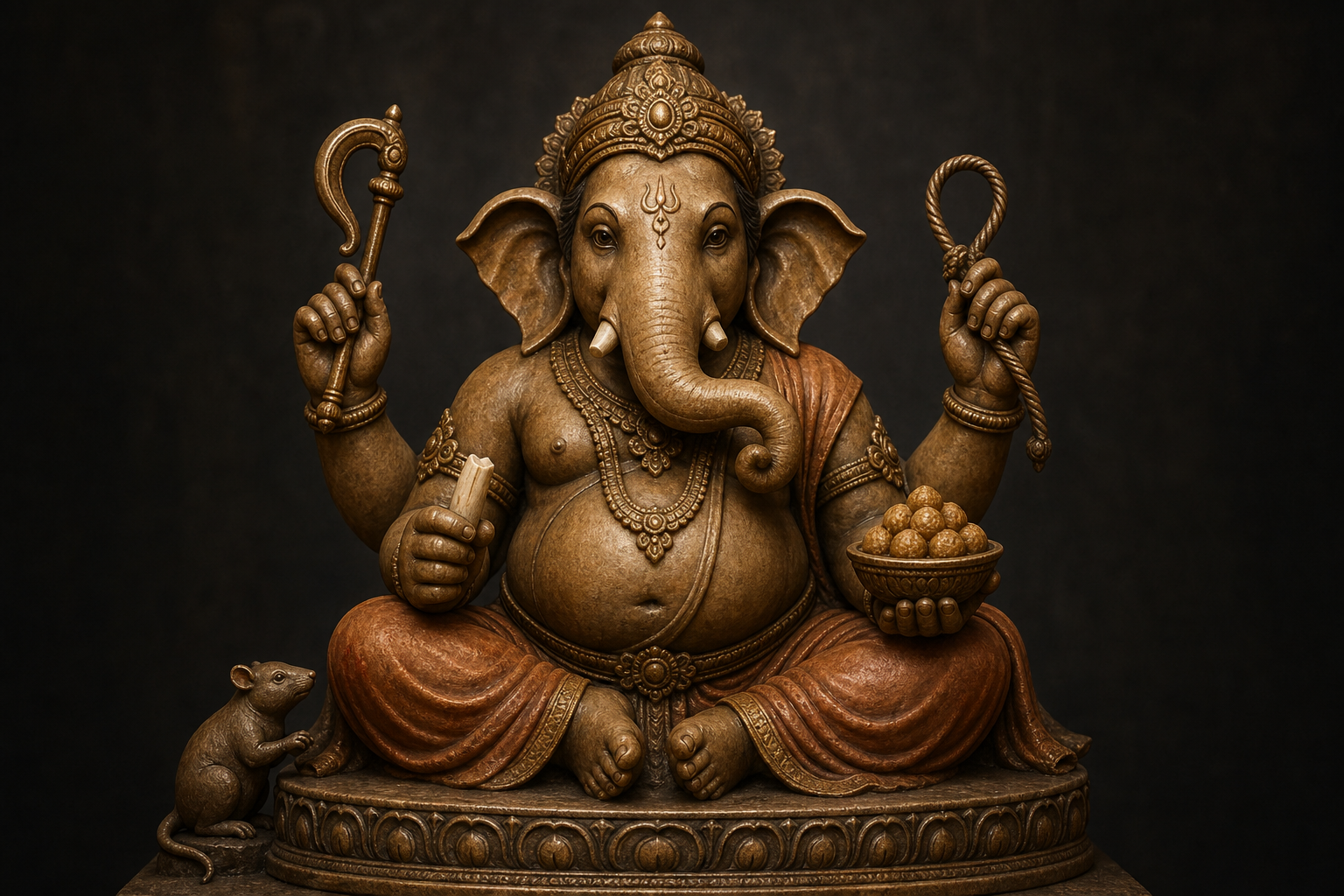
Ganesha’s murti, or sacred image, should not be reduced to a collection of decorative curiosities. Its elements form a practical grammar. Each one identifies a capacity to cultivate or an impulse to bring under dharmic direction.
| Element | Traditional meaning | What to practice |
|---|---|---|
| Elephant head | Expansive intelligence and steady memory | Enlarge your view before reacting, and remember the duty that should govern the decision. |
| Large ears | The primacy of listening in learning | In study, listen before claiming understanding. In conflict, let the other person finish before preparing your reply. |
| Curved trunk | Strength joined to adaptability and precision | Do not use maximum force for every obstacle. Choose the lightest effective action and change method when conditions change. |
| Single tusk, or Ekadanta | Sacrifice, resilience, and the transformation of limitation | Use the means available to complete a worthy duty instead of waiting for perfect conditions. |
| Noose and goad | Restraint of harmful impulses and guidance of the mind | Pair a boundary with a direction: stop the damaging habit, then specify the action that replaces it. |
| Mushika, the mouse | Restless desire and the mind’s subtle, darting movements | Notice the small compulsion before it becomes a large obstruction: the glance at a notification, the needless purchase, or the evasive excuse. |
| Modaka | The inner sweetness of knowledge, humility, and well-performed duty | Treat joy as the fruit of sadhana, not as a reward that must arrive before disciplined effort begins. |
Some traditions also see the curve of the trunk as an echo of Om. This connects the visible form with mantra and reminds you that sacred sound is not separate from attention, understanding, and conduct.
The broken tusk is especially useful because its narratives vary. One account associates it with Ganesha’s self-offering while writing the Mahabharata; another treats it as a divine weapon. The scribe narrative pairs uninterrupted work with the requirement to understand every verse. Its practical lesson is precise: speed without comprehension is not discipline, and sacrifice without a worthy purpose is merely loss.
Do not force every image into one generic decoding chart. The Mudgala Purana presents eight incarnations, each confronting a distinct kind of impediment, while Shilpa and Agama traditions describe thirty-two forms with particular gestures, emblems, and visual characteristics. When you encounter an unfamiliar Ganesha, first notice the posture, number of arms, objects, mudras, and regional setting. Then learn how that temple or sampradaya understands the form.
Build a simple puja you can sustain
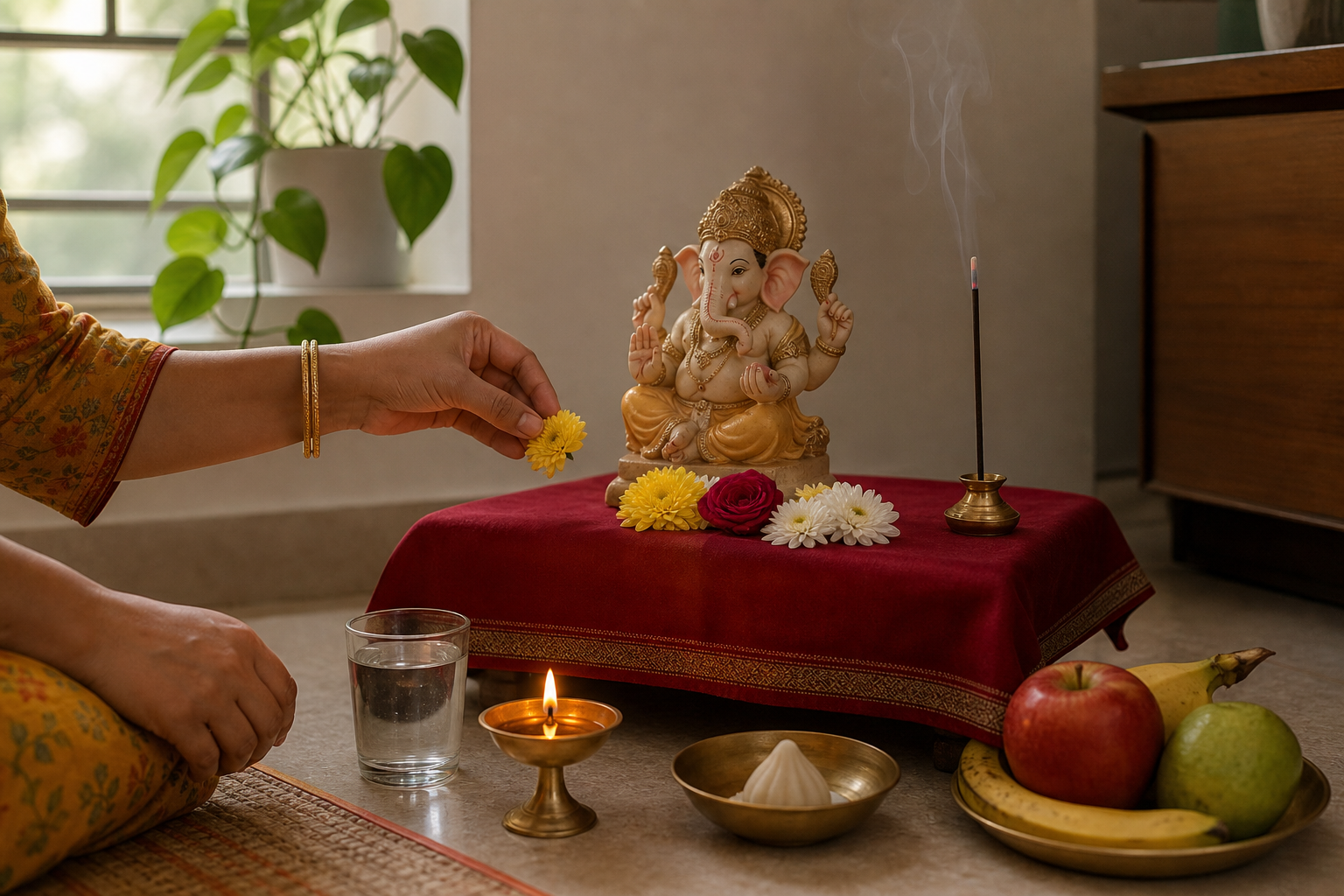
If your household or sampradaya has an inherited ritual method, follow it. The sequence below is intentionally simple. It is suitable for a personal invocation before work, study, travel, or another meaningful beginning; it is not a replacement for temple procedure or formal instruction.
- Prepare a clean place. Place the murti or image on a stable surface. Set out a flower, durva if available, and a simple food offering or modaka. Use a lamp only on a safe base and never leave an open flame unattended; an electric lamp is a sensible alternative where fire is unsuitable.
- State the undertaking. Say plainly what you are beginning and where you need clarity. Avoid an unfocused request for success in everything. A defined intention gives the invocation an ethical direction.
- Invoke Ganesha. Recite Om Gam Ganapataye Namaha carefully and without rushing. If your family or teacher has given you a particular pronunciation, count, or sequence, retain that practice.
- Make the offering. Offer the flower and durva with attention. Durva is often presented in groups totaling twenty-one blades, although inherited customs differ. Its cooling association recalls the account in which durva soothed Ganesha after he consumed the fiery Analasura.
- Close with action. Offer the food, sit briefly in silence, and ask for Buddhi to guide the work ahead. Receive the food as prasada, then complete the first concrete task connected to your intention.
That final step matters. If the puja precedes study, open the book and begin the assigned section. If it precedes reconciliation, write the first truthful and non-accusatory sentence. If it precedes a new enterprise, complete the first neglected duty rather than reaching immediately for publicity. The invocation should cross the threshold into conduct.
You can add a recurring rhythm through Sankashti Chaturthi, observed on Krishna Paksha Chaturthi each lunar month. Many regional practices complete the vrata at moonrise, and an observance falling on Tuesday is known as Angaraki Sankashti. Because the lunar date and moonrise are not fixed by the civil clock, use a reliable local panchanga or temple calendar rather than guessing the timing.
Ganesh Chaturthi brings the practice into community life. Public Ganeshotsav initiatives associated with Lokmanya Tilak helped the celebration become a major setting for cultural education, seva, and social cohesion. If you help organize one, treat environmental care as part of the offering: choose clay murtis where the community permits, plan a responsible immersion, and follow local water and waste guidance before the festival begins.
The Ashtavinayaka circuit in Maharashtra offers another form of sustained practice by joining eight ancient Ganesha temples in one pilgrimage. If you undertake it, learn the customary sequence and temple protocols locally. Do not reduce the journey to collecting eight photographs. Repeated darshana can become a movement through invocation, purification, insight, and gratitude only when the travel itself is disciplined.
Understand the global legacy without flattening it
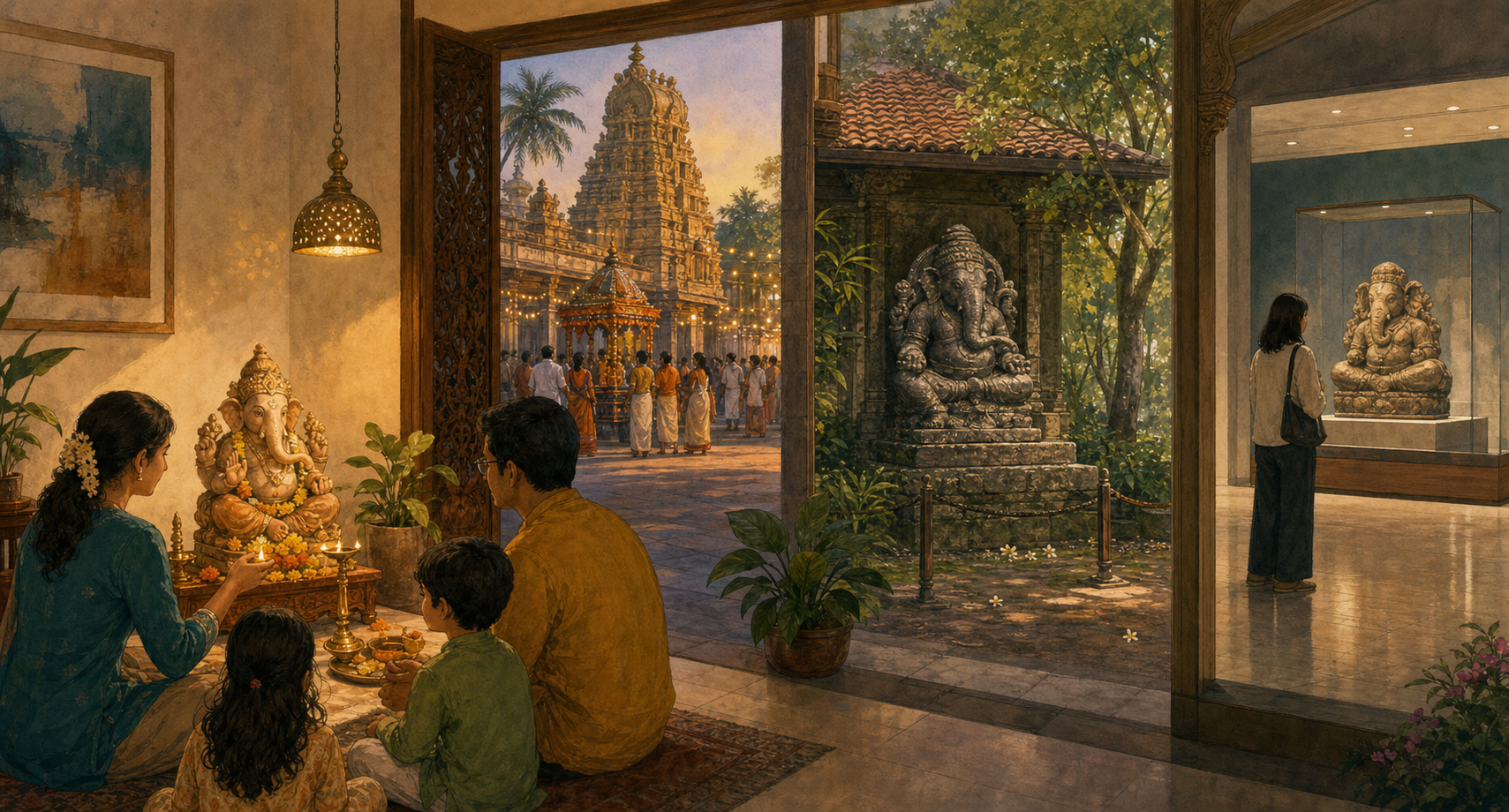
Ganesha’s presence outside a single region is visible in different names, materials, and ritual settings. Pillaiyar shrines are deeply rooted in Tamil life. Medieval Nepal produced Ganesha bronzes, Indonesia preserves temple sculptures, and Thailand knows an auspicious form as Phra Phikanet. Hindu temples across North America, Europe, Africa, and Oceania now sustain daily puja, children’s classes, festivals, and community seva.
This is cultural translation, not evidence that every community understands Ganesha in an identical way. The durable element is a recognizable sacred function joined to local language and aesthetics. When you meet Ganesha in a new setting, ask which name the community uses, what the displayed attributes signify there, and whether the image belongs to temple worship, public celebration, or a particular artistic tradition.
The same care is necessary when discussing other Dharmic religions. Maha Rakta Ganapati appears in Buddhist tantric literature, and Ganesha imagery occurs in certain medieval Jain temples and manuscripts. Sikh teachings on inner discipline and seva can resonate with the ethical work of overcoming impediments, but that resonance does not make Ganesha an object of Sikh worship. Shared values can support mutual respect without erasing distinct scriptures, disciplines, or theologies.
For a respectful encounter, do four things. Use the traditional name given by the host community. Learn the form before assigning it a meaning. Ask before touching an altar or photographing a rite. Support the living practices around the murti—puja, education, seva, and responsible festival observance—instead of reducing Ganesha to a generic lucky-elephant motif.
This distinction also protects Hindu continuity in the diaspora. A sculpture can travel as an aesthetic object, but a living legacy requires people who know how to invoke, teach, serve, celebrate, and transmit. Temples and household practices carry that work from one generation to the next.
Key takeaways
- Invoke Ganesha before an important beginning, then identify the external obstacle, the internal habit, and the next dharmic action.
- Read the elephant head, ears, trunk, tusk, noose, goad, mouse, and modaka as one discipline of intelligence, restraint, adaptability, and earned joy.
- Keep home worship simple when no inherited procedure applies: prepare a clean place, state your intention, chant, offer respectfully, and act.
- Follow family, temple, and sampradaya practice when it differs from a general explanation, especially for mantra counts, offerings, vrata, and pilgrimage.
- Use a local panchanga for Sankashti timing and plan clay murtis and responsible immersion before Ganesh Chaturthi where appropriate.
- Honor Ganesha’s global reach without treating Hindu, Buddhist, Jain, and Sikh traditions as interchangeable.
At your next beginning, place the undertaking before Ganesha and name the obstacle honestly. Make one respectful offering, invoke his guidance, and then perform the first duty you have been avoiding. Let the practice become more elaborate only as your attention, knowledge, and conduct become more disciplined.