
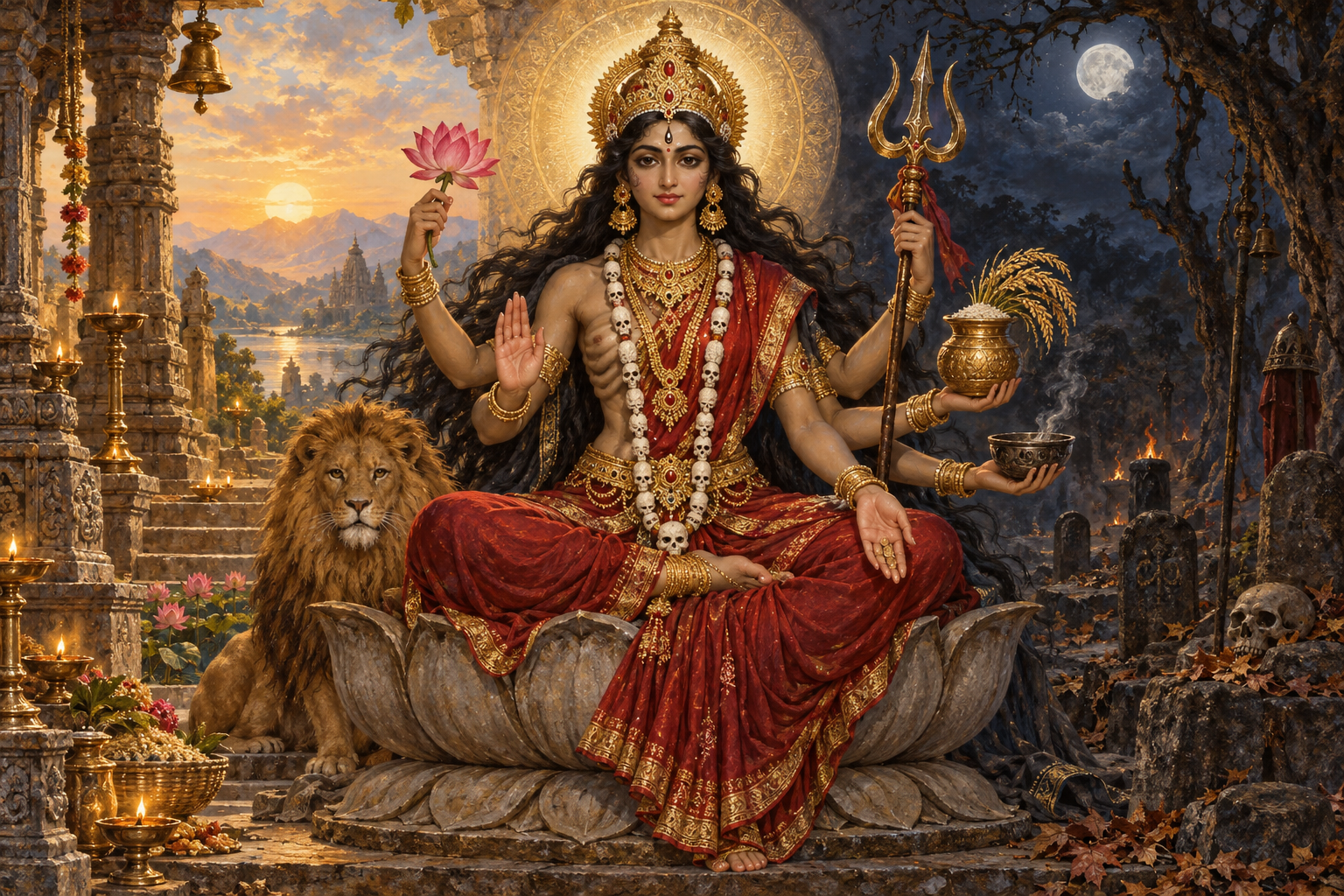
You may have encountered a murti, painting, or description that joins Chamunda and Mahalakshmi and wondered whether the pairing is contradictory. One form appears to confront decay, fear, and attachment; the other carries the promise of auspiciousness and prosperity. Which Goddess are you meant to see?
The most useful answer is not to divide the image into a frightening side and a benevolent side. Read it as a discipline for holding two truths together: you need resources to sustain a dharmic life, yet you must remain free enough to lose, share, or surrender them. The composite form makes sense when prosperity serves dharma and renunciation prevents prosperity from becoming bondage.
The question this form asks you
Our first instinct is often to place spiritual freedom and worldly well-being on opposite sides. One seems to require withdrawal; the other seems to require acquisition. The Chamunda-Mahalakshmi form challenges that split by presenting material prosperity and the search for universal truth within one sacred image.
Mahalakshmi’s presence does not make accumulation an end in itself. Food, shelter, knowledge, skill, time, social trust, and wealth can sustain a household, temple, community, or act of seva. The question is whether you receive and direct those resources responsibly.
Chamunda’s presence prevents that responsibility from hardening into possessiveness. Her austere and fearsome register asks what remains when beauty fades, status falls, certainty disappears, or the objects on which you built an identity are no longer available. In this pairing, renunciation is not neglect of life. It is freedom from being ruled by what supports life.
Use that relationship as a test for any interpretation you encounter. If an explanation praises wealth but removes detachment, it has lost Chamunda. If it glorifies deprivation while treating nourishment, beauty, and household duty as spiritually suspect, it has lost Mahalakshmi. A credible reading must preserve both.
Read the visual grammar before assigning a meaning
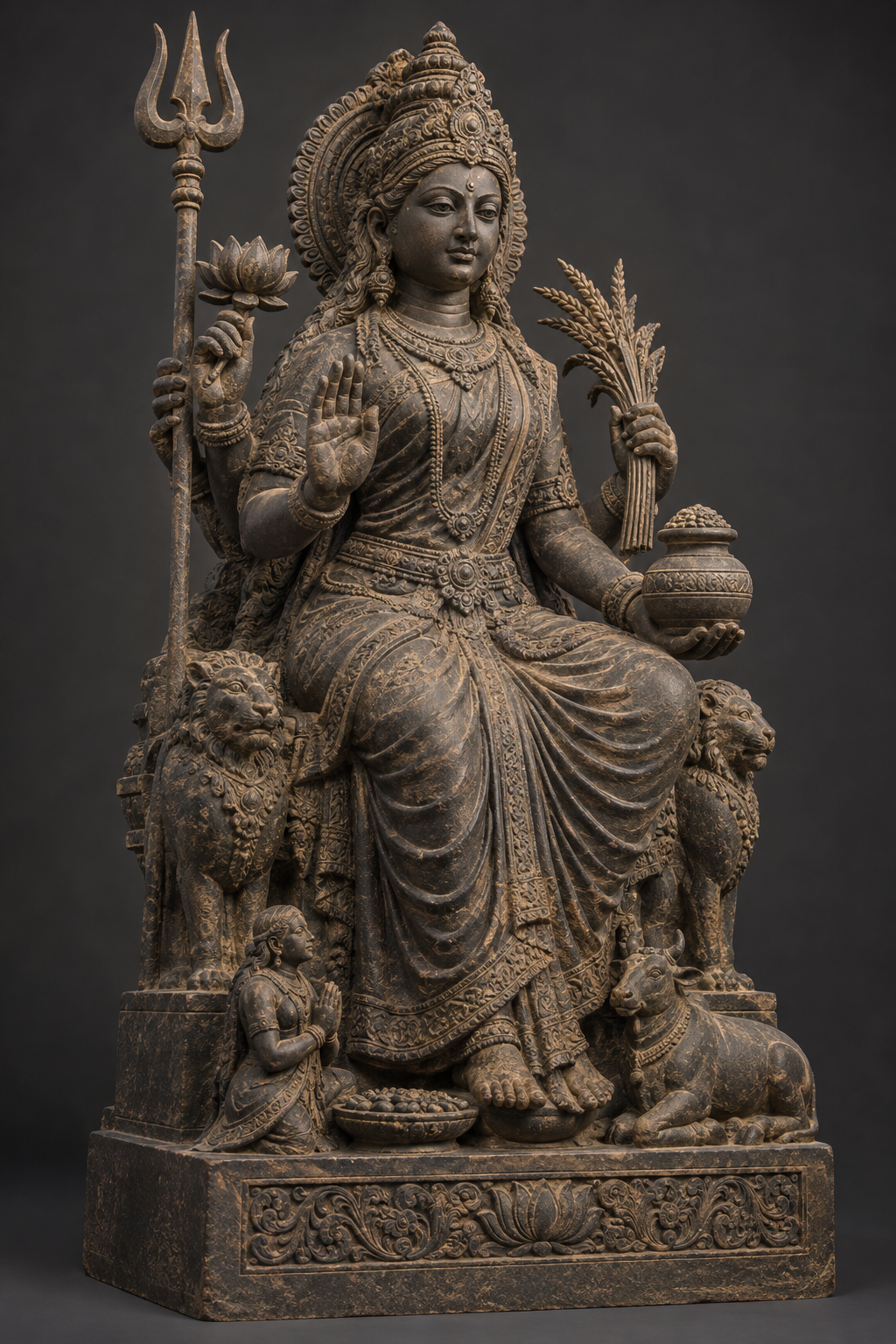
Composite iconography is visual theology, but it is also material evidence. Before explaining what an image means, identify what is actually present. This matters especially when you are looking at an unlabelled photograph, a damaged sculpture, or an online image detached from its temple and regional setting.
- Record the context. Note the temple, shrine, collection, region, caption, inscription, and local name, if any. A traditional identification preserved at the place of worship carries more weight than a title added to a circulating image.
- Describe without interpreting. List the posture, facial expression, body form, ornaments, hands, objects, attendants, vehicle, pedestal, and surrounding motifs. Write down what you can see before deciding which deity each feature represents.
- Look for clusters, not isolated symbols. A lotus may support a Lakshmi identification, while skeletal, skull, or mortuary imagery may support a Chamunda identification. Yet Hindu deities share many gestures, weapons, ornaments, and emblems. One object rarely settles the identity by itself.
- Study how the features are joined. Is the body divided into two visibly different halves? Are fierce and auspicious attributes carried by one undivided figure? Does one face combine contrasting expressions? The method of combination can be as important as the individual emblems.
- Separate identification from interpretation. The visible features may justify calling an image a Chamunda-Mahalakshmi synthesis. They do not automatically establish its date, scriptural origin, prescribed mantra, ritual use, or promised benefit.
Do not assume that every composite must resemble a vertically divided, half-and-half figure. Unity may be expressed through a single body carrying contrasting attributes, through a local form known by a combined name, or through an interpretive tradition that sees the two powers as inseparable. The exact claim should follow the available evidence.
This method protects you from a common mistake: turning an attractive symbolic reading into a historical assertion. You may reasonably say that an image evokes prosperity disciplined by detachment. You should not claim that a particular scripture mandated its exact design unless the scripture and passage can actually be identified.
What the union means – and what it does not mean
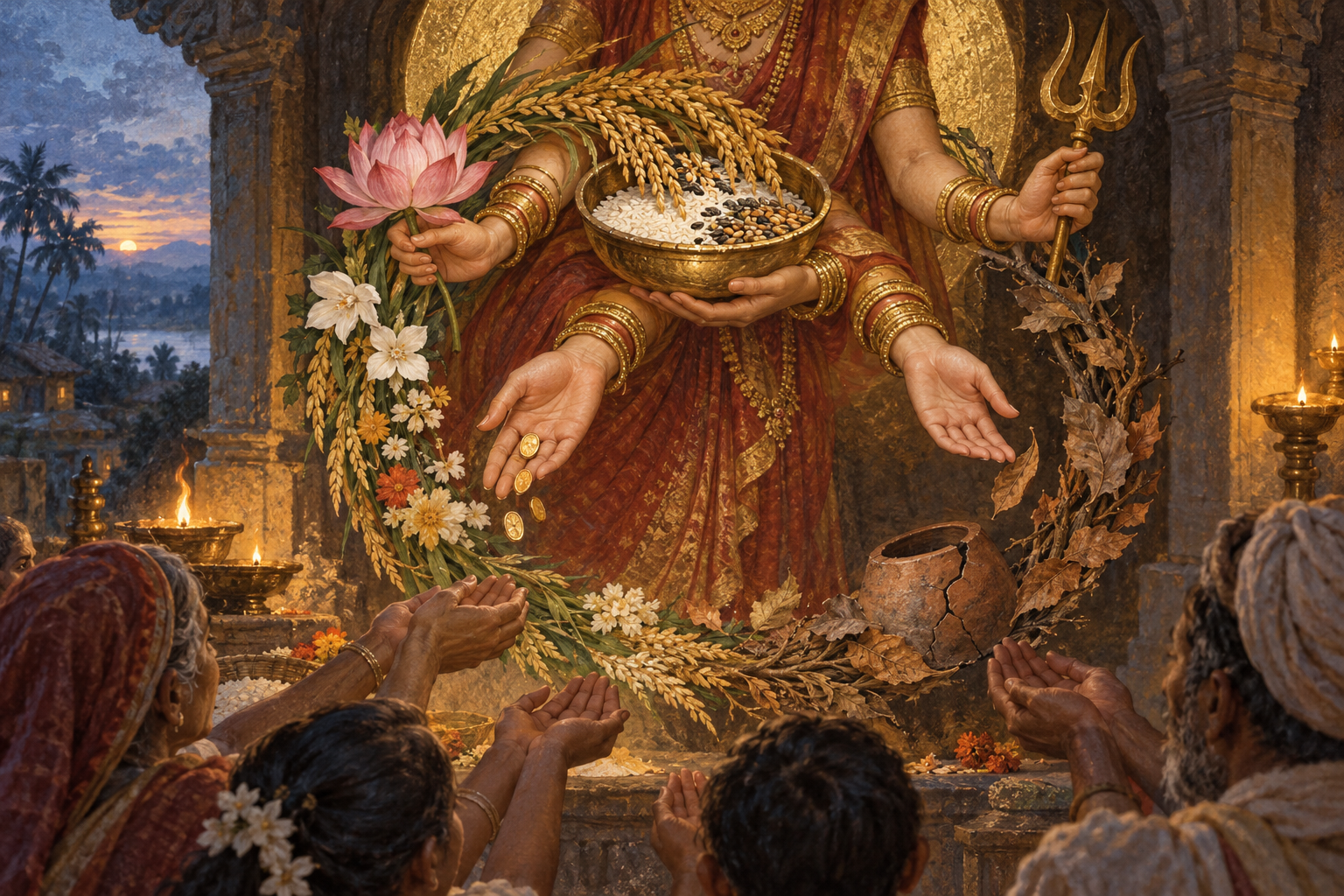
The composite does not ask you to choose which Goddess is higher. It invites you to recognize apparently contrary powers as expressions of Devi. Fierceness is not evil, and auspicious beauty is not spiritual weakness. Each becomes easier to understand through the other.
| Common misreading | More useful reading | Question to ask yourself |
|---|---|---|
| Mahalakshmi gives religious approval to accumulation. | Prosperity is a capacity to sustain dharmic life, not permission to make possession your identity. | What good is this resource enabling? |
| Chamunda glorifies misery or deprivation. | Renunciation exposes false security and loosens attachment; it does not excuse avoidable neglect. | What am I afraid to lose, and why? |
| The two aspects cancel each other. | Each disciplines an excess in the other: abundance needs non-attachment, and austerity needs a dharmic purpose. | Which side has become unbalanced in my life? |
| Every visual feature belongs neatly to one side. | A composite may integrate the powers rather than preserve an exact visual border between them. | How does the whole image change the meaning of each symbol? |
The distinction between having and clinging is central here. You can possess something without allowing it to possess your judgement. You can also renounce outwardly while remaining preoccupied with what you gave up. The composite form turns attention from the mere presence or absence of wealth toward the quality of your relationship with it.
It also corrects the idea that prosperity and mortality belong to separate worlds. Anything acquired exists under the conditions of change, decay, and eventual separation. Remembering that fact does not make abundance meaningless. It makes stewardship urgent. What comes into your care should be used before time turns possession into loss.
Turn the image into a practical contemplation
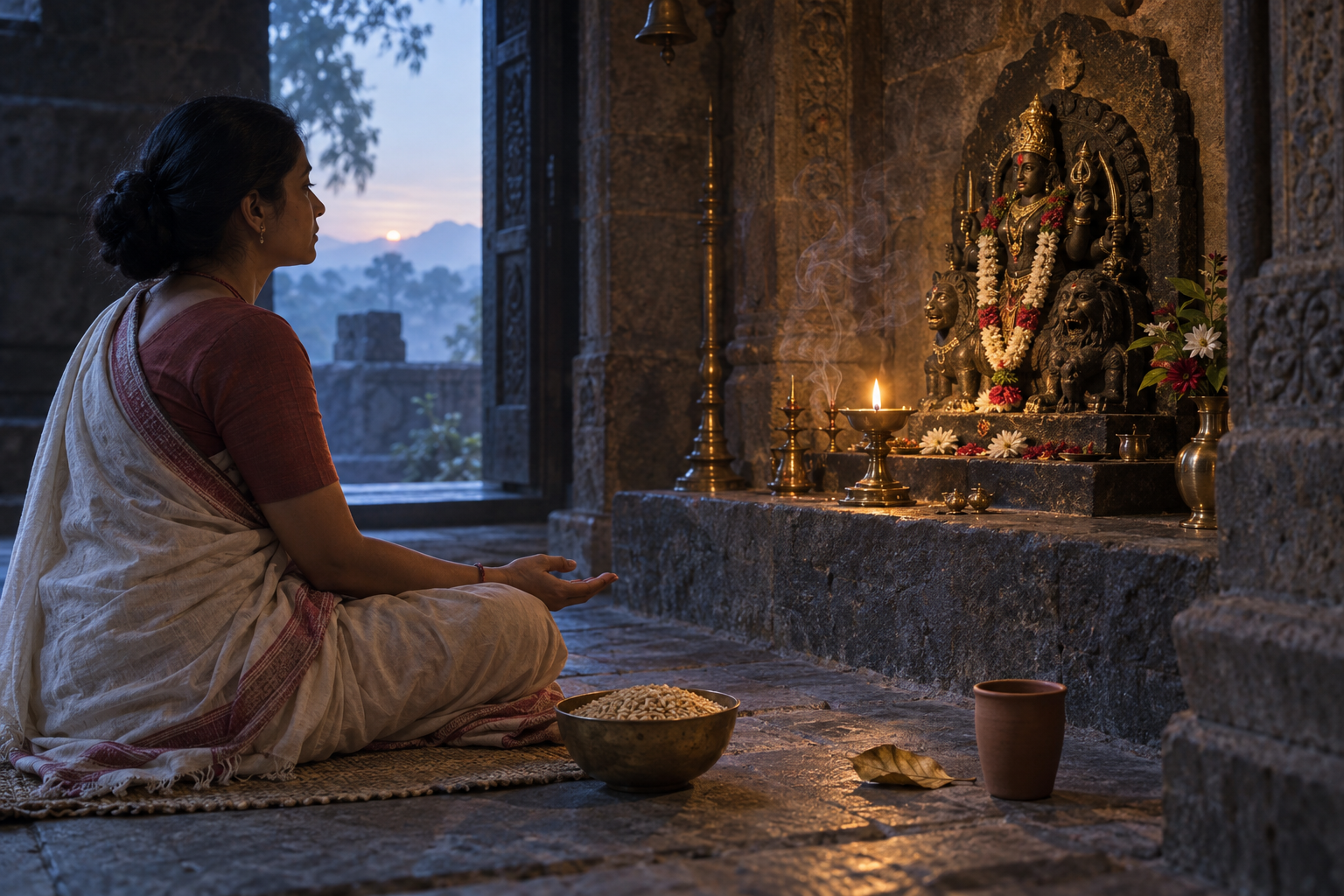
You do not need to invent a new ritual to learn from this form. If a temple or lineage has an established mode of worship, follow its guidance. If you are encountering the image outside such a setting, use it for disciplined reflection rather than assigning yourself an unsupported mantra or promising yourself a supernatural result.
- Observe before requesting. Look at the complete form without immediately asking for wealth, protection, or relief. Notice where your attention goes first: beauty, fear, abundance, death, ornament, power, or loss.
- Name what sustains you. Consider the resources currently entrusted to you – income, health, learning, relationships, authority, time, or inherited culture. Ask whether you are maintaining them well and directing them toward a worthy purpose.
- Name what binds you. Identify the possession, reputation, role, expectation, or comfort whose loss would seem to diminish who you are. The point is not to discard it impulsively, but to see the attachment clearly.
- Choose a paired action. Let one action express Mahalakshmi through care, order, generosity, or nourishment. Let another express Chamunda through restraint, truthfulness, relinquishment, or the refusal to feed vanity.
- End without bargaining. Offer gratitude or use the prayer taught by your tradition. Do not treat the Goddess as a mechanism that exchanges devotion for profit.
The paired action is important. If you have received more income, for example, the prosperous response is not merely to spend it, and the renunciatory response is not necessarily to reject it. You might direct part of it toward a genuine duty while refusing an unnecessary display meant only to secure admiration. If you hold a position of authority, use its reach to protect or support others while loosening your dependence on praise.
The same discipline applies to cultural life. Preserving a temple, manuscript, language, festival, or family tradition requires material support. Yet preservation becomes hollow when it is used mainly for status, factional ownership, or self-promotion. Mahalakshmi supplies the means to sustain an inheritance; Chamunda cuts the ego that tries to possess it.
Know when an interpretation is claiming too much
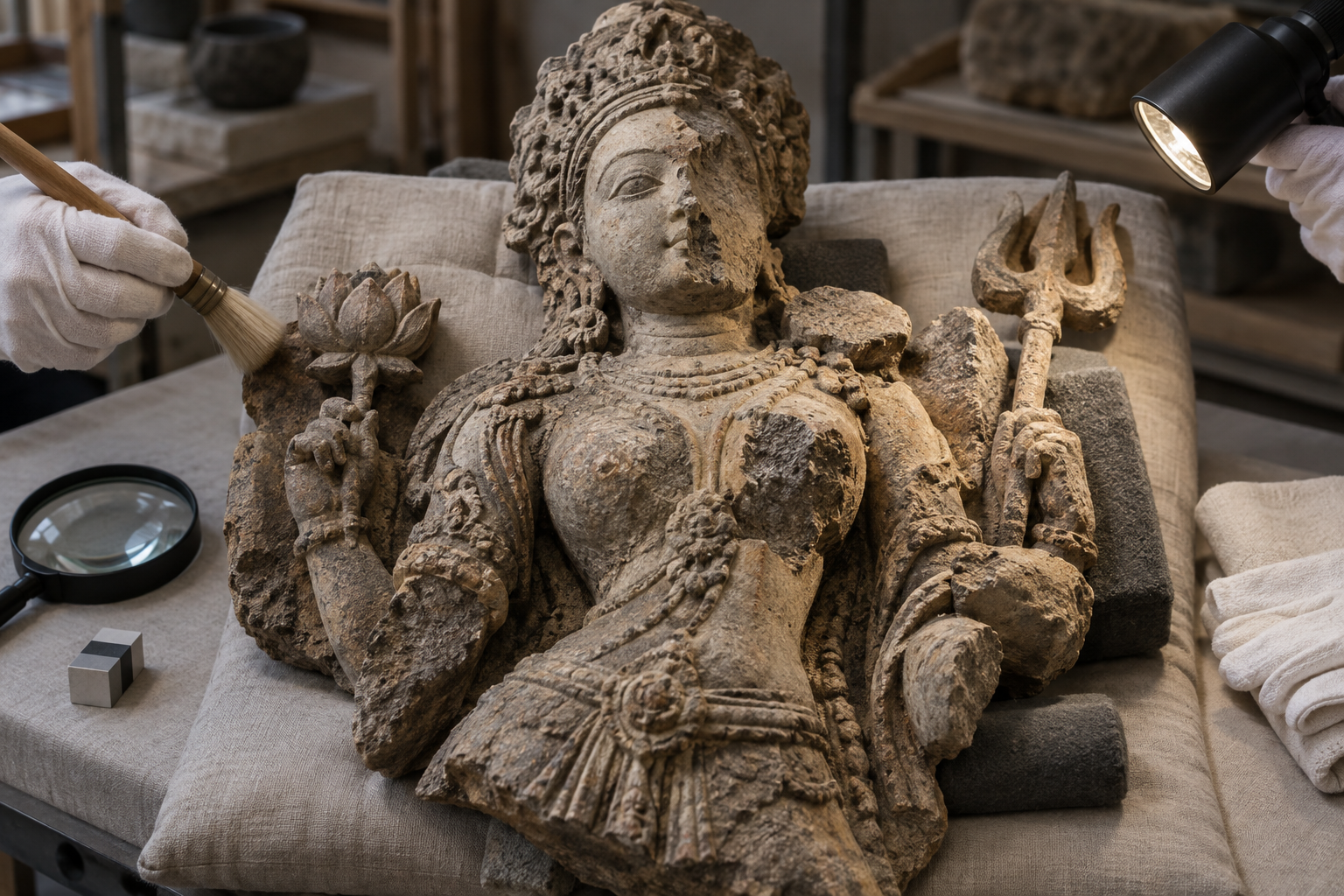
A compelling theological meaning does not prove every historical detail attached to an image. Hold the following claims open until there is supporting evidence:
- that a particular sculpture has a precise date or place of origin;
- that its combined form was prescribed by a particular scripture;
- that every object maps exclusively to either Chamunda or Mahalakshmi;
- that a modern caption preserves the image’s original name;
- that worship of the form guarantees wealth, removes a specific difficulty, or requires a particular mantra;
- that one interpretation applies identically in every region, temple, and Shakta tradition.
For those questions, look for an inscription, documented provenance, a temple’s living account of the murti, a named ritual or theological text, or a careful catalogue entry. Ask the pujari or custodian how the form is addressed locally and what observances belong to it. Record the answer as that tradition’s understanding rather than silently converting it into a universal rule.
When that evidence is absent, precise language is more respectful than false certainty. Say that a feature “may evoke,” “supports a reading of,” or “is commonly associated with” a deity. Reserve “is,” “originated,” and “was prescribed” for claims that can be established. Reverence does not require us to pretend that speculation is history.
Key takeaways
- Read Chamunda and Mahalakshmi as complementary expressions of Devi, not as evil and good halves.
- The central tension is between responsible prosperity and freedom from attachment, not between household life and spiritual life.
- Identify a composite image through clusters of features, provenance, inscriptions, and local tradition; do not rely on one emblem.
- Keep theological interpretation separate from claims about date, textual authority, ritual procedure, or promised results.
- Apply the icon through paired action: care for what sustains dharma, and release the attachment that turns support into bondage.
The next time you stand before this form, do not rush to resolve its tension. Let it expose the tension already present in your life. Choose one resource to steward more carefully and one attachment to loosen. That is where the composite image stops being an unusual arrangement of symbols and begins to shape a dharmic response.
References

Leave a Reply
You must be logged in to post a comment.