

You may have encountered Drutakarma Prabhu through a lecture, an interview, or Forbidden Archeology. If you are wondering whether his Vedic challenge to conventional accounts of human origins deserves serious attention, a quick yes-or-no verdict will not help you.
Read him at two levels at once. Examine his criticism of materialist assumptions, and audit each archaeological claim on its own evidence. Keeping those tasks separate lets you remain open to a Vedic account of reality without treating every anomaly as proof.
What Drutakarma Prabhu was actually arguing
Known outside ISKCON as Michael A. Cremo, Drutakarma Prabhu joined ISKCON in 1973, received initiation from A.C. Bhaktivedanta Swami Prabhupada, and worked as a writer and editor for the Bhaktivedanta Book Trust from 1980 to 1986. He later served as a research associate in the history and philosophy of science for the Bhaktivedanta Institute. These commitments were not a concealed influence on his work. They were his declared starting point.
He identified his position as Vedic creationism. His central contention was that reports suggesting extreme human antiquity had sometimes been overlooked, dismissed, or excluded from prevailing accounts of human origins. He also argued that Vedic teachings about time, consciousness, and the human person provide a more adequate interpretive framework than a strictly materialist account.
That contention contains two different questions. The empirical question asks whether particular finds were reported accurately, dated properly, and interpreted fairly. The philosophical question asks whether science should assume that matter is fundamental and consciousness derivative. An archaeological anomaly may challenge a chronology without proving a spiritual worldview. Equally, a spiritual commitment does not make an archival claim false before the evidence has been examined.
This distinction is the best starting point for a Dharmic reader. You do not have to accept the materialist boundaries of a debate merely to be rigorous. You also do not have to relax evidential standards merely because a proposed conclusion appears compatible with the Vedas.
Keep the report, interpretation, and worldview separate
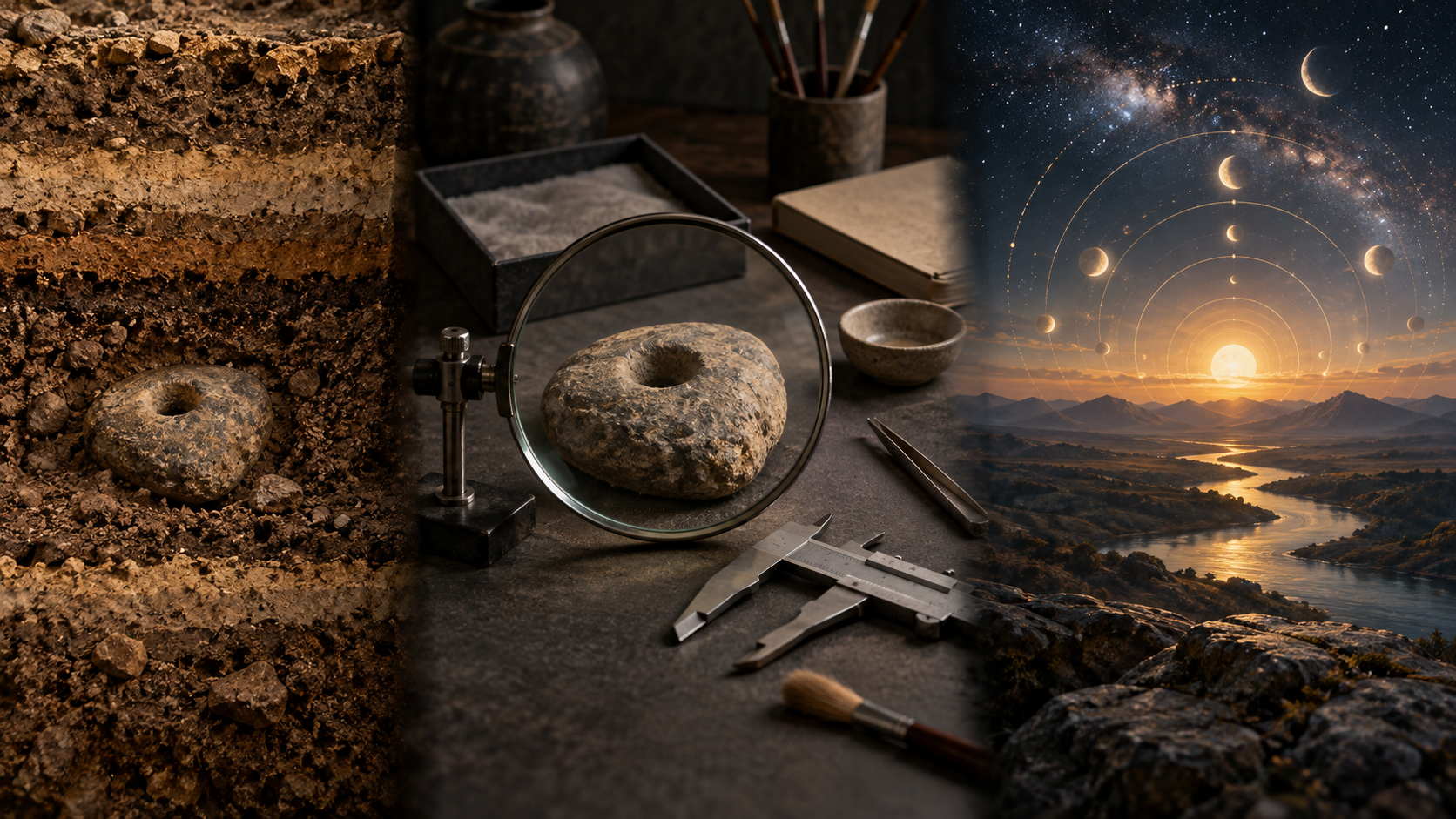
Discussions of alternative archaeology often move too quickly from an old report to a civilizational conclusion. Slow the reasoning down and identify three separate claims.
- The documentary claim: A particular discovery was described in a historical record. At this level, you are establishing what was reported, by whom, when, and under what circumstances.
- The archaeological claim: The object, remains, or traces genuinely belonged to the geological or archaeological context assigned to them. This requires attention to provenience, stratigraphy, disturbance, dating, identification, and preservation.
- The worldview claim: The finding is better explained within a Vedic understanding of human antiquity, consciousness, or cyclical time than within a conventional materialist account.
Evidence for the first claim does not automatically establish the second. Even a well-supported second claim does not, by itself, establish the third. The steps may support one another, but they are not interchangeable.
This prevents two common errors. An admirer can compress the entire chain into the claim that an unusual artifact proves the Vedic account. A critic can reverse the error and assume that the researcher’s devotional identity invalidates every case in advance. Both responses avoid the real work.
A method limited to material causes can measure material processes with great precision. But that rule cannot, by itself, settle whether consciousness is nothing more than matter. Conversely, a philosophical case for consciousness as irreducible does not determine the age of an object. Drutakarma Prabhu brought both debates into the same room; a careful reader must still know which debate is active at each moment.
A disciplined way to read the archaeological cases
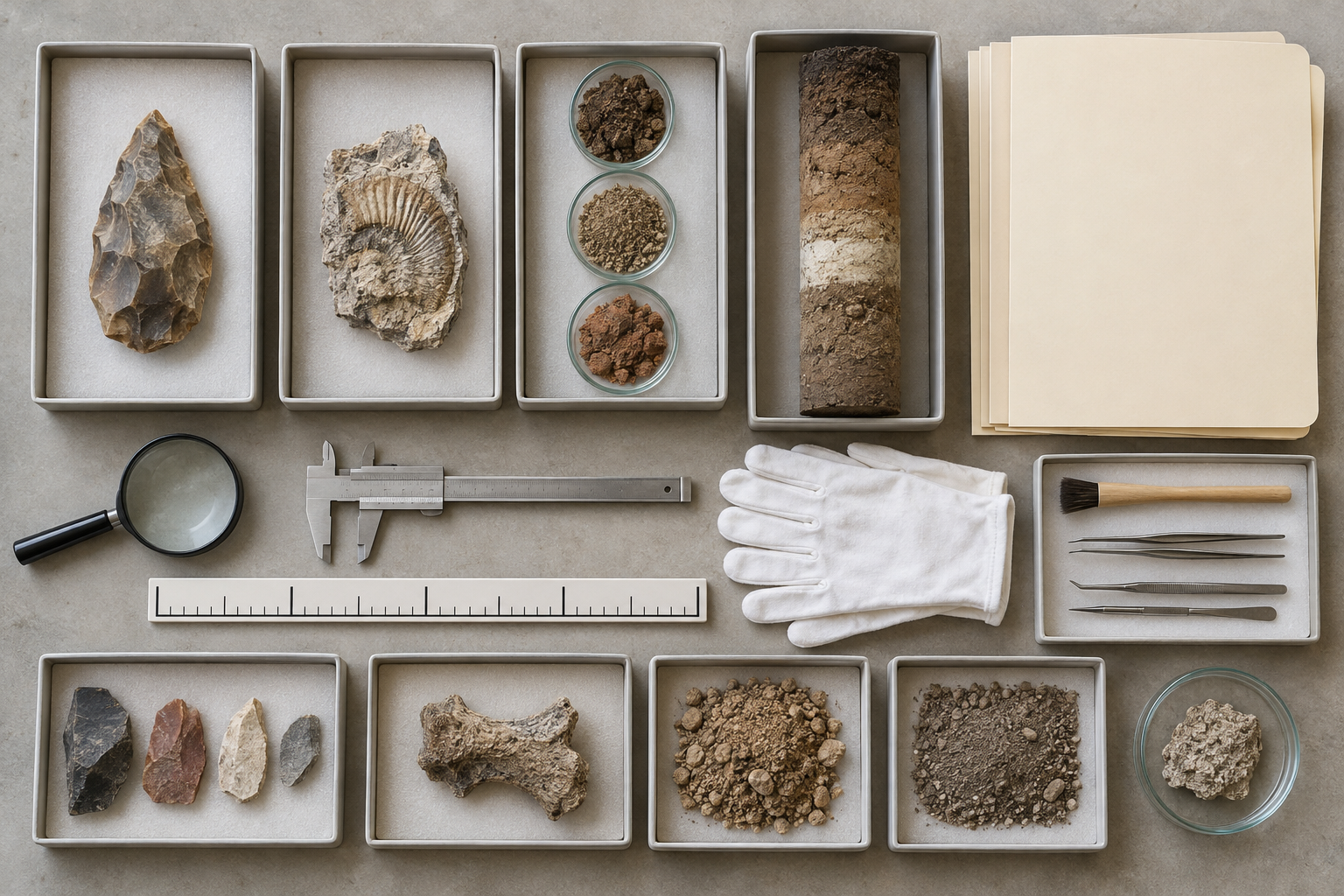
Choose your entry point according to the question you want to answer. The 1994 Hidden History of the Human Race is the shorter presentation of the research. The 914-page Forbidden Archeology, published in 1993 with Richard L. Thompson, is the fuller compilation. Turn to the 2000 Human Devolution when you want the broader Vedic alternative to Darwinian accounts of human origins.
Then use the same sequence for every case:
- Write down the narrow claim. Do not begin with whether the case proves a Vedic chronology. Begin with what was reportedly found, where it was found, and what age was assigned to its context.
- Locate the earliest available account. Distinguish an original field description from later retellings. Record whether the first account supplies a location, the discoverer’s identity, contextual observations, illustrations, measurements, or a preserved specimen.
- Separate observation from inference. The existence of an object is an observation. Its identification, age, depositional history, and significance are interpretations that may rest on different kinds of evidence.
- Audit the context. Ask whether provenience was recorded, whether the layer could have been disturbed, whether the object was recovered in place, and whether its association with the surrounding deposit was demonstrated. An assigned age is only as strong as the connection between the find and the dated context.
- Check the dating basis. Determine whether the age came from the object itself, the containing layer, an associated material, or a broader geological estimate. These are not equivalent. Also note which analytical methods were available when the claim was made.
- Test rival explanations. Consider misidentification, displacement from another layer, contamination, inaccurate dating, incomplete reporting, and the proposed alternative chronology. List what evidence would favor or weaken each explanation.
- Use a confidence label. Mark the case as documented but unverified, genuinely unresolved, evidentially weak, or a strong challenge to the prevailing account. Do not force every case into accepted or debunked.
The age of a report is not a reason to discard it, but it changes the questions you must ask. A nineteenth-century description may preserve an important observation while lacking the contextual controls expected in later fieldwork. Treat the limitation as part of the evidence rather than as either a fatal embarrassment or an excuse to believe more than the record supports.
Apply the same rule to institutional credentials. Drutakarma Prabhu was associated with the World Archaeological Congress and the European Association of Archaeologists, presented papers at international conferences, and lectured at universities around the world. That establishes sustained participation in scholarly discussion; it does not mean that those institutions endorsed his conclusions. Yet lack of consensus is not a substitute for examining an argument either.
Key takeaways
- Drutakarma Prabhu offered both an empirical challenge about excluded evidence and a philosophical challenge to materialist assumptions. Evaluate them separately.
- A recorded anomaly is not automatically a verified anomaly, and a verified anomaly is not automatically proof of a complete Vedic chronology.
- Judge each case by its provenience, context, dating basis, documentation, and ability to withstand alternative explanations.
- Neither devotional commitment nor institutional participation settles whether a claim is correct.
- Dharmic confidence is strongest when it permits open inquiry while refusing to exaggerate uncertain evidence.
His deeper legacy for Dharmic intellectual life
Drutakarma Prabhu’s importance does not rest on securing universal agreement about every archaeological case. He carried a Krishna-conscious understanding of the human person into discussions of archaeology, anthropology, evolution, reincarnation, and consciousness. He insisted that the premise that human beings are only material organisms is itself open to examination.
His reach was substantial. His books reportedly sold more than 300,000 copies and were translated into 26 languages. That scale matters because it shows how widely the question resonated: must modern people choose between intellectual seriousness and a Vedic understanding of consciousness?
His answer was no. But carrying that answer forward requires more than repeating his conclusions. Dharmic intellectual culture must resist two temptations at once. The first is cultural diffidence: assuming that a Vedic premise is inadmissible because it challenges the current intellectual fashion. The second is apologetic inflation: turning a suggestive anomaly into conclusive proof because the desired conclusion feels spiritually reassuring.
The stronger path is constructive. Preserve old records. Recover the earliest documentation. Invite technical scrutiny. State rival explanations fairly. Mark the difference between what is established, what is plausible, and what remains speculative. A transparent uncertainty is more useful to Dharma than a brittle certainty that collapses under inspection.
With Drutakarma Prabhu’s passing, you can honor his intellectual service by taking one case at a time. Keep four notes beside you: the precise claim, the evidence offered, the strongest alternative explanation, and your present confidence. If a claim survives that process, explain why. If it does not, let it go. A Vedic view of the conscious self need not depend on weak evidence, and a difficult anomaly should not be dismissed merely because its implications are inconvenient.
References

Leave a Reply
You must be logged in to post a comment.