
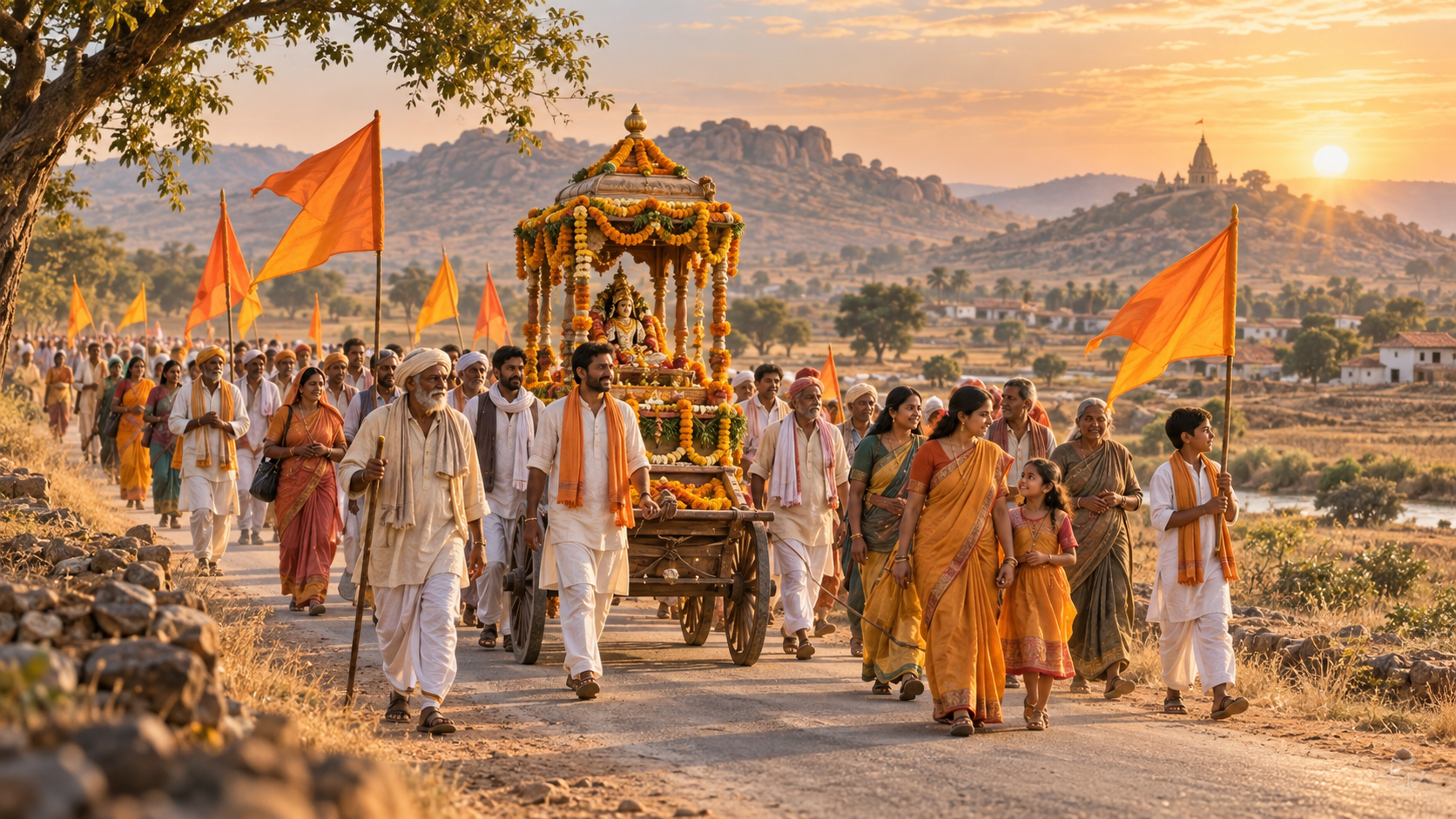
If you have heard about the Bageshwar Dham Hindu unity yatra and are deciding whether to attend, support or simply understand it, separate the headline from the commitment. Hindu unity is an important aim. Its value, however, depends on what people are asked to unite around, how they conduct themselves and what remains after the procession has passed.
The Sanatan Hindu Ekta Rath Yatra 3.0 has been announced under Bageshwar Dham’s Dhirendra Shastri as a 500-km mobilisation through five districts of Bundelkhand, with seven pledges presented at 20-km intervals and an expressly stated Hindu Rashtra objective. Those are the announced features of the campaign, not evidence of completed results. That distinction gives you a sound starting point for judging it.
What the scale and repetition are meant to accomplish

The 500-km distance is more than a headline number. A route crossing five districts creates a chain of local encounters rather than a single central gathering. People who may never travel to Bageshwar Dham can meet the campaign closer to home, while organisers can repeat the same appeal in different communities across Bundelkhand.
The 20-km pledge interval is equally important. A travelling movement risks becoming a sequence of welcomes, speeches and departures. Reintroducing seven pledges along the route is an attempt to keep a common commitment at the centre. Repetition can make a message memorable, but memory is not implementation. A pledge becomes useful only when its wording identifies a duty, its participants know what to do and someone accepts responsibility for the follow-through.
The label “3.0” tells you that the initiative is being presented as a continuing campaign. It does not, by itself, establish how much earlier activity endured, which institutions were built or whether past commitments were completed. If continuity is offered as a reason for confidence, ask what has continued between yatras.
The phrase “Hindu Rashtra” also needs careful attention. It can carry cultural, civilisational, social and constitutional meanings, and different supporters may not mean the same thing when they use it. No precise definition accompanies the announced route details. Do not silently substitute your preferred definition. Ask which duties, institutional changes and limits the organisers intend. Clear answers strengthen a movement; ambiguity merely allows incompatible expectations to travel under one slogan.
Keep devotion, social unity and politics distinct
A Hindu rath yatra can operate on several levels at once. You can respect its religious character without treating every political implication as settled. You can also examine its political programme without dismissing the spiritual motivation of those who join it. Three distinctions help.
- Religious participation: A yatra can express public devotion, collective sankalpa and confidence in Sanatan identity. Ask whether prayer, restraint, seva and respect remain visible when crowds and speeches grow.
- Social unity: Ekta should create cooperation across sampradayas, castes, regions and local affiliations. Ask who is invited to shape the programme, who is merely counted in the crowd and whether people who disagree on secondary matters are still treated as members of the Hindu family.
- Political direction: A stated Hindu Rashtra objective moves the campaign beyond a purely devotional gathering. Ask what concrete civic or institutional changes are proposed, whether the methods are lawful and peaceful, and how the programme protects dignity while pursuing Hindu interests.
Keeping these levels distinct prevents two common mistakes. The first is to treat attendance at a religious event as automatic consent to every political interpretation attached to it. The second is to treat serious questions about policy or organisation as hostility to Hindu unity. A durable Hindu movement must be confident enough to permit disciplined scrutiny from its own supporters.
Unity does not require uniformity. Shaiva, Vaishnava, Shakta, Smarta, folk and regional traditions do not need to erase their identities to cooperate on civilisational concerns. Nor should Dharmic kinship be used to presume political consent from Buddhist, Jain or Sikh communities, each of which has its own doctrines and institutions. Honest naming creates stronger relationships than inflated claims of representation.
Use seven tests before endorsing the seven pledges

Obtain the exact wording of all seven pledges before endorsing or circulating them. Keep the original language and any translation together. A paraphrase, short video clip or slogan may omit the qualifying words that determine what a commitment actually demands.
- Does each pledge state a positive Hindu duty? A serious sankalpa should tell participants what they will build, protect, learn, practise or serve. A promise defined only by opposition leaves people energised but directionless.
- Are its important terms defined? Words such as unity, protection and Hindu Rashtra can conceal major differences of meaning. Ask what each term requires in ordinary civic life.
- Can an individual or local institution act on it? A pledge should translate into conduct at home, in a temple, through a community organisation or within lawful public life. If no participant can name the next action, the wording is too abstract.
- Does it respect internal Hindu plurality? Unity should widen cooperation without imposing one region’s custom, one sampradaya’s practice or one leader’s authority on every Hindu.
- Are the means explicitly lawful, peaceful and truthful? Reject coercion, harassment and unverified allegations even when they are presented as shortcuts to mobilisation. Discipline is not weakness; it protects the moral credibility of the cause.
- Who owns the follow-through? Each pledge needs an identifiable local body or coordinator. A commitment assigned vaguely to “society” is easily abandoned once the rath leaves.
- How will progress become visible? Look for a follow-up date, public update, record of work or another verifiable sign. Crowd size and online reach show attention, not completion.
This test is not a demand for bureaucratic perfection. It is a way to preserve the sacred seriousness of a pledge. A sankalpa should bind conduct. If its only function is to produce a response during a speech, it has been reduced to theatre.
Turn participation into work that survives the procession
Before you share or travel
Verify the relevant district, route, timing and organiser contact through current local channels. Do not infer a stop from the total distance or assume that a forwarded image contains the latest information. When you share the campaign, label plans as announced plans. That small distinction prevents expectation from becoming misinformation.
Read the full pledges first. Decide which commitments you can genuinely keep rather than treating all public assent as symbolic. If a pledge is unclear, prepare a precise question and ask it respectfully. A movement benefits when supporters seek clarity before amplifying its words.
If you attend
Participate with the discipline expected of a Dharmic gathering. Follow local crowd instructions, keep emergency access clear and agree on a meeting point if you arrive with family members. Do not let enthusiasm turn into pressure on bystanders or hostility toward a person who asks a legitimate question.
Listen for more than the loudest slogan. Notice whether speakers explain the duties contained in unity, whether representatives from different Hindu communities have a meaningful role and whether organisers provide a way to continue the work locally. These details reveal whether the gathering is cultivating participants or merely spectators.
After the rath moves on
Choose one action that clearly corresponds to an actual pledge. It may involve Dharma education, temple service, preservation of local heritage, support for a vulnerable family or cooperation across community divisions, but the action should come from the pledge rather than being retrofitted to it. Name the person responsible, set the next meeting before people disperse and keep a simple public record of what was done.
Judge success by what remains: a functioning local group, a completed act of seva, a recurring learning effort, a resolved community problem or a trustworthy channel for cooperation. A procession demonstrates the ability to mobilise. Durable service demonstrates the ability to organise.
Public Hindu confidence is not a defect in democratic life. It becomes persuasive when it combines courage with self-command, solidarity with internal fairness and political aspiration with responsible civic conduct. If a yatra strengthens those habits, its influence can extend beyond the route. If it leaves only images and slogans, its reach will have been geographic rather than institutional.
Key takeaways
- The announced Sanatan Hindu Ekta Rath Yatra 3.0 is planned as a 500-km campaign through five Bundelkhand districts, centred on seven pledges presented at 20-km intervals.
- Its Hindu Rashtra framing is explicit, but you should seek a precise definition rather than assuming that every supporter means the same thing.
- Religious participation, social solidarity and agreement with a political programme are related but distinct forms of support.
- Read the exact pledges and test them for positive duties, clarity, Hindu plurality, lawful means, local ownership and visible follow-through.
- Measure the yatra’s enduring value by the service, relationships and institutions that continue after the rath has left.
If you are inclined to support the yatra, begin with the exact pledge text and the local mechanism for carrying it forward. Attend as a disciplined participant, ask concrete questions and accept a duty you can actually fulfil. Hindu unity gains substance when shared emotion becomes truthful speech, lawful action and dependable service.
References

Leave a Reply
You must be logged in to post a comment.