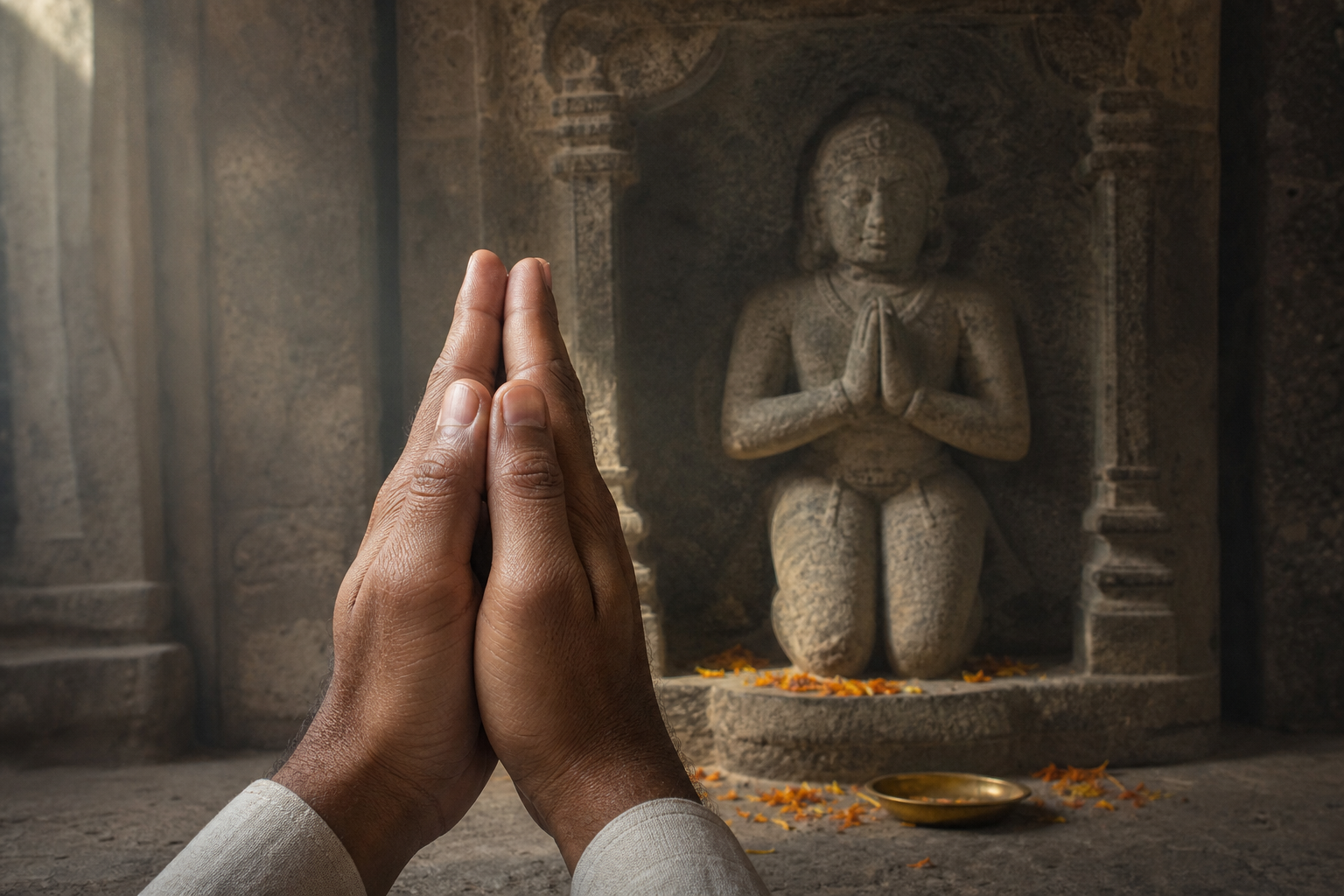
When a sculpted figure joins both palms, the hands do more than identify a respectful pose. Anjali Mudra establishes a relationship between devotee and sacred presence, gives that relationship an intelligible visual form, and quietly organizes the image around the body’s center.
Reading the gesture therefore requires more than recognizing folded hands. Its placement, symmetry, ritual associations, and surrounding figures reveal how sacred art turns an inward disposition into something visible—and how the viewer may be invited to answer with the same gesture.
One gesture performs three kinds of work
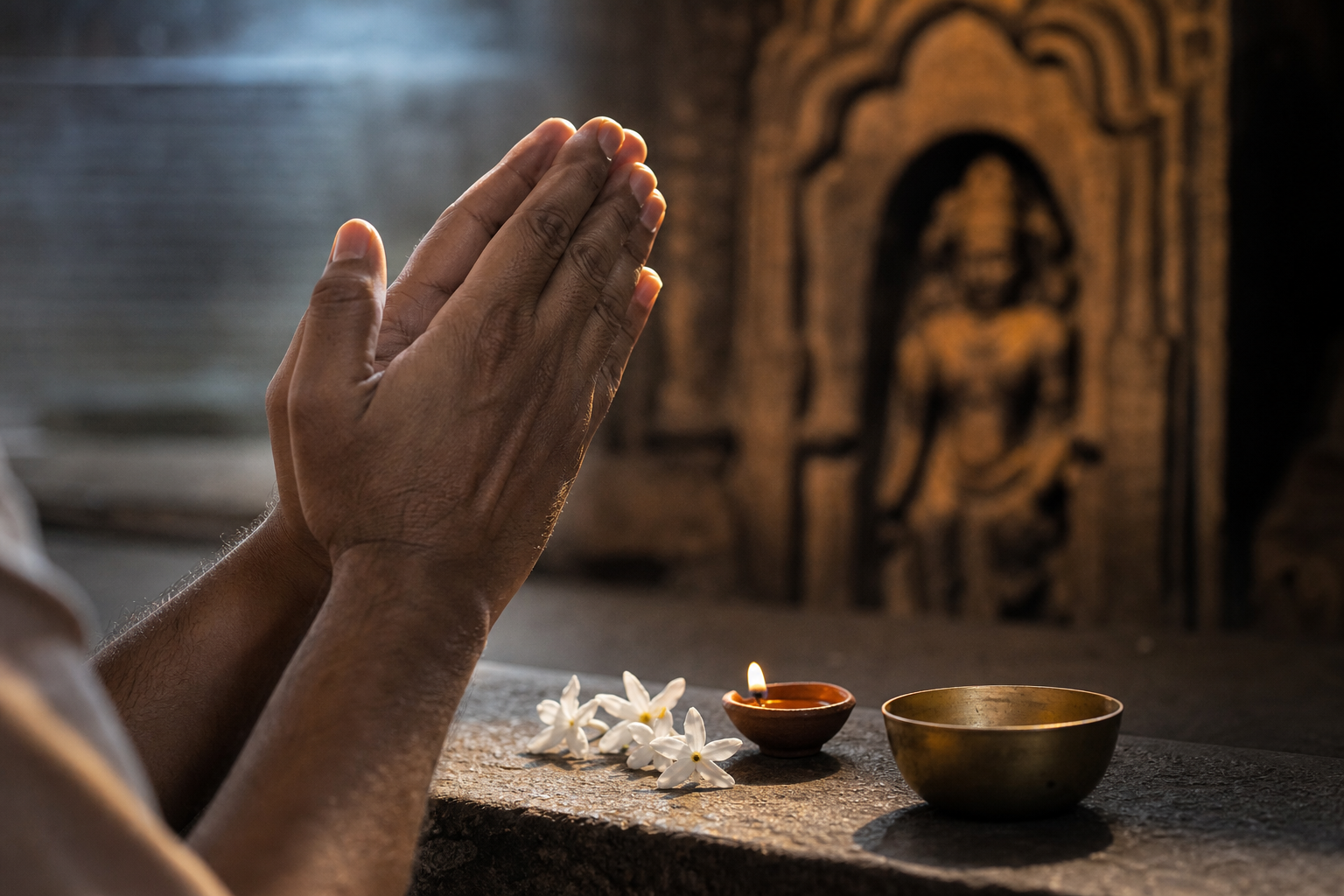
Anjali Mudra can be understood simultaneously as a sign, a vessel, and a compositional device. As a sign, it communicates reverence, welcome, humility, or attentive presence. As a vessel, the joined or cupped hands can receive flowers, rice, or water and carry an offering toward a deity. As a compositional device, the upright palms create a strong central form that gathers attention around the chest and face.
DharmaRenaissance’s earlier survey identifies Anjali—also called Namaskara or Atmanjali—as a joined-hand gesture whose Sanskrit name is associated with the root añj, conveying senses such as honoring, adorning, or anointing. The article also notes that an añjali can denote the quantity held between two cupped palms in an Ayurvedic context. These meanings illuminate an important devotional synthesis: the body does not merely indicate an offering; it becomes its container.
This doubleness distinguishes Anjali from a purely descriptive hand sign. Sacred art can show devotion without depicting the material being offered because the hands already imply both the act of honoring and the capacity to give. Conversely, when offerings are visible, the same configuration links inner intention to ritual action.
Symmetry makes an inward attitude legible
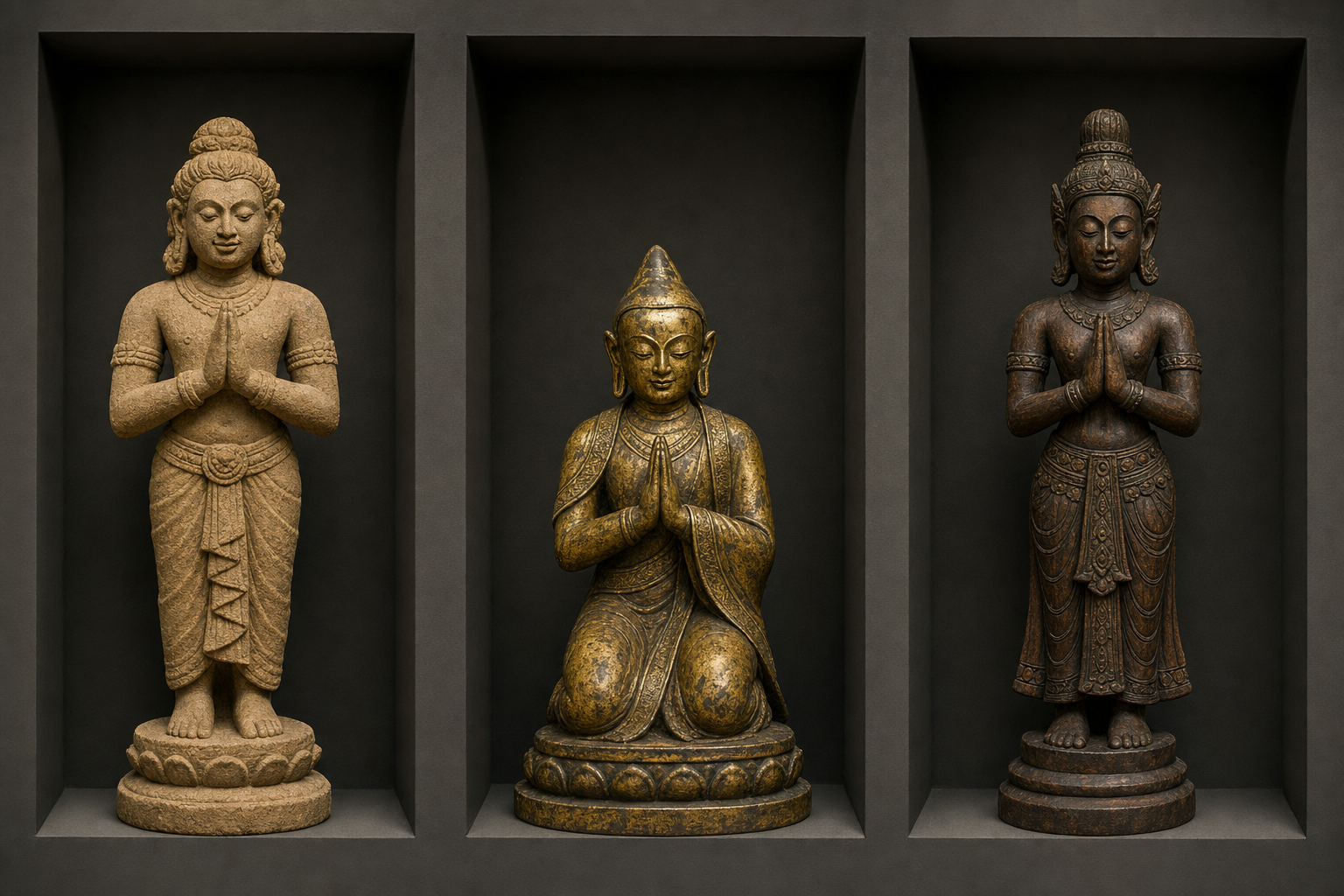
The source describes Anjali as a codified joined-hand form in which the fingers align, the wrists remain composed, and the forearms create a restrained triangular frame. It connects this precision with the proportional and morphological disciplines associated with sacred image-making, including tala-mana, rekha, and hasta-lakshana. The point is not technical exactitude for its own sake. Order in the hands allows reverence to remain readable even when the surrounding sculpture is dense with jewelry, textiles, attendants, or narrative activity.
The geometry also directs looking. Joined palms establish a vertical axis, while the forearms guide the eye toward the heart, throat, and face. In a frontal figure, that centered structure can reinforce bodily equilibrium. In a figure with a softer bend, it can provide a visual counterweight to movement. The source accordingly presents Anjali as compatible with both balanced samabhanga and more fluid tribhanga postures.
Fine details support this larger clarity. According to the source, sculptors may articulate tapered fingers, nails, knuckles, and adjoining planes with restraint so that light preserves the unity of the gesture rather than breaking it into unrelated parts. The most successful examples remain intelligible from a distance while rewarding closer inspection.
This helps explain why the gesture can serve as a moment of visual rest. In a crowded frieze, a pair of compact vertical palms interrupts lateral movement and marks a devotional pause. The stillness is not an absence of action; it is the image’s way of concentrating action into attention.
Height reveals the direction and intensity of reverence
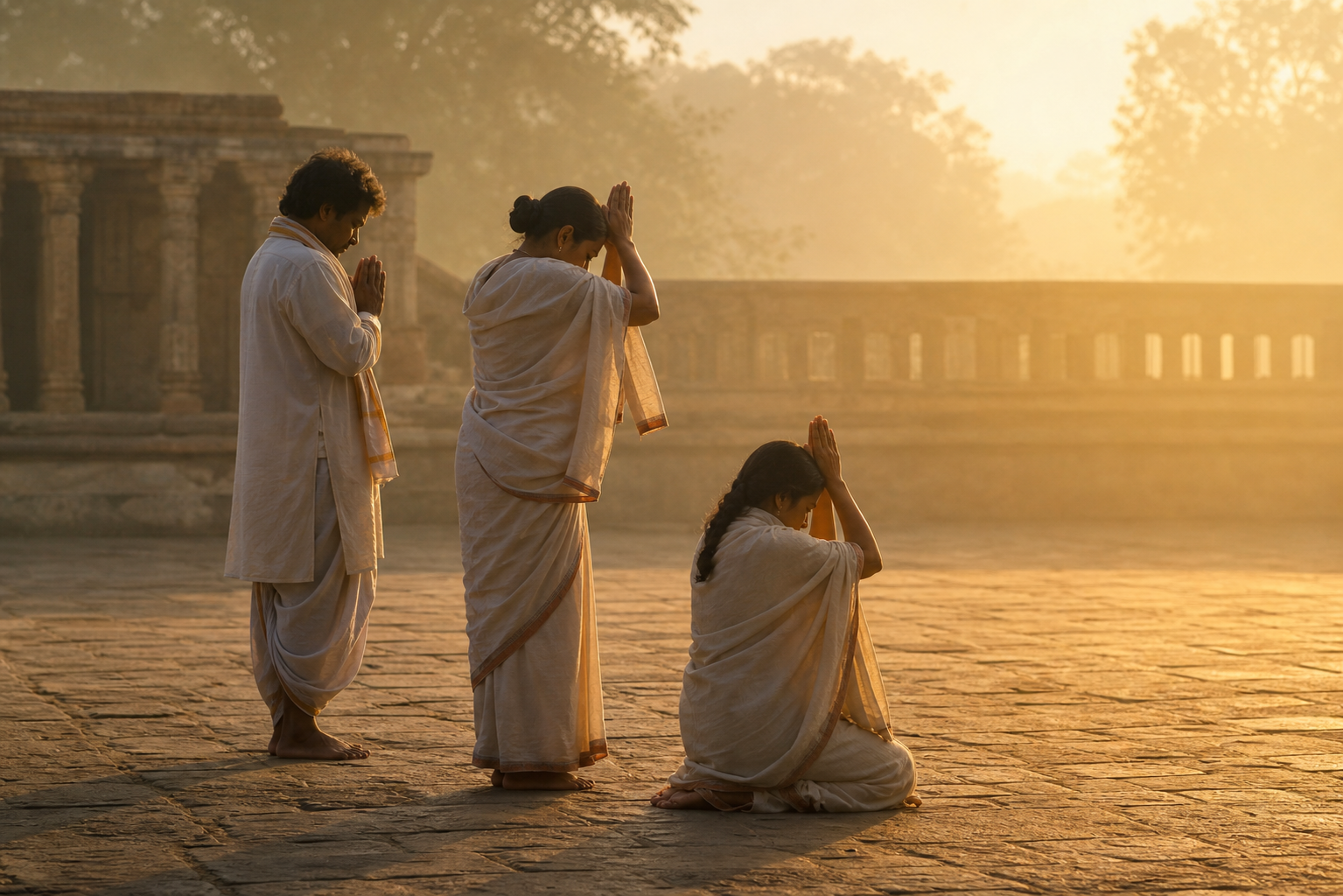
Not every sculpted Anjali carries precisely the same emphasis. The earlier DharmaRenaissance article proposes a vertical scale in which the position of the hands helps indicate the character of the encounter. This is best used as a reading aid rather than a mechanical rule, since posture, gaze, surrounding figures, and narrative context remain important.
| Position of joined hands | Emphasis reported by the source | What to examine nearby |
|---|---|---|
| At the heart or sternum | Greeting, devotion, and composed attention | The figure’s gaze, bodily balance, and relationship to the principal image |
| Before the face or brow | Heightened veneration | Whether a deity, teacher, revelation, or climactic event commands attention |
| Above the head | Supreme reverence or surrender | The sacred hierarchy and the possibility of an exalted presence beyond the surviving frame |
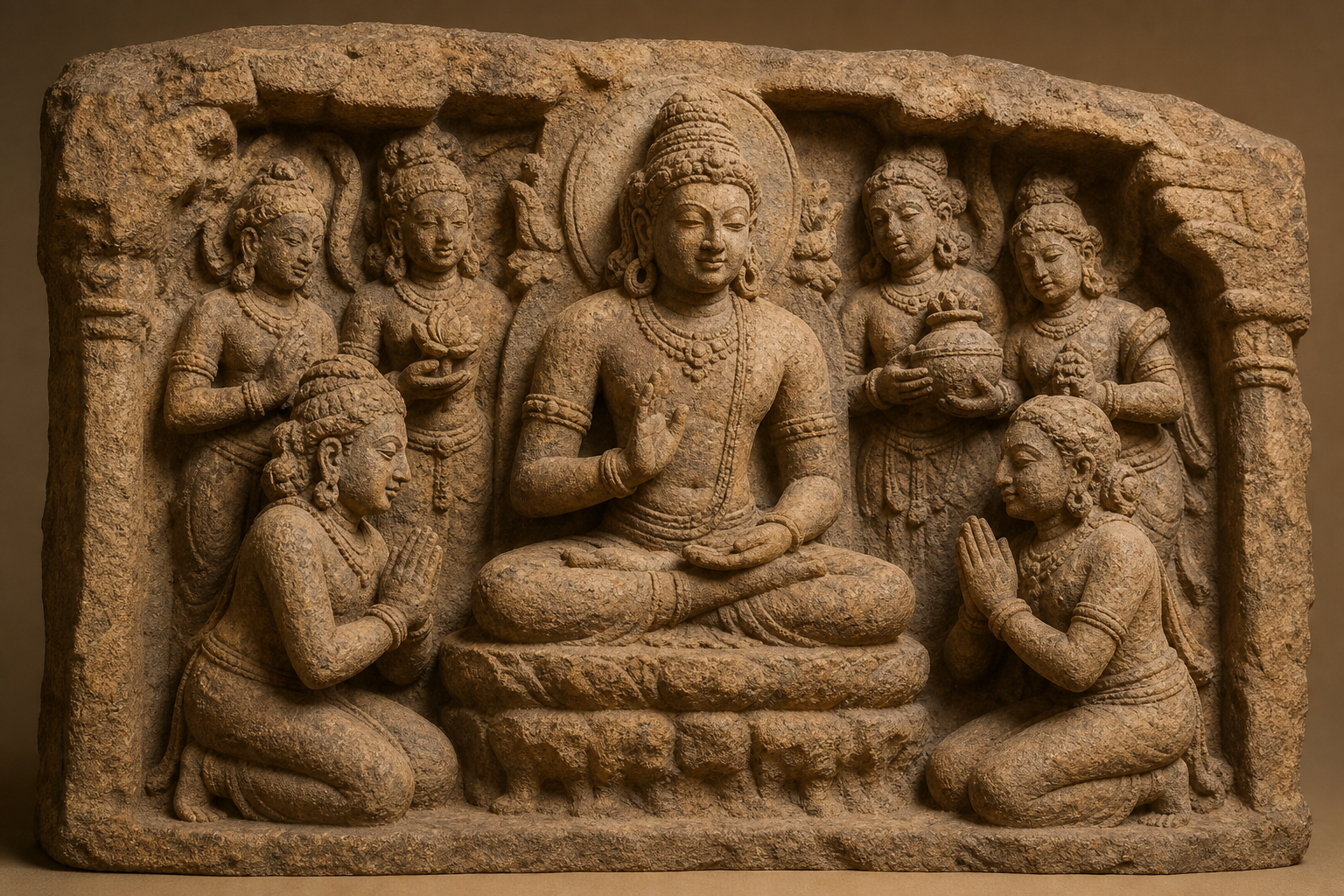
This vertical distinction can be particularly useful in narrative relief. A venerated figure need not remain visible for the devotee’s posture to disclose the direction of sacred attention. Folded hands, raised gaze, and bodily orientation may allow an absent or damaged focal presence to be inferred without pretending that the gesture alone settles every iconographic question.
Stone, performance, ritual, and greeting form a continuum
The source traces a broad artistic itinerary for the gesture. It reports joined hands among donors and celestial figures at Sanchi around the second-to-first century BCE, a refined serenity in Gupta-period art from the fourth to sixth centuries CE, and later appearances in the caves of Elephanta and Ellora, the reliefs of Mahabalipuram, and Chola and Hoysala contexts. Royal donors, saints, attendants, and airborne beings can all use the same basic configuration, although their identities and relationships to the sacred center differ.
That distribution matters because it discourages treating Anjali as the exclusive attribute of one type of person. A devotee on the ground, an attendant beside an icon, and a celestial figure above a scene may share folded hands while occupying different levels of the composition. Their common posture unifies the assembly; their position, scale, costume, and proximity preserve hierarchy.
The same source situates Anjali within a wider dharmic and regional field. It describes Hindu devotees and celestials before Shiva or Vishnu, Buddhist monks, donors, and attendants honoring the Buddha, Jain lay followers and celestial beings around tirthankara images, and folded hands during Sikh Ardas. It also connects the Indic gesture with the Khmer sampeah, Thai wai, and Javanese sembah, citing temple traditions at Angkor and Prambanan. The shared bodily structure should not erase doctrinal or cultural distinctions; its significance lies in how a concise form can be adapted to different relationships of devotion, greeting, and respect.
Performance and daily practice keep this visual language active. The source notes that Bharatanatyam and other classical forms use Anjali in salutations to divinity, teacher, and audience. It also associates heart-level Anjali with the anahata center in yogic interpretation and with composed breathing and attention in contemporary practice. Because the article acknowledges that scientific explanations continue to develop, the gesture’s calming effects are better presented as experiential and contemplative claims than as settled clinical conclusions.
These living uses change the encounter with sacred art. A viewer who folds the hands before an image moves from decoding a representation to inhabiting its bodily grammar. The sculpture models devotion, but the mirrored response completes a circuit between image, ritual memory, and present attention.
Key takeaways
- Anjali Mudra is at once a sign of reverence, a bodily vessel for offerings, and a device that centers a sacred composition.
- Alignment, symmetry, and the triangular frame of the forearms make an interior devotional attitude readable in stone or metal.
- The height of the hands can suggest increasing veneration, but surrounding posture and narrative context must guide interpretation.
- Its appearance among devotees, donors, attendants, and celestial beings creates unity without eliminating sacred hierarchy.
- Ritual, dance, yoga, greeting, and sculpture preserve related forms of the gesture while assigning them context-specific meanings.
Future encounters with Anjali in temples, museums, performances, or everyday greetings can begin with a simple question: not only what do the folded hands mean, but what relationship are they creating? That shift keeps the gesture from becoming a static symbol and restores its character as an active form of attention.