
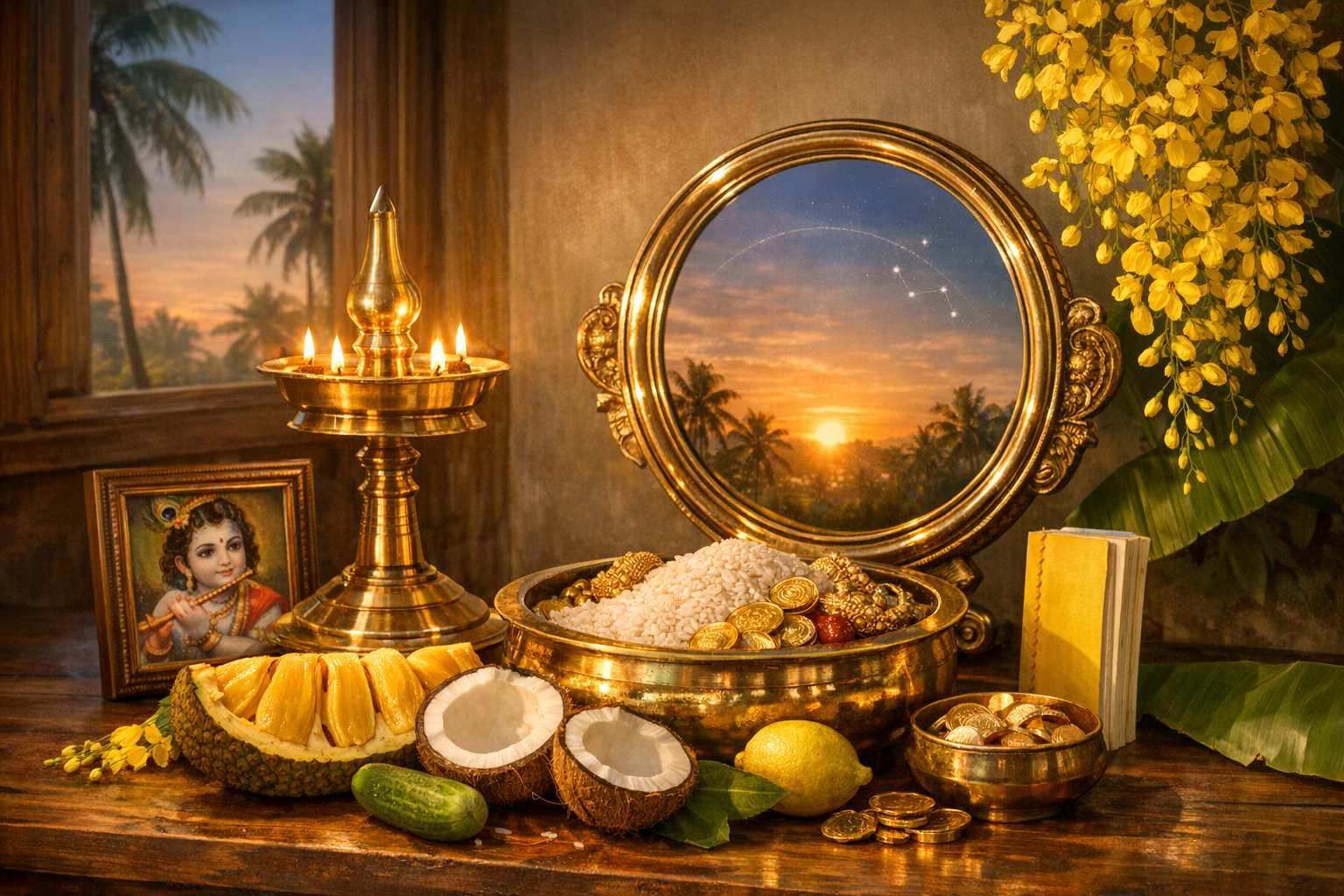
Vishu, observed as the Kerala New Year, holds enduring mahatmya for Malayalees because it harmonizes astronomy, agrarian rhythms, and devotional practice in a single luminous dawn. The festival’s core intention is simple yet profound: to begin the solar year with auspicious sight, balanced tastes, ethical giving, and communal joyan integrated template for well-being and prosperity in the months ahead.
The significance of Vishu in Kerala is anchored in the solar calendar. It coincides with Mesha Sankramanathe Sun’s entry into sidereal Ariesmarking the first day of Medam in the Malayalam Kollavarsham. While the etymology of “Vishu” is often linked to “viṣuvam” (equinox), ritual timekeeping in Kerala aligns the new year with this Aries ingress. The astronomical precision of the festival underscores a broader Indic insight: time (kāla), when read correctly, guides right action (dharma) in social, spiritual, and economic life.
Traditional panchanga calculations (historically through Vākya Panchangam and increasingly via drik, or observational, methods) determine the exact Sankramana moment and therefore the most suitable window for dawn rites. Households typically assemble the sacred arrangement the previous night so that Vishukkani Darshan is the first sight at sunrise. In this way, Kerala’s calendrical science translates into a lived experience: precision in time becomes clarity in vision.
At the heart of the ritual lies the Vishukkani, a curated tableau of abundance and light. An auspicious lamp (nilavilakku) is kindled beside a mirror (valkannadi), gold ornaments and coins, a traditional uruli filled with rice and seasonal produce (coconut, jackfruit, cucumber, lemon), and especially the golden blossoms of the kani konna (Cassia fistula). Icons or imagescommonly of Sri Krishna or Vishnupreside over the arrangement. The symbolism is layered: illumination dispels avidyā, the mirror invites self-reflection, grain and fruit embody fertility and prosperity, and the kanikonna blooms signal the precise seasonal turn unique to Kerala’s landscape.
The ritual sequence is tenderly communal. Elders awaken the household in the Brahma muhurta, gently guiding children to the pooja room with eyes half-closed so the first sight (kani) of the year is pure and intentional. Crackers (padakkam) often punctuate the early morning, new garments are donned, and prayers are offered at home shrines or temples. In an act known as Vishukkaineetam, elders gift coins or currency to the young and to dependents; this gesture extends outward as dana to neighbors, temple staff, and those in need, making generosity the festival’s social ethic.
Vishu is also a grand day of feasting, and culinary choices convey philosophical intent. A commonly invoked ideal speaks of balancing sweet, salty, bitter, and sour elements to acknowledge life’s full spectrum of experiences. Within the broader South Indian Spring New Year milieu, many Malayalee tables reflect this principle across the Vishu Sadyaserved on banana leafthrough an orchestra of pachadis, upperis, thoran, sambar, rasam, pickles, pappadam, and payasams.
Among the cherished seasonal dishes is the sour mango classic Mampazhappulissery, whose yogurt-and-ripe-mango profile captures Kerala’s summer produce and delivers a tangy, comforting depth. In some householdsespecially those influenced by neighboring regional New Year customsa bitter neem-based preparation is also included to represent life’s astringent lessons. While the neem element is more characteristic of allied mid-April festivals outside Kerala, its occasional presence at Vishu tables reflects the porous culinary and cultural borders that enrich the festival’s expression.
Temple visits deepen the day’s devotional arc. Major shrines such as Guruvayur and Sabarimala receive large numbers of devotees seeking Vishukkani Darshan. The sightlineslamp, mirror, deity, and golden blossomsrecreate at scale what families assemble at home. The shared aesthetics of radiance and order offer a felt experience of sanctity and continuity, linking household ritual to temple tradition and, by extension, to the civilizational fabric of Sanatana Dharma.
Astrological reflections, often referred to as Vishu Phalam, form a complementary strand. Regional astrologers present year-ahead assessments grounded in the solar ingress, planetary dispositions, and nakshatra considerations. While these are advisory and devotional in tone, they function culturally as collective planning promptsencouraging prudent livelihood choices, mindful stewardship of resources, and spiritual discipline through the year.
Placed in a wider Indic and Dharmic panorama, Vishu resonates with kindred mid-April solar New Year observancesPuthandu in Tamil Nadu, Vaisakhi among Sikhs, Pohela Boishakh in Bengal, and Bohag Bihu in Assam. Parallels also appear across Buddhist-majority regions where the Theravada New Year is marked in Sri Lanka and mainland Southeast Asia. These convergences illustrate a bedrock unity among dharmic traditionsHinduism, Buddhism, Jainism, and Sikhismaffirming plural pathways and shared civilizational rhythms without erasing distinctive local forms.
The agrarian and ecological dimensions of Vishu are equally instructive. The timely bursting of kani konna blooms, the availability of summer mangoes for Mampazhappulissery, and the organization of the Vishukkani around staples like rice and coconut situate the festival within Kerala’s biodiversity and farming cycles. In contemporary practice, many families emphasize sustainabilityreusing metal lamps and vessels, favoring local and seasonal produce, and reducing single-use plasticsthus aligning ritual beauty with environmental responsibility.
For Malayalees in the global diaspora, Vishu becomes an anchor of identity and intergenerational memory. Community halls transform into spaces for collective Vishukkani Darshan, children learn the meanings of nilavilakku and valkannadi, and elders transmit songs, recipes, and stories. The festival’s emotional vocabularyanticipation before dawn, the glow of lamps, the first bite of payasam, the crisp feel of new clotheskeeps Kerala’s cultural heritage vibrant across continents.
Taken together, the mahatmya of Vishu is comprehensive. Astronomically, it inaugurates the year at Mesha Sankramana; ritually, it centers on sacred sight and the ethics of giving; gastronomically, it honors balance and seasonality; socially, it binds communities through shared celebration; and civilizationally, it stands in fraternal alignment with parallel Dharmic observances across India and beyond. In this synthesis, Vishu offers a practical philosophy for the year ahead: see clearly, act generously, taste fully, and live in right relation to time, nature, and one another.
Inspired by this post on Hindu Pad.
