
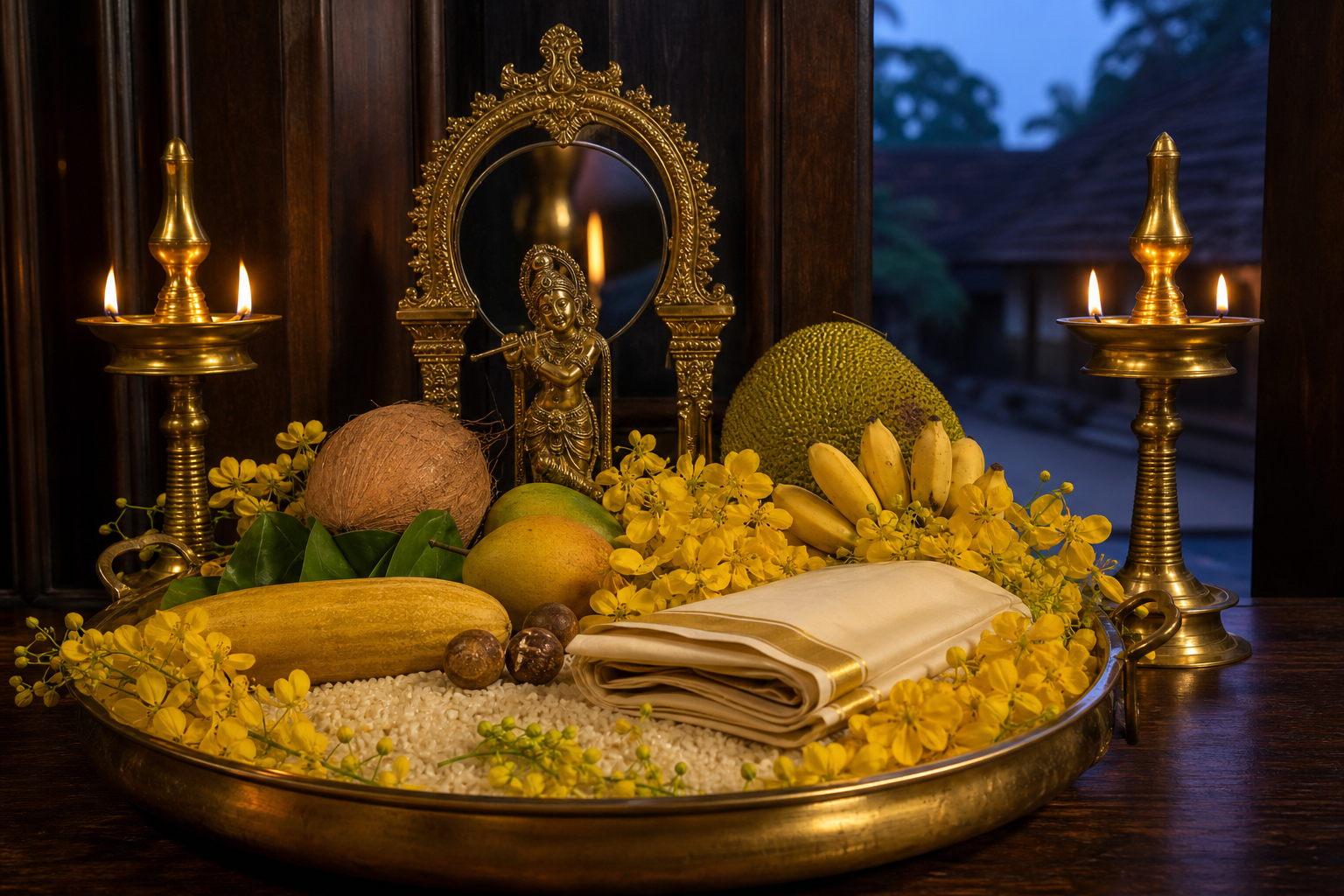
If you are arranging Vishu at home, you do not need the longest possible shopping list. You need the right sequence: prepare the Vishukkani the previous evening, let it become the family’s first sight at dawn, turn its promise of abundance into Vishukkaineettam, and then carry the same spirit to the table.
Vishu marks the solar or astrological New Year associated with the Sun’s entry into sidereal Aries, rather than the formal beginning of the Malayalam Era in Chingam. It usually falls on 14 or 15 April, but the observance is tied to the sunrise following Mesha Sankramana. Check the relevant year’s local panchangam or temple calendar before fixing your household schedule. Once that date is settled, the practice itself can remain simple, beautiful, and recognizably your family’s own.
Prepare the first sight, not merely a festive display
Vishukkani is the devotional center of Vishu. Kani means that which is seen first, so the arrangement has a purpose that ordinary decoration does not: before messages, chores, work, or casual conversation take possession of the mind, you encounter sacred light, nourishment, beauty, and responsibility.
Arrange it on the eve of Vishu. That protects the quiet of the morning and gives you time to correct an unstable lamp, a poorly angled mirror, or flowers that need water. A traditional uruli is ideal, but a clean and dignified vessel can serve when an uruli is unavailable. Material continuity matters, but devotion need not become dependent on owning every heirloom object.
- Clean and choose the space. Use a calm puja area where the whole arrangement can be seen at once. Put the oil lamp on a stable, heat-resistant surface, away from curtains, loose flower garlands, paper, and drafts.
- Establish the sacred center. Place an image or murti of Bhagavan Vishnu or Sri Krishna at the back, preferably near eye level. A Bhagavad Gita, Ramayana, or another family scripture may sit beside it.
- Set the vessel. Fill or line the uruli with raw rice, paddy, grains, or pulses. These are not generic signs of wealth; they represent the more fundamental prosperity of food security and responsible stewardship.
- Add seasonal produce. Mango, jackfruit, banana, coconut, lemon, cucumber, gourds, and other locally available produce express ripeness, nourishment, and dependence on the land. Use sound produce that can later be cooked or eaten rather than discarded.
- Place the kani konna. Let the yellow racemes frame the deity, vessel, or mirror without crowding the entire scene. If the flowers were cut the previous evening, keep their stems in water overnight so they remain fresh for dawn.
- Angle the mirror deliberately. A valkannadi may be used where available, but another clean mirror can perform the symbolic role. Position it so your face appears within the field of lamp, deity, flowers, and grain.
- Add signs of entrusted prosperity. Coins, a gold ornament, betel leaves and areca nut, turmeric, sandal paste, kumkumam, or a folded Vishukodi may be included according to family practice. Keep the arrangement ordered rather than forcing in every possible object.
- Ready the lamp, but light it at dawn. Prepare the oil and wick at night. Before sleeping, test that the route to the puja space is clear, especially if an elder will guide children with their eyes closed.
A useful test is to stand where the family will open their eyes. Can you see the divine image, flame, flowers, mirror, grain, and produce as one composition? If not, simplify or reposition. The power of the kani comes from a coherent first impression, not from the quantity of objects.
Read the symbols as instructions for the year
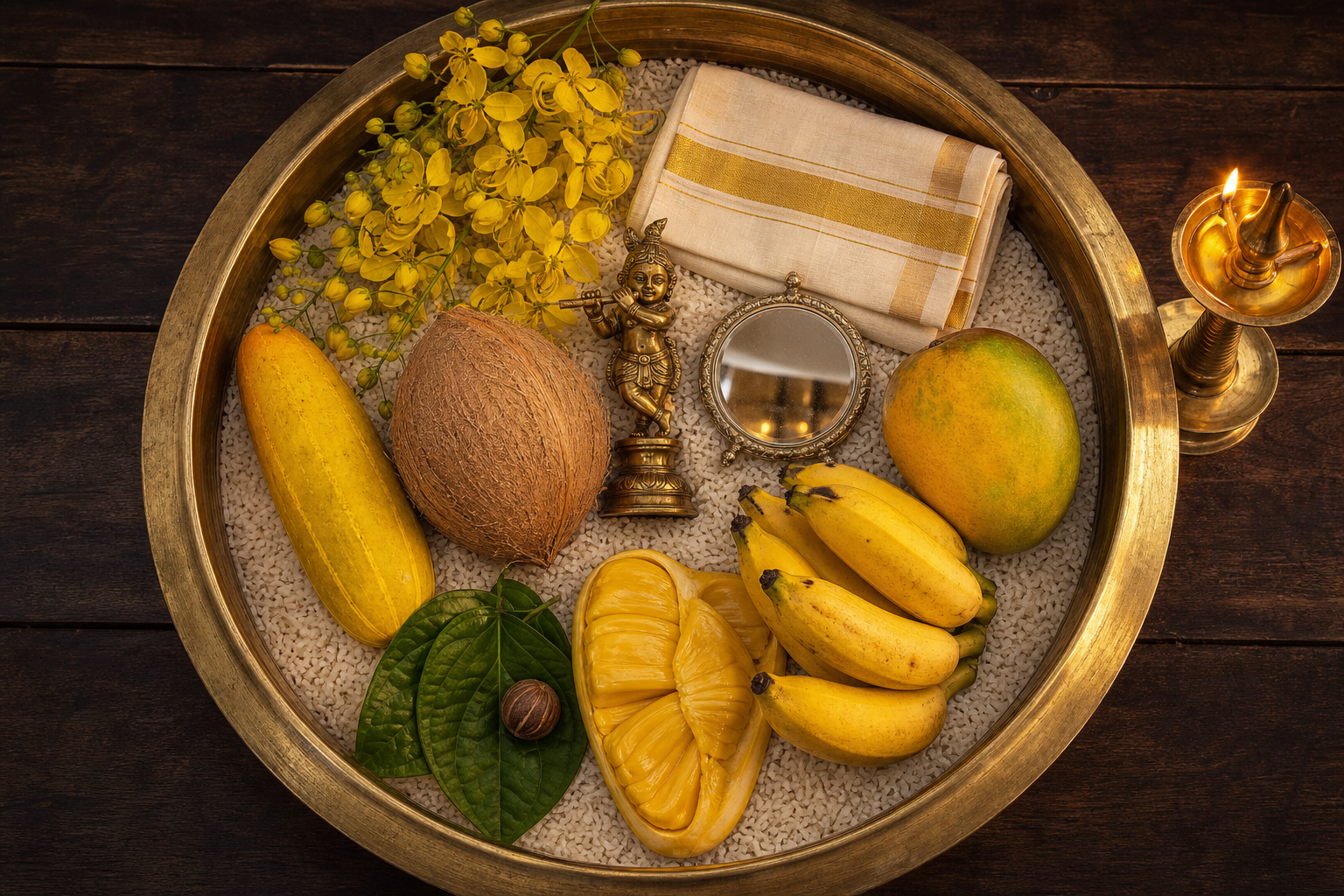
The Vishukkani is often described as a vision of prosperity, but prosperity here is not an isolated heap of possessions. The deity and scripture place wealth within dharma. Grain and produce connect it to sustenance and labor. The mirror brings the viewer into the scene. The lamp asks for discernment. The full arrangement says that abundance becomes auspicious when it is seen clearly, governed ethically, and shared.
| Element | What it signifies | How to use it thoughtfully |
|---|---|---|
| Vishnu or Krishna image, murti, or sacred text | Dharma as the center of the new beginning | Give it visual priority rather than treating it as one ornament among many |
| Nilavilakku | Jnana, clarity, and the removal of inner confusion | Use a steady flame on a safe base and supervise children |
| Mirror or valkannadi | Self-examination and participation in sacred order | Angle it to reflect both the viewer and the kani |
| Kani konna | Solar brilliance, seasonal renewal, and fruitfulness | Use a few fresh racemes and harvest without breaking young branches |
| Rice, paddy, pulses, and grain | Food security and stewardship | Place them in the central vessel and return usable food to the kitchen afterward |
| Mango, jackfruit, cucumber, banana, coconut, and other produce | Seasonal ripeness and agricultural interdependence | Prefer local produce that your household will actually consume |
| Coins or gold | Material stability held with responsibility | Connect the symbol to real giving through Vishukkaineettam or dana |
| Vishukodi | Renewal expressed through clean, fresh clothing | Choose simplicity and dignity rather than making newness a contest |
Handle kani konna as a living seasonal symbol
Kani konna is Cassia fistula, also called the golden shower tree. Its pendant clusters of five-petaled yellow flowers appear around the Vishu season and have become inseparable from the festival’s visual language. The golden color evokes sunlight, ripeness, and prosperity, while the tree’s seasonal flowering ties the domestic rite to Kerala’s actual ecological calendar.
Take only a few panicles from any one tree, and do not snap young branches merely to obtain a fuller display. Leaving flowers behind supports pollinators and future seed formation. A temple, school, or neighborhood that plants konna trees also makes a practical investment in future observances; the tree prefers sun and well-drained ground, and seed-grown trees may begin flowering in three to five years under suitable care.
Names can cause a dangerous mistake. Cassia fistula is sometimes called Indian laburnum, but it is not the toxic European laburnum, Laburnum anagyroides. Nor is it Koelreuteria paniculata, a landscape tree sometimes called golden rain. Cassia fistula has long hanging flower clusters and develops long, cylindrical, internally segmented pods; Koelreuteria later produces papery, lantern-like pods. If identification is uncertain, obtain flowers from a trusted local grower or use another locally available yellow blossom. Do not consume an unfamiliar flower or turn ritual leftovers into a home remedy.
When konna is genuinely unavailable, especially outside Bharat, marigold or another reverently chosen yellow flower can preserve the solar color of the arrangement. Substitution should be honest: it is better to say that you are adapting the ritual to place than to mislabel another species as konna.
Let dawn unfold in a deliberate sequence

The preferred period for Vishukkani darshan extends from Brahma Muhurta, approximately one and a half hours before sunrise, to sunrise. You do not need to fill that whole period with ceremony. The essential movement is from darkness and inward attention to a first, composed vision of light and abundance.
- Rise before the chosen darshan time. Wash, dress simply, and enter the puja space without first turning to routine distractions.
- Light the nilavilakku. An adult should remain beside the flame. Softly recite a Vishnu or Krishna stotra if that belongs to your family practice.
- Guide the family to the kani. Traditionally, an elder leads younger members with their eyes gently closed or covered. Do this only where the path is clear; safety is more important than imitating the gesture literally.
- Open the eyes and pause. Give everyone enough silence to see the complete arrangement. Do not rush immediately into photographs, instructions, or distribution of gifts.
- Offer prayer. Arati, tirtha, sandal paste, kumkumam, or a short scripture reading may follow. One carefully chosen verse can serve as a dharmic intention for the year more effectively than a long recitation performed in haste.
- Give Vishukkaineettam. Elders give coins or money to younger family members and dependents with a blessing. The amount is secondary; the rite joins prosperity to generosity and intergenerational care.
- Move into the public day. Wear Vishukodi, share breakfast, visit a temple if that is your custom, and gather for the sadya. If your household uses fireworks, keep them moderate, supervised, and away from the lamp, dry decorations, animals, and crowded spaces.
Prepare Vishukkaineettam before dawn so the moment does not become an improvised search for cash. Choose an amount you can give without strain, and avoid turning the distribution into a comparison between children or households. You can also extend the principle through annadanam, educational support, or another form of local dana. The ritual becomes complete when the wealth displayed in the kani begins to circulate for somebody else’s good.
Some families receive Vishu Phalam, the year’s astrological guidance, from a temple or practitioner of Kerala jyotisha. Treat such guidance as counsel for disciplined effort, reflection, and appropriate remedies, not as a fatalistic replacement for judgment. Vishu begins by orienting conduct; it does not absolve you from choosing and acting well.
Cook Vishu in two tempos: a quiet breakfast and full sadya
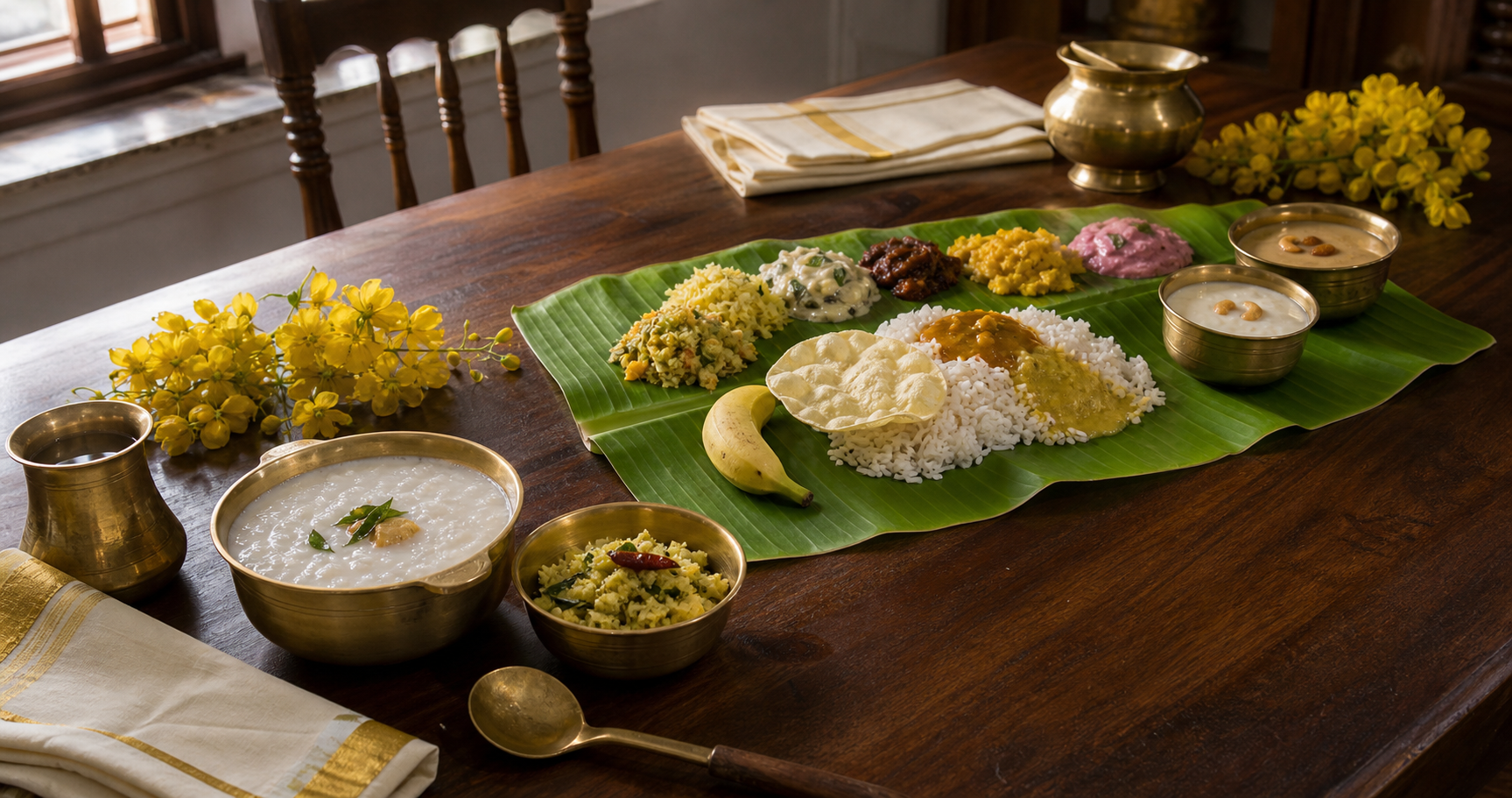
The morning meal and the later feast do different work. Vishu Kanji or Vishu Katta keeps breakfast restrained after the pre-dawn observance. The sadya then opens the table into a larger expression of seasonal plenty. Trying to make both meals equally elaborate usually creates needless pressure in the kitchen.
Choose between Vishu Kanji and Vishu Katta by texture
Both preparations begin with raw rice, fresh coconut milk, cumin, and salt. Vishu Kanji remains loose and spoonable; Vishu Katta is concentrated, cooled, and cut into pieces. Choose kanji if everyone will eat a warm breakfast soon after darshan. Choose katta if your family prefers a set preparation that can cool while the morning’s other observances continue.
A traditional large-batch household specification uses 2 1/2 cups of unakkalari or pacha ari, five grated coconuts, 1/2 teaspoon cumin, and salt to taste, with about an hour allowed for cooking. If that quantity is too large for your household, scale the rice and coconut together and keep the cumin deliberately subtle. The dish should taste primarily of rice and coconut, not spice.
- Rinse the rice. Wash until the water is mostly clear. A 15- to 20-minute soak helps the grains cook evenly.
- Press the coconut in two stages. Reserve the rich first extract as thick coconut milk. Use the thinner second extract for the longer cooking phase.
- Begin with gentle heat. Simmer the rice in thin coconut milk with enough water to keep the grains submerged. Stir periodically, scraping the bottom before starch can catch and scorch.
- For kanji, stop at a flowing consistency. Once the rice is fully tender and releasing starch, add the thick coconut milk over low heat. Add lightly bruised cumin and salt, then adjust the liquid until the porridge is easily spooned.
- For katta, continue concentrating. Cook and stir until the mixture is dense. Fold in the thick coconut milk, cumin, and salt; transfer it to a lightly greased plate or banana-leaf-lined tray; level the surface; and let it cool before cutting.
Do not boil the mixture hard after adding thick coconut milk. Excess heat can split the coconut emulsion and leave kanji oily instead of glossy. If katta will not hold a cut, the mixture was probably transferred while it still contained too much free liquid; return it to low heat, concentrate it a little further, and allow a longer cooling period. Refrigeration makes it firmer, but a rest at room temperature restores more of the coconut aroma before serving.
Serve kanji plain or with a restrained spoonful of jaggery syrup or a tart mango accompaniment. Katta also pairs with jaggery syrup or a mild pickle. These additions are optional. Their job is to provide contrast, not to bury the elemental character of rice, coconut, and cumin. The detailed difference between kanji and katta lies in concentration and setting, so one base preparation can be directed toward either result.
Build a sadya that your household can serve well
A large Vishu Sadya may include parippu with ghee, sambar, rasam, avial, thoran, olan, erissery, kootu curry, inji puli, pachadi, kichadi, pappadam, banana, sharkara upperi, rice, and payasams such as palada, ada pradhaman, or chakka pradhaman. The breadth of the meal expresses balance across tastes and textures, but a small household does not honor Vishu by cooking more food than it can eat.
For a manageable table, organize the menu by function: rice; parippu with ghee; one substantial curry such as sambar; one lighter liquid such as rasam; avial; one dry vegetable preparation such as thoran; one sharp or sweet-sour accompaniment such as inji puli or pachadi; pappadam; and one payasam. Add olan, erissery, kootu curry, kichadi, upperi, or a second payasam only when you have the people, time, and appetite to justify them.
Use the produce displayed in the Vishukkani wherever practical. Mango, jackfruit, cucumber, banana, and coconut can move from symbol to nourishment instead of becoming ritual waste. That passage from altar to shared table is not a compromise in aesthetics; it fulfills the kani’s agricultural meaning.
Adapt the materials without losing the ritual’s grammar
A diaspora household may lack an uruli, valkannadi, fresh konna, jackfruit, or the exact vegetables used in Kerala. Preserve the roles rather than chasing doubtful substitutions: use a clean metal or clay vessel for the uruli, a clear mirror for the valkannadi, local yellow flowers for konna, and ripe seasonal produce for Kerala’s April harvest. Keep the deity or scripture, lamp, grain, reflective surface, signs of nourishment, and act of giving in intelligible relationship.
Adaptation becomes hollow only when the objects remain but the sequence disappears. A beautiful kani glanced at after checking the phone is not doing the same work as a consciously protected first sight. A coin displayed but never shared reduces prosperity to possession. Keep the action intact, and modest substitutions will not sever the tradition.
Key takeaways
- Confirm the Vishu date with a local panchangam because the observance follows the sunrise after Mesha Sankramana, usually on 14 or 15 April.
- Arrange the Vishukkani the previous evening, and test the sightline, mirror angle, walking route, and lamp safety before going to bed.
- Let each symbol retain its purpose: divine presence for dharma, the lamp for clarity, the mirror for self-examination, grain for sustenance, produce for seasonal abundance, and money for responsible generosity.
- Harvest only a few konna racemes without breaking branches. If the plant cannot be identified confidently or is unavailable, use a trusted local yellow flower rather than risking a toxic lookalike.
- Give Vishukkaineettam with a blessing and within your means; extend the principle through dana when possible.
- Choose kanji for a warm, flowing breakfast and katta for a set, sliceable one. Keep the sadya generous enough to feel festive but small enough to serve and consume without waste.
Begin tonight with one concrete decision: choose what your family will see first, then make room for that sight to remain undisturbed. When dawn, giving, and food follow from the same dharmic intention, Vishu becomes more than an inherited arrangement. It becomes a practiced way of entering the year.
References
- DharmaRenaissance Blog — Konna Poo (Cassia fistula) in Vishu: Science, Sacred Symbolism, and Sustainable Tradition
- DharmaRenaissance Blog — Vishukkani Darshan Unveiled: Meaning, Muhurta, and Complete Setup for a Prosperous Vishu
- DharmaRenaissance Blog — Vishu Kanji & Vishu Katta: Authentic Kerala New Year Breakfast—History, Method, and Meaning
- DharmaRenaissance Blog — Vishu Festival Rituals and Customs: A Complete Guide to Vishukkani, Kaineettam, and Sadya