
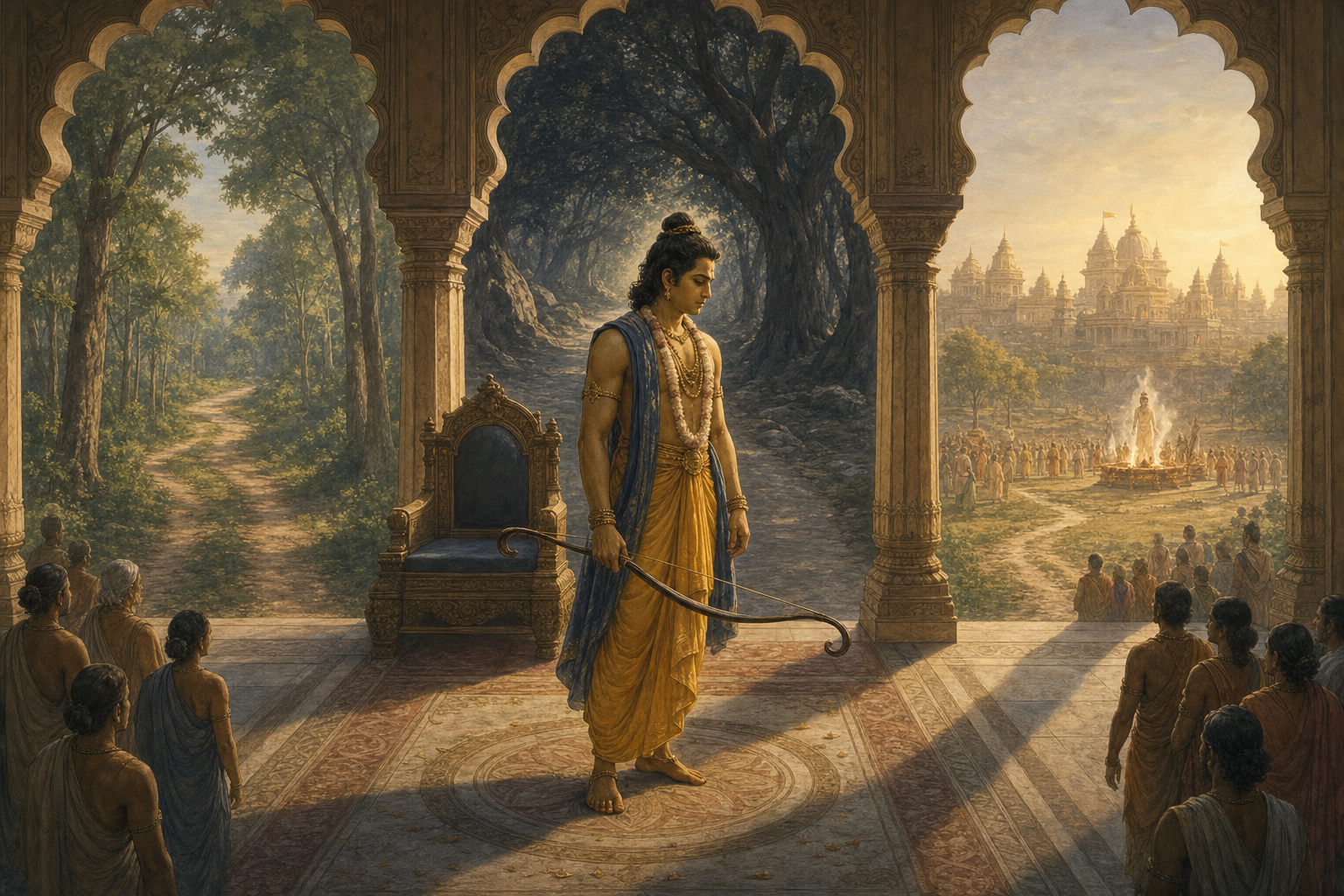
If you revere Sri Rama yet remain troubled by Vali-vadha, Sita’s Agni Pariksha, or her later separation from Ayodhya, you do not have to choose between devotion and moral honesty. Those episodes demand something harder: attention to competing duties, the use of power, and the human cost that remains even after a ruler invokes dharma.
The useful question is not whether you can make every difficulty disappear. It is how to examine a contested action without reducing Rama to either an unquestionable slogan or an ordinary political figure. That discipline also gives you a practical way to judge your own choices when loyalty, justice, reputation, and responsibility pull in different directions.
Start with the dharmas in conflict, not a ready-made verdict
Rama is called Maryada Purushottama because his greatness is expressed through restraint, accepted limits, and fidelity to duty. Although worshipped as an avatara of Vishnu, he does not use divine power to secure personal comfort or political advantage. He acts through the constraints of human relationships and institutions: as son, husband, brother, warrior, prince, ally, and king.
Those roles do not always issue the same command. A husband’s obligation to protect his wife can collide with a king’s concern for public confidence. An ally’s duty to rescue a wronged person can raise questions about jurisdiction and method. A son’s determination to honour his father can affect an entire kingdom. Dharma becomes difficult precisely where two genuine obligations compete.
Before judging an episode, separate three questions. First, what happens in the particular telling you are considering? Second, which duties and relationships shape the decision? Third, which principle, if any, should you carry into your own circumstances? An event can have theological meaning without becoming a literal rule for every household, workplace, or state.
Textual precision matters as well. Rama Katha reaches us through the Valmiki Ramayana and through devotional and regional tellings such as the Ramcharitmanas, the Adhyatma Ramayana, and Kamban’s Iramavataram. The Sanskrit tradition itself has northern and southern recensions shaped through a long history of transmission and redaction. This does not make the tradition disposable. It means you should identify the text, episode, and interpretive tradition before claiming that there is only one possible reading.
Self-limitation is therefore the starting point, not the end of the inquiry. A leader’s willingness to accept personal loss can establish moral seriousness. It does not automatically prove that every consequence imposed on another person is just. You still have to examine means, burdens, and accountability.
Key takeaways
- Reverence for Rama does not require you to suppress a serious ethical question.
- Identify the role-specific duties in conflict before declaring an action dharmic or adharmic.
- Judge the means separately from the desired end; a righteous goal does not settle every question about method.
- Ask who bears the cost, whether that person has a voice, and whether the decision-maker accepts a comparable burden.
- Carry forward the governing principle, such as self-restraint or answerability, rather than mechanically reproducing an ancient action.
Rama’s exile disciplines the claimant to power
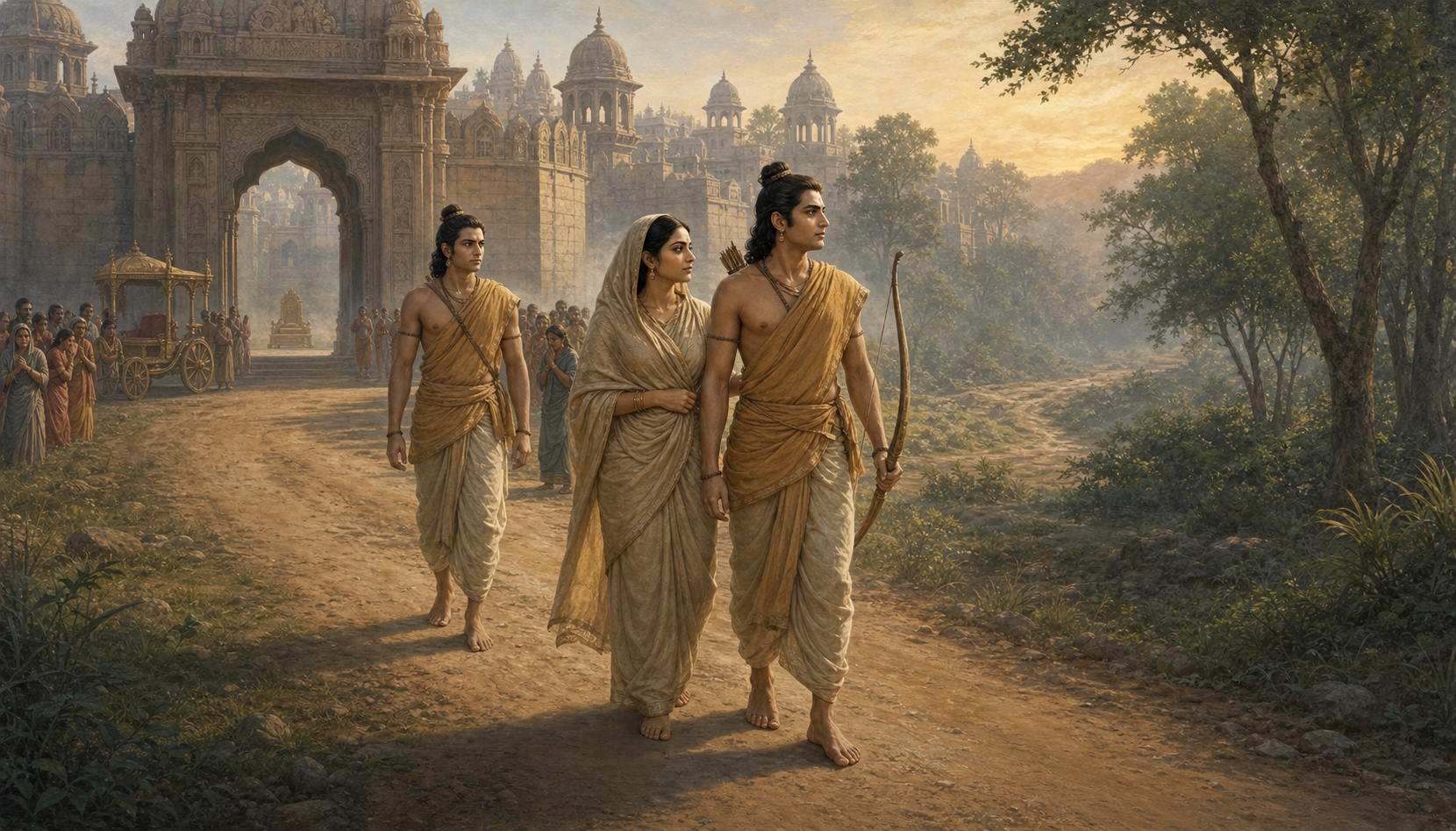
When Kaikeyi invokes Dasharatha’s two boons, she seeks Bharata’s coronation and Rama’s fourteen-year vanvas. Rama accepts exile without protest, even though the throne is within his legitimate expectation. He does not exploit his popularity, divide the royal household, or use divine status to escape the demand.
Calling this simple obedience misses the political depth of the choice. A succession struggle could have fractured Ayodhya. Rama binds himself to a promise made by the king, bears the immediate loss personally, and prevents his own claim from becoming an excuse for disorder. His action joins filial duty to institutional restraint.
Bharata supplies an essential counterpoint. He does not treat Kaikeyi’s demand as a moral licence to enjoy the throne. He rejects kingship as his own possession, places Rama’s sandals on the throne, and governs from Nandigrama as regent. Rama honours continuity; Bharata refuses to convert continuity into usurpation. Dharma is preserved by both renunciation and responsible administration.
The episode should make a powerful person more cautious, not give that person a sacred vocabulary for demanding submission from others. Rama gives up an advantage that would have benefited him. He does not cite duty while transferring every cost to someone with less authority.
Apply that distinction when a family promise, institutional rule, or public commitment becomes inconvenient. Ask who made the commitment, whether it remains legitimate, and who will pay for keeping it. If you hold authority, begin with the sacrifice that is actually yours to make. Invoking Rama to compel another person’s avoidable suffering reverses the moral direction of his exile.
Vali-vadha keeps the means under scrutiny

In Kishkindha, Rama and Sugriva form an alliance of mutual restoration: Sugriva will assist the search for Sita, while Rama will confront Vali’s unjust domination. The continuing difficulty is not merely that Vali dies. It is that Rama strikes him from tactical concealment.
Defences of Vali-vadha focus on Rama’s responsibility to uphold order against a ruler who violated kinship ethics and the sanctity of refuge. The objection focuses on method: even if Vali acted unjustly, did that justify an unseen attack? Both questions belong inside the dharmic inquiry. Ending the discussion with Vali was wrong leaves the hardest part unanswered.
Use four tests whenever someone defends an exceptional use of power:
- Standing: What gives the decision-maker authority to intervene? An alliance or good intention is not, by itself, unlimited jurisdiction.
- Wrongdoing: What injustice is being stopped, and how well has it been established? Moral outrage cannot substitute for a clear account of the wrong.
- Method: Why was concealment, force, or another exceptional tactic necessary? Saying that the end was righteous does not answer this question.
- Answerability: Could the decision-maker explain the action to the affected person and accept judgement under the same principle?
This framework neither dismisses traditional defences nor pretends that the tactical problem is trivial. It makes each defence do its full work. A dharmic argument must show why both the objective and the chosen means belong within justice.
You can use the same test in a community, workplace, or family whenever a decision is made secretly for an allegedly good end. Write down the reason you would give directly to the person affected. If the justification works only while the method remains hidden, concealment may be carrying more of the argument than dharma is.
Sita’s ordeals expose the cost of public duty
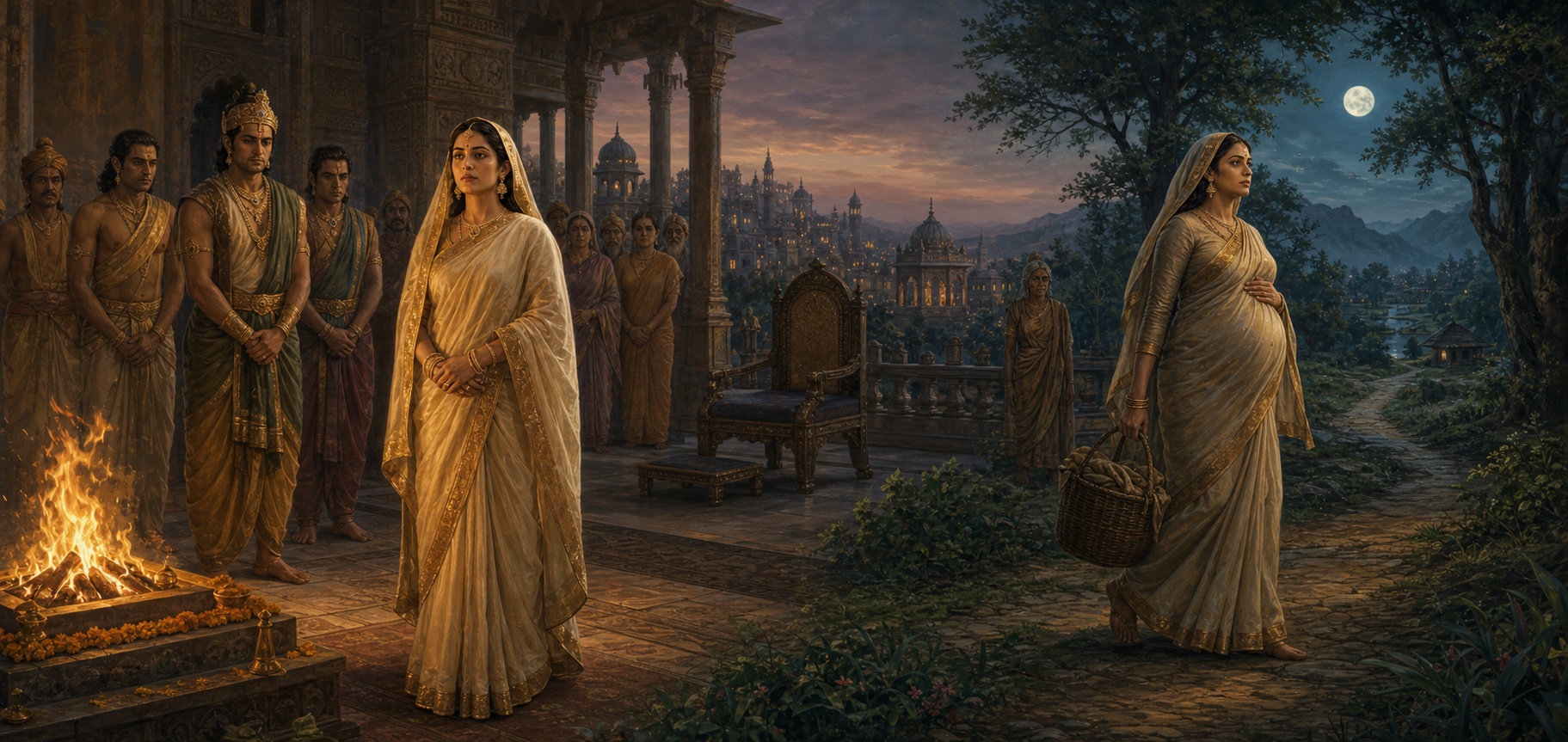
After Ravana’s defeat, Sita’s Agni Pariksha confronts the reader with a different problem. Devotional interpretations understand the ordeal as a revelation of her purity. Political readings emphasize the severe expectations placed upon royalty and the perceived need to answer public doubt. The ethical objection remains: why should the burden of proving purity fall upon the woman who was abducted?
These readings do not cancel one another. The fire may disclose Sita’s purity within the sacred narrative, while the demand for public proof still reveals a tragic imbalance in who must suffer for royal legitimacy. A defence that mentions reputation but ignores the burden placed on Sita is incomplete. An objection that ignores the story’s political theology is incomplete as well.
The conflict sharpens in the Uttara Kanda. Persistent public rumour leads Rama to ask Sita to reside in Valmiki’s ashrama, where she gives birth to Lava and Kusha. The defence presents a sovereign subordinating personal happiness to Rajadharma. The objection asks whether public confidence can be protected by making an innocent spouse bear the consequence of unverified accusation.
Do not turn that tragedy into an effortless rule for contemporary family life. A king’s political burden is not a general permission for a spouse to abandon fairness, inquiry, or protection. Public trust is not identical to gossip. Office does not transform rumour into evidence. Nor does personal sacrifice settle the matter if the heaviest and least reversible cost is imposed on someone else.
Rama Rajya is remembered as an order of justice, prosperity, and compassionate governance. If Rajadharma is invoked in a way that removes compassion from consideration, the account of duty is not yet complete. The ruler’s intention matters, but so do the affected person’s dignity, voice, and loss.
Sita must therefore be read as a moral agent, not merely as evidence in a case about Rama. Her fortitude sustains the narrative through captivity, ordeal, separation, motherhood, and her eventual return to Mother Earth. Lava and Kusha later recite Rama’s own story in his court, bringing memory back into governance. Sita’s life ensures that the cost of royal choice cannot be hidden behind the language of office.
The same widening of vision brings Urmila’s unheralded sacrifice and Tara’s wise counsel into view. Dharma is not sustained only by the person who gives the public order. It also depends on those who endure absence, speak unwelcome wisdom, preserve a household, or force power to confront what its decisions have cost.
Use a six-question test before calling your choice dharmic

No checklist can remove moral conflict, but disciplined questions are safer than using dharma as a label after you have already chosen what you want. Before a consequential decision, write one sentence in answer to each of these:
- Which role am I acting from? Name the concrete relationship: parent, spouse, colleague, leader, citizen, teacher, or devotee. Then name the other role whose duty may conflict with it.
- What rule or promise binds me? State who created it, whether it is legitimate, and whether you would apply it equally when it works against your own interest.
- Are the means consistent with the end? Examine secrecy, coercion, force, humiliation, and procedural shortcuts separately from the good result you hope to produce.
- Who bears the burden? Identify the person who loses safety, status, home, trust, or voice. Notice whether your sacrifice is real or whether you are chiefly sacrificing someone else.
- Am I responding to evidence or reputation? Separate verified harm from suspicion, pressure, and repeated rumour. Public noise can create a leadership problem without becoming proof of guilt.
- What precedent and repair follow? Ask whether you could defend the same principle publicly, accept it when used against you, and repair avoidable harm if your judgement proves wrong.
If the duties still cannot be reconciled, do not pretend that the cost has vanished. Name what you are choosing, what you are sacrificing, and why. Then accept the burden that properly belongs to you. In Rama’s contested choices, suffering does not disappear merely because duty has been invoked. Its continued presence is what makes the conflict tragic rather than tidy.
Devotional practice can steady this inquiry. Rama-nama japa, Sundara Kanda parayana, and kirtana cultivate attention and inner firmness; they need not replace ethical examination. Pair practice with a careful reading of the whole episode. State the strongest defence, state the strongest objection, include the voice of the person who pays, and only then identify the principle you would carry forward.
Rama Katha also gives you more than one model of dharmic agency: Rama’s restraint, Bharata’s refusal of wrongful benefit, Hanuman’s courageous bhakti, Vibhishana’s principled dissent, Sita’s fortitude, Tara’s counsel, and Urmila’s unseen service. When one episode leaves you uncertain, these lives help you notice that dharma can require renunciation, action, dissent, endurance, or truth spoken to power.
The next time you are tempted to justify a difficult decision by invoking Rama, pause and answer the six questions first. Do it before asking another person to accept the cost. That small discipline turns Rama’s example from a slogan about righteousness into a demanding practice of restraint, accountability, and compassionate judgement.