
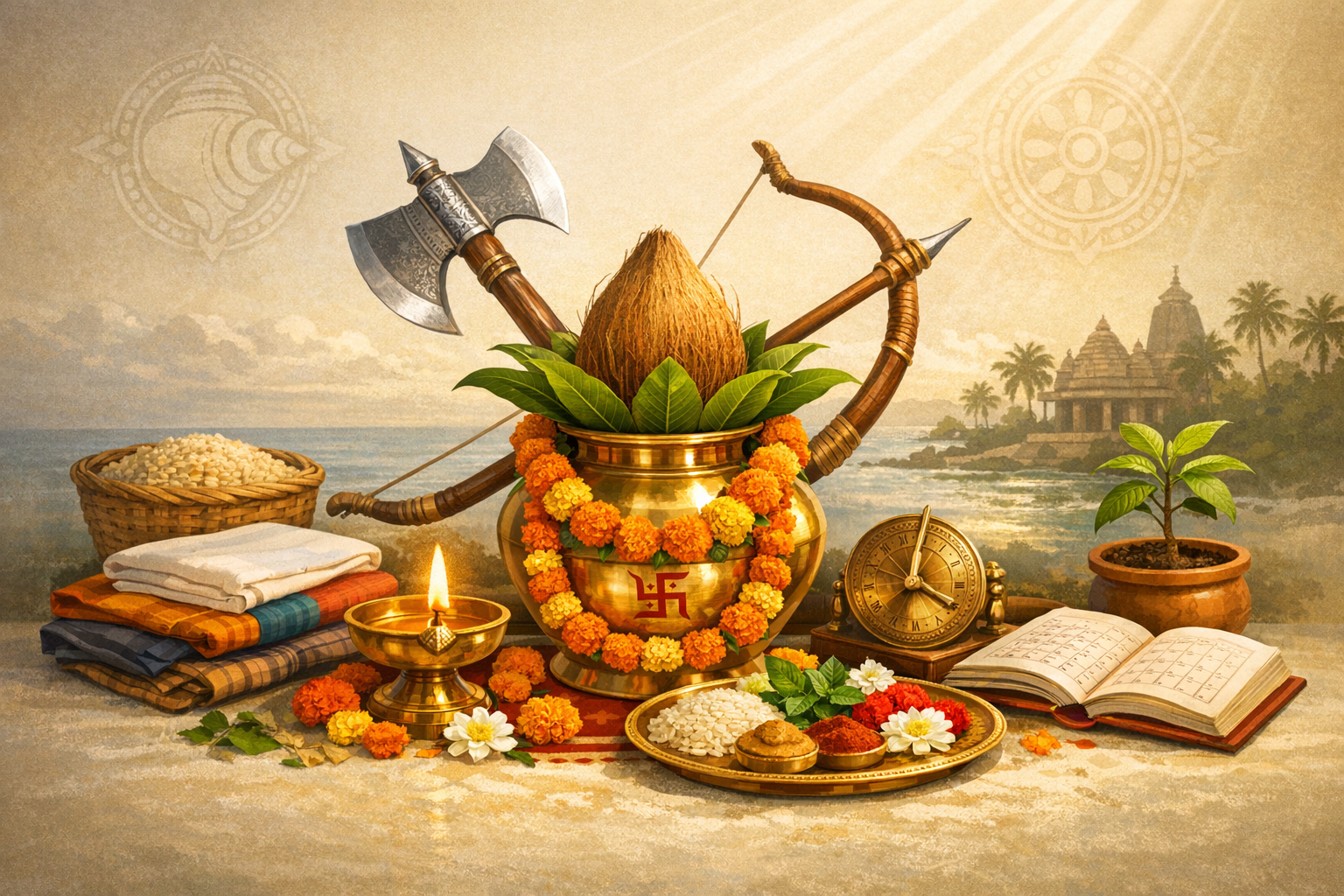
Parashurama Jayanti commemorates the appearance of Lord Parashurama, revered in the Dashavatara of Lord Vishnu as Bhargava Rama. In most traditions, this Jayanti coincides with Akshaya Tritiya, the third lunar day (Tritiya) of the bright fortnight (Shukla Paksha) in the Vaishakh month. In 2026, as in other years, observances align with the Tritiya tithi and the Akshaya Tritiya ethos of inexhaustible merit, auspicious beginnings, and sustainable prosperity. Communities across Indiaespecially in the Konkan region, Goa, coastal Karnataka, Maharashtra, and Keralamark the day with vrata, puja, and generous charity, weaving theological meaning with cultural continuity.
The calendrical foundation rests on the lunar tithi system used by traditional Panchangams. A tithi is defined by the angular separation between the Moon and the Sun, each tithi spanning 12 degrees of elongation; its clock time is therefore variable and rarely matches sunrise-to-sunset civil days. Parashurama Jayanti is observed on Vaishakh Shukla Tritiya, but local practice follows specific rules. Many almanacs prioritize the Madhyahna period (the Hindu midday) for Jayanti determinations; if Tritiya prevails during Madhyahna, that day is chosen. Where Tritiya does not touch Madhyahna or where Tritiya overlaps two dates, some lineages choose the day when Tritiya prevails at sunrise, while others defer to the next day or, rarely, to Dwitiya or Chaturthi alignment based on regional parampara. As a result, dates may vary by location and school, especially when Tritiya straddles sunrise across time zones.
Because Parashurama Jayanti coincides with Akshaya Tritiya, communities often follow the broader Akshaya Tritiya rules used in the region. Akshaya Tritiya is celebrated when Tritiya prevails at sunrise and is recognized as one of the most auspicious windows of the year, included among the Sade-Teen Muhurat in several traditions. When the Tritiya tithi spans two civil dates, some traditions privilege the day when Tritiya is present at sunrise, while Jayanti-focused traditions check the Madhyahna span. Devotees planning 2026 observances are best served by consulting a reliable regional Panchang (Drik or Vakyam per local custom) to confirm whether Vaishakh Shukla Tritiya is present at sunrise and/or at Madhyahna at their location.
Akshaya Tritiya adds a layer of sacred optimism to the Jayanti. The term “Akshaya” conveys inexhaustibilityspiritual merit that does not diminish. Ritual specialists often underline that acts of learning, dana (charity), annadanam (feeding), and initiation into svadhyaya begun on this day are believed to grow steadily like a perennial endowment of virtue. Families frequently begin long-term sankalpas, including daily recitation commitments, construction or restoration projects, or temple service, anchoring Parashurama Jayanti in a living cycle of personal and communal uplift.
Theologically, Parashurama is a unique synthesis of Brahminical knowledge and Kshatra discipline. Texts such as the Mahabharata, Vishnu Purana, and Bhagavata Purana describe him as the warrior-sage who restores dharmic balance in an era of rampant adharma. Born to Rishi Jamadagni and Devi Renuka, Parashurama is famed for confronting the tyranny of Kartavirya Arjuna and, in later narratives, instructing great heroes including Bhishma and Karna in the science of arms. As a Chiranjivi (long-lived being), Parashurama stands across yugasa reminder that the defense of dharma is a perpetual inner and outer task.
Iconographically, Parashurama carries the parashu (axe), signifying the incisive power of discrimination (viveka) and the courage to sever bondage to injustice. In many depictions he also bears a bow, linking his tapas (austerity) to martial excellence. The avatar’s message is not unchecked violence; it is the disciplined alignment of strength with sacred orderkshatra yoked to dharma. This balance resonates across the dharmic family: Buddhist, Jain, Sikh, and Hindu traditions each articulate the need for ethical courage, compassionate restraint, and responsibility toward society’s well-being.
Parashurama Jayanti observances in 2026 follow well-tested ritual patterns. Many devotees fast or adopt a light, sattvic diet, dedicating the day to puja and study. A simple, traditional sequence includes snana (purificatory bath) at dawn; sankalpa (statement of intent) specifying Vaishakh Shukla Tritiya and local place-time; and installation of Vishnu or Parashurama murtis or images on a clean altar. Where available, abhishekam with pañcāmṛta (milk, yogurt, ghee, honey, and sugar) is performed, followed by alankara (adorning), and either Panchopachara or Shodashopachara puja.
Mantra recitation may include “Om Namo Narayanaya” and “Om Parashuramaya Namah,” along with Vishnu Sahasranama, selected verses from the Bhagavad-Gita that extol the divine descent to restore dharma (e.g., 4.7–4.8), and hymns to Bhargava Rama where known. After naivedya (food offering), ārati, and pradakshina, the prasada is shared. Devotees often conclude with a heartfelt prayer to internalize Parashurama’s virtuescourage tempered by humility, learning joined to service, and strength governed by conscience.
Charity is central to both Parashurama Jayanti and Akshaya Tritiya. Traditional dana on this day includes annadanam, distribution of clean water, vastra dana (clothing), and support for education, healthcare, and environmental stewardship. In rural and urban contexts alike, households and temples organize community kitchens and food packets, honoring the day’s spirit of inexhaustible merit by tangibly nourishing those in need. Eco-conscious offeringslike planting trees or supporting sustainable water initiativesmeaningfully extend the Jayanti’s blessings to the shared environment.
Regional memories and myths enrich observance. In Kerala’s cultural memory, Parashurama is credited with creating the land of Kerala by casting his axe into the ocean, a sacred etiological tale that binds geography to grace. In the Konkan belt and Maharashtra, historic Parashurama templessuch as the Parshuram temple near Chiplunhost special darshans and processions. Farther east, Parshuram Kund in Arunachal Pradesh, though famed primarily for a Makar Sankranti mela, reflects the avatar’s pan-Indian presence in sacred geography.
From a Panchang perspective, several practical points guide 2026 planning. First, confirm the Vaishakh month alignment in the local system: North Indian purnimanta calendars and South Indian amanta calendars label months differently, but both converge on the same tithi-based day for festivals. Second, establish whether Vaishakh Shukla Tritiya prevails at sunrise and/or at Madhyahna locally; Jayanti traditions often emphasize Madhyahna, while general Akshaya Tritiya observances emphasize sunrise. Third, once Tritiya is established, select a puja window that avoids Rahu Kalam and Yamaganda where possible; Abhijit muhurta can be especially supportive for sankalpa, homa, or dana.
The day’s philosophical message is strikingly contemporary. Parashurama’s life dramatizes an ethical axiom found across dharmic traditions: power without wisdom corrodes, while wisdom without courage withers. By uniting study with discipline, and devotion with responsibility, the Jayanti calls practitioners toward inner kshatrathe fortitude to stand for truth, protect the vulnerable, and rectify wrongs, beginning with oneself. This insight resonates equally in Hindu, Buddhist, Jain, and Sikh reflections on right conduct, non-exploitation, and service.
Communities also draw inspiration from scriptural episodes. The meeting between Shri Rama and Parashurama in the Ramayana is often read as an allegory of the transition from one dharmic phase to anothermartial force giving way to sovereign righteousness. In the Mahabharata, Parashurama’s role as teacher of Bhishma and Karna shows that even titanic strength requires a moral compass; when that compass is set amiss, consequences follow. These narratives ground the Jayanti in a nuanced ethicsfirm, not fanatical; compassionate, not complacent.
For families and sanghas preparing for Parashurama Jayanti 2026, a simple plan ensures depth without complexity. Fix a clear sankalpa, specifying vrata intention and seva to be undertaken in the coming months. Prepare a concise puja with Panchopachara, a short stotra sequence, and annadanam or a chosen dana. Include children and elders in the storytelling of Parashurama’s life, linking ancestral memory to living practice. Where possible, visit a nearby Vishnu or Parashurama temple to connect personal sadhana with the community’s shared rhythm.
When calendar variations ariseespecially if local almanacs list different Jayanti datesfollowing the kula-parampara (family or lineage custom) or the schedule of the nearest temple is wise. Pan-Indian festivals often bear local inflections, all of which are part of the civilizational tapestry. The intention behind the observance, aligned with dharma and carried out with humility and care, is primary.
In spiritual terms, Parashurama Jayanti on Akshaya Tritiya invites a twofold aspiration. First, the aspiration to cultivate inexhaustible merit through learning, seva, and restraint. Second, the aspiration to wield inner strength ethically, committed to truth without anger and to courage without arrogance. In 2026, this synthesis remains profoundly relevantoffering a way to harmonize devotion and duty, tradition and renewal, individual resolve and community welfare.
In summary, Parashurama Jayanti 2026 is observed on Vaishakh Shukla Tritiya alongside Akshaya Tritiya. Exact dates may differ by region due to tithi overlaps and the use of sunrise or Madhyahna criteria. A balanced observance includes vrata, Panchopachara or Shodashopachara puja to Lord Parashurama or Vishnu, mantra recitation such as “Om Namo Narayanaya” and “Om Parashuramaya Namah,” charity with annadanam or essential goods, and mindful participation in local temple programs. Framed by the dharmic ideal of strength guided by wisdom, the Jayanti offers a living path that unites Hindu, Buddhist, Jain, and Sikh values around ethical action and compassionate service.
Inspired by this post on Hindu Pad.
