
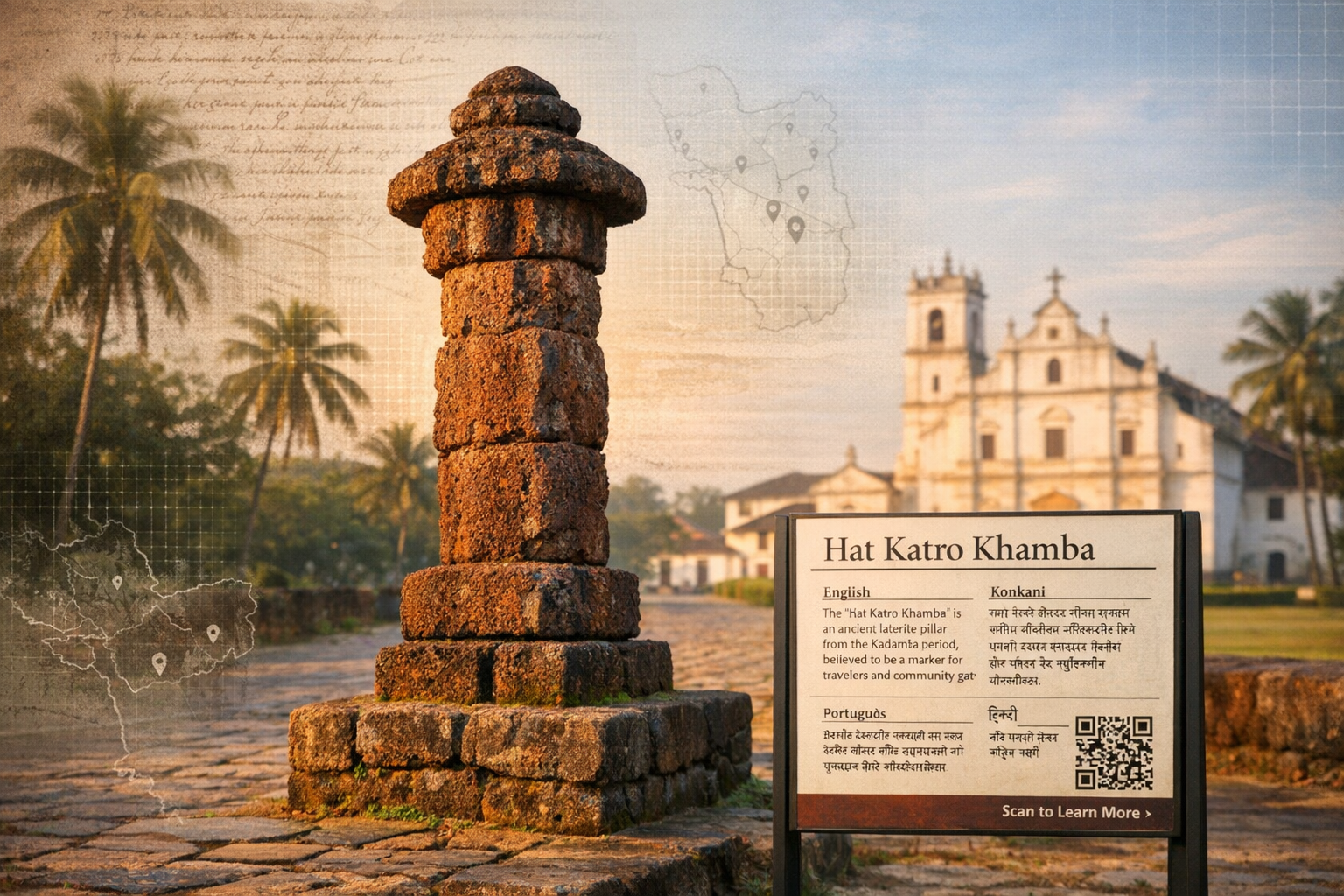
Hindu Raksha Maha Aghadi has opposed the proposal to rename ‘Hat Katro Khamba’ and urged the Goa Government to take steps to ensure that the history of the Inquisition is preserved and made known to the public. The appeal highlights a broader public-history question: how societies safeguard difficult heritage in ways that are accurate, inclusive, and educational. In the Goan context, the issue is not only about a nameplate but about conserving a layered archive of memory that informs contemporary identity and inter-community understanding.
‘Hat Katro Khamba’ occupies a distinctive place in local memory. The toponym itself, carried forward through oral traditions and community recollections, functions as an anchor for public remembrance. Even where the precise origins of such names are debated, toponyms often encode local experiences and historical consciousness, making them valuable evidence in reconstructing social histories otherwise underrepresented in formal archives.
Against this backdrop, the call to preserve Inquisition-era evidence in Goa acquires urgency. The Goa Inquisition, instituted in 1560, operated intermittently until the late eighteenth and early nineteenth centuries, intersecting with complex patterns of religious conversion, regulation, and social control. While scholars differ on scope and quantification, there is broad agreement that the period left a deep imprint on community life, ritual practice, and cultural expression across the region.
Understanding this past requires methodical engagement with diverse sources: Portuguese administrative records, ecclesiastical proceedings, traveler accounts, legal edicts, vernacular literature, and oral histories. Archival repositories in Portugal, India, and elsewherealong with local inscriptions, architectural traces, and family chroniclestogether enable a more granular reconstruction of events and their consequences. In such reconstructions, place-names like ‘Hat Katro Khamba’ constitute vital, place-based cues for inquiry and interpretation.
Names matter because they are evidence. Historical toponyms preserve continuity; they help historians triangulate narratives, identify sites of significance, and cross-reference archival claims with lived geographies. Changing a historically charged name without careful documentation and public explanation risks erasing or detaching social memory from the landscapean outcome at odds with good heritage practice and with the public’s right to understand its own history.
Globally, best practices in heritage conservationarticulated by ICOMOS charters, the Nara Document on Authenticity, the Burra Charter, and UNESCO’s emphasis on intangible heritageprioritize contextual integrity, layered interpretation, and inclusive stakeholder consultation. Applied to the Goan case, these principles recommend robust documentation, interpretive clarity, and community participation over nominal erasure through renaming.
In practical terms, opposing the renaming of ‘Hat Katro Khamba’ aligns with a preservation-first approach: retain the historical toponym, contextualize it with evidence-based interpretation, and invite multi-perspectival dialogue. This approach neither sensationalizes nor suppresses; it equips citizensacross generationsto engage with a complex past responsibly.
Preservation can and should be accompanied by thoughtful public history. Clear, multilingual interpretive signage (for instance, in Konkani, Marathi, English, and Portuguese) can explain what is known, what remains contested, and how scholars piece together fragmentary records. QR codes linked to curated digital dossiers, primary-source excerpts, maps, and timelines can deepen engagement while maintaining academic rigor.
A comprehensive program by the Goa Government could include: a moratorium on renaming historically significant toponyms pending independent review; a rapid heritage assessment of sites associated with Inquisition-era memory; and the establishment of an expert advisory panel comprising historians, archivists, conservation architects, local community representatives, and educators. Such a panel can recommend standardized interpretive frameworks, archival coordination, and conservation protocols.
Evidence preservation should be both analog and digital. High-resolution photogrammetry and 3D scanning of stones, pillars, and markers; GIS mapping of associated micro-sites; and systematic cataloguing of inscriptions and epigraphic traces would create a durable, shareable record. Digitally linking these materials to annotated bibliographies and archival finding aids would further support research and transparent public learning.
Collaboration with archives in Portugalsuch as the Arquivo Nacional da Torre do Tombo and the Biblioteca Nacional de Portugalcan facilitate access to pertinent manuscripts, edicts, and trial documentation. Parallel coordination with repositories in India (national and state archives, university libraries, and ecclesiastical collections) would help triangulate narratives and build an authoritative, open-access resource.
Education is pivotal. Age-appropriate modules for schools and colleges in Goa can introduce students to methods of historical inquiry, the ethical handling of contested pasts, and the responsibilities of civic memory. University partnerships can seed capstone projects on conservation, public history, and translation studies so that primary sources become accessible to broader audiences.
A balanced interpretive framework must also advance social cohesion. The objective is not to re-inscribe grievance, but to honor historical truth with dignity, foster empathy, and reinforce unity across communities. Preserving the memory of ‘Hat Katro Khamba’ through evidence-based interpretation can model how difficult histories are approached with careencouraging interfaith dialogue and shared reflection among Hindus, Buddhists, Jains, Sikhs, Christians, and others who together shape Goa’s plural civic life.
Legally, the state can draw on the Ancient Monuments and Archaeological Sites and Remains Act, 1958 (for centrally protected heritage) and complementary state-level policies to protect historically significant structures and associated contexts. Where structures are not formally classified as “ancient monuments,” policy instruments for cultural landscapes and intangible heritage can still safeguard names, narratives, and commemorative practices integral to community identity.
Transparency and accountability mechanisms matter. Publicly accessible conservation plans, peer reviews of interpretive content, and community consultations minimize politicization and maximize trust. Documenting both consensus and scholarly debateclearly and respectfullyhelps audiences grasp the complexity of evidence without conflating contested claims with established facts.
By retaining ‘Hat Katro Khamba’ and enriching it with rigorous, accessible interpretation, Goa can demonstrate how societies face their pasts without fear or erasure. Doing so would meet the core demand raised by Hindu Raksha Maha Aghadi while advancing a broader, inclusive vision of heritage stewardship grounded in accuracy, respect, and public education.
Ultimately, safeguarding Inquisition-era evidence in Goa is not about reviving division; it is about ensuring that the landscape continues to “speak” with integrity. Names, markers, and archives together form a living classroom. Protecting themand teaching with themallows future generations to understand what happened, why it matters, and how shared values of tolerance, dignity, and unity can guide the present.
Inspired by this post on Hindu Jagruti Samiti.
