
If you want to observe Utpanna Ekadashi but are unsure about the date, fasting rules or puja sequence, begin with one principle: the vrata should bring your food, conduct and attention under one sankalpa. Severity alone does not make an observance spiritually meaningful.
You can keep this Ekadashi sincerely without turning your home into a temple or attempting a fast your body cannot safely sustain. What matters is knowing which tithi to follow, understanding the katha, choosing an appropriate level of fasting and completing the vrata with parana on Dwadashi.
Confirm the Ekadashi tithi before planning your fast
Utpanna Ekadashi, also called Utpatti Ekadashi, is observed on the eleventh lunar day of the dark fortnight. It falls in Margashirsha or Kartika, depending on the regional calendar system being followed.
That difference in the month name does not necessarily mean that one calendar is wrong. Hindu lunar calendars do not all name months in the same way. The practical mistake is to search for a month name, choose an English date from an unrelated region and begin the fast without checking when Ekadashi tithi operates locally.
Use a panchang calculated for your location. Check three things: the civil date on which Ekadashi is observed, whether your sampradaya follows a different observance date, and the permitted parana window on Dwadashi. Sunrise and tithi boundaries matter, so a date copied from another time zone may not apply where you live.
If your family, guru-parampara or temple follows a particular Vaishnava calendar, remain consistent with it. A general panchang can identify the lunar day, but lineage rules may determine which of two nearby civil dates receives the vrata. Do not try to settle that difference by mixing the date from one tradition with the parana time from another.
The katha: Ekadashi manifests as Vishnu’s protecting shakti

The Bhavishyottara Purana frames the teaching as a conversation in which Arjuna asks Sri Krishna about the importance of Ekadashi vrata. Krishna’s answer gives Ekadashi an exceptionally elevated place among devotional observances. That praise belongs to the katha’s sacred register: it calls the devotee toward disciplined remembrance, not toward treating merit as a transaction.
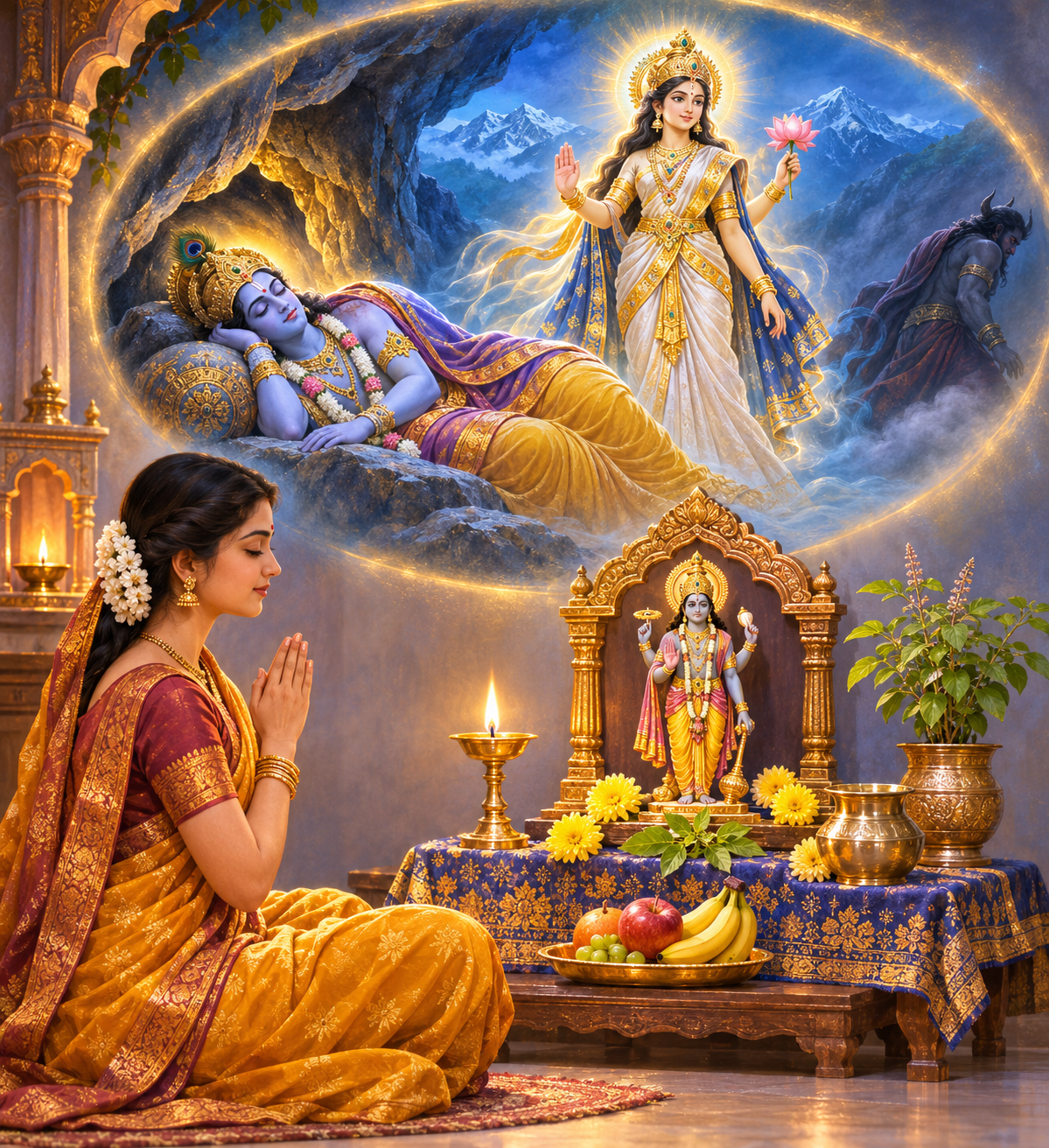
In the traditional Utpatti Ekadashi vrat katha, the asura Mura becomes a threat to the devas. Lord Vishnu confronts him in battle. When Vishnu withdraws to rest, Mura sees an opportunity to attack him.
At that moment, a radiant feminine power manifests from Vishnu. She defeats Mura before he can carry out the attack. When Vishnu beholds what has happened, he offers the maiden a boon. She asks that those who observe her tithi with devotion receive spiritual purification and the fruit of the vrata. Because she appears on the eleventh lunar day, she is named Ekadashi. Utpanna, meaning manifested or arisen, remembers this appearance.
The story gives you a useful way to understand the fast. Mura attacks when watchfulness appears to have withdrawn. Ekadashi arises as an inner power of vigilance. Hunger is therefore not the central achievement. The real practice is to notice the impulse that tries to seize an unguarded mind: anger, compulsive consumption, harsh speech, laziness or habitual distraction.
This is a devotional interpretation rather than the only possible reading of the katha. Yet it explains why Ekadashi practice joins bodily restraint to remembrance of Vishnu. The vrata trains you to interrupt an impulse before it becomes an action. If food is restricted while resentment and heedlessness are freely indulged, the outer form has been retained while the story’s challenge has been missed.
A practical Utpanna Ekadashi vrat vidhi at home
Household customs differ, so preserve the rules received from your family or sampradaya where you have them. If you do not have an inherited procedure, the sequence below gives the day a clear devotional shape without pretending that every tradition uses an identical menu, mantra or offering.
- Choose the level of fasting before the vrata begins. A strict fast, a water-only fast, a fruit-and-liquid observance and a simple non-grain diet are not interchangeable in every lineage. Follow the form your tradition accepts and your body can safely manage. Do not assume that a waterless fast is automatically the most faithful choice.
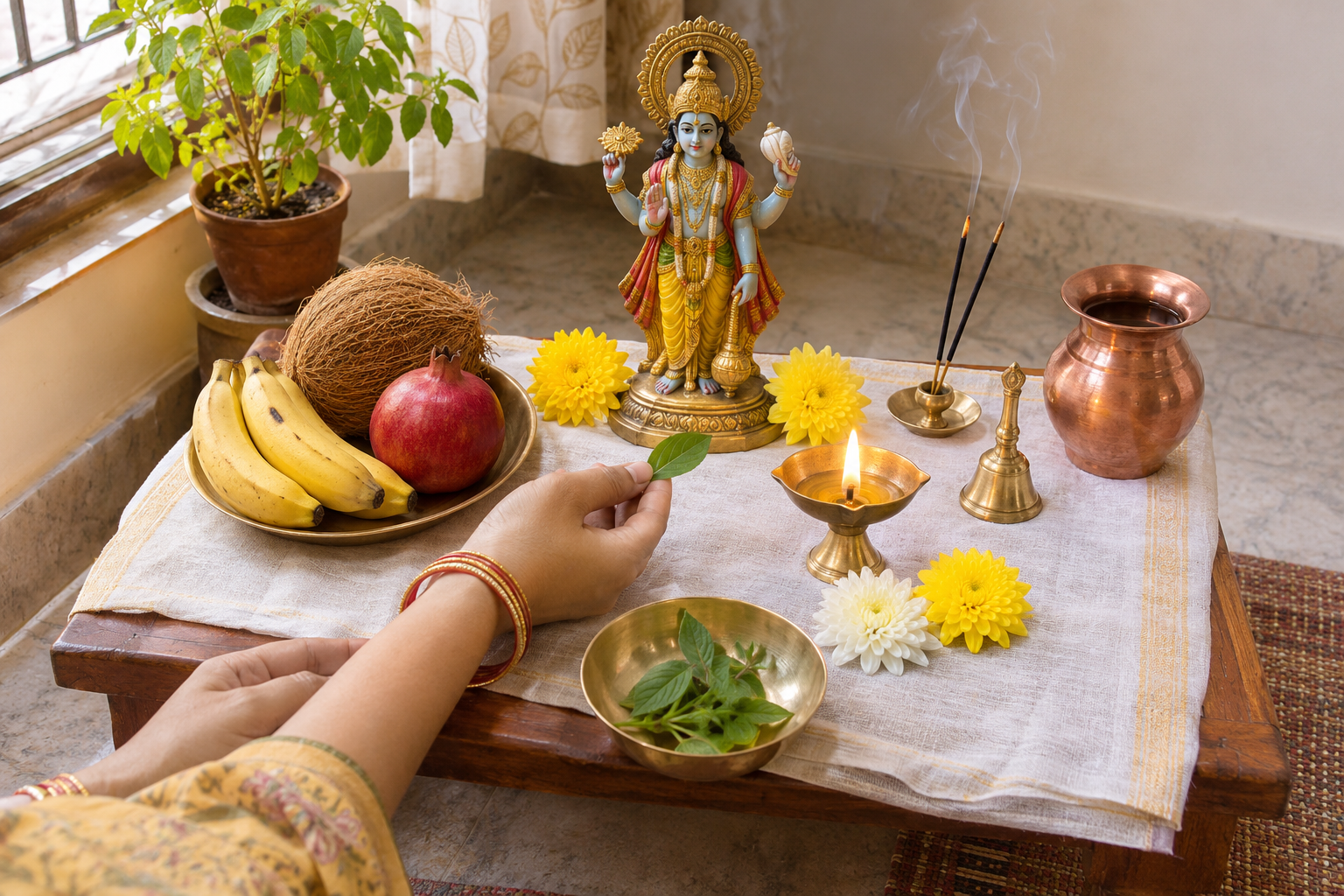
- Prepare on Dashami. Eat moderately, settle unnecessary work and gather what you will use for worship. A simple arrangement may include an image or murti of Vishnu, clean water, a lamp, flowers and fruit. Tulsi may be offered where it accords with your practice and is available.
- Begin Ekadashi with cleanliness and sankalpa. Bathe, wear clean clothing and make the worship space orderly. State plainly what you are undertaking. For example: “On Utpanna Ekadashi, I observe this vrata for purification, steadiness and remembrance of Sri Vishnu.” Make a commitment you can actually keep.
- Offer a simple Vishnu puja. Light the lamp, invoke the Lord, offer water, flowers and permitted food, and repeat a Vishnu nama or mantra from your tradition. Elaborate materials are not required for a focused home observance. Give more attention to presence than to displaying many objects.
- Keep the dietary discipline you selected. Ekadashi practice commonly excludes grains and pulses, while the permitted alternatives vary by household and lineage. Decide your food in advance so that the day is not consumed by negotiating exceptions or searching for special dishes.
- Read or hear the Utpanna Ekadashi katha. Do not treat this as an ornament added after the fast. The story supplies the vrata’s inner question: what gains power when your attention falls asleep, and what form of vigilance must arise before it governs your conduct?
- Guard speech, attention and action. Reduce entertainment and avoid quarrelling, gossip, intoxication and needless indulgence. Use the space created by the fast for japa, prayer, scripture, quiet service or remembrance of Vishnu. If your tradition keeps a night vigil, observe it only to the degree that health and essential responsibilities permit.
- Complete the vrata with Dwadashi parana. Consult the same local panchang used to choose the observance date and break the fast within its stated parana window. Offer gratitude before eating. After a demanding fast, begin gently rather than turning parana into an oversized feast.
Fasting is not safe at the same intensity for everyone. Children, older adults, pregnant or breastfeeding people, anyone with diabetes or an eating disorder, and people whose medication must be taken with food should not attempt a strict or waterless fast merely to imitate someone else’s observance. Choose a modified devotional discipline and obtain appropriate medical guidance when a health condition or medicine affects eating and hydration. A vrata should cultivate clarity, not create a preventable medical emergency.
Make the vrata a discipline of attention, not a food puzzle

The Sanskrit idea of upavasa carries the sense of dwelling near. In practice, that means reducing what normally crowds your awareness so that attention can remain near the Divine. The food rule supports this movement; it is not the whole movement.
Give the vrata three connected forms. Restrain the palate through the fasting discipline available to you. Restrain the senses by reducing noise, scrolling and entertainment. Direct the freed attention toward Vishnu through nama-japa, puja, katha and compassionate conduct. Each part corrects a weakness in the others: dietary restraint prevents the day from becoming ordinary, while remembrance prevents restraint from becoming a test of pride.
If illness or another real limitation prevents you from fasting, do not abandon the entire observance. Eat what you need, keep it simple where possible, and undertake a definite discipline of speech, attention and prayer. “I cannot fast strictly” does not have to become “I can do nothing.” The useful question is which form of restraint will honestly turn you toward Vishnu on this particular day.
You can also make the katha personal without reducing Mura to a slogan. Before the day begins, name one recurring impulse you will watch: irritation, procrastination, gossip, compulsive media use or unnecessary consumption. When it appears, pause before acting and repeat the Divine Name. That small interruption is where the story becomes practice.
For a family observance, divide the responsibilities instead of leaving one person to prepare special food, arrange the altar and lead the reading. Let one person check the panchang, another prepare the puja space and another read the katha. Children can participate through a flower offering, a short nama-japa period or listening to the story without being pushed into an unsuitable fast.
Key takeaways
- Utpanna or Utpatti Ekadashi is the dark-fortnight Ekadashi of Margashirsha or Kartika, with the month name depending on the calendar system.
- Use a local panchang for the observance date and Dwadashi parana window; do not copy timings from another location.
- The katha remembers Ekadashi as the divine feminine power that manifests from Vishnu and defeats the asura Mura.
- Choose a fasting level that accords with your lineage and health; a more extreme fast is not automatically a more sincere one.
- Join dietary restraint to Vishnu puja, nama-japa, the vrat katha, careful speech and watchfulness over one recurring impulse.
Before your next Utpanna Ekadashi, make three decisions: confirm the tithi in your local panchang, choose a safe form of fasting and name the habit you intend to watch. Prepare those choices on Dashami. Then the vrata can begin as a deliberate act of remembrance rather than a hurried argument about what you may eat.
References
- Hindu Pad – Utpanna Ekadashi Vrat Vidhi | Procedure of Utpanna Ekadashi Pooja
- Hindu Pad – Utpatti Ekadashi Vrat Katha | Story of Utpanna Ekadashi

Leave a Reply
You must be logged in to post a comment.