
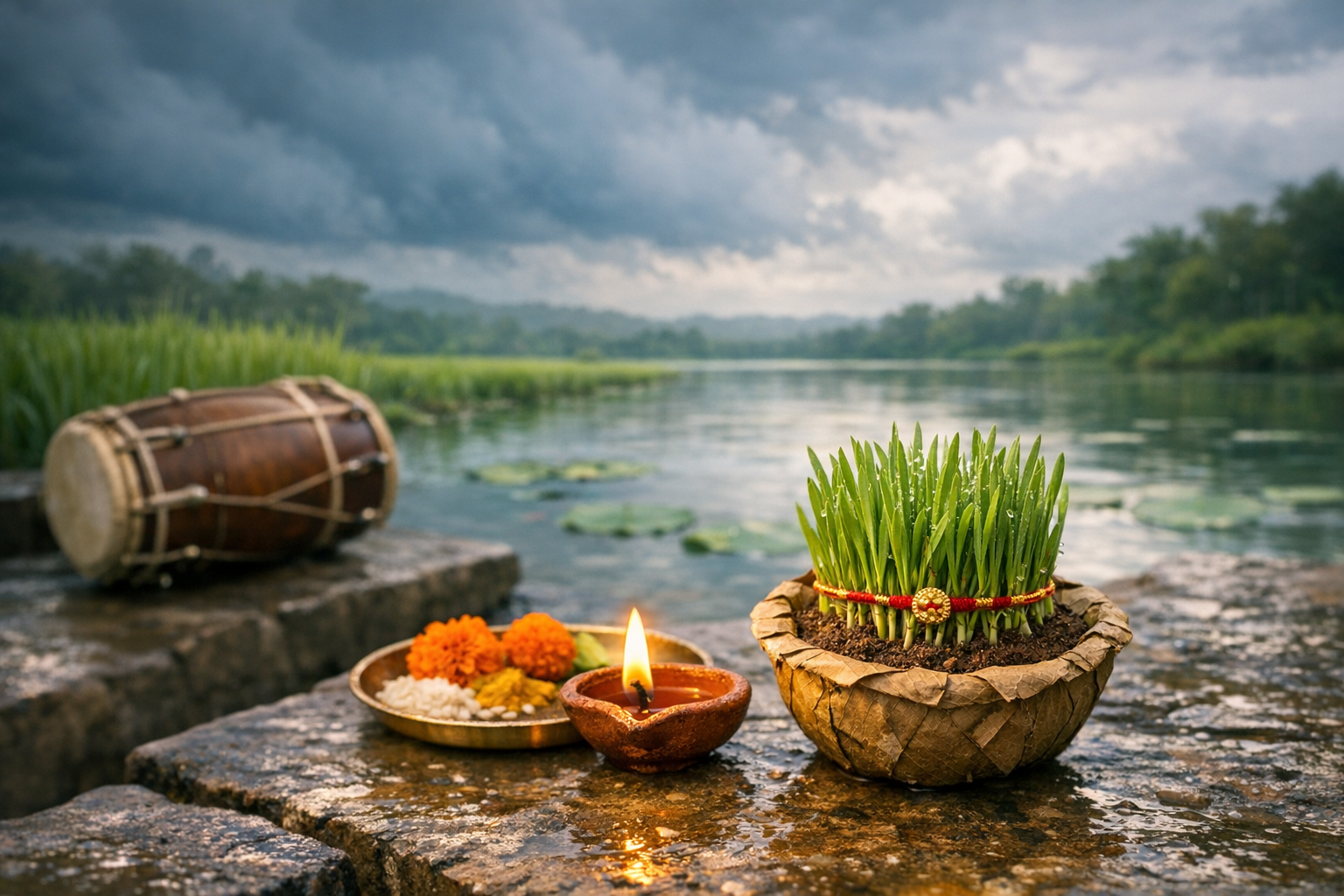
Kajari Purnimaalso known as Kajri Poornima, Kajili Poornima, or Kajli Purnimafalls on Shravan Purnima and coincides with Raksha Bandhan. In 2026, the festival will be observed on Friday, August 28. Celebrated predominantly in Madhya Pradesh, Chhattisgarh, and Uttar Pradesh, this monsoon-season observance is deeply embedded in agrarian life and is regarded as a prayer for crop protection, timely rains, and household wellbeing.
The festival’s ethos emerges from the intimate relationship between agrarian communities and the monsoon. By aligning sacred time (Shravan Purnima) with the agricultural calendar, Kajari Purnima functions as a ritual safeguard for the kharif season. While the actual crops in fields are typically paddy, maize, and millets, households use barley or wheat seedlings as symbolic proxies of fertility, growth, and resilience. This symbolism underscores a central truth in rural life: care for the seed mirrors care for community, and attention to cycles of nature reflects spiritual stewardship.
Etymologically, “Kajri/Kajari” evokes the dark, rain-bearing monsoon clouds and the evocative folk-song tradition known as kajri geet. In the Mirzapur–Varanasi cultural belt, kajri songs have long been sung through the monsoon, expressing longing, reunion, and gratitude for life-renewing rains. These songs, sometimes set in Hindustani semi-classical styles, preserve ecological memoryrecording when the clouds arrive, how fields transform, and why community bonds matter during the sowing season.
Ritually, the observance commonly begins on Kajari Navami in the waning phase of Shravan, when women prepare a small basket or leaf-cup (dona/pattal) with clean soil and sow barley (jau) or wheat. The seedlings are carefully tended indoorsoften in a shaded, sanctified corneruntil Shravan Purnima. On Purnima, the sprouted greens are carried in a simple procession to a river, pond, or well; after prayers to Bhagavati (locally revered as Kajari/Kajli Mata in some regions), the seedlings are offered back to the waters. Many households then gently place a portion of the sprouts along field edges or retain a few for home shrines, signifying a bridge between domestic devotion and agrarian labor.
Fasting and vows (vrata) are observed by many women for family prosperity, children’s health, and crop security. The emphasis is on nurturingof households, fields, and local ecosystems. Simple offerings (naivedya), lamps (deepa), and protective invocations accompany the rites, with gratitude directed to the monsoon’s life-giving power and to the divine principle that sustains seed, soil, and society.
Regional practice varies across Madhya Pradesh, Chhattisgarh, and Uttar Pradesh, especially in Bundelkhand and adjoining cultural zones. In some communities, groups gather to sing kajri geet on Purnima evening; in others, the focus is the morning immersion of seedlings followed by rakhi-tying later in the day. Such variations are customary and arise from local panchang traditions and agrarian rhythms; households typically consult community elders or temple notices for precise practice and timing.
Because Kajari Purnima coincides with Shravan Purnima, it shares the day with Raksha Bandhan and, in many regions, with Vedic Upakarma as well as coastal observances like Narali Purnima. Together, these festivals create a mosaic of seasonal gratitude: bonds of kinship (rakhi), renewal of study (upakarma), and reverence for waters, winds, and seeds (Kajari Purnima). This convergence exemplifies the unity of diverse dharmic pathwaysHindu, Buddhist, Jain, and Sikh communities alike honor the monsoon through service, restraint, and respect for the environment, reinforcing a shared ethic of care and interdependence.
It is important not to confuse Kajari Purnima with Kajli Teej (observed notably in Rajasthan’s Bundi). While the names sound similar, Kajli/Kajari Teej occurs earlier in the season and follows its own regional liturgy and calendar logic. Kajari Purnima, by contrast, distinctly culminates on Shravan Purnima and is centered on seed-sowing symbolism and crop protection.
Suggested home observance for 2026 (consult a local panchang for exact muhurta):
1) Before Purnima: On Kajari Navami, prepare a clean basket or leaf-cup with sanctified soil. Sow barley/wheat grains (rinsed and sun-dried) with a simple sankalpa (intention) for family wellbeing and a resilient harvest. Keep the seedlings in a shaded, hygienic place; lightly moisten the soil as needed.
2) Purnima morning: Perform a brief puja at home to Bhagavati (Kajari/Kajli Mata as locally revered). Offer water, flowers, a lamp, and seasonal fruits. Recite simple mantras or stotras as per family tradition.
3) Immersion: Carry the seedlings to a clean waterbody. Offer gratitude for rains and protection of fields and farmers. Where immersion is not feasible, place a portion of the sprouts respectfully at field edges or around a sacred tree, and return the remainder to the home shrine.
4) Community dimension: If customary, sing or listen to kajri geet in the evening. Participate in Raksha Bandhan rites within the family, recognizing the larger theme of protective bondsbetween siblings, communities, and nature.
Ecologically responsible practice is intrinsic to Kajari Purnima. Households are encouraged to use biodegradable materials (leaf cups, natural flowers, cotton wicks), avoid plastics near water sources, and source grains locally. The ritual’s corenurturing seedlings, conserving water, and honoring monsoon timingembodies sustainable agriculture principles that rural communities have refined across generations.
Key details for 2026: Kajari Purnima is on August 28, 2026 (Shravan Purnima). As lunar tithis can span two civil dates, regional calendars may mark auspicious windows that begin the prior evening or extend into the day. For precise puja or immersion times, local temple notices and panchang listings should be followed.
In sum, Kajari Purnima integrates devotion, ecology, and community life. By tending a small bowl of soil and sprouts, households symbolically tend vast fields and shared futures. The festival not only blesses the agricultural cycle but also affirms a unifying dharmic ethic: care for the earth is care for one another, and gratitude for rain is gratitude for life itself.
Inspired by this post on Hindu Pad.
