
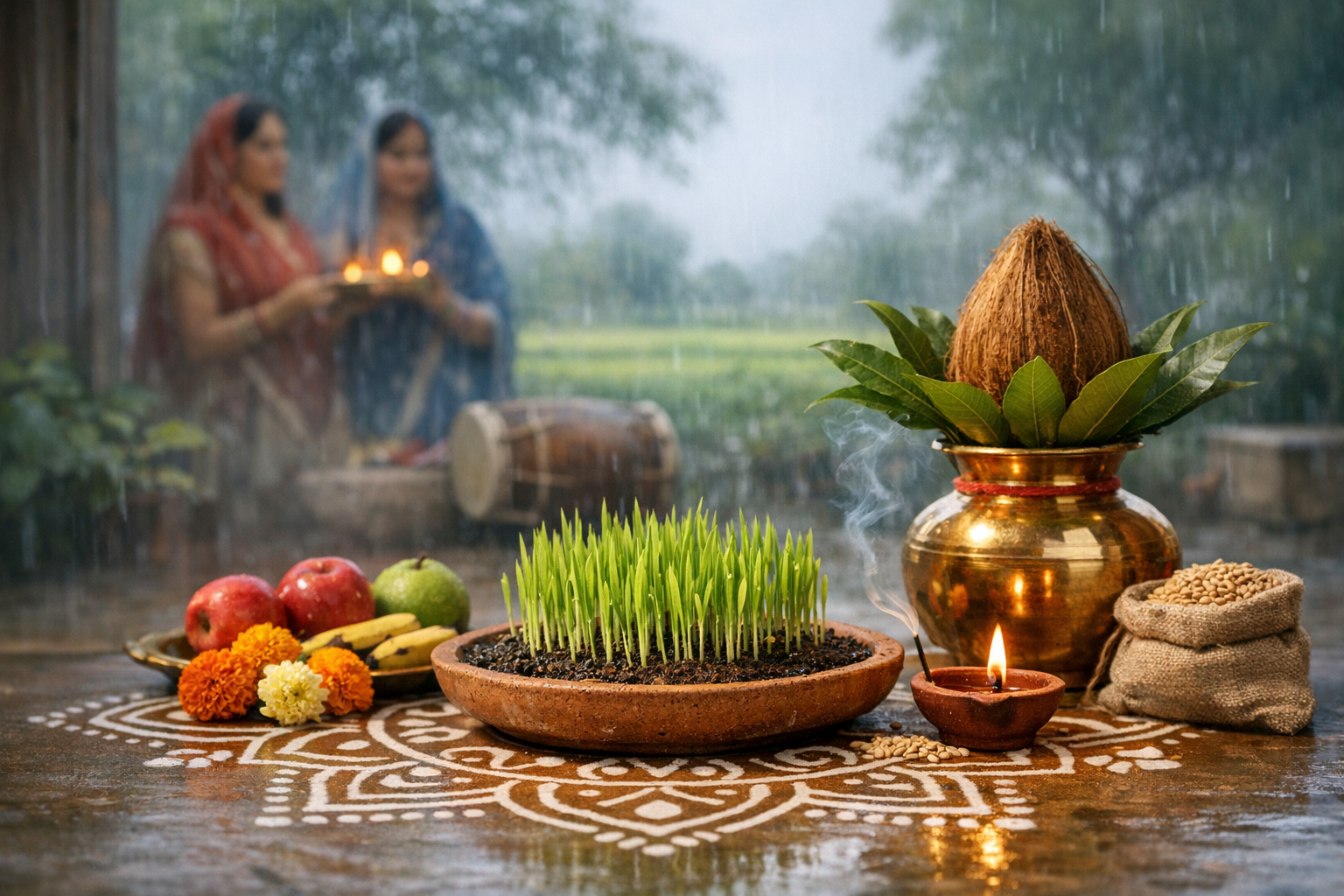
Kajari Navami is a regional monsoon festival observed with particular devotion in Madhya Pradesh, Chhattisgarh, and Uttar Pradesh during Shravan (Sawan) Month of the Hindu calendar. In 2026, Kajari Navami falls on 22 August, aligning with Shukla Paksha Navami in Sawan Maas as followed in the Hindi Vikram Samvat calendars used across these regions. The day inaugurates a focused seasonal observance that culminates on Shravan Purnima, known locally as Kajari Purnima, and centers on prayers for agricultural abundance, household well-being, and the long life of children.
Functioning as a sacred prelude to Kajari Purnima, Kajari Navami binds ritual practice to the ecological rhythm of the monsoon. In the Bundelkhand–Baghelkhand cultural belt and adjoining areas of Awadh, the observance integrates agrarian symbolism with devotion, while traditional Kajri songs evoke the longing and relief associated with the rains. The festival’s tone is at once domestic and communitarian: household worship begins on Navami and continues until Purnima, reflecting gratitude for rainfall, harvest security, and social harmony.
From a calendrical perspective, Kajari Navami corresponds to the ninth lunar day (Navami tithi) of the bright fortnight (Shukla Paksha) in Shravan. For 2026, regional panchangs indicate 22 August as the civil date. Because tithi start and end times vary by location, households generally align observance with the day on which Navami prevails at local sunrise or, where customary, during the primary daylight period. This practical approach preserves ritual integrity while accommodating the astronomical nature of the lunar calendar.
Ritually, the day begins with thorough cleaning and sanctification of the household shrine. The puja area is swept, sprinkled with sanctified water, and prepared with an auspicious floor design. This foundational act is more than preparation; it establishes sacred order, welcoming the monsoon season’s beneficence into the domestic sphere.
A distinctive feature of Kajari Navami in these regions is the sowing of barley (jau) seeds in a small earthen pot or shallow tray filled with clean, moistened soil. The vessel is placed on a freshly prepared altar. Daily worship is offered from Navami through Purnima as the shoots emerge and strengthen, mirroring hopes for a thriving crop and resilient family life. The barley symbolizes fertility, prosperity, and continuity, and the mindful tending of the sprouts underscores the agrarian heart of the observance.
Puja Vidhi typically includes a clear sankalpa, or statement of intent, specifying place, date, and purpose, followed by the installation of a kalash or the consecration of the barley vessel as the focus of worship. Invocations to Devioften addressed as Gauri, Bhagavati, or the Mother Earth principleare accompanied by lighting a lamp, offering incense, flowers, and seasonal fruits, and performing aarti. Households may incorporate regional Kajri melodies during the worship sequence, thereby blending devotion with living folklore. Each day until Purnima, a brief aarti and offering sustain the vow and nurture the sprouting barley.
Many households, especially married women, observe a vrata associated with Kajari Navami and the days thereafter, often choosing partial fasts or sattvic meals while maintaining routine duties. The vrata intention emphasizes the protection and longevity of children, harmony within the family, and relief from seasonal ailments. Charitysuch as distribution of grains, water, or simple mealsis frequently included, aligning personal devotion with social care during the monsoon.
The agrarian and ecological ethos of Kajari Navami is explicit. Farmers and agricultural families traditionally pray for timely, well-distributed rains, healthy soils, and freedom from pests and disease. Implements and seeds receive respectful acknowledgment. On Kajari Purnima, in many localities, the sprouted barley is immersed in a river or placed at the roots of a sacred tree such as the Peepal or Neem, completing a cycle of reverent return to nature. For those residing away from rivers, the offering is adapted thoughtfully to local environmental norms, ensuring both ecological sensitivity and ritual completion.
Regional expressions vary subtly across Madhya Pradesh, Chhattisgarh, and Uttar Pradesh. In parts of Bundelkhand and eastern Uttar Pradesh, for instance, the domestic ritual emphasis is complemented by oral traditions and community singing of Kajri. In northern Chhattisgarh and Baghelkhand, household vows and agricultural symbolism often take center stage. These variations reflect the flexibility and depth of Hindu domestic ritual while maintaining the shared core of Navami-to-Purnima observance.
Kajari Navami is sometimes confused with Kajari Teej. The two are distinct. Kajari Teej generally falls earlier, during the Krishna Paksha of Shravan or Bhadrapada depending on regional reckoning, and has its own set of marital and devotional emphases. Kajari Navami, by contrast, is situated on Shravan Shukla Navami and explicitly inaugurates the sequence leading to Kajari Purnima. Clarifying this distinction preserves both observances’ integrity and their specific regional meanings.
Music and folklore enrich Kajari Navami. The Kajri song traditionwidely known in the Hindustani repertoire and rooted in Awadhi and Bhojpuri-speaking areascaptures the emotive tenor of the monsoon. When incorporated into household worship, these songs reinforce the sensory dimensions of devotion, linking rain-washed landscapes outside with inner spaces of reverence and hope.
Although Kajari Navami is a Hindu domestic festival, its guiding sensibilityexpressing gratitude to nature, practicing self-discipline, and cultivating social careharmonizes with the broader dharmic family. In many regions, Jain households undertake Shravan fasts and devotional readings during the same monsoon window; Sikh families routinely offer Ardas for well-being and agrarian prosperity; and Buddhist communities often emphasize compassion and mindful living during seasonal observances. The shared commitment to ecological respect and ethical conduct underscores unity across dharmic traditions, even as each community follows its distinct liturgical forms.
Preparation for Kajari Navami is simple and meaningful. Households gather barley seeds, clean soil, and an earthen pot or tray, as well as a lamp, incense, water, flowers, fruits, and a modest sweet offering. The puja area is arranged thoughtfully, with a clean cloth or chowk, and the daily worship routine from Navami through Purnima is planned to accommodate family schedules. Where elders maintain inherited methods, younger family members can assist and learn, helping transmit living tradition.
Auspicious conduct during the observance includes maintaining a clean and peaceful home environment, simplicity in diet where fasting is observed, kindness in speech, and modest acts of charity. Many households add small ecological practices, such as watering plants or feeding birds, as extensions of the ritual ethic. Each of these actions reaffirms the festival’s central promise: a harmonious relationship between human life, society, and the monsoon-nourished earth.
For 2026 planning, the key date to note is 22 August for Kajari Navami. Local panchang details can be referenced to confirm the Navami tithi at sunrise in each locality, especially for those living outside the core regions where community practices guide the timing. Observed in this manner, Kajari Navami eloquently marks the sacred beginning of the Kajari Purnima cycle in Sawan Maas and invites households to align devotion, ecology, and culture throughout the monsoon.
Inspired by this post on Hindu Pad.
