
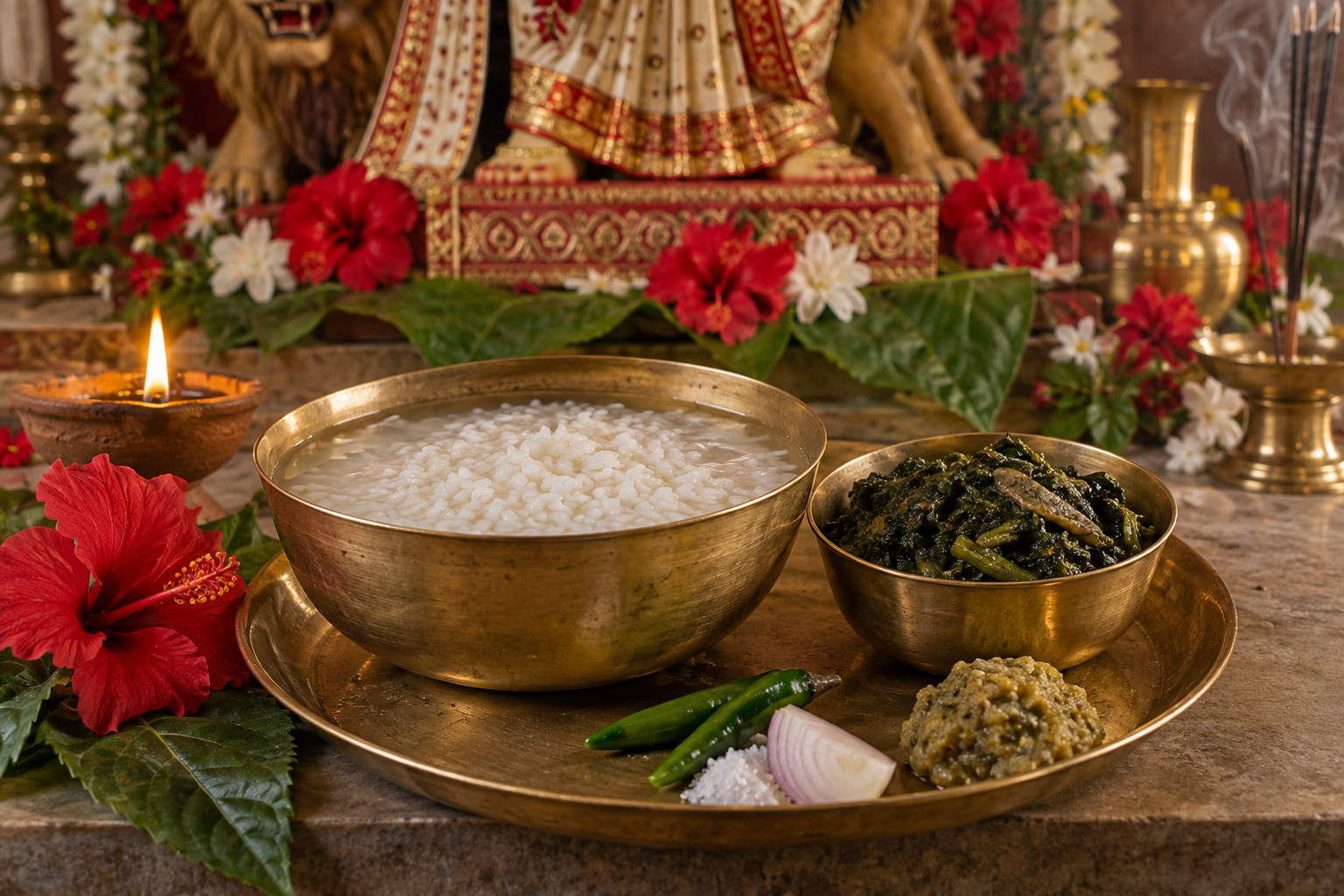
If you are deciding what to offer Maa Durga on Dashami, the traditional answer in this Bengali observance is strikingly simple: kachu shaak and panta bhaat, or taro greens and water-soaked rice.
The ingredients matter, but so do timing and context. This is a farewell offering on the tenth and final day of Durga Puja, made before the murti is taken for ceremonial immersion. Use the traditional pair as your foundation, then let your household or puja community determine the exact preparation.
What belongs in this Dashami offering
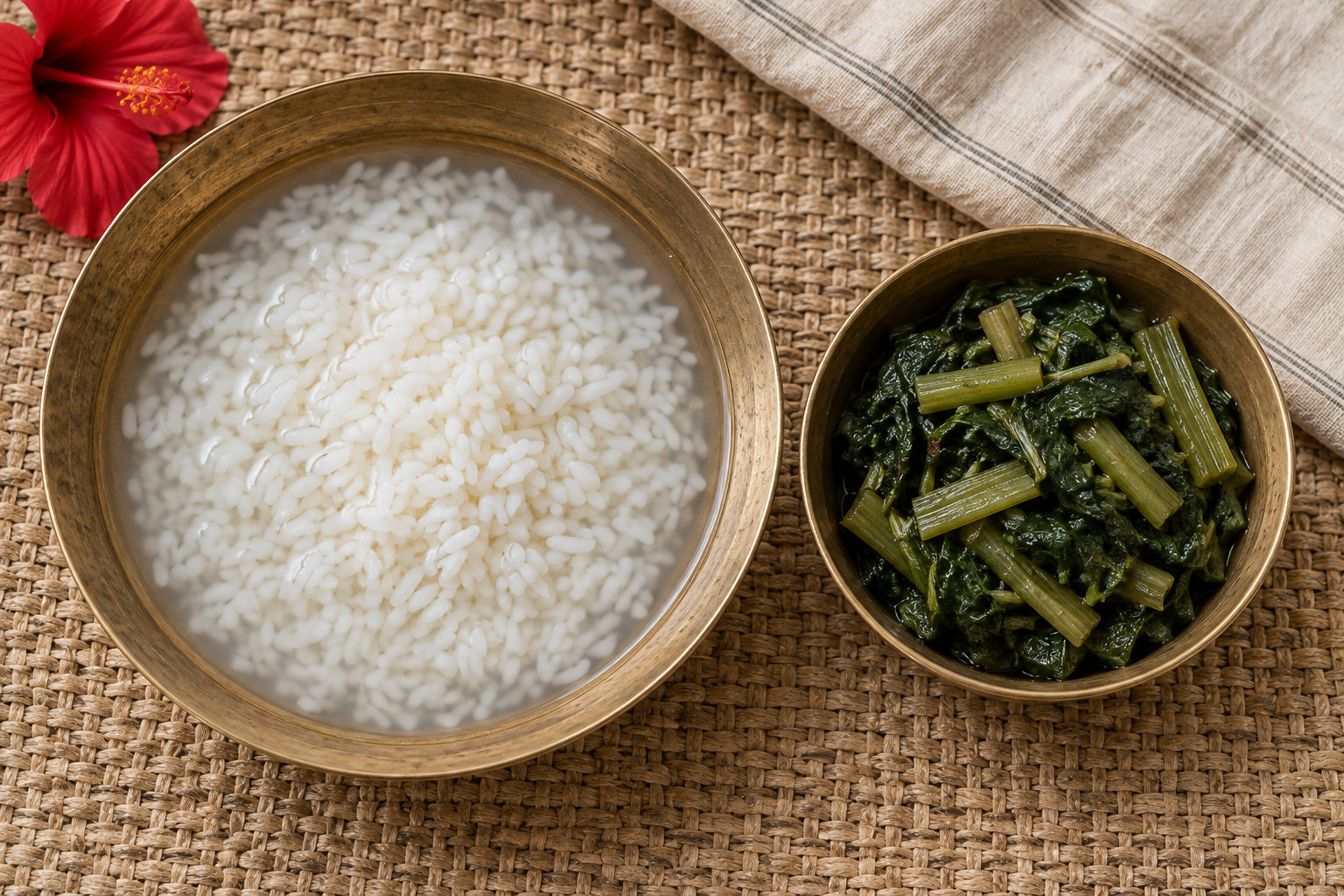
Kachu shaak is a preparation of taro leaves or greens. Panta bhaat is cooked rice soaked in water. Together, they form a humble Dashami offering to Goddess Durga before visarjan.
If this is the tradition you intend to observe, keep those two foods at the centre. Do not replace them merely because they appear too ordinary for a major festival. Their simplicity is not an oversight that needs to be corrected with a grander menu.
It also helps to distinguish the identity of the offering from its recipe. The words “kachu shaak” identify the green, but they do not settle every question about seasoning, texture, accompaniments, or cooking method. “Panta bhaat” identifies the soaked-rice preparation, but it does not override the way your family has learned to make it. Preserve the inherited form where one exists.
You may serve other customary items if your household does so, but additions should not obscure the pairing that gives this particular farewell bhog its character. Treat the food as an offering first and a festive menu second.
Keep the offering before visarjan
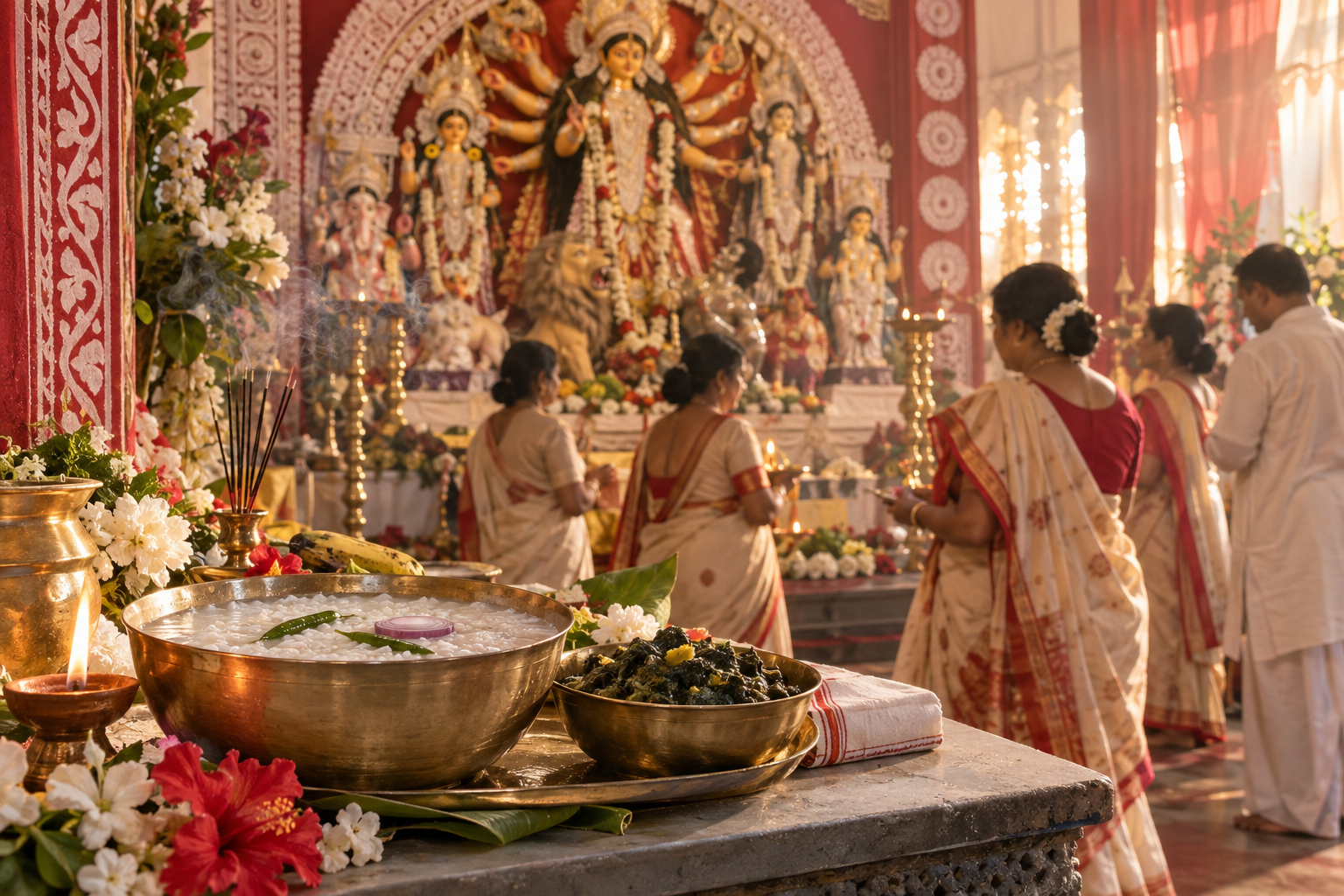
The clearest ritual fact is the sequence: the food is offered while Maa Durga is still present in the puja space, before the ceremonial immersion. That means planning the bhog cannot be separated from planning the Dashami departure.
- Confirm the custom. Ask whether your family, neighbourhood puja, or temple follows the kachu shaak and panta bhaat tradition. Do this before buying ingredients.
- Confirm the local recipe. Get the preparation from the elder, cook, or ritual organiser responsible for preserving the household form. The dish names alone are not complete cooking instructions.
- Reserve the offering portion. Keep the bhog separate and untouched until it has been presented to Maa Durga.
- Coordinate with the farewell rites. Have the food ready early enough for the offering to be completed before the murti leaves for visarjan.
- Ask what happens afterward. Follow the established household or community practice for handling and distributing the offered food rather than assuming every puja uses the same procedure.
The preventable mistake is usually not a missing decorative item. It is discovering too late that the kitchen schedule and the immersion schedule do not match. Before Dashami, identify who will cook, who will conduct the offering, and when the murti is expected to leave.
Why a humble meal suits Durga Puja’s farewell
Dashami is not simply another day of festival hospitality. It is the point at which worship turns toward departure. In that setting, familiar rice and greens carry a different weight from an elaborate display: everyday nourishment becomes the language of farewell.
This is why “humble” should never be confused with careless. Prepare the food cleanly, use the form recognised by your family, and present it with attention. Simplicity removes spectacle; it does not remove reverence.
The pairing also keeps the emotional centre of Dashami visible. The devotee is not trying to impress the Devi with rarity or expense. The offering places ordinary sustenance within an extraordinary relationship between Maa and her devotees. Its force lies in affection, memory, and the knowledge that the moment of immersion is approaching.
If you are explaining the practice at a public puja, keep the description precise: “Kachu shaak and panta bhaat are offered to Maa Durga on Dashami before visarjan.” That teaches visitors what is happening without turning one Bengali custom into a universal rule for every Durga Puja.
Respect family and regional differences
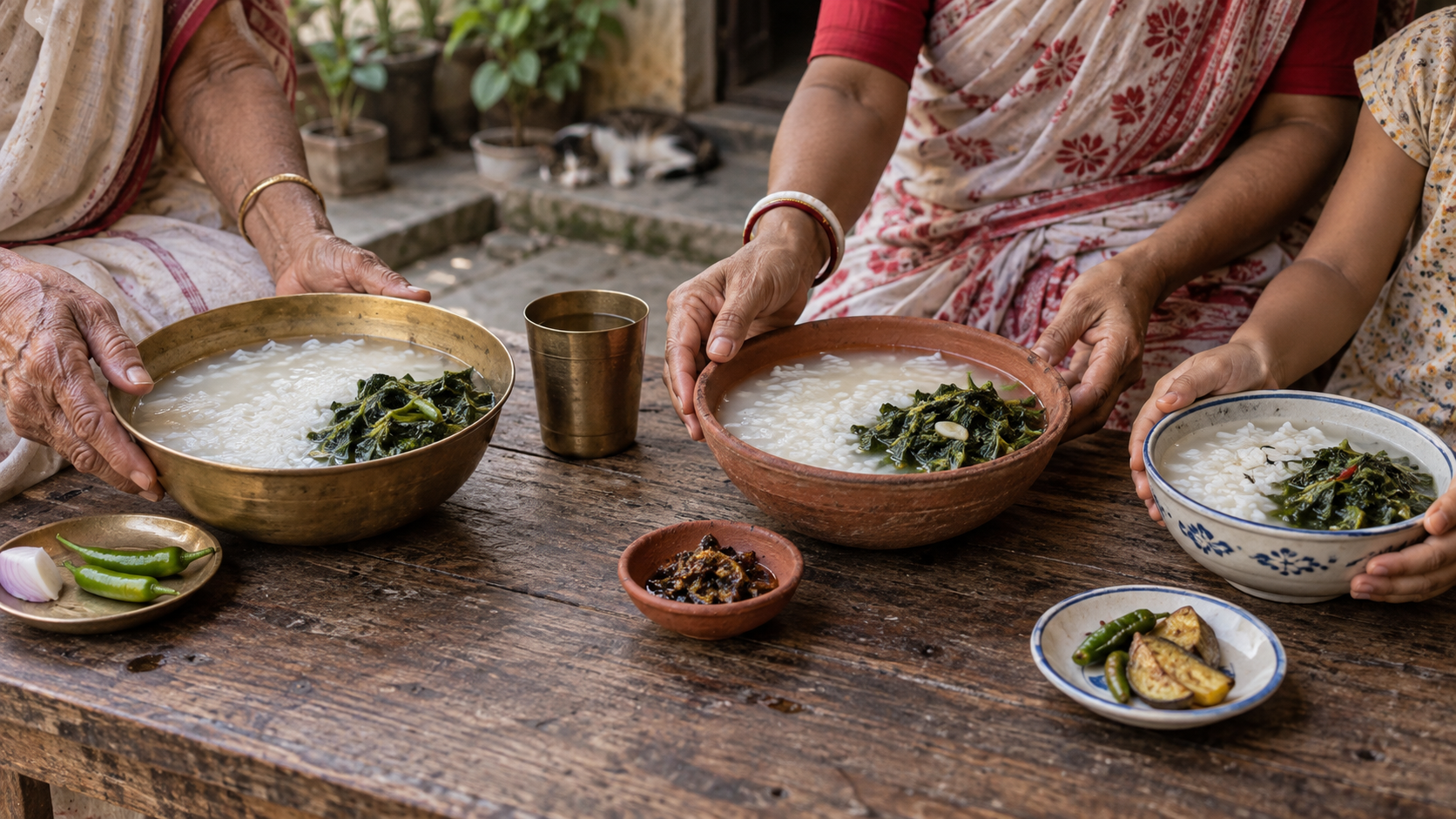
A named tradition often has a stable core and a variable household form. Confusion begins when the two are treated as identical.
- The stable core: Maa Durga, Dashami, kachu shaak, panta bhaat, and an offering completed before visarjan.
- The local form: the precise recipe, quantity, vessels, accompanying foods, spoken prayers, division of responsibilities, and handling of the bhog afterward.
If two relatives remember the preparation differently, first ask whether they learned it in different households. A difference in seasoning or service does not by itself prove that one person has abandoned the tradition. Give priority to the practice of the home or puja community in which you are worshipping.
If you cannot obtain one of the ingredients, do not quietly rename a substitute as the traditional dish. Tell the person directing the puja what is unavailable and agree on an adaptation. That preserves honesty: you can honour the farewell without claiming that a replacement is the inherited kachu shaak and panta bhaat pairing.
If you have never prepared taro greens, Dashami is not the occasion to improvise from the dish name. Use a trusted household recipe or ask an experienced cook to take responsibility. Ritual accuracy includes knowing when an ingredient requires knowledge you do not yet have.
Nor should this custom become a test by which you judge another family’s devotion. A household may preserve Durga Puja through a different inherited Dashami observance. Follow this offering faithfully where it belongs, and describe it as a Bengali tradition rather than the sole valid farewell to Maa Durga.
Key takeaways for your Dashami plan
- The characteristic food pairing is kachu shaak and panta bhaat: taro greens with water-soaked rice.
- The offering belongs on Dashami, the final day of Durga Puja.
- Complete the offering before the murti departs for visarjan.
- Use your family’s or puja community’s established preparation instead of guessing from the names.
- Preserve the meal’s simplicity; expensive additions are not what give the farewell its meaning.
- Treat variations and substitutions honestly rather than declaring one household recipe universally binding.
Before Dashami arrives, make one short call to the person who knows your household custom. Confirm the recipe, the puja time, and the departure time for visarjan. With those three points settled, you can prepare this quiet farewell without letting logistics overwhelm its meaning.
References

Leave a Reply
You must be logged in to post a comment.