-
Love Those Who Lift You, Forgive Those Who Hurt: Dharmic Wisdom for Resilient Living

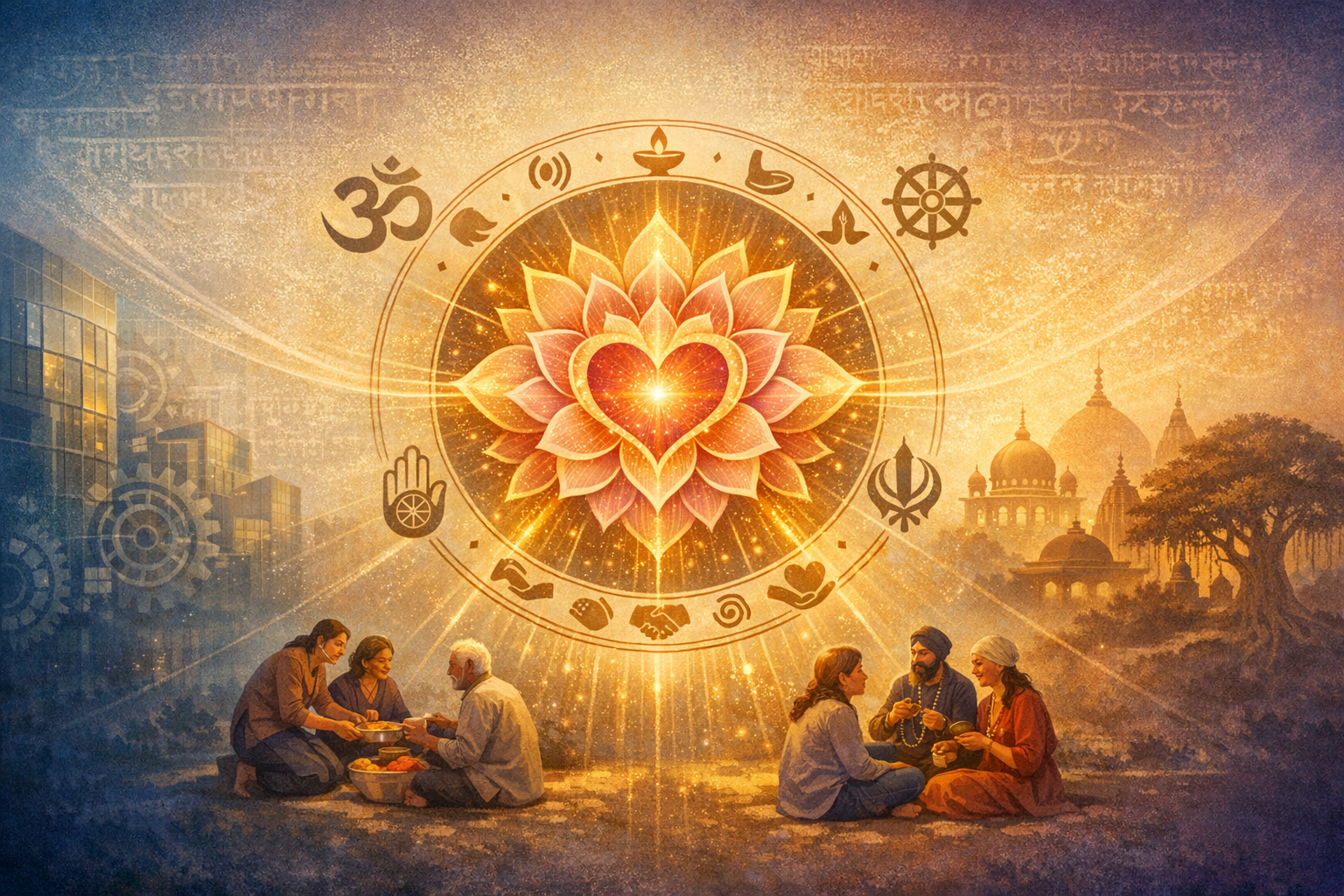
This article explores the dharmic wisdom behind the maxim “Love the people who treat you right, forgive the ones who don’t.” It clarifies how loving support builds sattva, while forgiveness safeguards inner peace without excusing harm. The analysis balances compassion with justice, showing how Dharma requires both accountability and kṣamā. Cross-tradition parallels in Buddhism, Jainism,…
-
Shantadurga’s Compassion: The Skanda Purana Goddess Who Guards Even the Ants

Shantadurga, celebrated in the Sahyadri Khanda of the Skanda Purana, is revered as a compassionate form of Goddess Durga whose protection extends even to ants. Her association with the valmika (anthill) in Goan traditions transforms everyday landscapes into sacred teaching spaces. This narrative illuminates ahimsa as a lived ethic, aligning Hindu devotion with shared dharmic…
-
Guru Ladho Re! Bhai Makhan Shah’s Daring Search and the Discovery of Guru Tegh Bahadur Ji

“Guru Ladho Re!” captures the pivotal moment when Bhai Makhan Shah Lubana identified Guru Tegh Bahadur Ji at Baba Bakala, restoring unity amid competing claims. Anchored in Sikh history, the episode showcases discernment, fidelity to vows, and ethical leadership. It offers a relatable model for navigating crisis, testing truth with humility, and affirming authenticity. The…
-
Srimad Bhagavatham’s Timeless Wisdom: Sri Krishna’s Leelas, Devotee Tales, and Living Bhakti

Srimad Bhagavatham, attributed to Sri Veda Vyasa, offers an elegant, spiritually rich portrayal of Sri Krishna’s Leelas and the lives of devoted bhaktas. Its narratives of divine play, ethical courage, and compassionate guidance bring Bhakti into daily practice. Readers often find emotional resonance in Krishna’s childhood tales and practical insights for cultivating humility, seva, and…
-
Discover Your Ishtadevata by Lagna: Pancham Bhava Guidance to Deepen Sadhana and Peace

A respected Jyotish perspective holds that the lord of the 5th house (Panchamesh) indicates one’s Ishtadevata. Because the 5th rules purva-punya, mantra, and bhakti, aligning upasana with the Pancham Bhava strengthens sadhana and steadies the mind during doshas. This approach complements other classical methods while honoring the Dharmic ideal of many valid paths. Read as…
-
पितृ ऋण (Pitru Runa) Explained: Causes, Family Signs, and Dharmic Paths to Healing

This article clarifies Pitru Runa (पितृ ऋण) as an ethical-spiritual responsibility rather than a fatalistic burden. It outlines traditional causes, observed family signs, and context from Jyotish while discouraging deterministic interpretations. Readers find inclusive, dharmic pathways for healing that honor Hindu, Buddhist, Jain, and Sikh perspectives through remembrance, seva, compassion, and accountability. Practical steps—family storytelling,…
-
Daksha’s Lineage Unveiled: How the Devas and Asuras Were Born—and Why Narada Intervened

This retelling from the Brahma Purana traces how Daksha Prajapati’s lineage explains the birth of the Devas and Asuras through the marriages of his sixty daughters, especially those wed to Rishi Kashyapa. It recounts Narada’s provocative counsel to the Haryashvas and Shabalashvas, who chose knowledge-seeking over rulership, underscoring the primacy of inquiry before power. Readers…
-
Viral Video: Father Pleads to Lord Jagannath, Child Shows a Stirring Moment of Relief
A widely circulated video shows a father praying before Lord Jagannath while holding his ailing child, followed by what viewers interpret as initial signs of responsiveness. The scene highlights the confluence of devotion, parental love, and hope without making medical claims. Placed within the dharmic tapestry of Hinduism, Buddhism, Jainism, and Sikhism, it reflects shared…
-
Why the Gauripatta Faces North: Sacred Geometry of the Shivling and Temple Vastu

The Gauripatta (yoni/Argha) at the base of the Shivling is traditionally oriented toward the north, uniting symbolism, ritual function, and Vastu principles. North evokes stability, prosperity, and ascent—linked to Dhruva, Kubera, and the Himalaya, the realm of Pārvatī. This orientation channels abhisheka offerings through the Somasutra without disrupting the Nandi–Linga darshan line, preserving sanctity and…
-
पितृ ऋण के कारण: संतान व मान–प्रतिष्ठा पर गहरा प्रभाव, Pitru Runa remedies और व्यावहारिक उपाय

यह लेख “पितृ ऋण (Pitru Runa)” की धारणा को स्पष्ट करते हुए कारण, प्रभाव और व्यावहारिक उपायों का संतुलित, अकादमिक विश्लेषण प्रस्तुत करता है। इसमें बताया गया है कि कृतज्ञता, सेवा और पारिवारिक उत्तरदायित्व के क्षीण होने पर मान–प्रतिष्ठा व संतान-सुख प्रभावित हो सकते हैं—जैसे संतानाभाव, संतान का स्वास्यि खराब होना या बुरी संगति में…
-
Unveiling the True Source of Energy: Matter, Consciousness, and Dharmic Unity

Energy in daily life invites a deeper question: what truly animates matter? Dharmic traditions suggest that matter is latent potential, activated by living energy and ultimately grounded in consciousness. Hindu philosophy and Vedanta speak of Brahman and Shakti; Buddhism emphasizes dependent origination and clarity of awareness; Jainism distinguishes jiva’s inherent energy from material accretions; Sikh…
-
Why Vishnu Rests on Cosmic Waters: Deep Symbolism, Dharmic Unity, and Living Wisdom

The image of Vishnu reclining on the cosmic waters conveys a complete philosophy of preservation, balance, and conscious repose. Scriptural narratives from the Puranas situate this scene in the primordial ocean, where yoga-nidra, Ananta Shesha, and the lotus of creation converge. Water symbolizes undifferentiated potential, while the lotus represents pure emergence and order. Psychologically, the…
-
Timeless Longings of the Soul: Bhakti’s Divine Dance, Vrindavan, and Loving Seva

This reflection explores three timeless aspirations described in the Bhakti tradition: witnessing the divine rasa dance, entering the eternal realm of Vrindavan, and cultivating loving seva. It presents these aims as a universal spiritual psychology that resonates across Hindu, Buddhist, Jaina, and Sikh paths. Readers gain a clear, inclusive framework that honors each tradition’s language…
-
Srimad Bhagavatam 2.2.5: Nature’s Abundance, Divine Shelter, and Fearless Simplicity

Srimad Bhagavatam 2.2.5 uses striking imagery—torn cloth, generous trees, life-giving rivers, and mountain caves—to argue that nature itself sustains a simple, dharmic life. The verse culminates in the assurance of divine protection, aligning security with inner renunciation and devotion rather than accumulation. Its values resonate across Hinduism, Buddhism, Jainism, and Sikhism through shared ideals like…
-
Unshakeable Resilience in Hindu Dharma: How True Warriors Turn Setbacks into Inner Strength

The statement “True warriors don’t let setbacks define them. They overcome them” resonates with Hindu philosophy as a call to cultivate resilience, courage, and inner strength. Rather than treating adversity as a verdict, dharmic teachings reframe it as an opportunity for growth and self-mastery. The Bhagavad Gita’s emphasis on equanimity, disciplined practice, and ethical action…
-
Bhagavad Gita’s Battlefield Wisdom: Practical Guidance for Modern Life’s Daily Conflicts

The Bhagavad Gita was taught on a battlefield, signaling that wisdom belongs in the most demanding spaces of life. Its guidance on dharma reframes everyday dilemmas—from work pressures to family responsibilities—as opportunities for ethical clarity. Karma Yoga encourages action with excellence while reducing anxiety through non-attachment to outcomes. Equanimity (samatva) and disciplined focus provide stability…
-
November 22, 2025 Panchang: Shukla Dwitiya to Tritiya, Auspicious Hours and Ritual Focus

Saturday, November 22, 2025, in the Panchang – Hindu calendar begins with Shukla Paksha Dwitiya and shifts to Shukla Paksha Tritiya at approximately 3:11 PM local time. The morning favors thoughtful beginnings and gentle discipline; the afternoon supports continuity and sustained devotional effort. Good time (shubh muhurat) depends on local calculations, so a regional Panchang…