
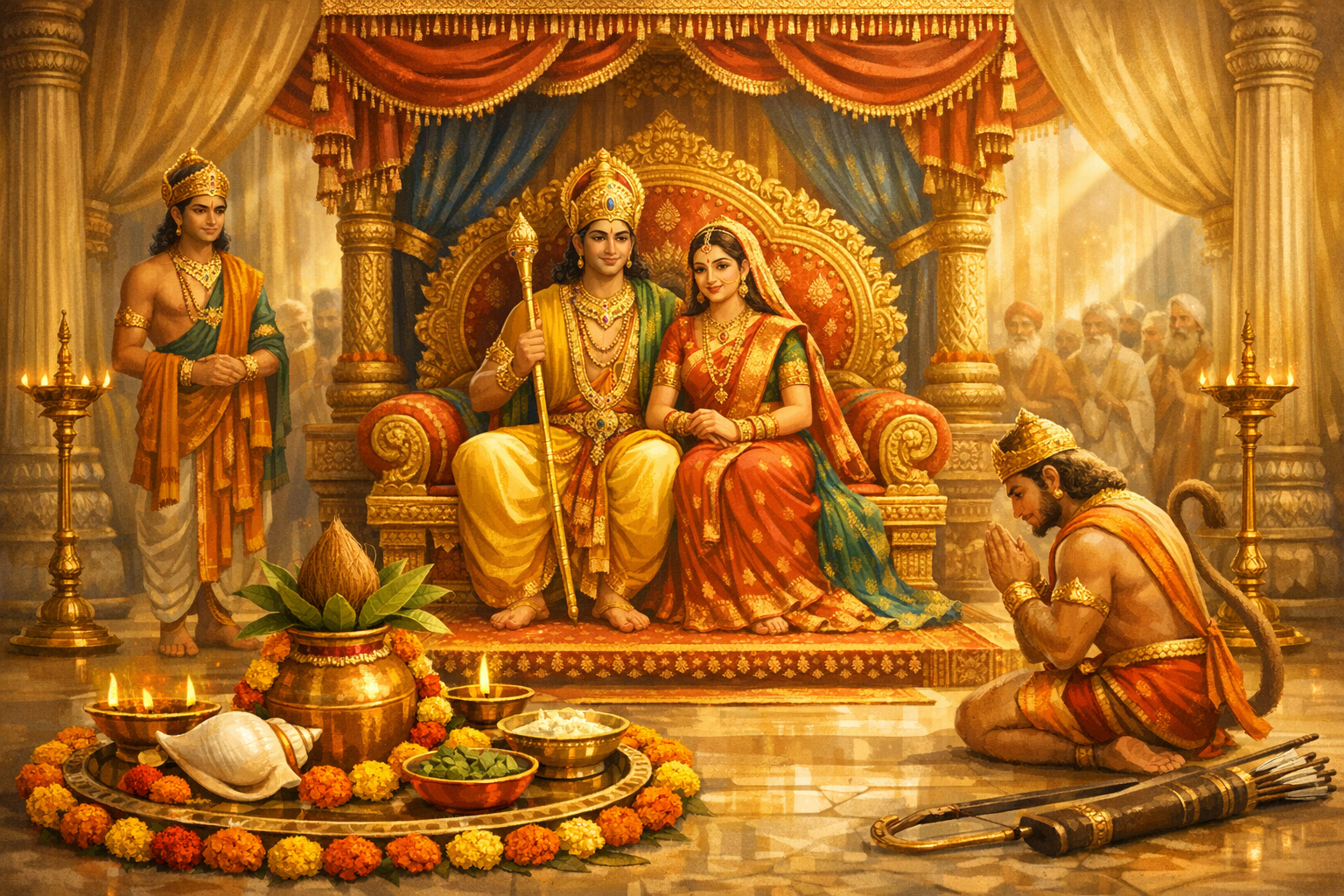
Sri Rama Rajyotsavam (also known as Sri Rama Pattabhishekam or Sri Ram Rajyabhishek) commemorates the coronation of Lord Sri Rama and the public reaffirmation of dharma-centric governance, or Rama Rajya. Guided by traditional reckoning in the Ramayana, this observance is associated with Chaitra Shukla Panchami, the fifth lunar day in the bright half of the Chaitra month. In 2026, Sri Rama Rajyotsavam is expected to be observed on 23 March (Gregorian calendar), aligning with local panchang calculations of Chaitra Shukla Panchami across many regions.
Within the broader Ram Navami Utsav and the sacred cycle of Chaitra Month and Chaitra Navratri (often referred to as Ram Navratri in many communities), Sri Rama Rajyotsavam serves as the moment when ideal kingship and social ethics are actively invoked. It is thus not only a devotional commemoration but also a cultural articulation of Maryada Purushottama Sri Rama’s vision of righteous statecraft, social equity, and spiritual responsibility.
Scriptural memory for this observance is anchored in the concluding chapters of the Yuddha Kanda in Valmiki Ramayana, which narrate the return to Ayodhya and the coronation that restores serenity and order. The imagery of the Rajyabhishekaabhisheka with sanctified waters, the placing of the crown, the assembly of sages, and the rejoicing of citizensestablishes a civilizational template for good governance. In later tellings across regions and languages, this scene becomes a living paradigm for the promise of dharma-guided leadership.
Because Hindu calendrical practice prioritizes sunrise-to-sunrise tithi observance, devotees and temples generally perform Sri Rama Rajyotsavam rituals during the duration of Chaitra Shukla Panchami as per their regional panchang (Panchang and Tithi determinations may vary by location). In 2026, many Indian almanacs align this Panchami with Monday, 23 March, though exact muhurta selection remains a local, tradition-specific choice.
The philosophical intent of the day is profound. Rama Rajya is not merely political order; it represents a harmonious social fabric in which dharma guides artha and kama toward the ultimate goal of moksha. The coronation is thus read as an ethical symposium in action: governance as service (seva), law tempered by compassion, and power restrained by vows (vrata) of integrity, truth (satya), and non-injury (ahimsa) in public life.
Temple and home observances share a common ritual architecture (puja vidhi) while differing in scale. Preparations center on sanctification of space, installation or worship of Sri Rama with Sita, Lakshmana, and Hanuman, and performance of panchopachara or shodashopachara offerings. Devotees commonly recite Ram Raksha Stotra, passages from Sundara Kanda, and the Pattabhisheka episodes of Yuddha Kanda, accompanied by kirtana and bhajans invoking “Sri Ram, Jai Ram, Jai Jai Ram.”
For a typical home puja on Sri Rama Rajyotsavam 2026, many households adopt a simple, disciplined sequence. After cleaning the altar and lighting a lamp, a sankalpa is taken for Sri Rama Pattabhishekam on Chaitra Shukla Panchami (23 March 2026, subject to local tithi). Panchamrita abhisheka may be performed for a Rama-Sita murti or framed image, followed by vastra and alankara as available, archana with tulasi or seasonal flowers, and naivedya of satvik preparations. Aarti concludes the core sequence, with distribution of prasada and sharing of food as an act of community warmth.
In temple settings, Sri Rama Pattabhishekam often includes a ceremonial abhisheka with sanctified waters, including contributions symbolic of sacred rivers, followed by rajopachararegal offerings evoking the duties of kingship aligned to dharma. The ritual crowning (kirita-sthapana), scepter (rajadanda) symbolism, and darshan of the deities in “Pattabhisheka alankaram” culminate with a spirited aarti, creating a devotional milieu that unites liturgy, music, and the shared memory of Ayodhya’s rejoicing.
Muhurta selection for Sri Rama Rajyotsavam 2026 is best undertaken with a regional panchang or guidance from a family priest. While the overarching criterion is the presence of Shukla Panchami, many traditions also value auspicious segments such as Abhijit Muhurta or a mid-day window aligned to the kshetra’s parampara. When available, alignment with auspicious nakshatras connected with Sri Ramasuch as Punarvasu or the coronation-associated Pushyamay be preferred; local sunrise times and tithi balance remain decisive.
Recitation practices on this day are both devotional and didactic. The Ramayana parayana (especially the coronation sargas of Yuddha Kanda) allows devotees to re-enter the narrative not only as hearers but as civic participants, absorbing the ethical grammar of Rama Rajya. Chanting of “Om Sri Ramaya Namah,” Vishnu Sahasranama, and the popular Ram Raksha Stotra is widespread; many families add Hanuman Chalisa to honor devotion (bhakti) and service (seva) embodied by Sri Hanuman.
Ritual food offerings (naivedya) emphasize simplicity and purity to reflect the ethos of Maryada Purushottama. Common preparations include sweet pongal, kheer, fruits, and seasonal satvik items, offered with gratitude and later shared as prasada. In several regions, anna-dana or community meals are organized, translating Rama Rajya’s social ethics into tangible hospitality and care.
Though Sri Rama Rajyotsavam centers on Chaitra Shukla Panchami, regional calendars sometimes integrate coronation themes into other utsavas (for example, in some locales during Dussehra/Dashami) or schedule complementary rituals on nearby dates for practical reasons. Such diversity of practice illustrates the Panchang’s regional nuance and the broader Hindu capacity to honor a shared ideal through multiple, living traditions.
The observance resonates across dharmic pathways. In Buddhist literature, the Dasaratha Jataka preserves an early retelling of the Rama narrative that highlights righteous conduct. In Jain traditions, texts like the Paumachariyam reframe the Rama story while continuing to esteem ethical self-mastery; Rama is presented as a moral exemplar within a distinct philosophical arc. In Sikh tradition, the sacred Name “Ram” in Gurbani signifies the all-pervading Divine; the ethical ideal of righteous rule lends thematic kinship to the aspiration of a just and compassionate community. Together, these perspectives affirm a civilizational consensus on virtue, self-restraint, and public welfare.
Across India, Sri Rama Rajyotsavam inspires distinctive local aesthetics. In Ayodhya, the day’s meaning is amplified by the sacred geography of Rama’s capital. In South Indian temples, elaborate Pattabhisheka alankarams and vahanam processions may be seen; elsewhere, intimate satsangs and Ramayana katha gatherings predominate. Diaspora communities replicate these patterns with evening pujas, group parayana, and cultural programs to transmit the values of Rama Rajya to younger generations.
As a civic ethic, Rama Rajya calls attention to concrete duties: truthfulness in speech and accounting, fairness in trade and employment, reverence for elders and teachers, and protection of the vulnerable. Many families therefore observe the day by recommitting to ahimsa in diet and conduct, timely charitable giving, educational support for children in need, or environmental care such as tree planting and plastic-free celebrationseach a small tribute to the coronation’s larger social promise.
For Sri Rama Rajyotsavam 2026, a balanced personal observance can include early-morning meditation, a short fast or satvik diet, a home puja at a locally suitable muhurta during Panchami, and Ramayana reading at evening satsang. Musically inclined households may add kirtana, while children can be engaged with story circles that foreground courage, compassion, and adherence to vowstimeless lessons the coronation narrative seeks to embed.
From an ethical-historical perspective, Sri Rama Pattabhishekam situates power within service. The crown in the ceremony functions not as a symbol of entitlement but as a reminder of accountability to dharma and to the people. The Rajyotsav’s lasting contribution is thus pedagogical: it educates generations to prefer character over charisma and responsibility over rhetoric.
In contemporary practice, the day’s spiritual core integrates seamlessly with community life. Temples and cultural associations may coordinate joint parayana, health camps, blood donation, or food distribution for the under-served. Such initiatives extend the ritual’s inner meaning outward, echoing the Ramayana’s vision of prosperity coupled with justice and compassion.
As with all tithi-based observances, confirmation from a trusted panchang is prudent. Weather, local customs, and temple schedules can shape the final choice of timing on 23 March 2026. Where uncertainties arise, the guiding principle remains clear: honor Chaitra Shukla Panchami and the coronation’s dharmic intention with sincerity, simplicity, and service.
Sri Rama Rajyotsavam 2026 therefore stands as a converging point of devotion, culture, and public ethics. By remembering Sri Rama’s coronation, communities renew a collective vow to uphold dharma in private and public spheres alike. The festival’s most meaningful offering is not only the lamp lit before the altar, but also the steady light of integrity carried into daily lifean enduring gift of Rama Rajya.
Inspired by this post on Hindu Pad.
