-
In Memoriam: HG Ekanatha Prabhu ACBSP—Guardian of the Bhaktivedanta Archives and Vedabase

HG Ekanatha Prabhu ACBSP of The Bhaktivedanta Archives passed away on Vijay Ekadasi in Sandy Ridge, North Carolina, following sudden heart failure. He is remembered for exemplary stewardship of Srila Prabhupada’s books, tapes, photographs, and the Bhaktivedanta Vedabase. His work exemplified archival best practices—high-fidelity audio digitization, careful image capture, rigorous metadata, and OAIS-aligned long-term preservation.…
-
Deepak Chopra in the Epstein Files? What the Records Show—and How Dharmic Unity Responds

Headlines claim Deepak Chopra appears in the “Epstein files,” a term that refers to unsealed civil-court materials including contact lists, calendars, and emails. Inclusion in such documents does not, on its own, prove wrongdoing, and context is essential. Screenshots circulating online attribute controversial email lines to Chopra, while his public statement condemns abuse, denies criminal…
-
HH Bhaktivaibhava Swami in Stroke Rehabilitation, Kolkata: Health Update and Solidarity

HH Bhaktivaibhava Swami is undergoing structured stroke rehabilitation under medical supervision in Kolkata. This update provides clear, factual context about his care, focusing on evidence-based recovery practices and the importance of timely rehabilitation. As a respected ISKCON spiritual leader, his health has drawn compassionate concern from global well-wishers. The response reflects shared dharmic values—compassion, ahiṁsā,…
-
Annambhatta’s Brilliant Legacy: A Clear Guide to Hindu Logic in the Tarkasamgraha

Annambhatta, a 17th century CE philosopher and logician from Andhra Pradesh, authored the widely respected primer Tarkasamgraha. Recognized for clarity and simplicity in Sanskrit, his work offers an accessible introduction to Hindu logic (tarka). Students consistently turn to Tarkasamgraha to build foundational skills in structured reasoning and inference. The text’s lucidity transforms initial apprehension into…
-
Devaki Mata: A Mother’s Courage and Divine Destiny in the Birth of Sri Krishna

Devaki Mata—daughter of Devaka, sister of Kamsa, and wife of Vasudeva—embodies maternal courage and unwavering devotion in the birth of Sri Krishna. The narrative clarifies that Kamsa slew six infants, Balarama was divinely transferred to Rohini’s womb, and Krishna was miraculously carried to safety in Gokul. Readers gain an accurate, accessible retelling grounded in the…
-
Srila Prabhupada’s Daring Voyage and Enduring Legacy: How One Sage Ignited Global Bhakti

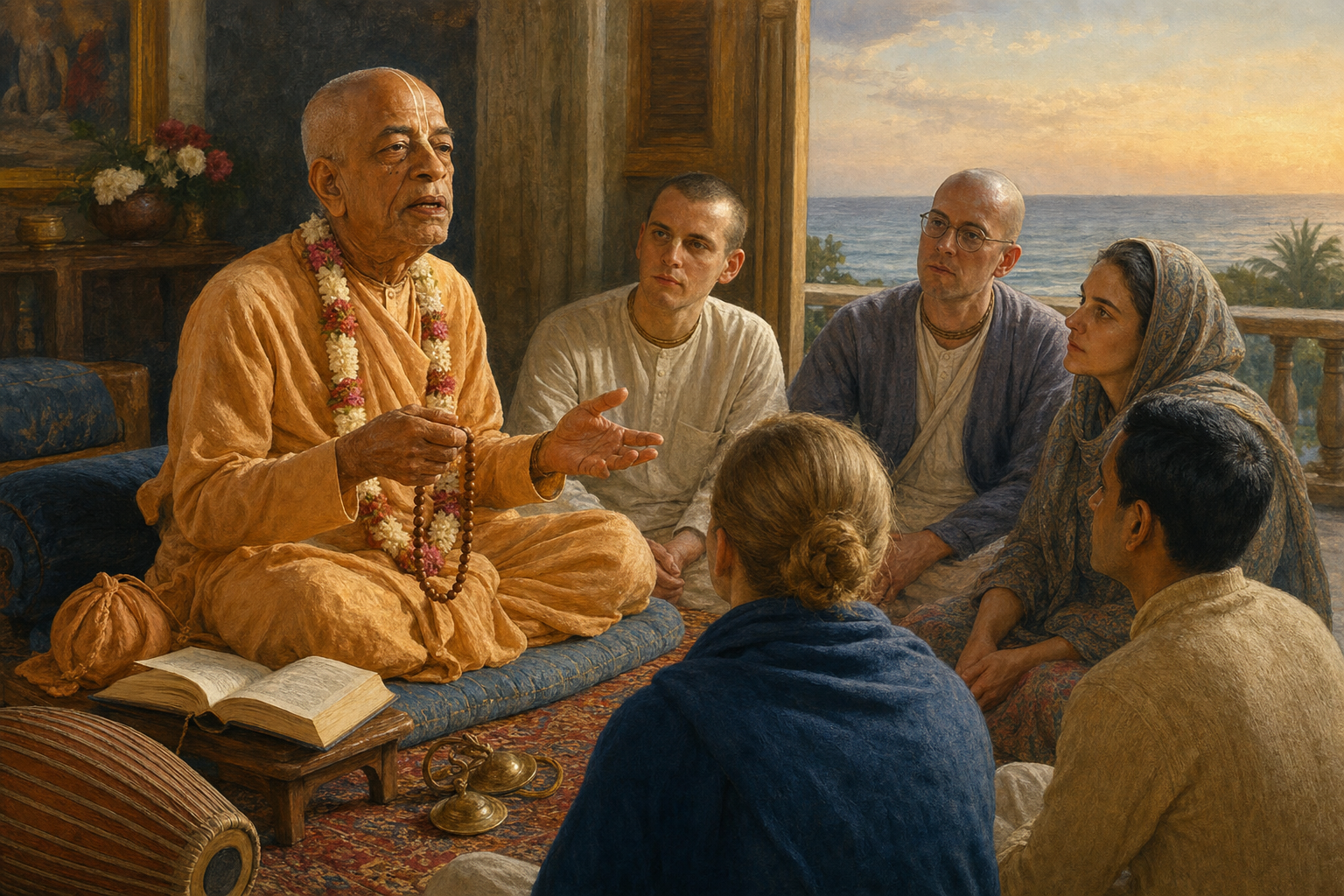
Srila Prabhupada’s achievement stands out as a singular moment in global religious history: at seventy, with no resources or contacts, he catalyzed the Hare Krishna movement across cultures. Thomas Hopkins’s assessment underscores the uniqueness of this feat in a foreign social landscape. The movement’s accessible practices—kirtan, prasadam, and study—blend devotional depth with public engagement. Readers…
-
When Srila Prabhupada Mastered a Dictaphone: Shattering Assumptions About Tradition and Tech

A brief, vivid episode with a Dictaphone reveals Srila Prabhupada’s calm mastery of electronics, overturning the common assumption that spiritual leaders resist modern tools. Recounted by Gargamuni Das, the scene demonstrates discernment, adaptability, and confidence in service of the Hare Krishna movement’s mission. Readers gain a practical model for integrating technology without compromising spiritual purpose.…
-
Tukaram Beej 2026 (Sant Tukaram Punyatithi): Sacred Date, Meaning, and Varkari Traditions

Tukaram Beej 2026, observed on March 5, commemorates Sant Tukaram’s Punyatithi and his traditional ascent to Vaikunth, the heavenly abode of Lord Vishnu. Rooted in the Varkari bhakti movement, the observance is especially significant in Maharashtra, with Dehu near Pune at its heart. Devotees gather for kirtan, abhang recitations, and satsang, while many undertake pilgrimages…
-
Baba Jaimal Singh: 19th‑Century Sikh Mystic Who Built the Beas Dera and Inspired Seekers

Baba Jaimal Singh stands out as a 19th-century Sikh mystic who advanced the Radha Soami tradition and founded a welcoming spiritual center at Beas in Punjab. His initiation at age 17 by Shiv Dayal Singh marked a disciplined, lifelong pursuit of inner realization. The Beas Dera encouraged seekers to practice meditation, ethical living, and devotion—values…
-
When One Verse Moved a Sage to Tears: Rallapalli A. Sarma and Annamacharya’s Revival

This essay examines the life and legacy of Ganakalasindhu Sri Rallapalli Anantakrishna Sarma, focusing on his seminal role in reviving Tallapaka Annamacharya’s Kritis for TTD and his formation within the Guru-Shishya Relationship at Parkala Matha. It recounts a moving episode in which a single Ramayana verse moved his Guru, Sri Krishnabrahmatantra Yatindra, to tears—an emblem…
-
Princess Bamba Duleep Singh: The Enigmatic Heiress Who Guarded the Sikh Empire’s Legacy

Princess Bamba Duleep Singh emerges as an enigmatic heiress who safeguarded the Sikh Empire’s legacy across the British Raj and postcolonial transitions. As the eldest daughter of Maharaja Duleep Singh and granddaughter of Maharaja Ranjit Singh, she balanced lineage with responsibility. Her stewardship—often referenced through the Princess Bamba Collection—anchors a tangible, scholarly pathway to Sikh…
-
Bhai Vir Singh: The Sixth River of Punjab and a Bridge Uniting India’s Dharmic Traditions

Bhai Vir Singh stands as the “sixth river” of Punjab—a poet and thinker whose work renews Punjabi literature and deepens ethical life. His celebrated writings, including Rana Surat Singh, Sundari, and Satwant Kaur, weave devotion with courage and civic responsibility. Grounded in Sikh spirituality, his vision resonates with shared dharmic values across Hinduism, Buddhism, and…
-
Srila Prabhupada-lilamrita with HG Kusha Mataji: A Powerful Portrait of Compassion and Dharma

Srila Prabhupada-lilamrita offers a scholarly yet accessible portrait of His Divine Grace A. C. Bhaktivedanta Swami Prabhupada, illuminating how devotion and disciplined leadership reshaped global spiritual discourse. The narrative emphasizes universal compassion and unity in spiritual diversity, aligning with the shared ethical core of Hinduism, Buddhism, Jainism, and Sikhism. Readers gain clear insights into ISKCON’s…
-
Sri Ramakrishna’s Tarpana Dilemma: Symbolism, Grief, and Spiritual Evolution

Sri Ramakrishna Paramahamsa’s inability to perform tarpana for his mother is a symbolic, compassionate teaching on the unity of ritual and realization. It reframes ancestor rites (tarpana, Shraddha, Amavasya) as living expressions of gratitude grounded in intention. The episode models how devotion, grief, and non-dual awareness can converge without dismissing Hindu rituals. It offers practical…
-
Sri Ramanujacharya as Adisesha: Divine Grace, Vishishtadvaita, and Inclusive Bhakti

Sri Ramanujacharya is revered in the Vaishnavite tradition as an incarnation of Adisesha, symbolizing stability, service, and compassionate protection. His Vishishtadvaita Vedanta harmonizes devotion and philosophical rigor, affirming a personal Vishnu and the transformative power of bhakti. Historical accounts emphasize his stewardship of temples and inclusive practices that broadened access to worship. This inclusive ethos…
-
Sant Maskeen Ji: From Partition Survivor to Panth Rattan, a Beacon of Sikh Wisdom and Unity

This profile traces Sant Maskeen Ji’s journey from Partition-era displacement to recognition as Panth Rattan, highlighting how Gurbani-centered practice nurtures resilience, ethical clarity, and community cohesion. Readers will gain a concise understanding of his teaching method—rooted in Naam Simran, humility, and seva—and how it translates into practical guidance for daily life. The narrative emphasizes religious…
-
Jassa Singh Ahluwalia’s Rise: Forging Kapurthala State and Sikh Unity in 18th-Century Punjab

In an age of upheaval following the Mughal decline and Afghan incursions, Jassa Singh Ahluwalia unified Sikh forces and laid the institutional foundations for the Kapurthala State. His leadership in the Ahluwalia misl and Dal Khalsa fused defense with public welfare, echoing the Khalsa principle “Deg Tegh Fateh.” The result was safer routes, protected communities,…
-
Baba Lokenath: Early Life, Enduring Wisdom, and Practical Lessons for Today’s Seekers

Baba Lokenath, born in 1730 in a Brahmin family near Kolkata, exemplifies the disciplined learning and practice that defined 18th century Indian spirituality. Trained in the Vedas and Shastras under a learned scholar, he followed his father’s wish to embrace the spiritual path. Leaving home in youth for rigorous sādhanā within the guru–śiṣya paramparā, he…
-
Sri Ramanujacharya’s Magnificence: How Bhakti Masters Illuminate Kali‑yuga and Inspire Unity

This reflection situates Sri Ramanujacharya within a Gaudiya Vaishnava narrative that honors multiple bhakti masters sent to uplift Kali-yuga. It presents Sri Krishna Caitanya’s descent to Gauda-bhumi as a devotional-theological perspective, while highlighting Ramanuja’s enduring contributions to compassionate, rigorous practice. Readers gain a clear, accessible context for the Bhakti and Vedic Traditions and their relevance…
-
Ramanujacharya’s Auspicious Birth and Enduring Legacy: Inspiring Unity in Dharma

This post presents a concise, academically grounded account of Ramanujacharya’s birth, including precise dating (1017 A.D.; ‘sasthi’ in Chaitra), South Indian geography (Sriperumbudur between Kancipuram and Madras), and lineage. Readers gain clarity on traditional descriptions honoring him as a partial incarnation of Lord Ananta Shesha and Laxman, situated within the broader context of medieval India.…