
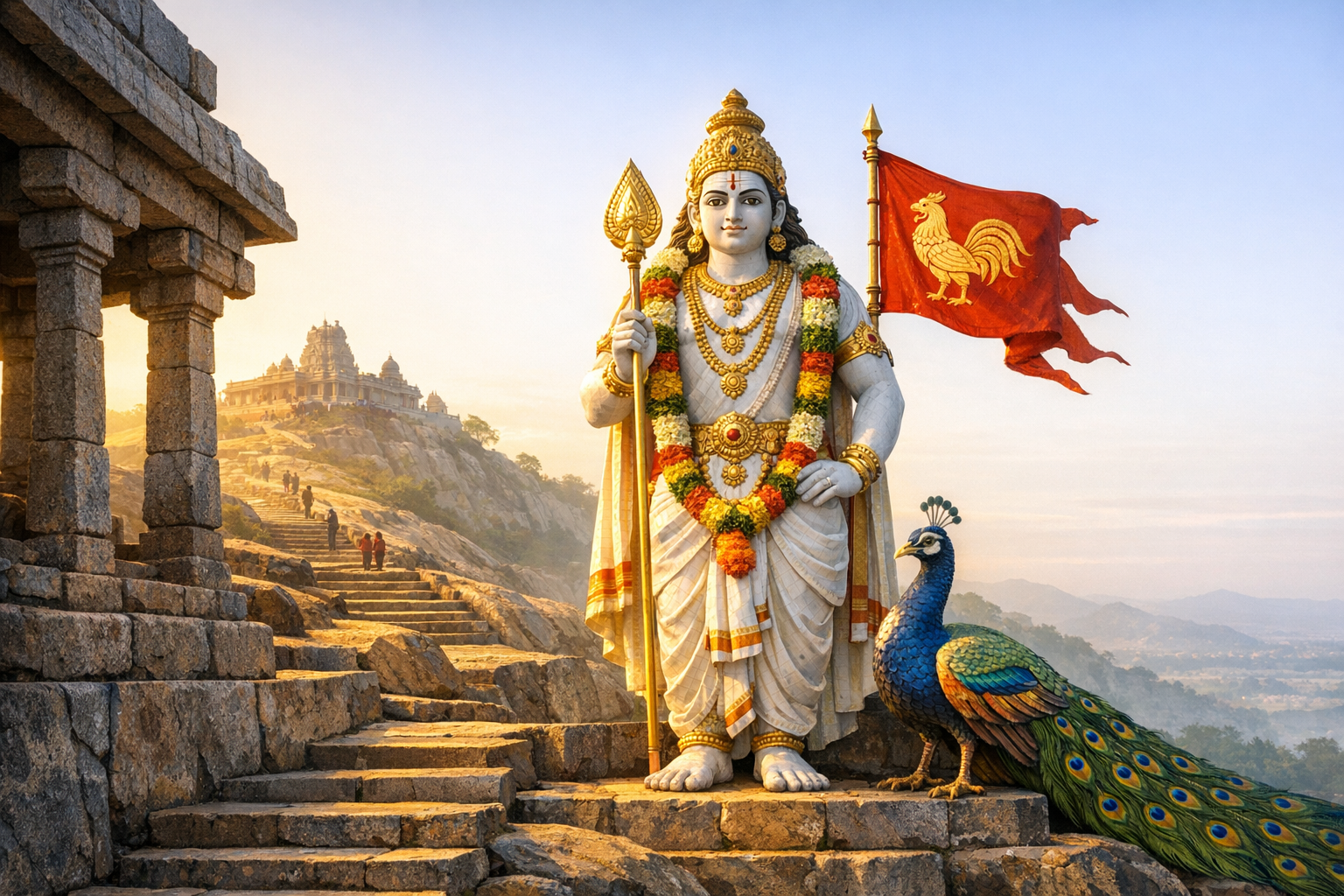
Perched atop a granite outcrop in western Tamil Nadu’s Kongu Nadu, the Tiruchengode Murugan Temple venerates Sengottuvelanan east-facing, white-hued icon of Subrahmanya who bears the Vel (spear) and the rooster emblem (seval kodi). The site integrates living ritual, medieval Tamil architecture, and literary memory, forming a focal point of Murugan bhakti for pilgrims across the Kongu region and South India.
Sharing the sacred hill with the renowned Ardhanāreeshvara sanctum, the Sengottuvelan shrine embodies the Saiva–Śākta–Subrahmanya synthesis that characterizes Dravidian temple culture. The co-presence of Shiva–Śakti (as Ardhanārīśvara) and Skanda (as Sengottuvelan) affirms a core dharmic insight: multiple paths converge upon a single truth. This inclusive vision resonates across Hindu, Buddhist, Jain, and Sikh traditions that prize compassion, discipline, inner valor, and seva.
The epithet Sengottuvelan, conventionally understood as “the Lord of the eminent Vel,” centers devotion on the divine spear as a symbol of viveka (discriminating wisdom) and kshatra (ethical courage). The rooster motif signals vigilance and triumphant awakening. The rare white surfacecontrasted with the darker stone typical of many South Indian iconsforegrounds sattva (clarity and calm), while the eastward gaze aligns the deity with sunrise, renewal, and auspicious beginnings.
Canonical narratives in Skanda Purana and the Tamil Kanda Puranam recount the Surapadma cycle: upon the asura’s defeat, the peacock becomes Murugan’s vāhana and the rooster his standard. Hence the seval kodi that accompanies Sengottuvelan at Tiruchengode. The Vel is both a cosmic weapon and an inner instrument, cleaving through delusion and inertia; the iconography thus operates at mythic and psychological registers simultaneously.
Arunagirinathar (15th century), composer of over 1,300 Tiruppugazh hymns, inscribed Tiruchengode within an expansive sacred geography of Murugan worship that arcs across Tamil Nadu. His compositions for Sengottuvelan interweave musical sophistication with theological precision and accessible devotion, ensuring that the hill shrine remained a vibrant node in pan‑Tamil pilgrimage networks and an enduring locus of Murugan bhakti.
Tiruppugazh performance practicerooted in intricate prosody and raga-sensitive phrasinganimates daily and festival worship at Tiruchengode. Sung before the white icon of Sengottuvelan, these hymns transform the literal climb into an inner ascent; meter becomes meditation and poetry becomes prārthanā. For many pilgrims, the cadence of Tiruppugazh at dawn seals an intimate, contemplative encounter with Subrahmanya.
Architecturally, the hill complex exhibits Kongu‑Dravidian features adapted to terrain: rock‑cut steps, circumambulatory paths, and mantapas that modulate space, light, and breeze. While the Ardhanāreeshvara complex provides a monumental Saiva frame, the Sengottuvelan sanctum articulates Murugan’s martial grace. Inscriptions and stylistic cues suggest iterative patronage across medieval and early modern periods, typical of Kongu heartland temples that evolved through Chola, post‑Chola, and Nāyaka phases.
The ritual calendar follows the classical Murugan cycle: Vaikasi Visakam (appearance), Aadi and Thai sequences, Skanda Sashti (Soorasamharam), Karthigai Deepam, Panguni Uthiram, and monthly Sashti observances. Abhishekam, alangaram, archana, and pradakshina remain central. Vibhuti and kumkum offerings amplify the icon’s didactic claritypurity (sattva) and energizing grace (shakti)while the rooster standard underscores vigilance in practice.
Pilgrims commonly recount the felt hush of wind near the sanctum and the sight of the white Sengottuvelan catching the soft eastern light. The ascent by stone‑cut steps or the gentle drive to the summit is experienced as tapas in motion; darshan at sunrise becomes a study in stillness, punctuated by the resonant timbre of nāgaswaram and tavil. Devotees often describe leaving with an abiding clarity, as if the Vel had parted inner hesitation.
In a wider dharmic frame, Murugan/Skanda’s attributeswisdom, restraint, fearlessnessfind kinship with ideals cherished in Buddhism (śīla and prajñā), Jainism (samyak‑cāritra and aparigraha), and Sikh tradition (nirbhau, nirvair, and the ethic of seva). Tiruchengode’s hill therefore functions as more than a denominational emblem; it models a shared civilizational vocabulary of virtue, where many paths reinforce one another.
Geographically, Tiruchengode lies between Salem and Erode in Namakkal district, well connected by road within the Kongu region. Major railheads at Erode and Salem provide convenient access, with broader air connectivity through Coimbatore and Tiruchirappalli. For many travelers tracing the Murugan circuitPalani, Thiruchendur, Swamimalai, MarudamalaiTiruchengode offers a distinctive pause: an east‑facing, white Sengottuvelan with seval kodi, remembered for a serene, incisive darshan.
The whitened iconography invites layered reading: an aniconic clarity that aids meditative focus; a luminous tonality associated with sattva; and a semiotic emphasis that foregrounds the Vel and rooster standard as interpretive anchors. Taken togethereastward orientation, white surface, and seval kodithe triad directs attention from darkness to discernment, aligning practice with both cosmology and ethics.
As a living heritage site, the temple’s vitality depends on balancing pilgrimage flow, liturgical continuity, and conservation of masonry and murals shaped by monsoon, heat, and time. Community stewardship and scholarly documentationinscriptions, oral histories, musical traditionstogether sustain the integrity of the Tiruchengode Murugan Temple and safeguard Sengottuvelan’s darshan for future generations.
Viewed through the prisms of iconography, music, architecture, and practice, Tiruchengode’s Sengottuvelan distills the Murugan ideal into a single, unforgettable image. The encounter that animated Arunagirinathar’s Tiruppugazh continues today: a disciplined compassion, a fearless wisdom, and a luminous path where diverse dharmic traditions can walk together.
Inspired by this post on Hindu Blog.
