
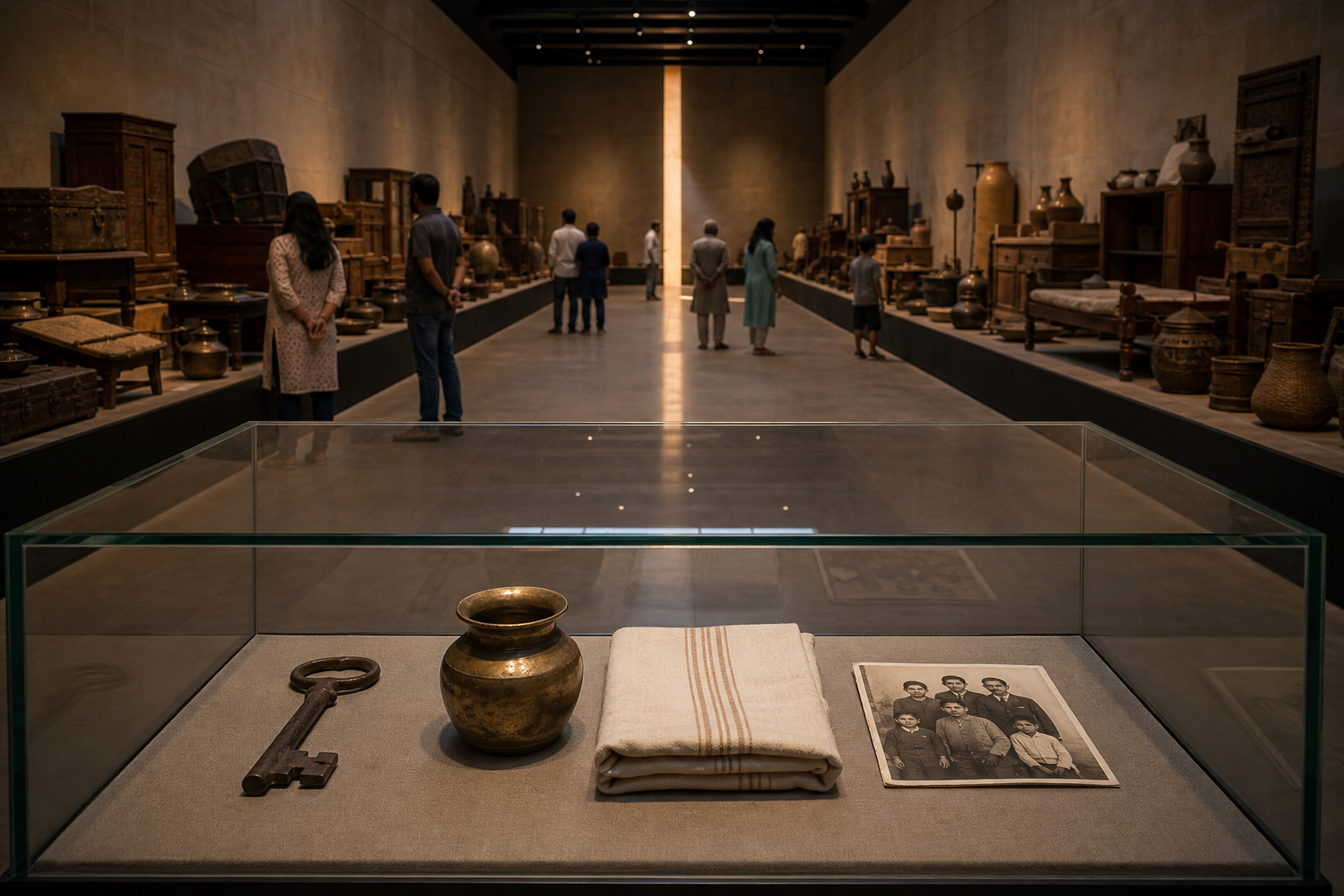
Perhaps your family still has a place-name, a key, a photograph, or a sentence an elder would never finish. Perhaps you have walked through a Partition display and wondered whether you were seeing history or a carefully managed version of it. In either case, the practical question is the same: what would make a Partition museum worthy of your trust?
A credible museum must do more than evoke sorrow. It must help you connect decisions with consequences, public events with family experience, and religious identity with the realities people faced. It should preserve Hindu memory without turning memory into inherited hatred. Here is how to judge whether it succeeds.
A museum must do what a commemoration cannot
A memorial, a museum, and an archive serve different purposes. A memorial asks you to remember and mourn. A museum asks you to examine objects, testimony, chronology, and interpretation. An archive preserves the underlying records so that claims can be checked, challenged, and studied again.
A serious Partition institution needs all three functions, but it should not confuse them. An emotionally powerful room is not automatically a reliable historical account. A wall of documents is not automatically intelligible. A collection of family stories, however moving, cannot explain causes unless those stories are placed beside maps, decisions, dates, institutions, and competing testimony.
This is why the case for Partition museums in Bharat is larger than a demand for another cultural building. Partition memory remains distributed among families, inherited silences, political arguments, local commemorations, and objects whose meanings may disappear when the last person who recognizes them is gone. A museum can bring those fragments into a setting where they can speak to one another.
That setting matters because each common form of remembrance has a limitation. A textbook compresses. A family account preserves intimacy but may lose chronology. A political speech selects what serves its immediate argument. Social media rewards the most shocking fragment, often stripped of provenance. A museum should slow the process down. It should let you see what is known, how it is known, what remains disputed, and why the distinction matters.
When you leave an exhibition, do not ask only whether it moved you. Ask whether you can now explain one event more accurately than you could before entering. Can you identify the evidence supporting that explanation? Can you distinguish a witness’s recollection from a curator’s conclusion? If not, the institution may have created an atmosphere without creating understanding.
What a credible Partition museum must preserve
The Partition of 1947 cannot be represented honestly through leaders, borders, and official dates alone. Nor can it be understood as an undifferentiated cloud of communal sadness. The historical record has to connect statecraft, social breakdown, religious identity, displacement, survival, and reconstruction.
Use the following criteria when you assess an existing museum, support a proposed one, or consider donating family material.
- Testimony with provenance. An oral account should identify who spoke, when it was recorded, who conducted the interview, which language was used, whether the displayed text is a translation, and what restrictions apply. If a museum presents an isolated sentence without that context, you cannot tell whether you are hearing the witness or the editor.
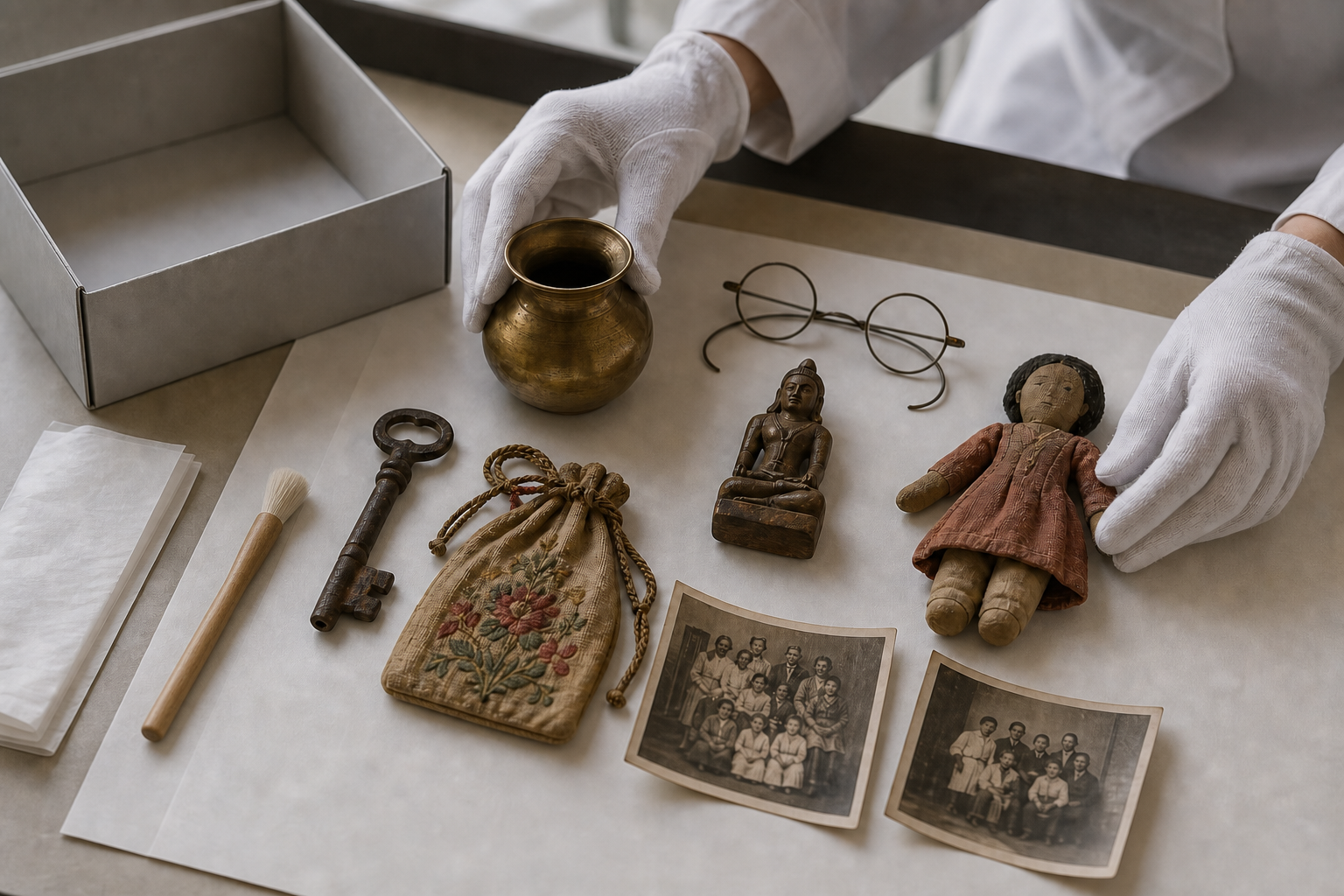
- Objects with biographies. A key, utensil, letter, sacred image, photograph, garment, account book, or travel document matters because of the life attached to it. The label should explain who owned it, where it came from, how it survived, and how the museum acquired or borrowed it. An object without provenance becomes stage decoration.
- Religious identity stated plainly. If people were threatened, selected, protected, expelled, or killed because they were Hindu, Sikh, Muslim, or belonged to another community, the label should say so when the evidence supports it. Replacing every identity with vague terms such as “people” or “communities” can erase the mechanism of the violence.
- Mechanisms as well as suffering. Images of grief reveal consequences, but visitors also need to understand how ordinary life became unsafe. Exhibits should connect testimony to the decisions, rumours, propaganda, institutional failures, seizure of property, movement of populations, and local actions relevant to the case being presented. Otherwise horror appears to have arrived from nowhere.
- Geographical precision. Place-names should be mapped, including older and present names where that helps identification. A route should not be reduced to an arrow across a large map if the family account contains villages, stations, camps, rivers, neighbourhoods, or sacred places. Local detail is often what turns an anonymous movement into recoverable history.
- The long aftermath. Crossing a border is not the end of a displacement story. A museum should follow people into resettlement, lost property claims, new occupations, altered languages, rebuilt temples and gurdwaras, changed family structures, and the practices through which communities re-established continuity. Survival is historical evidence, not a sentimental epilogue.
- Visible uncertainty. Memories can conflict. Dates can be approximate. A family tradition may preserve something that available documents neither confirm nor disprove. A trustworthy label marks those limits. It does not quietly convert recollection into verified fact or treat the absence of a record as proof that an experience never occurred.
Several warning signs should make you more cautious. Notice passive constructions such as “violence occurred” when the available evidence could identify actors. Notice whether the chronology begins only after the causes become uncomfortable. Notice whether a Hindu family’s religious identity disappears from the label even though that identity explains why it fled. Notice, too, whether shocking images have been chosen for emotional force without enough information to establish where, when, and by whom they were created.
Fairness does not mean giving every community an identical number of panels or forcing every documented act into an artificial symmetry. It means applying the same evidentiary rules to every claim. Name what can be established. Mark what remains uncertain. Do not lower the standard when a claim flatters your preferred politics, and do not raise it selectively when Hindu suffering enters the frame.
How to read an exhibit without being managed by it
Every museum interprets. Selection begins when someone decides which object to collect, which voice to record, where the chronology starts, and which words appear on the wall. The answer is not to demand an impossible absence of interpretation. It is to make interpretation visible and testable.
Begin with the caption before surrendering to the atmosphere. For each major claim, sort what you see into one of three categories: direct evidence, remembered experience, or curatorial interpretation. A dated letter is direct evidence that its writer expressed something at that time; it is not proof that every statement in the letter was accurate. A recorded memory tells you how a person recalls an experience; it may require comparison with other records. A wall text that connects several items into a larger explanation is interpretation, even when it is written in a confident institutional voice.
Then examine the verbs. “Left,” “moved,” and “relocated” can conceal decisive differences. Did a family plan a departure, flee a threat, obey an order, follow relatives, or leave after losing the means to remain? The label may not be able to answer every question, but it should not erase a known cause through bloodless language.
Follow one person or family through the entire exhibition. Where did ordinary life begin? What changed first? What was carried? Who helped or harmed them? What was lost? Where did they go? What did they rebuild? This method prevents a large national narrative from reducing people to a photograph of a crowd.
Look for absences as carefully as you look at displays. Does the museum include sacred life, or does religion appear only as a cause of conflict? Are temples, gurdwaras, festivals, household worship, pilgrimage ties, and inherited obligations treated as parts of lived civilization? Does the exhibition show agency and rebuilding, or are Hindus and Sikhs visible only as faceless victims? Does it identify rescuers and neighbours who acted against the pressure around them without using those cases to dilute documented persecution?
Keep empathy and causation separate. You can recognize suffering across communities without pretending that every event had the same cause, sequence, or scale. Compassion tells you that pain matters. Historical reasoning asks what happened in this place, to these people, through which actions, under which conditions. One should not be used to disable the other.
You do not have to abandon a pro-Hindu standpoint to apply this method. A standpoint becomes more credible when it is disciplined by evidence. If an exhibition understates Hindu suffering, you will be able to identify the omission precisely: a missing identity, an unexplained euphemism, a broken chronology, an unsupported equivalence, or a failure to preserve testimony. That is stronger than rejecting an institution merely because its conclusion feels unsatisfactory.
Before leaving, write down one claim you want to verify, one object whose provenance you want to know, and one voice you did not hear. A museum visit becomes civic participation when those questions turn into a respectful request for a catalogue entry, acquisition policy, reading list, corrected label, or future exhibition theme.
Turn family memory into history others can use
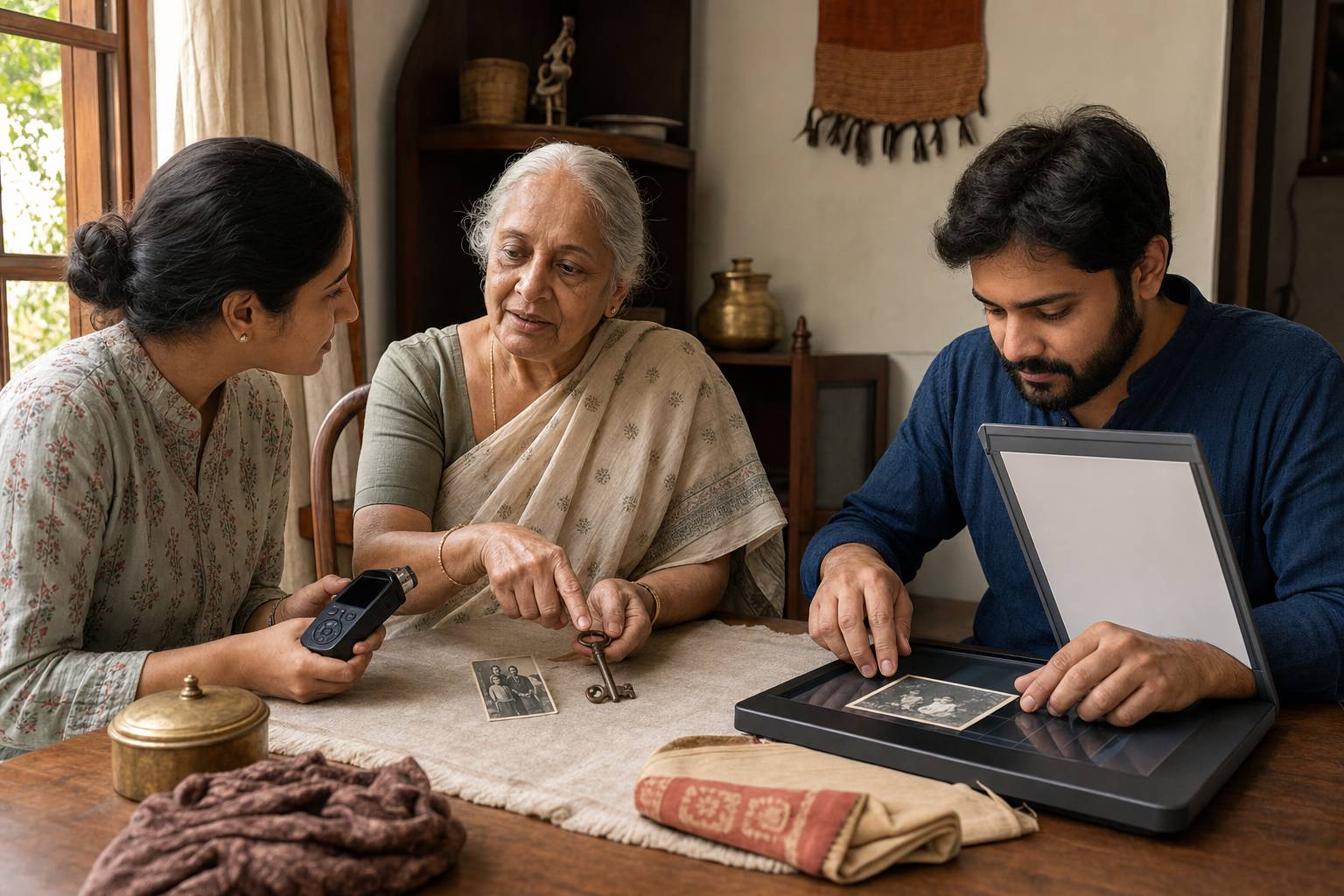
You do not need to wait for a national institution to begin preserving a family account. You do need to preserve it in a form that another person can understand without relying on your memory. A recording with no name, date, place, or permission may become unusable even if its contents are extraordinary.
- Ask for informed permission. Explain whether the conversation is only for the family, may be shared with researchers, or could be offered to a museum. Let the speaker restrict sensitive sections. Consent to speak with a relative is not automatically consent to worldwide publication.
- Record identity carefully. Note the speaker’s full name, names used at different stages of life, approximate or known birth details, the interview date, the interviewer, the language, and the relationship between speaker and interviewer.
- Establish the map before the crisis. Ask about the home, neighbourhood, work, school, worship, festivals, markets, relatives, and nearby landmarks. You need to know what ordinary life looked like before you can understand what changed.
- Use open prompts. Ask, “What happened next?” or “How did you know it was time to leave?” Avoid supplying the answer inside the question. Let silence remain for a moment instead of rushing to fill it.
- Separate experience from later knowledge. Ask which events the person directly witnessed, which were reported by relatives, and which were learned years later. All three may matter, but they are not the same kind of evidence.
- Document every object. Photograph the front and back, record inscriptions, identify every known person in a photograph, and note who currently owns the original. Preserve envelopes with letters and captions with photographs; context is easily separated from the item it explains.
- Keep the original voice. A transcript can correct obvious typing mistakes, but it should not polish away dialect, hesitation, repetition, or emotionally difficult wording merely to make the speaker sound more formal. If you translate, retain the original recording and identify the translator.
- Create a simple inventory. Give each recording, photograph, document, and object a stable name. Add a short description, relevant place-names, approximate dates where necessary, ownership information, and any access restriction. Store copies separately from the originals.
- Clarify the terms before donating. Ask whether an institution wants ownership or a loan, whether it may reproduce the material, whether the family will receive a digital copy, how access restrictions will be enforced, and what happens if an item is not accepted into the permanent collection. Do not hand over an irreplaceable original without written documentation.
Useful prompts often concern continuity as much as rupture. What did the family carry, and why? Which deity, scripture, photograph, recipe, song, surname, craft, or observance connected the old home to the new one? Who offered help? Which place-name continued to be used inside the family? What part of the account came from someone no longer living?
Do not force a relative to relive an experience for the sake of completeness. If the person declines a question, record the boundary rather than pressing past it. Do not publish allegations about identifiable living people without careful verification and permission. Preservation is not a licence to remove dignity, privacy, or agency from the person whose history you want to save.
A Dharmic discipline for public remembrance
Partition memory in Bharat requires truth without self-erasure and compassion without falsification. A Dharmic approach can hold those obligations together.
Satya demands accurate naming. Hindu suffering should not be hidden behind neutral-sounding language when religious identity was central to what occurred. Nor should an uncertain accusation be upgraded into a fact merely because it confirms an inherited grievance.
Karuna requires attention to the human person rather than consumption of suffering as spectacle. It allows you to mourn your own people fully while recognizing another family’s pain. Recognition is not an agreement that every historical responsibility was identical.
Ahimsa does not require amnesia. Refusing to name violence can protect a false peace at the expense of the dead and displaced. But remembrance should not manufacture a fresh licence to humiliate, threaten, or collectively condemn people living now. Historical responsibility attaches to evidence, actions, institutions, and ideas; it is not inherited automatically through ancestry.
Viveka, the work of discernment, asks you to distinguish grief from proof, testimony from interpretation, civilizational continuity from present-day state boundaries, and legitimate historical judgement from indiscriminate blame. A border can divide political territory. It cannot retrospectively erase the sacred geographies, family networks, languages, and memories through which people understood their world.
This discipline also clarifies what a Partition museum should refuse to become. It should not be a courtroom whose verdict was selected before the evidence. It should not be a hall of vague sorrow in which nobody did anything to anybody. It should not require Hindu visitors to dilute their own memory before they are permitted to speak. And it should not train visitors to treat present neighbours as substitutes for historical perpetrators.
Key takeaways
- A Partition institution deserves trust when it combines remembrance, explanation, and records that can be checked.
- Test every major claim by asking whether it is direct evidence, remembered experience, or curatorial interpretation.
- Religious identity should be named when it explains persecution, protection, flight, survival, or reconstruction.
- Fairness means using consistent evidentiary standards, not manufacturing equal-looking narratives.
- Family testimony becomes usable history only when it includes consent, provenance, place, language, ownership, and access terms.
- A Dharmic memory practice can tell the truth about Hindu suffering while refusing inherited hatred and collective guilt.
Before your next museum visit, choose one family name, one place, one object, and one unanswered question. If an elder is willing to speak, preserve the account with consent and context now. If an institution wants your support, ask to see its provenance rules, oral-history process, and approach to contested claims. Public memory becomes dependable when private fragments are preserved carefully and public institutions are expected to earn trust.
References
