
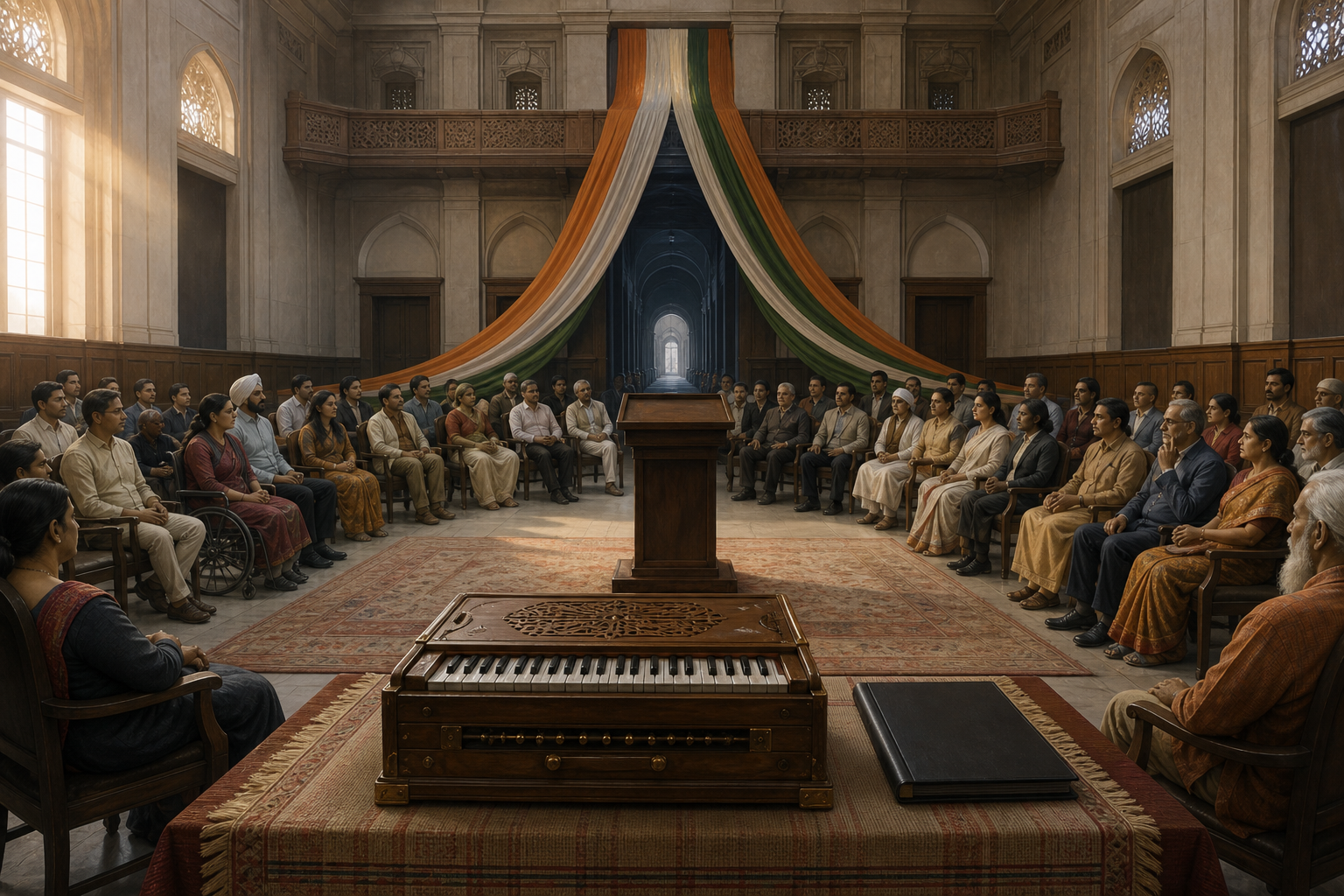
If you are trying to decide whether the latest Vande Mataram dispute is ceremonial trivia or evidence of a deeper political habit, begin with a precise question: did Congress protect individual conscience, or did it allow a sectarian objection to narrow a shared civilisational inheritance?
On the available facts, the appeasement charge has substance. Congress chose an institutional restriction for everyone at its function rather than merely allowing an unwilling individual to abstain. But precision matters. The reported act was not a national ban on Vande Mataram, and the comparison with the Khilafat movement is useful only as a warning about political incentives, not as proof that two different historical moments are identical.
Begin with the exact decision, not the loudest accusation
The immediate facts are narrow. At a Congress event in Goa attended by party president Mallikarjun Kharge, party workers reportedly sang only the first two stanzas of Vande Mataram. The episode followed the Congress Working Committee’s reaffirmation of its 1937 position that only those two stanzas would be sung at party functions.
That does not establish that Congress banned the song, stopped anyone from singing it in full elsewhere, or altered a national legal protocol. None of those broader claims follows from the reported event. If you discuss the controversy, describe the act accurately: Congress retained a two-stanza rule for its own functions and applied it at the Goa event.
This narrower formulation does not weaken the criticism. It strengthens it by placing responsibility exactly where it belongs. The question is not whether Congress possesses the organisational authority to choose its programme. It plainly makes that choice. The question is what its choice communicates about the place of Bharat’s civilisational memory in national politics.
The controversy exists because the limitation is not understood as a neutral decision about time or performance length. It is associated with historical objections to the song’s civilisational imagery. Once that history supplies the reason for retaining only two stanzas, the omission becomes a political statement even if Congress presents it as settled convention.
Union Home Minister Amit Shah has characterised the decision as an extreme form of appeasement and argued that the historical truncation dishonours Bankim Chandra Chattopadhyay and the freedom fighters inspired by the song. You need not accept every part of that partisan formulation to recognise the underlying issue: a party cannot make a culturally consequential choice and then treat it as empty protocol.
The practical test for distinguishing inclusion from appeasement
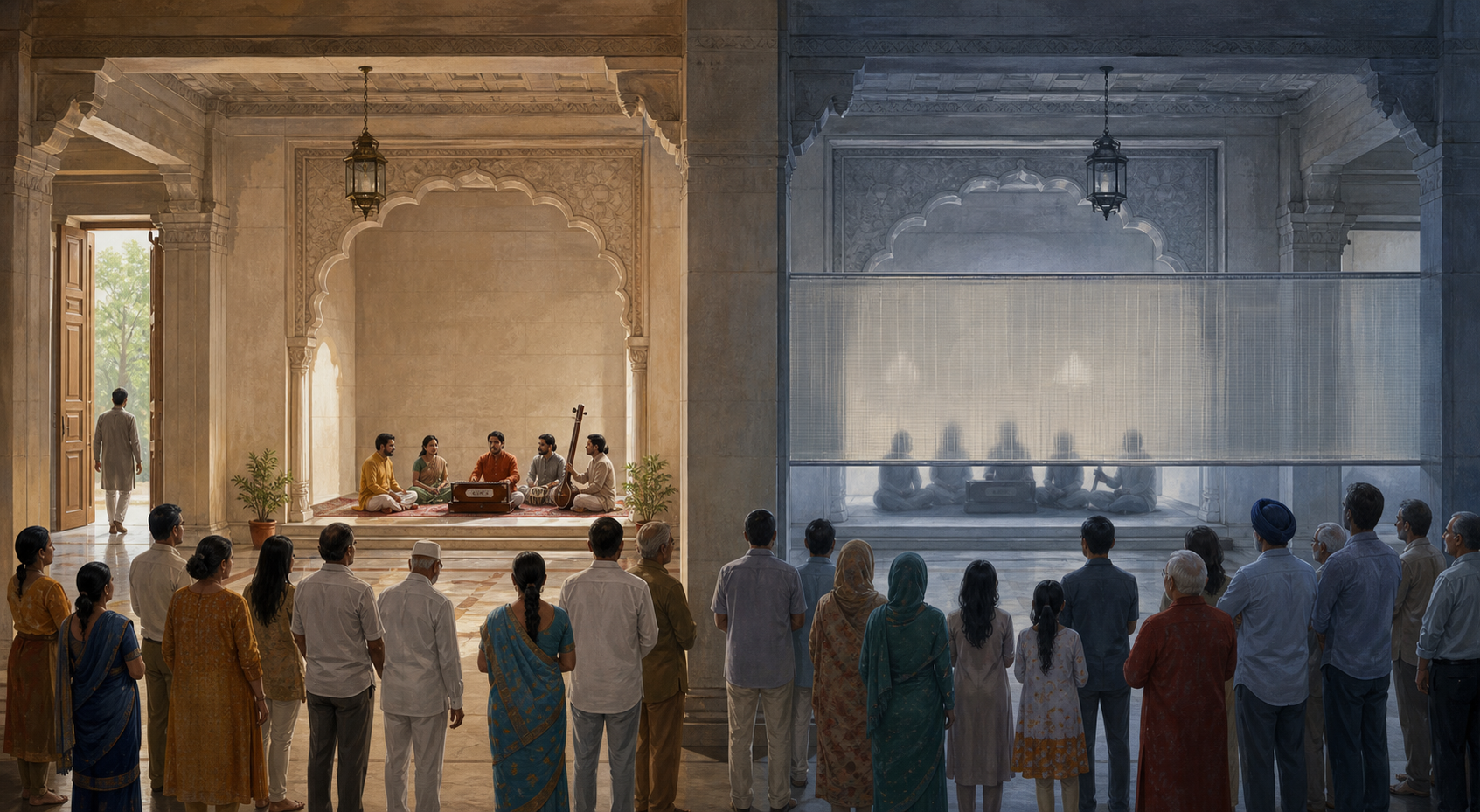
Not every accommodation is appeasement. A plural society routinely makes room for conscience, dissent and different forms of worship. Accommodation becomes appeasement when a political institution narrows a shared norm to placate a particular objection, cannot explain the concession through a general rule, and expects the wider society to bear the cultural cost.
You do not need access to private electoral calculations to evaluate this pattern. Apply five public tests:
- Is there a general principle? Ask whether the same rule would govern objections to symbols associated with every religious or cultural tradition, or whether it is a special exception made in one politically sensitive case.
- Who is being protected? Excusing an individual from singing protects conscience. Editing the institutional rendition for everyone changes the common expression itself.
- Who bears the burden? A balanced accommodation leaves both the dissenter and the cultural tradition intact. An asymmetric one preserves the objection by reducing what everyone else may hear or perform.
- Is participation being confused with endorsement? A person can be free not to sing without acquiring the power to determine which parts everybody else may sing.
- What is the endpoint? A principled settlement explains what has been protected and why. Appeasement tends to create a precedent under which the next objection demands another retreat.
Applied to the Goa episode, the decisive point is institutional agency. Congress did not merely leave participation to personal choice. Its Working Committee reaffirmed a rule limiting the rendition at party functions. The restriction therefore affects the party’s collective presentation of the National Song, not only the conscience of a possible dissenter.
That is why the charge of appeasement is defensible. The choice appears to preserve an old objection by narrowing the song for the entire gathering. Congress could answer the charge by articulating a neutral principle that it applies consistently across cultural disputes. Simply pointing to 1937 does not supply that principle. It identifies when the accommodation was made, not why present-day Indians should continue to accept it.
This distinction also prevents a common mistake in public debate. Respect for a citizen is not the same as acceptance of every political demand made in the citizen’s name. Treating a community as if it has one permanent objection, one authorised spokesman and one predictable political response is itself a form of vote-bank thinking. Genuine pluralism leaves room for disagreement within communities as well as between them.
Why the Khilafat comparison matters, and where it stops
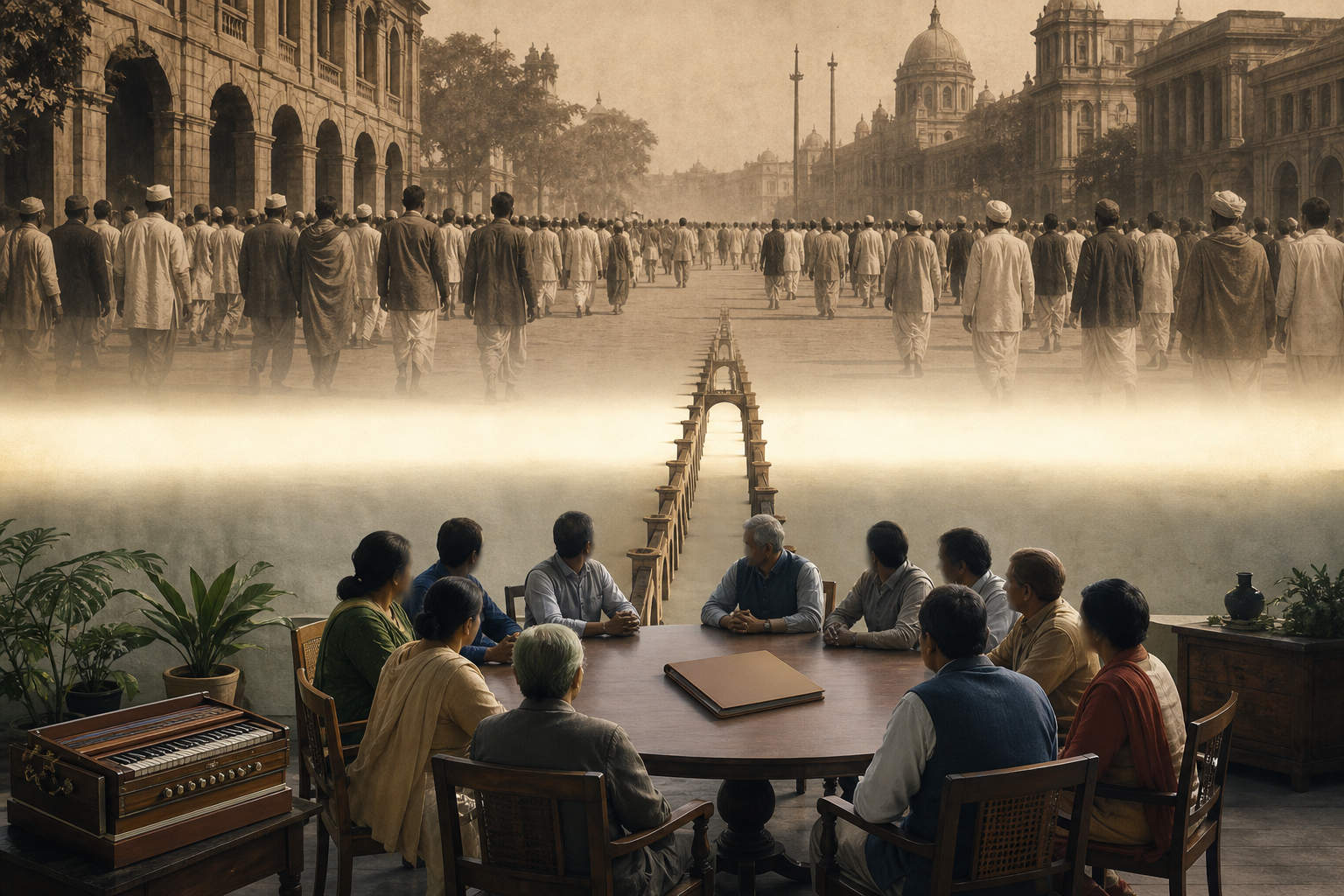
The proposed Khilafat analogy rests on a recognisable political mechanism. In 1919, Congress leadership allowed a particular religious-political demand to enter the broader nationalist strategy in the hope of securing political unity. The warning is that a tactical coalition can be purchased by accepting a sectarian premise that later weakens the shared civic basis of the coalition itself.
The comparison is useful at that level. In both arguments, political managers seek unity by conceding that a religiously framed objection must shape a common nationalist platform. The immediate concession can look small or expedient. The long-term effect is conceptual: national belonging begins to depend on how much of the majority civilisation can be placed outside the common space.
Three risks follow from that mechanism. First, civic unity becomes transactional. Instead of citizens meeting under a shared framework while retaining their differences, political unity depends on satisfying demands presented by communal intermediaries. Second, those intermediaries gain an incentive to maintain the objection because their political relevance rests on their ability to negotiate concessions. Third, a tactical compromise can harden into inherited doctrine. Later leaders then defend it by age rather than by principle.
But the analogy has limits that should be stated plainly. A party’s rule about singing two stanzas is not, by itself, equivalent in scale, circumstances or consequences to the Khilafat movement. The known facts do not establish such an equivalence. Saying that Congress has literally recreated 1919 would overstate the evidence and make it easier to dismiss the legitimate concern.
The responsible claim is more exact: the same political temptation may be visible. A leadership can pursue short-term harmony by granting a sectarian objection authority over a shared national expression. History is valuable here because it reveals the incentive and its possible direction. It should not be used as a slogan that eliminates every difference between past and present.
When you encounter this comparison, therefore, ask what mechanism is being alleged. If the answer is merely that both episodes involved Congress and religious politics, the argument is too thin. If the answer identifies tactical unity, asymmetric concession and the conversion of a temporary compromise into a lasting veto, then the comparison has analytical value.
A decision from 1937 still requires a justification in 2026

The strongest defence available to Congress is continuity. Its Working Committee did not invent the two-stanza practice for the Goa event; it reaffirmed a position dating to 1937. On this view, the rendition follows a long-established party settlement rather than a new surrender to immediate pressure.
That defence deserves to be heard, but it does not settle the matter. Political resolutions are decisions made under particular historical conditions. Their age can explain why an institution behaves as it does, but age cannot turn a strategic compromise into a timeless moral rule. Reaffirming the resolution is itself a present decision. Today’s Congress therefore owns the policy and must defend its rationale today.
A second defence might appeal to inclusion: retaining the first two stanzas could be presented as a way to preserve a common core while avoiding material that some people contest. That is a coherent political argument, but it immediately raises a harder question. Why must inclusion be achieved by reducing the inherited cultural expression rather than by allowing voluntary participation?
Personal conscience and cultural completeness need not be enemies. A person should not have to prove patriotism through compelled singing. At the same time, an institution need not redefine an entire civilisational inheritance around that person’s objection. The fair arrangement protects the dissenter from coercion without converting dissent into editorial control over the shared tradition.
This is also where a pro-Hindu response needs discipline. The decision under scrutiny belongs to Congress. Accountability should remain with the leaders and committees that made or reaffirmed it. Ordinary citizens of any religious community are not collectively responsible for a party’s calculations. Turning criticism of appeasement into hostility toward a whole community would reproduce the communal logic that the criticism is supposed to oppose.
A Dharmic civic position can be firm without becoming coercive: preserve the full cultural memory, apply equal standards, permit individual freedom and reject collective blame. That stance is harder for opponents to caricature because it does not demand submission from anyone. It asks only that an objection remain an objection, not become a veto.
Key takeaways for judging the controversy
- The accurate factual claim is that Congress reportedly used only the first two stanzas at a Goa party event after reaffirming its 1937 position for party functions. Calling this a national ban goes beyond the known facts.
- The appeasement charge is strongest because the decision changes the institution’s rendition for everyone instead of merely protecting an individual’s choice not to participate.
- A historical resolution explains the origin of the practice but does not justify its continuation. Reaffirmation makes it a present policy for which the current leadership is accountable.
- The Khilafat comparison can illuminate a recurring incentive: tactical unity purchased through a sectarian concession. It cannot prove that the two episodes are identical in scale or consequence.
- The principled response is to defend complete civilisational memory, voluntary participation and one rule for all communities while keeping criticism focused on political decision-makers.
For the next symbolic controversy, write down three things before choosing a slogan: the exact institutional act, the general rule offered to justify it, and the people made to bear the concession. In this case, Congress should be asked why a settlement from 1937 remains necessary, whether its reasoning would be applied consistently to other contested traditions, and why personal freedom requires an abridged institutional rendition.
Vande Mataram does not need to be defended through exaggerated claims or collective anger. It is better defended through factual accuracy, equal civic standards and a refusal to let yesterday’s tactical accommodation become today’s unquestionable doctrine.
References
