

If you saw a headline claiming that India had laid claim to Sindh, pause before choosing between outrage and applause. The episode establishes something narrower: an Indian reference to Sindh prompted an official Pakistani accusation of expansionism. It does not, by itself, establish a new territorial policy.
The useful question is not whether Sindh matters to Bharat’s civilizational memory. It plainly does. The question is what kind of claim is being made – cultural, emotional, political or territorial – and what evidence supports that reading.
What the dispute establishes – and what it does not
On 24 November 2025, Pakistan’s Ministry of Foreign Affairs condemned remarks attributed to India’s Defence Minister Rajnath Singh that referenced Sindh. It characterized the remarks as reflecting a ‘Hindutva mindset,’ said they challenged established realities and renewed Pakistan’s charge that India is ‘expansionist.’
That tells you what Pakistan’s official reaction was. It does not give you enough, on its own, to conclude that India announced a plan to alter a border, adopted a new doctrine or threatened imminent action. A reference to a place can express memory, identity, aspiration, criticism or policy. Those meanings are not interchangeable.
Two easy claims should therefore be resisted. ‘India has announced that it will take Sindh’ goes beyond the established facts. ‘Pakistan reacted to nothing’ ignores the fact that a formal diplomatic objection was made. A serious reading can reject Pakistan’s characterization of Indian intent without pretending the reaction never occurred.
This distinction matters because rhetoric is often reported faster than its context. An official protest can be verified as an event; the accusation inside that protest still has to be evaluated as an accusation. Repetition across headlines does not transform a government’s characterization into independent proof.
Sindh occupies three different maps
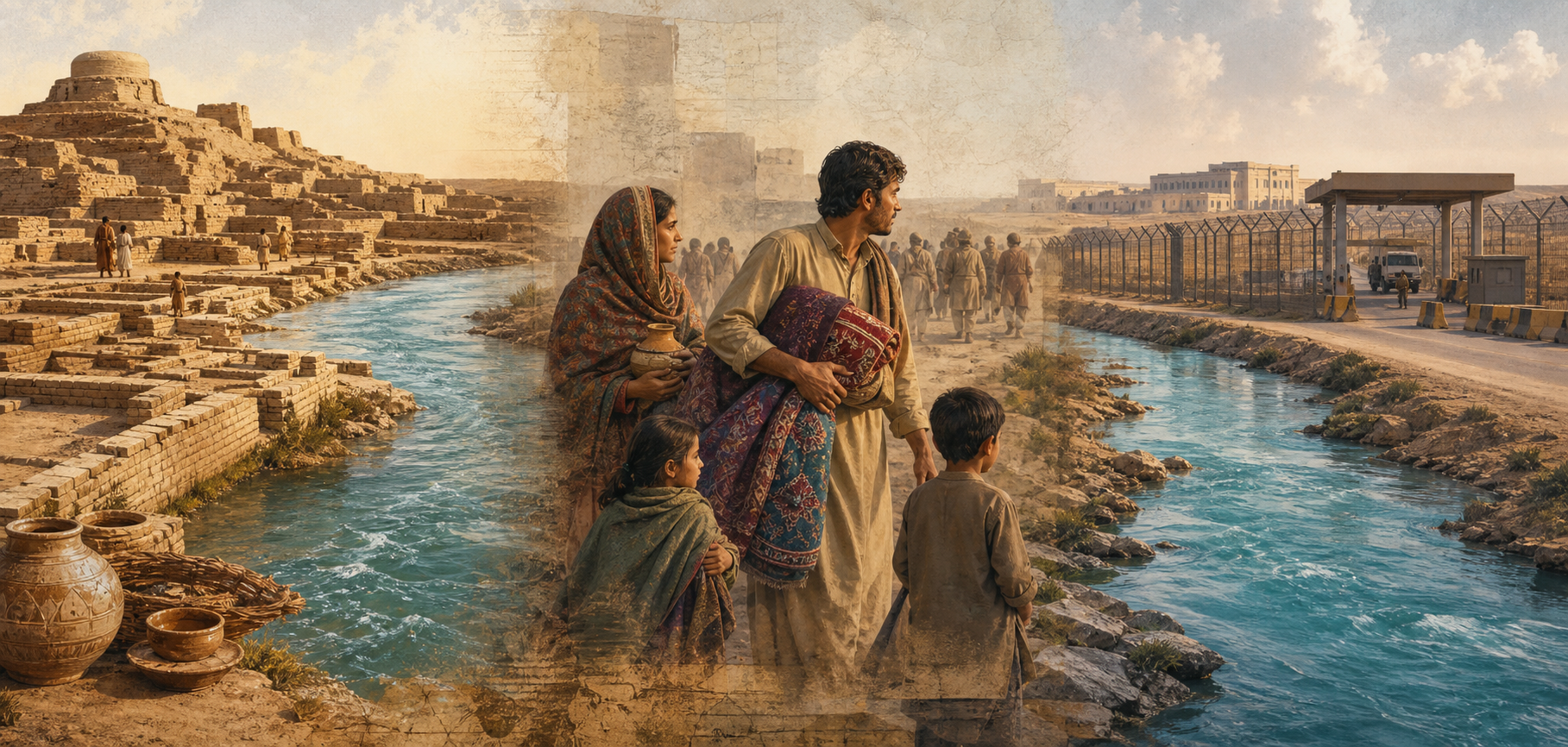
Much of the confusion disappears when you recognize that the name Sindh can operate on three different maps at once.
- The civilizational map: Sindh belongs to the historical and cultural world of the Indian subcontinent. Linguistic, artistic and spiritual currents crossed the borders that govern the region today. Hindu, Buddhist, Jain and Sikh connections form part of that inheritance.
- The map of personal memory: Families and communities can retain roots in Sindh even when present-day borders separate them from ancestral places. Their attachment is not a foreign-policy program; it is lived historical memory.
- The legal and strategic map: Contemporary states exercise sovereignty within recognized borders. A territorial policy belongs to this register and requires much stronger evidence than a civilizational reference.
The common mistake is a category error: treating every civilizational statement as a territorial demand, or treating every emotionally satisfying slogan as though it were settled state policy.
For readers who understand Akhand Bharat primarily as a civilizational idea, precision is especially important. A civilization can remain connected across borders through memory, scholarship, pilgrimage traditions, language and community ties without every expression of that continuity becoming a proposal for annexation. Conversely, anyone making an actual strategic claim should state it plainly and accept scrutiny of its legal and human consequences.
Maps perform different jobs. A cultural map preserves belonging; a political map administers power. You do not have to erase the first to respect the reality of the second. You also should not smuggle a demand about the second into sentimental language about the first.
Why the ‘expansionist’ label has strategic consequences

Calling India ‘expansionist’ does more than express disagreement. It assigns an intention: that cultural language is evidence of a plan to enlarge the state. Once that frame takes hold, audiences begin debating the alleged plan rather than asking whether such a plan was actually stated.
The charge also places Hindutva itself inside a security narrative. Pakistan’s use of ‘Hindutva mindset’ is a political characterization of the remark, not independent evidence of Indian intent. In the same way, a patriotic interpretation offered by Indian supporters cannot establish government policy merely because it is emotionally compelling.
This is why wording becomes part of statecraft. In a sensitive India-Pakistan setting, ambiguous phrases can shape public sentiment, harden siege mentalities and reduce the room available for confidence-building. The effects can spread to Track I diplomacy, meaning official government engagement, and Track II engagement among scholars, former officials and civil-society participants.
Precision is not timidity. If an Indian leader means that Sindh remains part of Bharat’s civilizational memory, saying so clearly protects that legitimate cultural argument from being repackaged as an unstated military threat. If a speaker means something more, the public deserves the exact proposition rather than a slogan elastic enough to mean whatever each audience wants.
You should therefore separate three things whenever this dispute resurfaces: the original words, the interpretation placed on them and any action that follows. A dramatic interpretation is not an action. An official objection is not confirmation that the objection’s premise is true.
Use this five-question test on the next Sindh headline

You do not need to be a diplomat to read these disputes carefully. Before sharing a clip or accepting a headline, work through five questions in order.
- What were the exact words? Look for a full transcript or an uncut recording. If only paraphrases are available, describe the remark as attributed or reported rather than quoting a claim that you cannot verify.
- What kind of statement was it? Decide whether the speaker was discussing heritage, historical memory, political aspiration, a legal claim or a threat of action. Do not jump from the first category to the last.
- What institutional weight supports it? A change in state policy normally leaves more than a rhetorical trace. Look for an official policy statement, legal measure, diplomatic position or operational action. The absence of such evidence does not prove that words are harmless, but it does limit what you can responsibly claim.
- Whose interpretation are you repeating? Keep India’s words, Pakistan’s response, media framing and social-media commentary in separate mental boxes. Each may be a relevant fact, but none should be silently substituted for another.
- What concrete consequence followed? Check whether official talks, border arrangements, trade channels, cultural exchanges or confidence-building measures actually changed. If no consequence has been established, classify the episode as a rhetorical dispute rather than automatically calling it a strategic shift.
Key takeaways
- Pakistan officially condemned a Sindh reference attributed to Rajnath Singh and framed it as evidence of Indian expansionism.
- The dispute, by itself, does not establish that India adopted a new territorial policy toward Sindh.
- Sindh’s place in Bharat’s civilizational memory is a different question from contemporary sovereignty and state action.
- Your safest reading method is to verify the words, identify the type of claim, inspect its institutional backing and look for a concrete consequence.
A dharmic position can be firm without being careless

There is no need to surrender the civilizational memory of Sindh merely because Pakistan labels an Indian reference expansionist. Sindh’s historical connections with the broader Indic world do not disappear at a modern border. Hindus, Buddhists, Jains and Sikhs can study, preserve and speak about those connections without asking permission from a hostile political frame.
But civilizational confidence should produce discipline, not verbal carelessness. Dharmic restraint is not passivity or historical amnesia. It means aligning speech with intention, refusing falsehood and considering the foreseeable consequences of one’s words.
That principle points to different responsibilities for different people:
- Political leaders should state whether they are speaking about heritage, political aspiration or government policy. Ambiguity may energize an audience for a day while narrowing diplomatic options for much longer.
- Cultural institutions should preserve Sindh’s linguistic, artistic and spiritual inheritance through scholarship, archives and community exchange. Cultural continuity becomes more durable when it rests on knowledge rather than slogans.
- Diplomats and policy practitioners should keep measurable objectives in view, including trade facilitation, humanitarian channels and cultural exchanges. These do not settle every disagreement, but they create practical tests of whether dialogue is serving citizens.
- Readers and commentators should retain uncertainty where the exact words or policy context remain uncertain. Sharing a categorical territorial claim without that evidence helps the most inflammatory interpretation dominate the discussion.
A pro-Bharat position need not accept Pakistan’s description of Indian motives. It also need not turn every historical attachment into a casual threat. The stronger position is to defend Sindh’s place in our civilizational consciousness, insist on factual precision and demand that any claim about state policy be supported by state-level evidence.
When Sindh next appears in a speech, ask what map the speaker is using and what action, if any, stands behind the words. Preserve the memory. Verify the claim. Do not let either an adversary’s accusation or a partisan headline do your thinking for you.
References
