
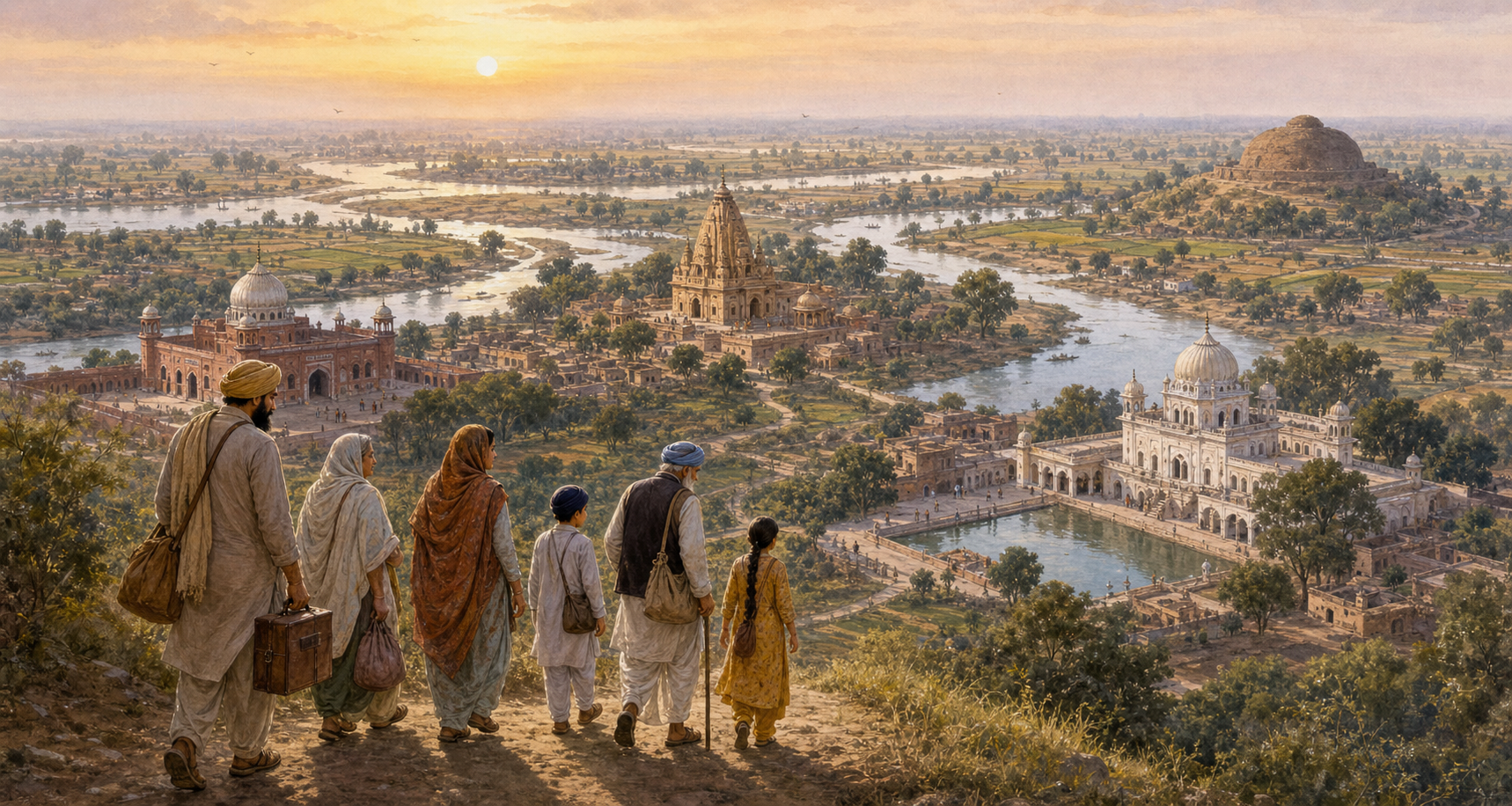
You may know historic Punjab through one gurdwara, an ancestral town, a Partition story, or a temple whose name survived in family conversation. The difficult question comes next: how do you connect that inheritance without flattening every tradition into sameness or letting the modern border dictate the limits of memory?
Build a layered map rather than a list of monuments. Follow sacred associations, rivers, scripts, family testimony, living practices, and the people who care for each place. That method can guide a pilgrimage, an interview with an elder, a family archive, or a more truthful understanding of Punjab itself.
Begin with the journey you actually need
Historic Punjab is too large, and its inheritance too layered, for a generic heritage checklist. Before choosing destinations, finish this sentence: I need this map so that I can… Your answer may be to recover a family route, understand Guru Nanak’s geography, place a Hindu shrine within its wider landscape, study Gandharan Buddhism, or explain shared Dharmic memory to the next generation.
That purpose determines what you record. A pilgrim needs access information, sacred etiquette, and time for worship. A descendant needs old and current place-names, family pronunciations, neighborhood details, and consent to preserve testimony. A student needs chronology, architectural context, and a clear distinction between evidence and interpretation.
Two Punjabi ideas provide a useful orientation: janambhumi treats the land as birthplace and intimate belonging, while yatra treats movement as a disciplined act of remembrance. You may be undertaking one, the other, or both. Naming the difference prevents a heritage trip from becoming mere sightseeing.
Key takeaways
- Map relationships, not just monuments: connect each sacred place to a river system, language, community, practice, and present custodian.
- Look for shared values without erasing doctrinal differences. Sikh, Hindu, Buddhist, Jain, and Sufi sites belong in the same regional history, but they are not interchangeable.
- Treat family memory as testimony that deserves preservation and verification, not as a detail to romanticize or a claim to force into certainty.
- Ask before photographing, publishing, or mapping sensitive details. A visitor’s desire to document never outranks the dignity and safety of the people who live with a sacred place.
Read each tradition clearly before seeking common ground
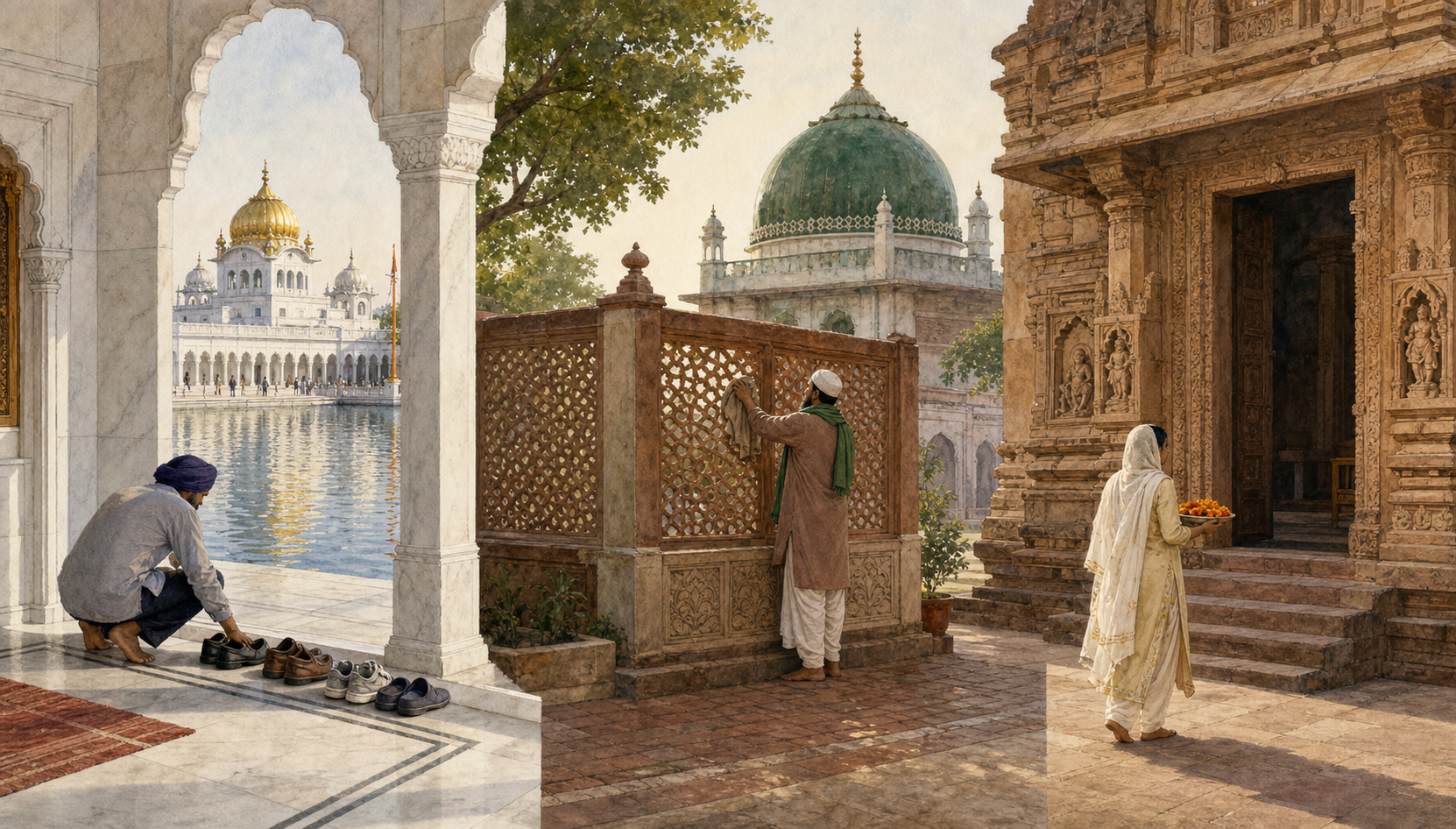
The strongest account of shared heritage begins with distinctions. If every shrine becomes proof that all religions are secretly the same, you lose the histories that make the landscape meaningful. Study what a place means within its own tradition first. Only then ask how routes, languages, artistic forms, hospitality, and ethical practices connect it to neighboring worlds.
Sikh anchors: birth, testimony, and culmination
Nankana Sahib, Gurdwara Panja Sahib at Hasan Abdal, and Kartarpur should not be treated as three interchangeable stops. Nankana Sahib is associated with Guru Nanak’s birth, Panja Sahib with sacred touch and testimony, and Kartarpur with his final years. Together they let you follow a life through place rather than reduce Sikh geography to isolated buildings.
If you are planning a route, decide which part of that sacred biography you are trying to understand. At Nankana Sahib, attend to how a birthplace becomes a continuing center of devotion. At Panja Sahib, ask how physical place carries remembered encounter. At Kartarpur, notice how worship, agriculture, community, and the Guru’s mature teaching belong to the same setting. The Kartarpur Corridor opened in 2019 and enabled visa-free darshan for many Indian devotees, making it a significant example of a modern arrangement serving an older sacred relationship. Treat that date as a historical milestone, not as a substitute for checking the access rules that apply when you travel.
Do not leave with photographs of facades alone. Record what keeps the institution alive: the sung word, the order of the congregation, the langar hall, the work of volunteers, and the conduct expected of a guest. A gurdwara is understood through seva and sangat as much as through architecture.
Hindu sacred geography: complexes and extended routes
Katas Raj requires a different way of looking. It is a constellation of temples where sacred narrative, archaeological remains, and continuing seasonal worship overlap. Approach it as a complex rather than a single photogenic ruin. Identify which features belong to worship, which reveal changes over time, and which are part of the larger setting. That separation will make your notes more accurate and your reverence more attentive.
A sacred map also needs connections beyond Punjab. Hinglaj Mata lies in Balochistan, yet its pilgrimage memory reaches through Sindh toward Gujarat and Rajasthan. Its relevance is methodological: the modern provincial outline is not the same thing as a historical yatra circuit. When a song, family practice, or itinerary carries you outside Punjab, follow the connection but label the geography honestly. A wider civilizational network does not make every node geographically Punjabi.
Buddhist and Jain layers: learning, art, and movement
At Taxila, do more than search for a famous sculpture. Gandharan art and monastic sites such as Dharmarajika and Jaulian place the region within exchanges linking South Asia, Central Asia, and the Hellenistic world. Look at how monasteries organize movement, teaching, residence, and devotion. The layout can tell you that Buddhism here was an institutional and intellectual presence, not merely a style of stone carving.
Jain heritage is easier to omit because some of its visible anchors lie beyond Punjab proper. The carved medieval temples of Nagarparkar in Sindh and the Thar preserve evidence of Jain mercantile and monastic worlds connected with ports, caravan routes, and inland markets. Add this layer when you are mapping the economic and ethical networks around Punjab, but do not silently relocate it. Precision strengthens the civilizational argument.
Sufi presence: connection without appropriation
Sufi shrines in Lahore and Multan belong to the region’s lived religious environment; Sehwan extends that environment into Sindh. Sama, qawwali, dhamaal, poetic devotion, and traditions of hospitality reveal forms of public piety that have spoken across community boundaries.
Notice the relationship without relabeling Sufism as a Dharmic religion. Ask narrower and more useful questions: Who is welcomed? How is food shared? What language carries the poetry? What conduct is praised? Where do ideas of service, compassion, restraint, love, or remembrance meet, and where do their theological foundations remain distinct? Shared Punjab becomes clearer when connection does not require appropriation.
Let rivers and scripts repair the inherited map
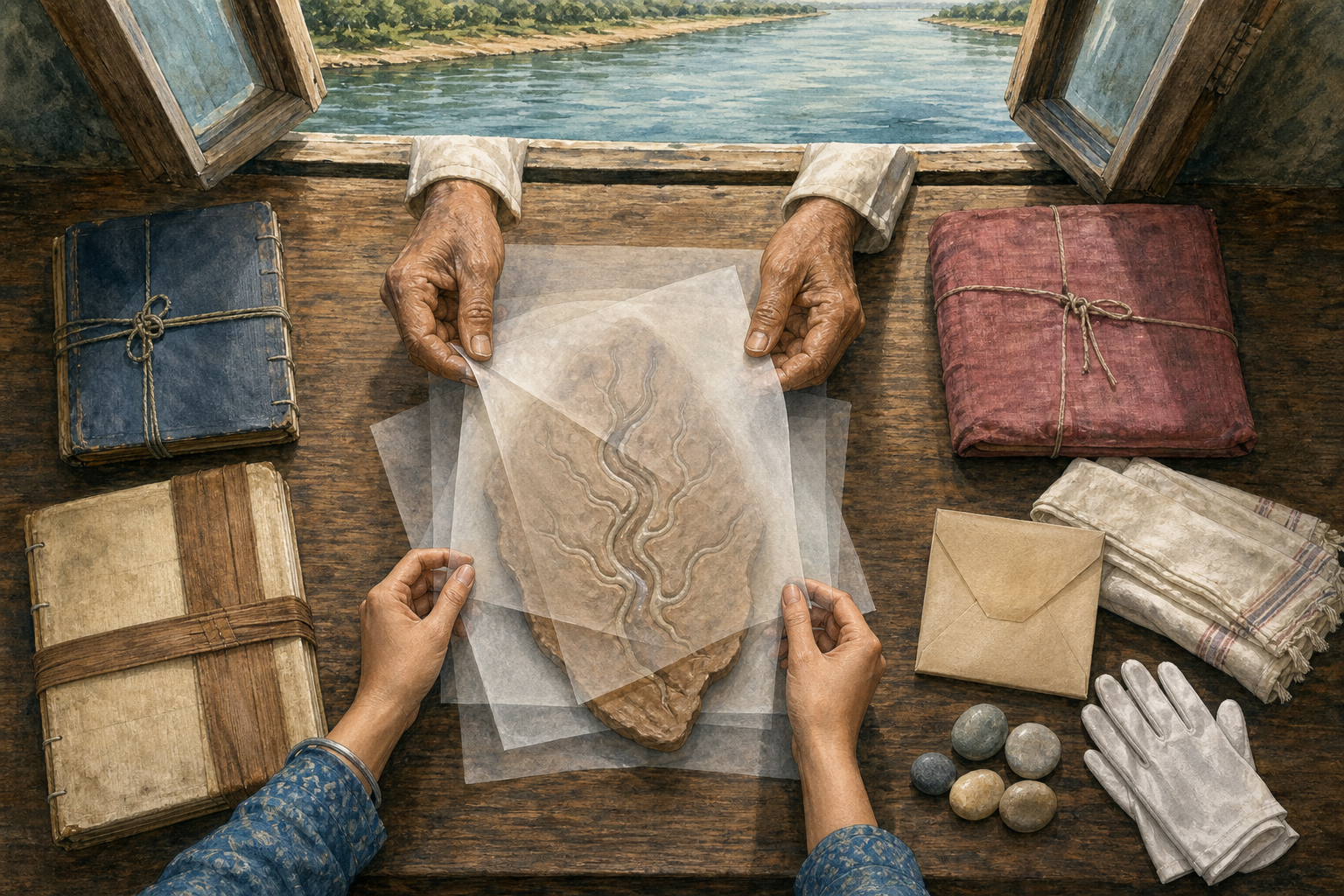
A border-first map makes sacred places look like disconnected dots. A river-first map reveals how communities moved, traded, farmed, spoke, and worshipped. The Indus system and its doabs connected speech, commerce, ritual, and agricultural life; the Ravi and Chenab, along with canal landscapes and seasonal rhythms, continued to shape ordinary experience even after political separation.
You do not need specialist cartography to use this insight. Give every place in your notes five fields:
- Name: Write the spelling used by your family or community, then add the current spelling if you can verify it. Preserve uncertainty rather than guessing.
- Language and script: Note whether the name or testimony reaches you in Punjabi, Hindi, Urdu, or another language. Punjabi’s life in Gurmukhi and Shahmukhi means that a script difference may conceal a familiar word.
- Water geography: Add the river, doab, canal landscape, or nearby water feature when known. This often explains a route better than the present border does.
- Sacred association: State precisely whether the place is linked to a Guru, deity, tirtha, monastic community, saint, story, ritual season, or ancestral practice.
- Living care: Record who opens, cleans, repairs, feeds, guides, sings, teaches, or safeguards the place now. Heritage survives through people, not through coordinates alone.
This format also prevents a common mistake: confusing a renamed place with a vanished one. Sound, script, district boundaries, and official spellings can change independently. Search across variants and ask a Punjabi speaker familiar with the relevant script before concluding that an ancestral location cannot be found.
Language offers another kind of continuity. A greeting, hymn, place-name, or line of family speech may cross Gurmukhi and Shahmukhi even when readers on either side cannot immediately read the other’s script. Preserve the original sound in an audio recording when consent is given. A rough transliteration can be corrected later; a pronunciation that was never recorded may be harder to recover.
Handle Partition memory as testimony, not scenery
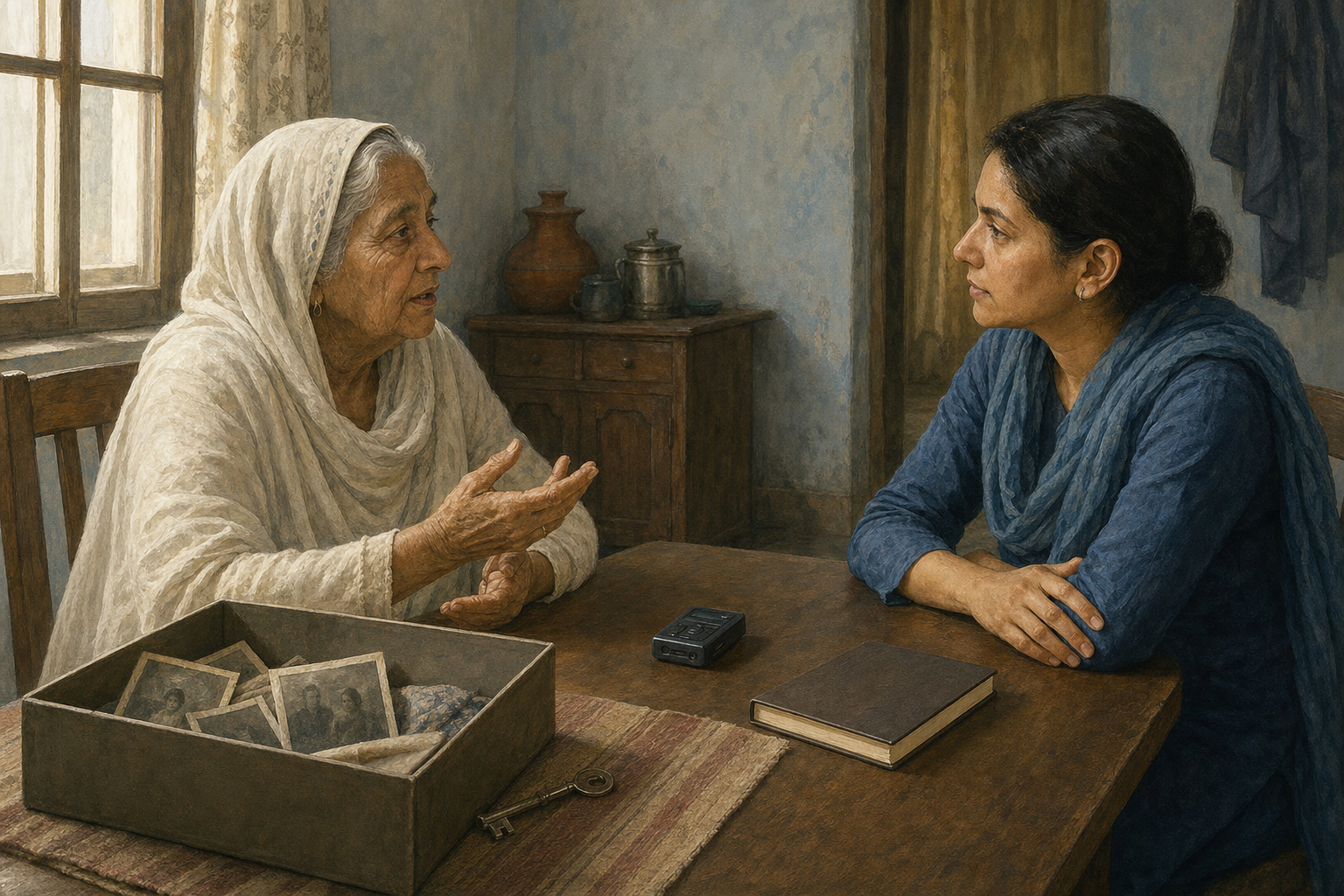
The Partition of 1947 broke routes and dispersed families, but it did not empty place-names of meaning. Lahore, Gujranwala, Sialkot, Rawalpindi, and countless smaller localities may survive in a household through a remembered courtyard, well, market, shrine, crop, fruit, prayer, or turn of phrase. These details are not decorative nostalgia. They are leads that can reconnect a story to a location and a location to a social world.
Family testimony still needs disciplined handling. Memory can compress time, merge two places, inherit another person’s viewpoint, or preserve an old pronunciation after an official name has changed. None of that makes it worthless. It tells you to archive the memory and its uncertainty together.
A five-part family interview
- Start small. Ask for one lane, one journey, one festival day, or the route from home to a shrine. A bounded memory usually produces more usable detail than a request to describe all of pre-Partition Punjab.
- Collect every place-name version. Ask the speaker to repeat the name slowly, identify the language, and mention nearby towns, rivers, wells, markets, mandirs, gurdwaras, or dargahs.
- Separate experience from inheritance. Mark whether the speaker saw something personally, heard it from a parent, or learned it later. Do not turn an inherited account into an eyewitness claim.
- Keep uncertainty visible. Record competing spellings, approximate locations, and disagreements between relatives. A question mark is better archival practice than invented confidence.
- Agree on privacy. Ask whether names, audio, images, former addresses, and painful events may be shared publicly. Keep the unedited recording private when that is what the speaker wants.
Do not force an elder’s experience into a message of easy harmony. Truthful remembrance has room for displacement, fear, rupture, devotion, affection, and help received from neighbors. Refusing competitive victimhood does not require minimizing anyone’s suffering. It means preserving one community’s wound without declaring another community’s memory illegitimate.
Once the interview is complete, make two copies of the recording, add the date and participants, transcribe the original language before translating it, and attach a simple place index. Keep corrections beside the original testimony rather than silently rewriting it. The result will remain useful even when later evidence changes your understanding.
Make pilgrimage useful to living heritage
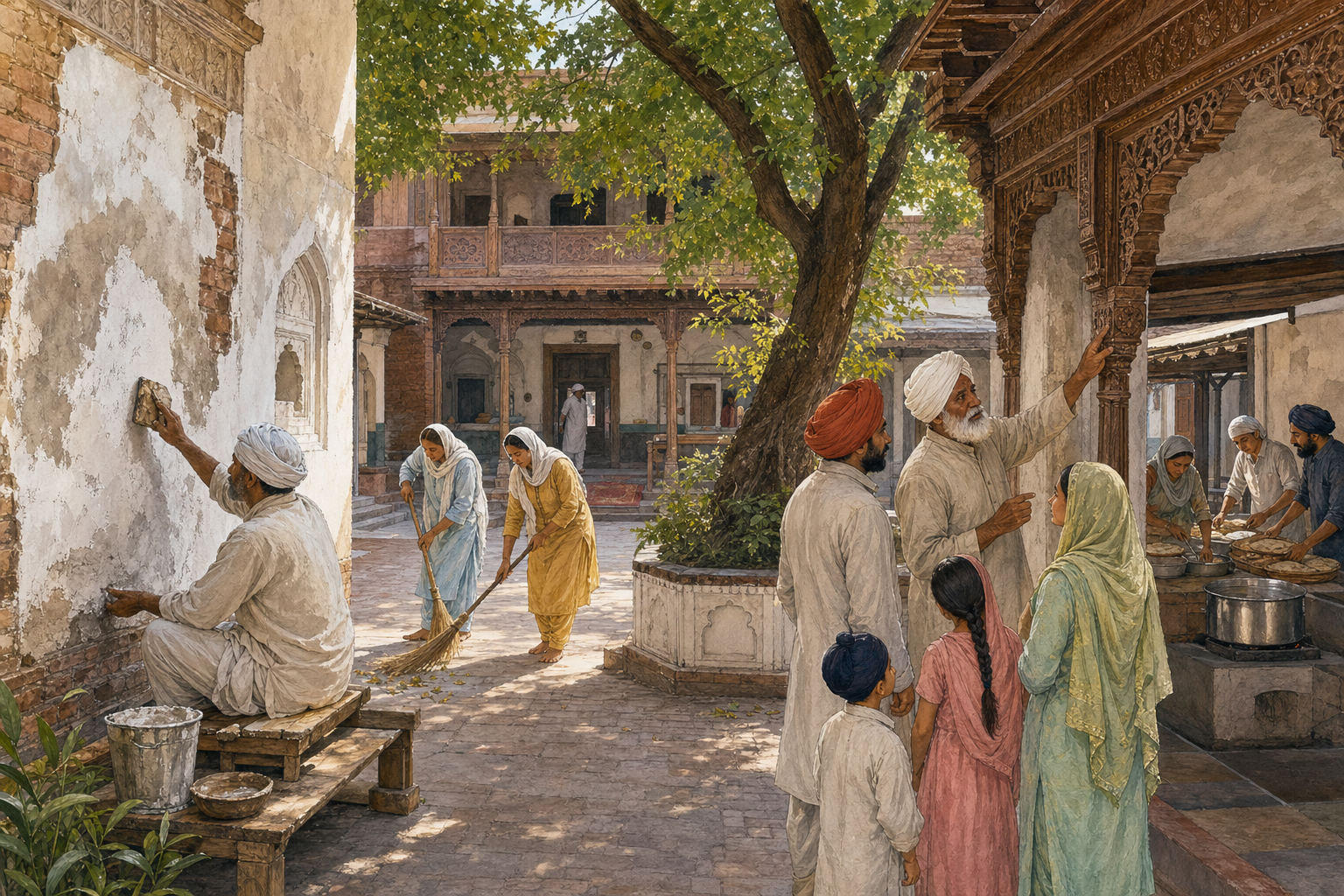
A sacred place is not waiting passively for a visitor to give it meaning. Worshippers, attendants, cooks, volunteers, local residents, scholars, donors, and administrators already live with its needs. Your task is to arrive prepared, observe without intrusion, and leave behind an accurate record rather than a trail of contextless images.
Before you go
Choose a small route with a clear question. Learn each site’s sacred association and expected conduct. Verify current entry, identity-document, security, and photography requirements with the responsible administration; do not infer them from the experience of an earlier traveler. Carry the place-name in every script or transliteration you can verify, plus the contact details for your accommodation and local host.
Decide what you will not publish. Exact residential locations, vulnerable objects, private rituals, and identifiable people may require restraint even when a camera is technically permitted. Heritage documentation is not automatically ethical merely because it is well intentioned.
While you are there
Ask before photographing people, worship, manuscripts, interior spaces, or conservation work. Follow the site’s rules on dress, head covering, footwear, food, movement, and silence. If a caretaker explains a feature, note the person’s role and whether the explanation may be shared. Distinguish what you directly observe from what you are told.
Pay attention to verbs. Who serves, gives, refrains from harm, comforts, repairs, teaches, or welcomes? The regional moral vocabulary includes seva, dana, ahimsa, and karuna. These terms do not erase theological differences; they help you recognize how virtue becomes daily work. A langar meal, a patient queue, a cleaned threshold, or a repaired roof can reveal more about living heritage than an ornamental detail viewed in isolation.
After you return
Caption every image with the place, the tradition, the feature shown, and the date of your visit. Mark uncertain identifications as uncertain. Link oral testimony to its recording and transcript. If a community member corrected you, preserve the correction. Share photographs or notes with the family or custodian who helped you when that is welcomed.
Preservation is distributed work. Caretakers, municipal coordination, diaspora philanthropy, scholarly documentation, and restoration efforts can all affect whether a site remains intelligible and usable. Before offering money or publicity, ask the responsible people what help is appropriate. Sometimes a careful transcription, translated label, organized family archive, or properly contextualized photograph is more useful than another public appeal.
Begin this week with one anchor place. Write its remembered name, current name, script variants, nearest river connection, sacred association, family link, and present custodian on a single page. That page is the first unit of a Punjab heritage map your family can verify, expand, and pass on.