
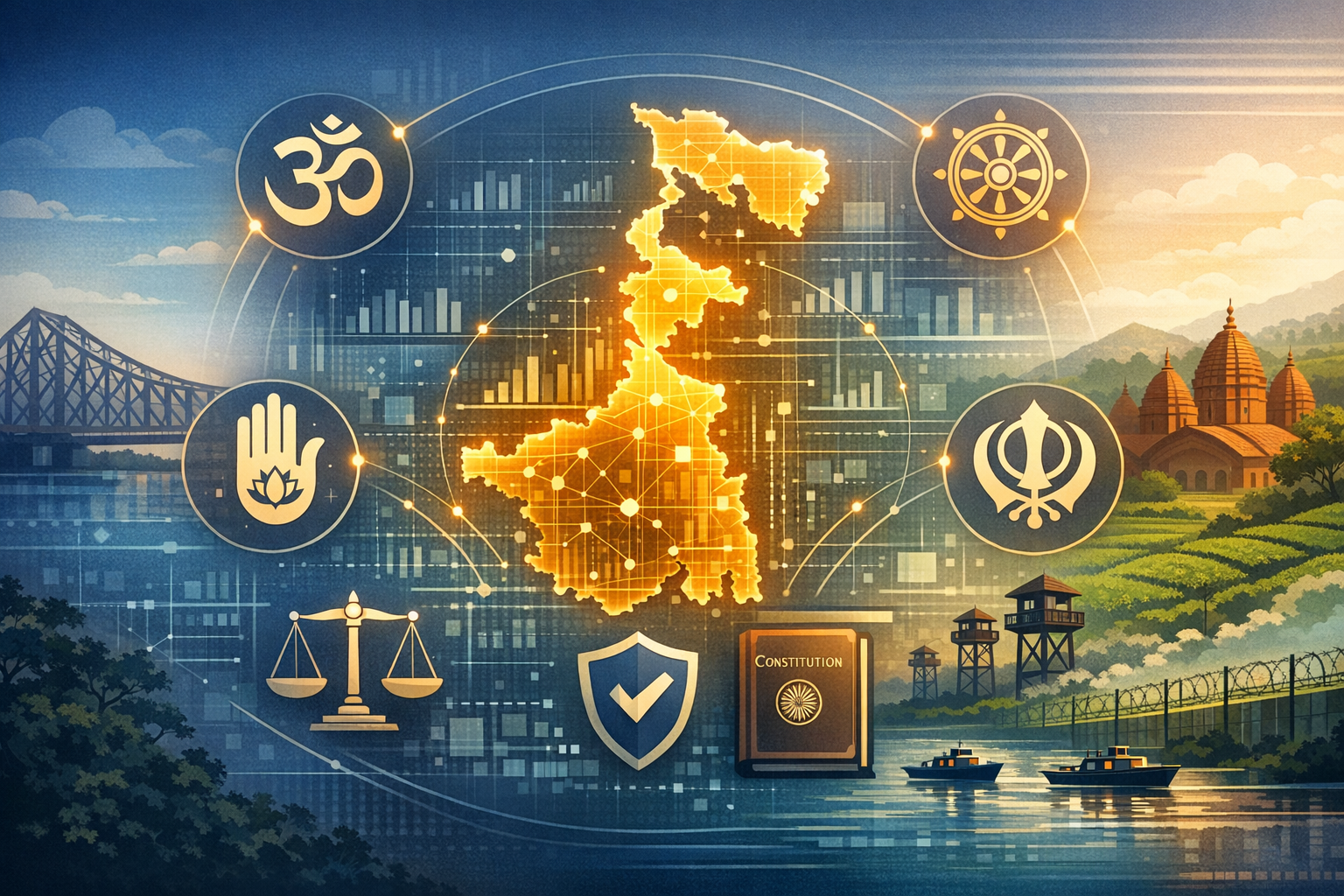
At a press interaction in Shimla on 1 May 2026, Vishwa Hindu Parishad (VHP) central secretary general Milind Parande asserted that a future BJP government in West Bengal would “work in Hindus’ interest.” The briefing foregrounded two recurrent themes in West Bengal’s public discoursecommunity security and demographic change along the India–Bangladesh borderwhile situating them within the fast-approaching WB Assembly Election 2026. The remarks invite a careful, evidence-led examination of what safeguarding “Hindu interest” can mean within India’s constitutional architecture and how that objective can align with dharmic unity across Hindu, Buddhist, Jain, and Sikh communities.
Placed in political context, the statement functions as both a programmatic signal and a mobilizational cue. It engages a long-running set of issues in West Bengal: cross-border vulnerabilities, law-and-order management, rights of religious communities to practice and manage their institutions, and the socio-economic stability of border districts. Observers of West Bengal’s electoral landscape note that such themes tend to shape issue salience, cadre mobilization, and turnout dynamics, particularly in districts abutting international borders and in rapidly urbanizing belts.
Interpreted through a constitutional lens, “working in Hindus’ interest” must be coextensive with the guarantees of Articles 14–15 and 25–30 of the Constitution of India: equality before law, non-discrimination, and freedom of conscience and religion. Within this framework, public safety, fair access to justice, and the protection of religious and cultural institutions are legitimate state aimsprovided they are pursued through neutral, rights-respecting instruments that strengthen security and social cohesion for all citizens, including Buddhists, Jains, and Sikhs who share India’s broader dharmic civilizational matrix. In this sense, dharmic unity and constitutionalism are not competing priorities but mutually reinforcing guardrails.
Security formed a central pillar of the Shimla briefing. West Bengal’s approximately 2,200-km land and riverine boundary with Bangladesh presents a complex operational environment for policing, customs, and border management. Effective strategies here historically combine three layers: robust inter-agency coordination (state police, Border Security Force, intelligence units, and coastal/riverine authorities), community-centered policing that builds trust with local populations, and targeted action against organized smuggling networks that can exacerbate local crime and social tension. Good practice globally emphasizes transparent oversight, due process, and human-rights–compliant operations, which in turn enhance public cooperation and the evidentiary quality of prosecutions.
Demography and irregular migration were referenced as additional points of concern. District-level religious composition in West Bengal has historically shown considerable variation (as reflected in Census 2011), and the state’s proximity to an international border has long shaped migration patterns. When demographic change is alleged or perceived, policy design benefits from rigorous, disaggregated data; cross-verified administrative records; and independent social-science fieldwork. Transparent publication of such data, coupled with institutionalized community consultations, reduces rumor-driven polarization and focuses attention on lawful documentation, service delivery, and neighborhood safety.
Documentation and citizenship administration are closely connected to these debates. Following the notification of rules under the Citizenship (Amendment) Act in 2024, administrative clarity, legal aid, and accessible grievance redressal have become essential to ensure that documentation processes remain humane, transparent, and non-discriminatory. International experience suggests that predictable timelines, multilingual assistance in border districts, and independent appellate review reduce error rates and enhance trust, particularly for vulnerable households who may lack legacy documents. Due process protects both community security and individual dignity.
Institutional governance of religious endowmentsanother topic that often features in VHP’s policy advocacycan be addressed without undermining constitutional equality or inter-communal harmony. Jurisprudence such as Commissioner, Hindu Religious Endowments, Madras v. Shirur Mutt (1954) recognized the autonomy of religious denominations in essential matters, even as states retain a role in safeguarding property, preventing mismanagement, and conserving heritage. A constructive reform path in West Bengal would emphasize transparent audits, professional conservation of temple architecture and artifacts, non-intrusive oversight against financial impropriety, and community participation in management bodies. These principles, when applied consistently and lawfully, can support the legitimate aspirations of devotees while respecting the plural and shared nature of dharmic heritage.
Dharmic unity provides a stabilizing normative core to these policy questions. Historically, Hindu, Buddhist, Jain, and Sikh traditions have coexisted across eastern India, sharing pilgrimage circuits, artisan lineages, and philosophical cross-pollination. In practice, a unity-first approach translates into: focusing security policy on behavior (crime and violence) rather than identity; prioritizing heritage and educational initiatives that highlight shared ethics (ahimsa, dana, sewa, karuna); and strengthening local dispute-resolution forums that de-escalate tensions before they harden into communal fault lines. Such measures anchor “majority welfare” not as zero-sum advantage but as a wider public goodsafety, justice, and dignityfor all dharmic communities and neighbors beyond.
Electoral implications for WB Assembly Election 2026 are significant yet should be read carefully. Issue salience around border security and demographic change can vary between North and South Bengal, between industrial towns and agrarian tracts, and across communities with different migration histories. Empirically grounded strategies therefore privilege district-specific diagnostics over one-size-fits-all messaging. This includes tailoring law-and-order deployment to local crime profiles, aligning welfare delivery with ground realities in border blocks, and building civic partnerships with credible community institutions that can sustain social peace during contentious political periods.
A governance pathway consistent with constitutional norms would likely include: time-bound modernization of police stations in border districts; integrated case management that links First Information Reports, forensic labs, and fast-track courts for serious offenses; public dashboards that publish anonymized border-crime and adjudication statistics; expanded victim-support services; professionalized heritage management for temples and related endowments; and civic education that underscores rights and duties under Articles 14–30. In addition, regular, good-faith dialogues with Hindu, Buddhist, Jain, and Sikh representatives can institutionalize dharmic unity as a standing principle of policy formation rather than a periodic campaign theme.
Safeguards against polarization are essential. Clear ministerial standard operating procedures on crowd control and hate-speech response, third-party social audits of welfare schemes in mixed localities, and community early-warning mechanisms reduce the risk of escalation. Likewise, disinformation containmentthrough rapid fact-checking and coordinated public communicationprotects citizens from rumor cycles that often accompany border incidents or sensitive criminal cases. These measures are not merely procedural; they are the institutional expression of equal respect for every dharmic path and the shared civic project of West Bengal.
In sum, the Shimla remarks by Milind Parande spotlight unresolved questions at the intersection of security, demography, and religious-institution governance in West Bengal. Addressed within the discipline of India’s Constitution, these questions can be converted from sites of contestation into platforms for durable social peace and growth. If pursued with transparency, due process, and an explicit commitment to dharmic unity, the promise to work in “Hindus’ interest” can converge with the broader objective of safeguarding rights, dignity, and opportunity for all who inhabit Bengal’s plural public sphere.
Note on method and scope: This analysis synthesizes publicly available legal and policy frameworks and situates the reported Shimla press interaction within those standards. Where specific empirical claims (e.g., migration volumes or crime trends) are often contested, the emphasis here is on process integritydata transparency, lawful administration, and rights-consistent enforcementas the most reliable pathway to both community security and social cohesion.
Inspired by this post on Struggle for Hindu Existence.
