

You did the right thing and nothing improved. Someone else caused harm and seems to prosper. If karma is real, the delay can look like evidence that dharma does not work – or that your present pain must be payment for an unknowable past. Neither conclusion follows.
The direct answer is that karma created in this life can bear fruit now, later in this life, or in a future birth. There is no single waiting period. The more useful question is not simply, “When will I get the result?” It is, “What conditions let this action ripen, what tendency is it forming in me, and what remains within my power now?”
Karma is not a queue in which one lifetime waits behind another

A common Hindu classification separates karma into three relationships with time:
- Sanchita karma is the accumulated field of karmic potential from many lives.
- Prarabdha karma is the portion already ripening as the given conditions of this life, including birth circumstances and inborn endowments.
- Agami or kriyamana karma is being formed through your present choices.
These categories do not mean that everything you do today is placed at the back of a cosmic line. An action performed this morning can affect your mind, reputation, relationships, and surroundings before nightfall, even while older conditions continue to unfold. Present experience can therefore contain the effects of past action and the beginning of new effects at the same time.
Another distinction separates drsta-phala, an observable result, from adrsta-phala, a result that remains unseen or delayed. Mimamsa uses the idea of apurva to account for an action’s non-immediate potency, while Nyaya-Vaisheshika speaks of adrsta as a non-obvious causal link. The terms differ, but both resist the assumption that every morally relevant effect must be visible at the moment of action.
This is also why karmic fruits may appear immediately, develop over time, or wait for a later embodiment. Yoga Sutra 2.12-2.14 describes a karmic store rooted in affliction whose results emerge under suitable conditions. Yoga Sutra 4.8 adds that the tendencies compatible with a particular field of experience become manifest there. A karmic seed is therefore not a dated appointment. It is a potential whose fruition depends upon conditions.
Prarabdha names what is already in motion; purushartha names meaningful human effort within that situation. The terrain may be given, but your next step is not. Some conditions will persist despite sincere effort. Your response can still lessen harm, strengthen discernment, repair relationships, and shape agami karma. That is enough to reject fatalism.
Key takeaways
- This life’s karma does not have one fixed date of fruition; it can ripen immediately, gradually, or beyond this life.
- Time alone does not trigger a result. Intention, repetition, intensity, context, and enabling conditions all matter.
- A pleasant present does not prove virtue, and hardship does not prove guilt. You cannot reconstruct a person’s moral history from one visible circumstance.
- The practical purpose of karma is to improve the action available now, not to predict when the cosmos will reward you.
Three time horizons help you notice fruit without inventing a verdict

Calling these horizons “clocks” is convenient, but no countdown is implied. A new deed may bear fruit quickly, while an old potential may remain dormant until a matching situation appears. Use the horizons to examine consequences, not to calculate a spiritual payment date.
| Horizon | What it can look like | What you should do |
|---|---|---|
| Immediate and visible | Truthful or deceptive speech affects trust; cruelty or restraint changes the mental state in which you continue acting. | Notice the result without treating it as the complete fruit of the deed. Correct concrete harm promptly. |
| Cumulative within this life | Repeated conduct becomes habit, reputation, social capital, and a durable samskara or vasana. Sustained habits can also influence bodily well-being, although illness is never proof of moral failure. | Examine patterns rather than defending each incident as an exception. Change the conditions that permit repetition. |
| Deferred or unseen | A karmic potential lacks the conditions needed to mature and may ripen much later or in a future embodiment. | Do not assign it a date, use it to explain another person’s suffering, or assume that an invisible result gives you secret knowledge. |
Several factors affect which horizon applies. They are better used as questions for self-examination than as a formula:
- Intention or bhava: What were you actually trying to produce? An accident and a deliberate injury do not carry the same moral quality, although accidental harm can still require repair.
- Intensity: Was the choice casual, deeply willed, or made under a powerful emotion? A highly charged act can form a stronger impression than many minor gestures.
- Repetition or abhyasa: Is this a single lapse or a cultivated pattern? Repetition turns conduct into character and makes the next similar action easier.
- Reach: Who benefited or suffered, and how far did the effect spread? Conduct affecting a family, institution, community, or ecosystem can continue through many participants.
- Desa, kala, and patra: Place, time, and recipient change the field in which an action operates. The same outward gesture can have a different meaning and consequence in a different context.
- Understanding or jnana: What did you know, and what are you now willing to see? Greater understanding can change both the quality of the next action and your relationship to old tendencies.
Intention matters, but it does not magically cancel impact. If you meant well and still caused harm, acknowledge both facts. Repair the effect you can verify, then learn enough to act differently. Conversely, an outwardly useful deed performed for vanity may still help its recipient while reinforcing attachment in the doer. Karma is subtle because an action can have interpersonal, social, psychological, and spiritual effects on different schedules.
Causation is also networked. Families, institutions, societies, and ecosystems carry the effects of many people’s choices. You can suffer from a structure you did not individually create, and you can benefit from sacrifices you did not personally make. This does not abolish individual responsibility. It expands responsibility to include the systems your present conduct supports, reforms, or leaves unchallenged.
What is transmitted across lives depends on the tradition

Hinduism, Buddhism, Jainism, and Sikhism all preserve moral continuity beyond a single visible moment, but they do not describe the bearer of that continuity in the same way. Respecting those differences prevents a vague idea of “karma” from replacing the teachings themselves.
Hindu traditions: karmic potential and samskara
In the common sanchita-prarabdha-agami framework, karmic potential accumulated through volitional action conditions present and future embodiment. Repeated actions leave samskaras and vasanas: impressions and tendencies that incline perception, desire, and conduct. What continues is not limited to conscious autobiographical memory. A tendency can remain operative without your remembering the act that formed it.
This is why liberation cannot be reduced to collecting pleasant outcomes. Karma Yoga seeks action without possessive attachment to its fruit. Bhakti reorients agency through devotion, jnana exposes mistaken identification, and dhyana steadies the mind that otherwise repeats its conditioning. Bhagavad Gita 4.17 warns that action, inaction, and wrong action are difficult to discern. Bhagavad Gita 4.37 then uses the image of knowledge as fire reducing karma to ash. Knowledge here is transformative seeing, not information stored while conduct remains unchanged.
Buddhism: causal continuity without an eternal self
Buddhist accounts explain karma-vipaka through dependent origination rather than an eternal, unchanging soul. Intention conditions later experience within a continuing causal process. Yogacara language describes karmic bijas, or seeds, whose fruition depends upon supporting conditions. The doctrine of anatta means that causal continuity should not be mistaken for an immortal personal essence moving unchanged from life to life.
The practical response is sila, samadhi, and panna: ethical discipline, collected awareness, and insight. You interrupt transmission by removing the ignorance, craving, and habitual reaction that keep producing the next unwholesome condition.
Jainism: bondage, fruition, restraint, and shedding
Jain philosophy gives karma a distinctive account as subtle karmic matter, or pudgala, that binds to the soul. Bandha names bondage, upashama subsidence, and udaya fruition. Vows, disciplined conduct, tapas, and pratikraman restrain new influx, confront wrongdoing, and support the shedding of bondage.
Anekantavada adds an important discipline to any discussion of timing: reality has many aspects, and your present viewpoint is not exhaustive. That humility should make you more exacting about your own conduct and less confident when judging another person’s fate.
Sikhism: karma within hukam and nadar
Sikh teaching acknowledges karma’s influence on birth and experience while refusing to make liberation a piece of moral bookkeeping. Life unfolds within hukam, the divine order, and liberation depends upon nadar, divine grace. Seva and simran unite responsibility with surrender: you serve without self-importance and remember the Divine rather than obsessing over your personal karmic balance.
These traditions overlap in ethical seriousness, but their metaphysics should not be blended casually. If you follow a particular sampradaya or path, let its full discipline guide you. Do not borrow a comforting fragment from one tradition to avoid a demanding practice in another. The shared practical point is narrower and stronger: what you repeatedly intend and do matters, and present practice remains meaningful even when fruition is delayed.
Use karmic teaching to govern your conduct, not judge a sufferer
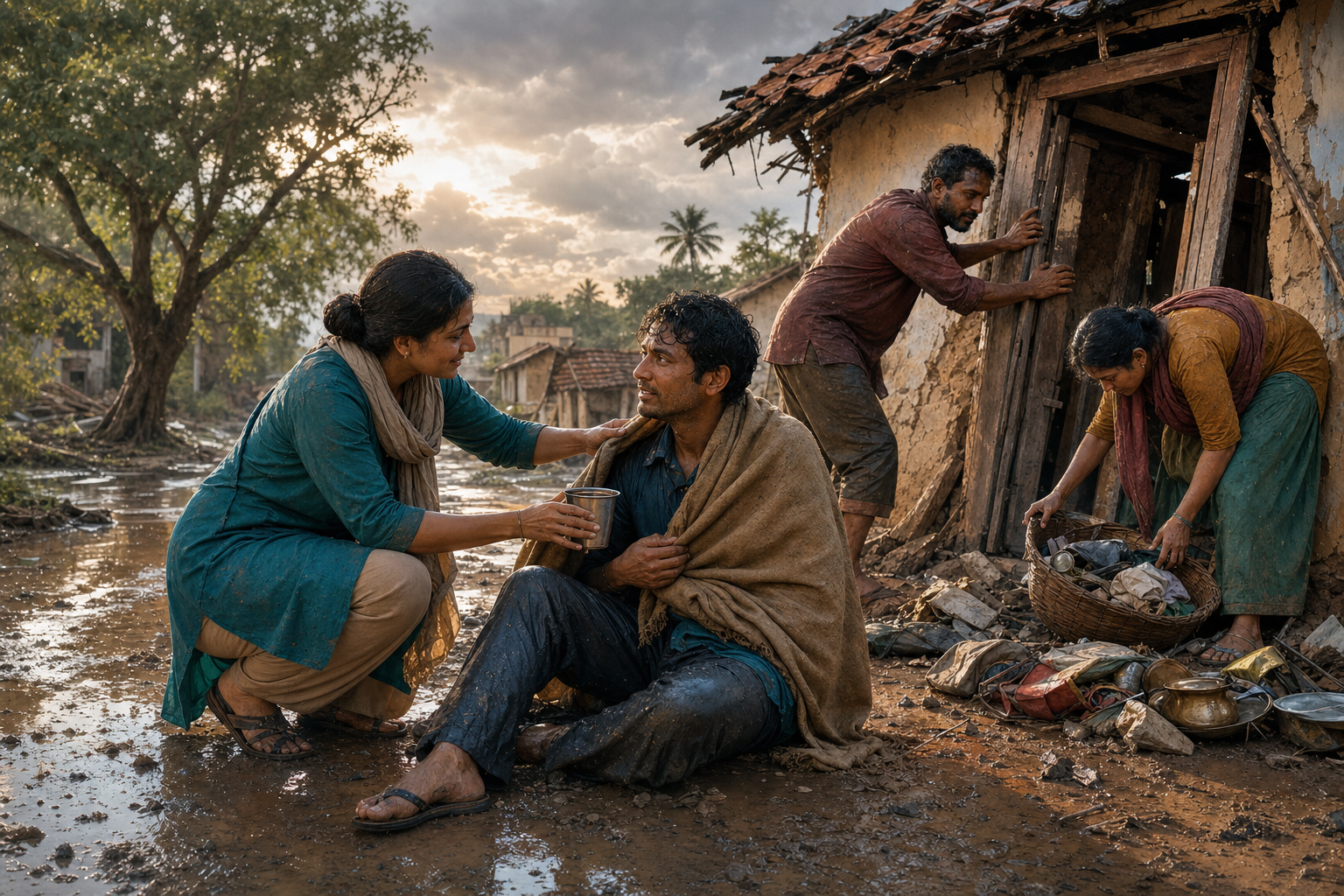
The safest grammatical rule for discussing karma is simple: use it first in the first person. Ask, “What am I creating now?” Do not begin with, “What must you have done to deserve this?”
Visible circumstances do not reveal a complete karmic history. You cannot know which causes are ripening, how individual and collective conditions interact, or what inner freedom a person may be cultivating during hardship. Wealth is not a certificate of righteousness. Illness, poverty, violence, disability, or bereavement is not evidence that a victim deserves less care.
When someone is suffering, respond in this order:
- Reduce the immediate harm where you safely can.
- Listen to what the person actually needs instead of supplying a metaphysical explanation.
- Name present causes that can be verified, including abusive conduct, institutional failure, economic pressure, or environmental damage.
- Support repair, protection, justice, and seva.
- Discuss karmic interpretation only when it is welcome, and use it to preserve agency rather than assign blame.
This order is not a retreat from karmic law. Compassion is itself action, and indifference also forms consequences. Ahimsa requires you to stop avoidable harm. Satya requires you to identify real present causes. Seva requires useful assistance. Dharma therefore includes both personal discipline and the reform of harmful collective conditions.
The same restraint applies to your own pain. You do not need to invent a past-life offense before seeking help, setting a boundary, reporting abuse, obtaining treatment, or correcting an injustice. A karmic framework should deepen responsible action in the present. If it persuades you to remain passive before preventable harm, it has been misapplied.
Work with karma now instead of bargaining for a future reward
You do not need certainty about an action’s ultimate fruit before correcting its visible direction. Use this examination after a consequential choice, a conflict, or a recurring lapse:
- State what happened without self-protection. Describe the action, the person affected, and the observable result. Leave past lives and cosmic explanations out of this first account.
- Examine bhava. Ask what you wanted, what you feared, what you knew, and what you chose not to know. Distinguish intention from impact without using either to erase the other.
- Look for the fruit already present. Notice changes in your mind, relationships, habits, reputation, and surroundings. Immediate discomfort may be a signal to repair, not the whole karmic consequence.
- Repair the concrete harm. Correct the false statement, return what is not yours, apologize without demanding forgiveness, restore what can be restored, and accept a fair consequence. Prayaschitta is incomplete when remorse never becomes changed conduct.
- Install a counter-practice. Meet harsh speech with truthful restraint, grasping with dana, neglect with seva, confusion with svadhyaya, and habitual reaction with meditation. Jain practitioners may use pratikraman and vows; Buddhist practitioners the precepts and mindful insight; Sikh practitioners seva and simran; Hindu practitioners Karma Yoga, bhakti, jnana, or dhyana in accordance with their path.
- Release the demand for a timetable. Continue the right action because it is dharmic, not because you expect a visible reward on your preferred schedule. This is the discipline of non-attachment, not indifference to consequences.
Remedial practice is not a transaction that purchases immunity from consequences. Dana does not license fresh greed. Austerity does not excuse unaddressed injury. Prayer does not replace an apology. Grace does not make effort unnecessary. The reliable test is whether the practice reduces the tendency that produced the harmful action and increases your capacity for truthful, compassionate conduct.
At your next uncertain choice, replace “When will I be repaid?” with three questions: “What tendency am I strengthening? Who may bear the consequence? What action remains dharmic even if its fruit is delayed?” Then take that action, repair what is already within reach, and leave the larger timing without resentment.