
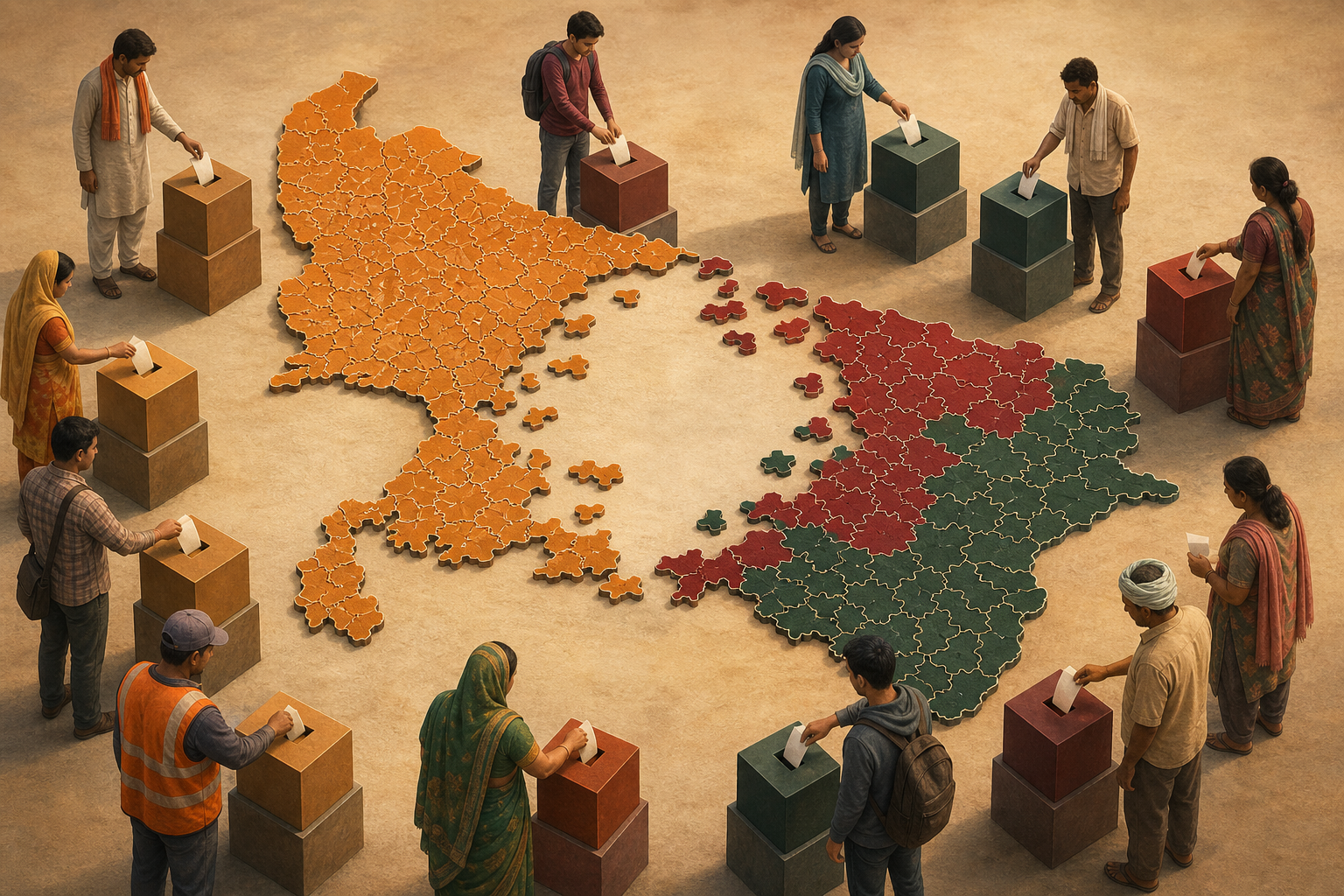
Uttar Pradesh’s 2027 election is better understood as a contest to assemble a majority constituency by constituency than as a single statewide duel between Yogi Adityanath and Akhilesh Yadav. Leadership will matter, but it will operate through candidates, alliances, social coalitions, local organization and voters’ experience of government.
The supplied DharmaRenaissance analysis frames this challenge as a possible “150 vs 150” contest. The figure is not presented as a poll prediction. Its analytical value lies in showing how far both principal blocs could still be from power even after securing a large foundation of competitive seats.
Key takeaways
- The “150 vs 150” formulation describes potential starting blocs of competitive constituencies, not guaranteed victories.
- With 403 elected Assembly seats and 202 needed for a majority, a bloc beginning at 150 would still require about 52 additional wins.
- The source-reported 2024 Lok Sabha result gives the Samajwadi Party a significant opening, but parliamentary performance cannot be transferred mechanically to an Assembly election.
- The decisive variables are likely to include candidate quality, alliance vote transfer, regional concerns, cadre participation, public-service delivery and the geographic efficiency of each bloc’s vote.
A 150-seat foundation is neither safe nor sufficient

The arithmetic reveals the scale of the unfinished contest. The source notes that Uttar Pradesh has 403 elected Assembly constituencies and that 202 seats are required for a majority. If each leading camp possesses an initial advantage in approximately 150 constituencies, 103 seats remain outside those notional columns. A party starting at 150 must find roughly 52 more victories to govern on its own.
That does not mean all 300 foundational seats are already settled. In the framework used by the source, a base seat is a constituency in which a party has a viable starting coalition because of earlier results, social support, an alliance network or local organization. It is not necessarily a safe seat. An unpopular nominee, an alliance rebel, weak worker participation or a comparatively small shift in votes can reverse the apparent advantage.
The remaining constituencies therefore perform two roles. They are the most visible route from a large base to a majority, but they can also compensate for losses inside that base. A bloc that gains 52 marginal seats while unexpectedly surrendering 15 presumed strongholds has not completed the journey from 150 to 202. The relevant calculation is consequently net movement across the entire map, not merely success in a predetermined list of battlegrounds.
This is also why statewide vote share can mislead. In a constituency-based plurality contest, additional votes concentrated in seats already won comfortably may produce few new legislators. A smaller but well-distributed shift across close contests can be more consequential. Organization must turn social support into turnout in the places where another few votes can change the winner.
Three election results point in different directions
The historical figures reported by the supplied article do not create a straight-line forecast. Instead, they establish three distinct lessons: the BJP’s high ceiling in 2017, its reduced but durable Assembly majority in 2022, and the opposition’s parliamentary breakthrough in 2024.
| Election | Source-reported Uttar Pradesh result | What it contributes to the 2027 calculation |
|---|---|---|
| 2017 Assembly | BJP: 312 seats; wider NDA: 325 | Shows the scale once achieved by a broad BJP-led coalition, but not a result that can be assumed as the current baseline. |
| 2022 Assembly | BJP: 255; NDA: 273. SP: 111; SP and its then-allies: 125 | Shows continued BJP strength alongside substantial SP recovery, leaving the challenger well short of government. |
| 2024 Lok Sabha | SP: 37; BJP: 33; Congress: 6; RLD: 2; Apna Dal (Soneylal): 1; Azad Samaj Party (Kanshi Ram): 1 | Establishes opposition momentum and BJP vulnerabilities, while measuring a parliamentary rather than an Assembly contest. |
The comparison places both complacency and inevitability out of reach. The BJP retained power in 2022 despite losing much of its 2017 seat abundance. The SP became the principal challenger but did not approach the majority threshold. According to the source, the SP-Congress combination then emerged as Uttar Pradesh’s largest parliamentary formation in 2024, making that verdict a warning for the BJP and an opportunity for the opposition.
Yet the three results are not interchangeable. The first two selected a state government; the third was a national election conducted through larger parliamentary constituencies. As the source observes, an Assembly campaign gives greater weight to the local nominee, factional disputes, district administration, municipal services and access to an MLA. Alliance voters may also respond differently when the office at stake changes. The 2024 result is therefore evidence about political capacity, not a certificate for 2027.
Regional variation will reshape the statewide contest

The source’s regional survey suggests that Uttar Pradesh should be treated as several connected electoral arenas. The same statewide message can encounter different social alignments and policy priorities as it moves from the west to Rohilkhand, Awadh, Purvanchal, Bundelkhand and the major cities.
In western Uttar Pradesh, the reported equation includes agrarian concerns, Jat politics, a substantial Muslim electorate, Dalit communities and fast-growing urban districts. The RLD’s place in the NDA gives the BJP-led camp an organizational bridge, but its electoral value will depend on actual vote transfer. The source identifies sugarcane payments, farm costs, land acquisition, employment, law and order and civic pressure in the National Capital Region as issues capable of influencing local contests.
Rohilkhand presents a different combination involving Muslim voters, non-Yadav OBC groups, Dalits and upper castes. Awadh and central Uttar Pradesh contain competitive networks among Kurmis, Pasis, Yadavs, Brahmins and smaller communities. These descriptions should not be treated as fixed voting instructions for entire communities; they identify the coalitions that parties must negotiate through representation, candidates and local performance.
Purvanchal combines Yogi Adityanath’s personal influence with the local importance attributed by the source to Apna Dal (Soneylal), the NISHAD Party and SBSP. Bundelkhand may place greater emphasis on water security, agricultural stress, migration and infrastructure. In the urban belt, jobs, housing, transport, pollution, policing and municipal administration are more likely to test whether broad political approval survives everyday encounters with the state.
This geographic diversity makes candidate selection part of the arithmetic rather than a secondary campaign decision. A nominee capable of combining an alliance’s social components in one district may not be transferable to another. Likewise, a statewide welfare or law-and-order claim can be strengthened or weakened by highly local experiences of delivery.
How each camp can convert support into seats
For the BJP-led camp, the central question is whether incumbency, leadership appeal, welfare support, allies and a large booth network can operate as one constituency-level system. The source reports that national president Nitin Nabin’s July 2026 visit to Lucknow included meetings spanning the chief minister, deputy chief ministers, party office-bearers, district leaders, Shakti Kendra conveners and booth workers. It interprets that breadth as evidence of an organizational review reaching from senior coordination to the campaign’s smallest operational units.
The same article reports the appointment of Kurmi leader Pankaj Chaudhary as state BJP president and reads the restructured state organization as an effort to reinforce non-Yadav OBC representation while retaining other social and regional components. Numerical representation in party posts, however, is only an input. Its electoral effect depends on whether those leaders possess authority, workers believe they are heard and voters see resources and administrative responsiveness reaching their localities.
For the SP-led opposition, the 2024 performance raises a different conversion problem. The source credits a wider distribution of candidates and the PDA formulation – Pichhda, Dalit and Alpsankhyak – with helping validate a broader coalition. The implication for 2027 is that symbolic breadth must be reproduced through Assembly-level nominations, compatible allies and credible local organizations across hundreds of separate contests. Parliamentary momentum can open constituencies, but it cannot choose suitable Assembly candidates or prevent local alliance friction.
Both camps therefore face the same final test from opposite directions. The incumbent must prevent organizational and social erosion from turning strong seats into marginals. The challenger must turn dissatisfaction and coalition breadth into net seat gains without concentrating support inefficiently. Rebels, weak vote transfer and poor candidate choices can undermine either project even when its statewide narrative appears favourable.
As candidate selection and alliance arrangements take shape, the most useful indicators will be found below the headline contest: which local disputes are resolved, where partners can transfer votes, whether workers remain engaged and whether governance concerns receive visible answers. Those developments will determine whether either notional 150-seat foundation becomes a route to 202 or merely the starting point of another incomplete coalition.