
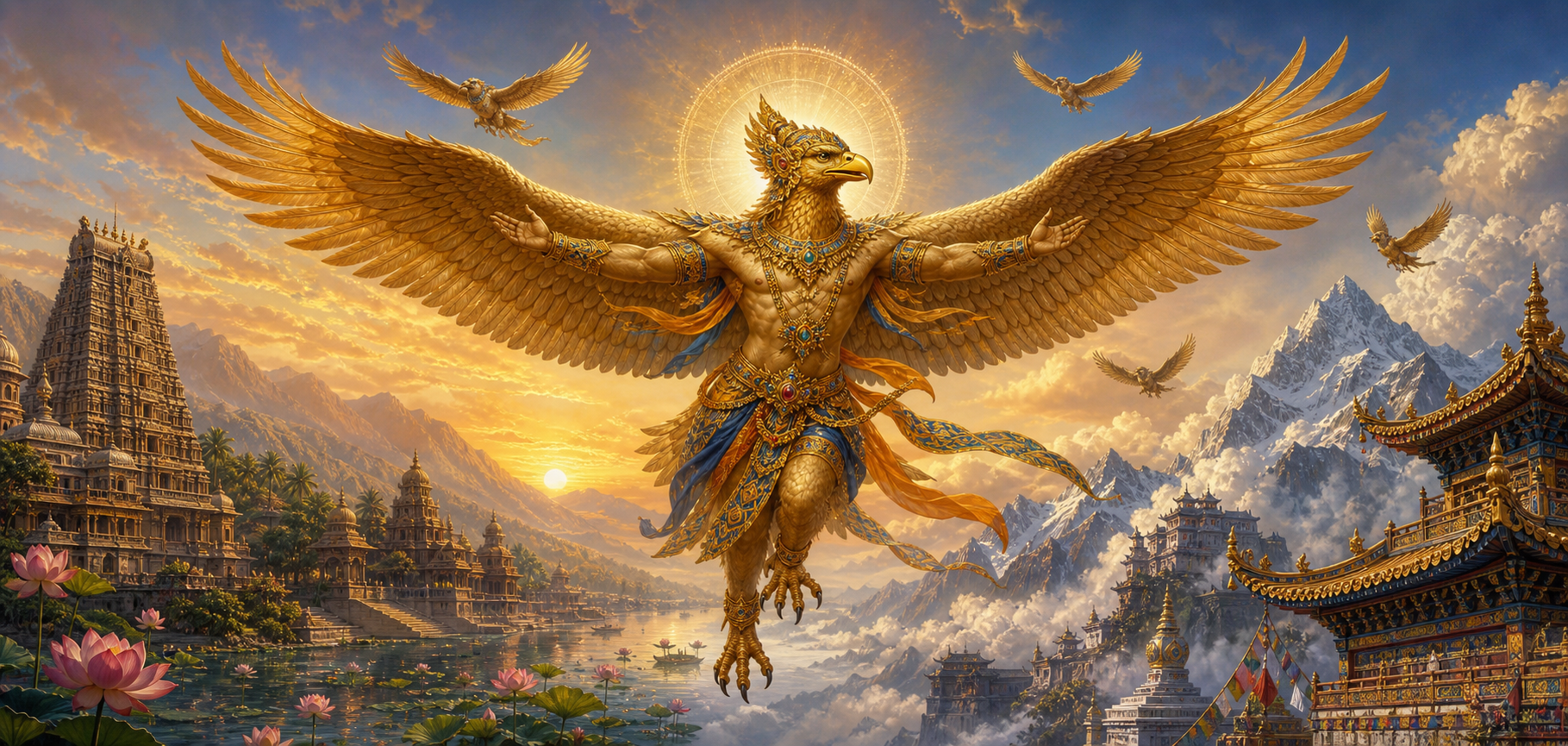
Garuda is recognizable across Asia as an immense, radiant bird associated with extraordinary speed and power. Yet the shared image does not always represent the same kind of sacred being: Hindu traditions chiefly present Garuda as a particular divine figure and devotee of Vishnu, while Buddhist traditions also speak of garudas as a class of powerful non-human beings.
Understanding Garuda across traditions therefore requires more than matching names or appearances. The important questions concern identity, narrative purpose, religious allegiance and the ways communities discipline potentially dangerous power.
A shared sacred image with different identities
The supplied DharmaRenaissance account identifies a common visual vocabulary: enormous wings, celestial speed, golden radiance and the ability to confront serpent beings. These continuities made the bird figure adaptable across religious and cultural boundaries. They do not, however, prove that every Garuda-related image depicts one unchanged deity.
Within the Hindu material described by the source, Garuda is the son of Kashyapa and Vinata, the liberator of his mother and the chosen vehicle of Vishnu. In Buddhist cosmology, the source presents garudas more broadly as powerful beings who can be associated with protection of the Dharma. In China, that inherited imagery interacted with the indigenous Peng bird and contributed to Dapeng Jinchi Mingwang, the Golden-Winged Great Peng King of Illumination. The relationship is consequently one of transmission and transformation, not simple equivalence.
Key takeaways
- Hindu narratives center on Garuda as a distinct epic figure, exemplary devotee and mount of Vishnu.
- Buddhist traditions can treat garudas as a category of formidable non-human beings rather than only as one divine personality.
- The conflict with nagas expresses kinship, rivalry and the regulation of power, not a universal opposition between good birds and evil serpents.
- Dapeng Jinchi Mingwang preserves connections with Indian garuda traditions while reflecting Chinese cosmology, symbolism, ritual and literature.
The Hindu narrative joins freedom, restraint and service
According to the source’s summary of the Mahabharata’s Adi Parva, Garuda’s defining quest begins when Vinata is enslaved after losing a wager to her sister Kadru through deception. Kadru’s children, the nagas, demand amrita, the nectar of immortality, as the price of Vinata’s release. Garuda undertakes the dangerous quest to obtain it, but he does not seek immortality for himself.
This motivation gives his strength a moral direction. Garuda overcomes the obstacles guarding the nectar while remaining focused on liberating his mother. After the vessel is placed before the nagas, Indra recovers it before they can drink. The source relates that the serpents then lick the kusa grass on which the nectar had rested, providing the narrative explanation for their split tongues.
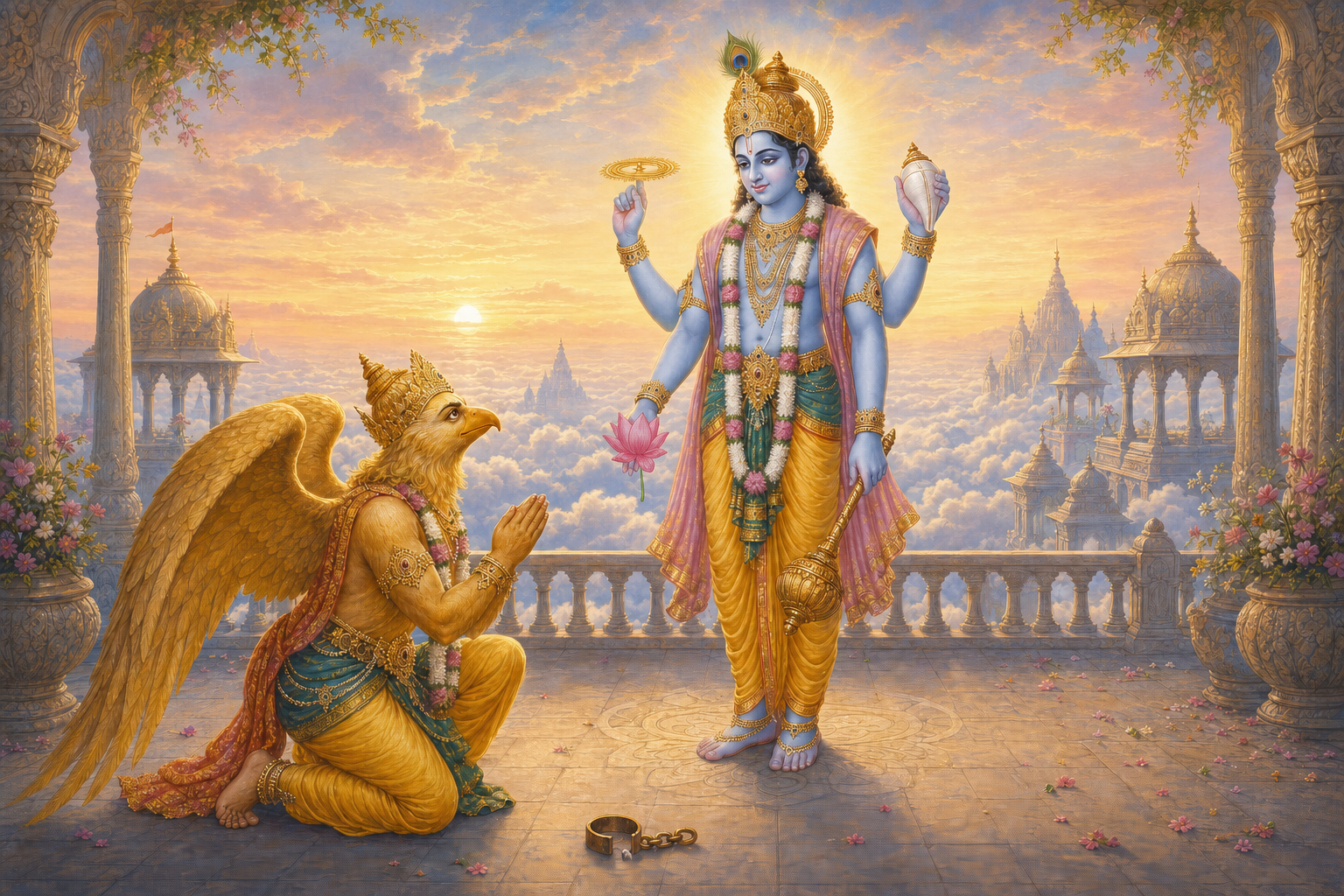
Garuda’s subsequent relationship with Vishnu develops the same theme in a different register. The source reports that Vishnu, impressed by his strength and self-restraint, grants him a boon. Garuda becomes associated with Vishnu’s banner and voluntarily accepts the role of the deity’s vehicle. His exalted status and his service are therefore complementary: devotion is represented as a freely chosen exercise of power rather than a loss of dignity.
Vaishnava iconography makes that relationship visible. Garuda may appear kneeling with joined hands before Vishnu, or flying while carrying the deity. In the Gajendramoksha theme discussed by the source, Vishnu travels on Garuda to rescue the distressed elephant Gajendra. Garuda’s speed becomes more than an impressive physical trait; it conveys the immediacy of divine response to a devotee’s appeal.
Even the familiar description of Garuda as an eagle is only approximate. The source associates him with the Sanskrit name Suparna and describes forms ranging from a colossal bird to a winged, humanlike attendant. Golden coloring can communicate luminosity, majesty and incorruptible power, while flight suggests freedom from ordinary constraint.
Buddhist adoption changes the religious framework
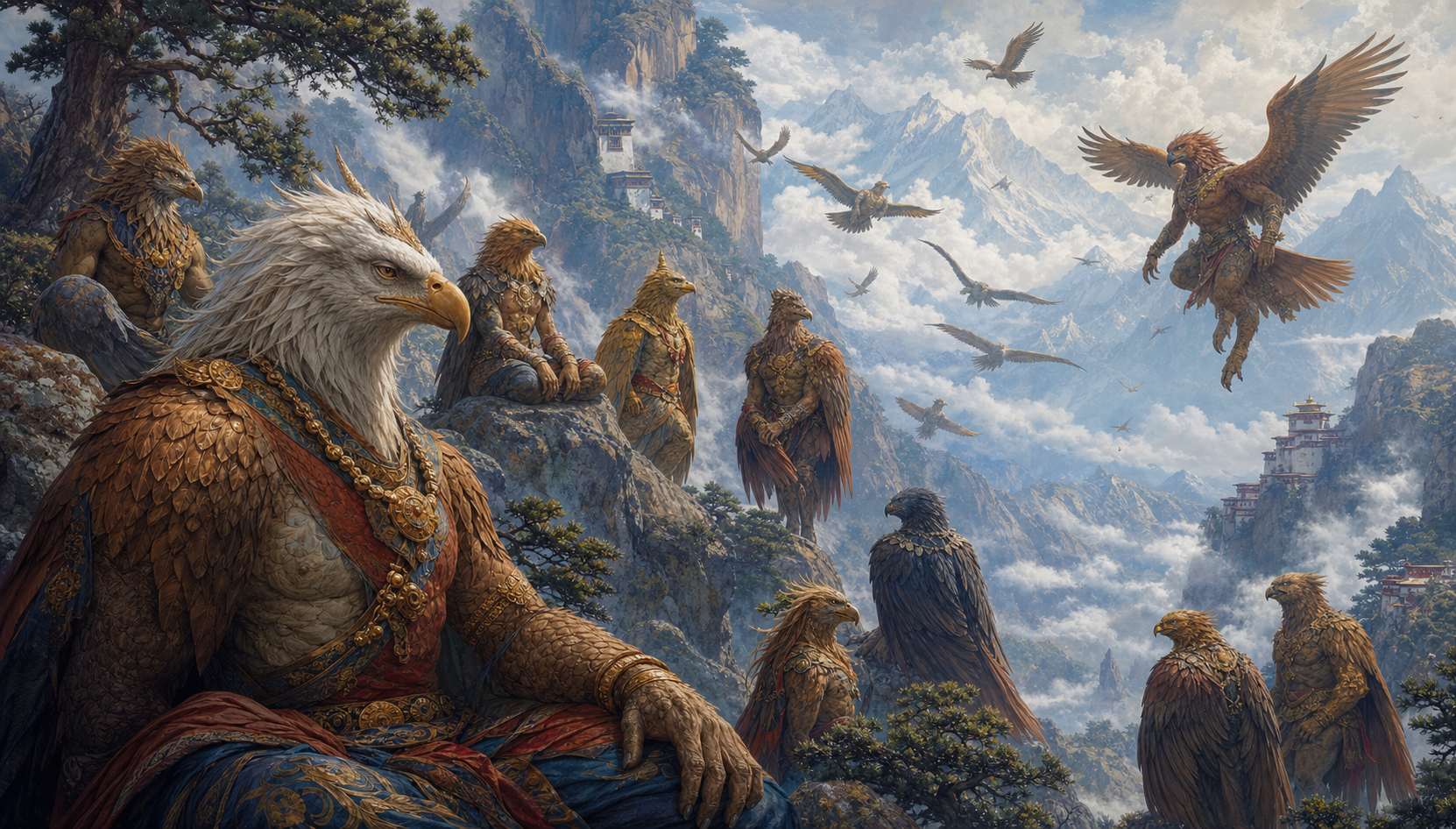
The Buddhist development is better understood as reinterpretation than as the insertion of an unchanged Hindu deity into a new pantheon. The source reports that Buddhist texts incorporated garudas into their own cosmology as powerful non-human beings, sometimes connected with guarding the Dharma. This plural identity matters: the term can designate a type of being whose members must be understood through Buddhist narratives and moral categories, rather than automatically through Garuda’s epic biography.
The continuity lies chiefly in a recognizable cluster of qualities, including aerial power, immense scale and the capacity to confront nagas. The transformation lies in what those qualities serve. A figure defined in Vaishnava settings by personal devotion to Vishnu can enter Buddhist settings as a potentially dangerous force brought into a Dharma-centered cosmos. Similar imagery thus performs different theological work.
This distinction also prevents visual resemblance from being mistaken for doctrinal identity. A winged guardian in a Buddhist context may retain signs of Indian garuda imagery without carrying every element of the Mahabharata narrative, just as a Vaishnava Garuda image need not embody later Chinese stories attached to the Great Peng.
China transformed the golden-winged guardian again
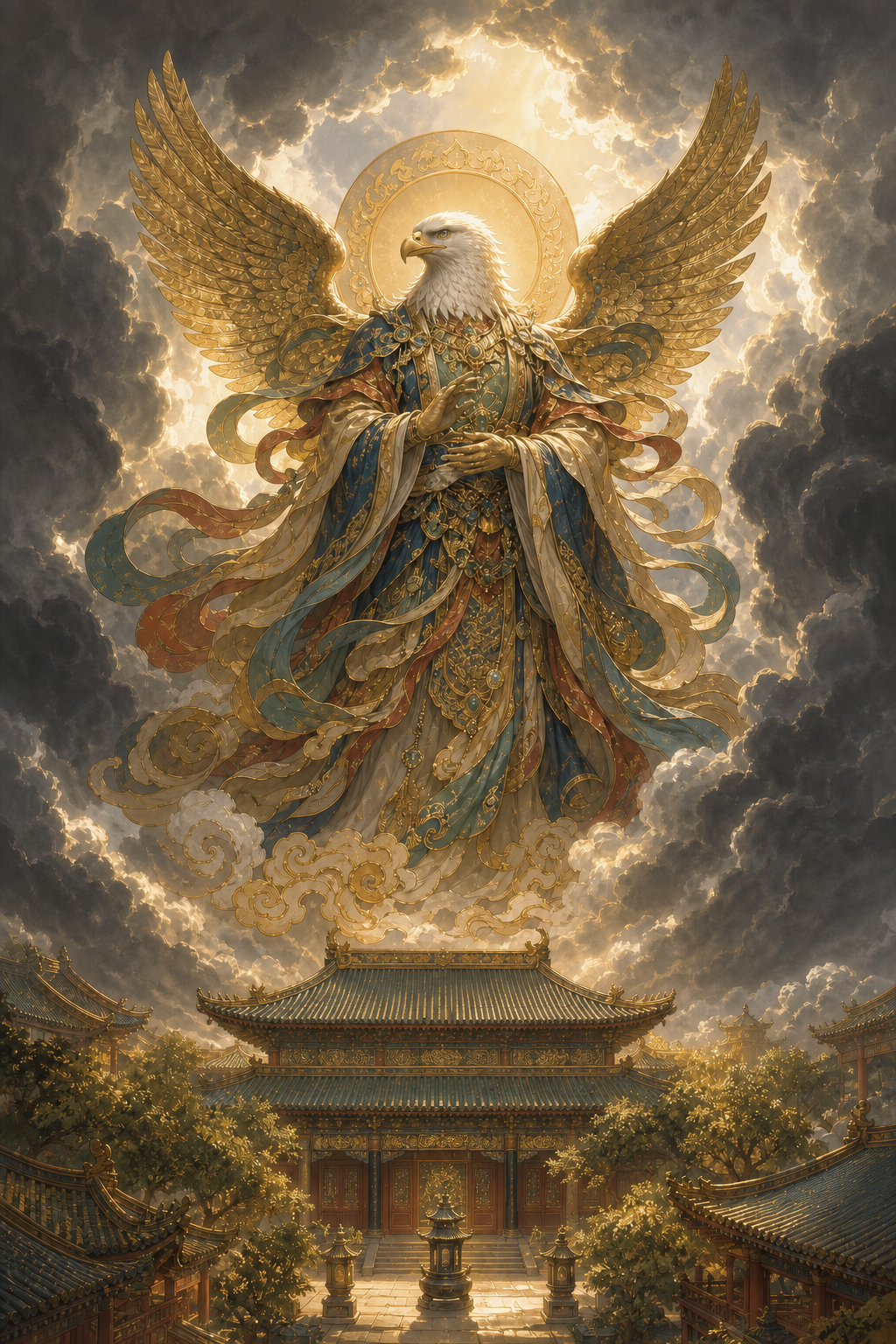
As Indian Buddhist concepts moved into China, the source explains, they encountered an existing Chinese image of the colossal Peng bird. Buddhist cosmology, Chinese bird symbolism, esoteric ritual, temple iconography and popular literature then contributed to the layered figure called Dapeng Jinchi Mingwang.
Calling Dapeng merely the Chinese name for Garuda would conceal this creative process. The figure retained the prestige of the golden-winged celestial bird while acquiring locally meaningful names, relationships, moral functions and visual forms. Neither total identity nor total separation adequately describes the result. Dapeng belongs to a history of cultural translation in which inherited sacred imagery remains recognizable while becoming embedded in a different religious environment.
This case also illustrates why transmission should not be imagined as passive copying. Communities interpret imported figures through symbols already intelligible to them. The resulting form can preserve a connection to its source while developing an identity that must be studied in its own setting.
The naga rivalry is about regulating power
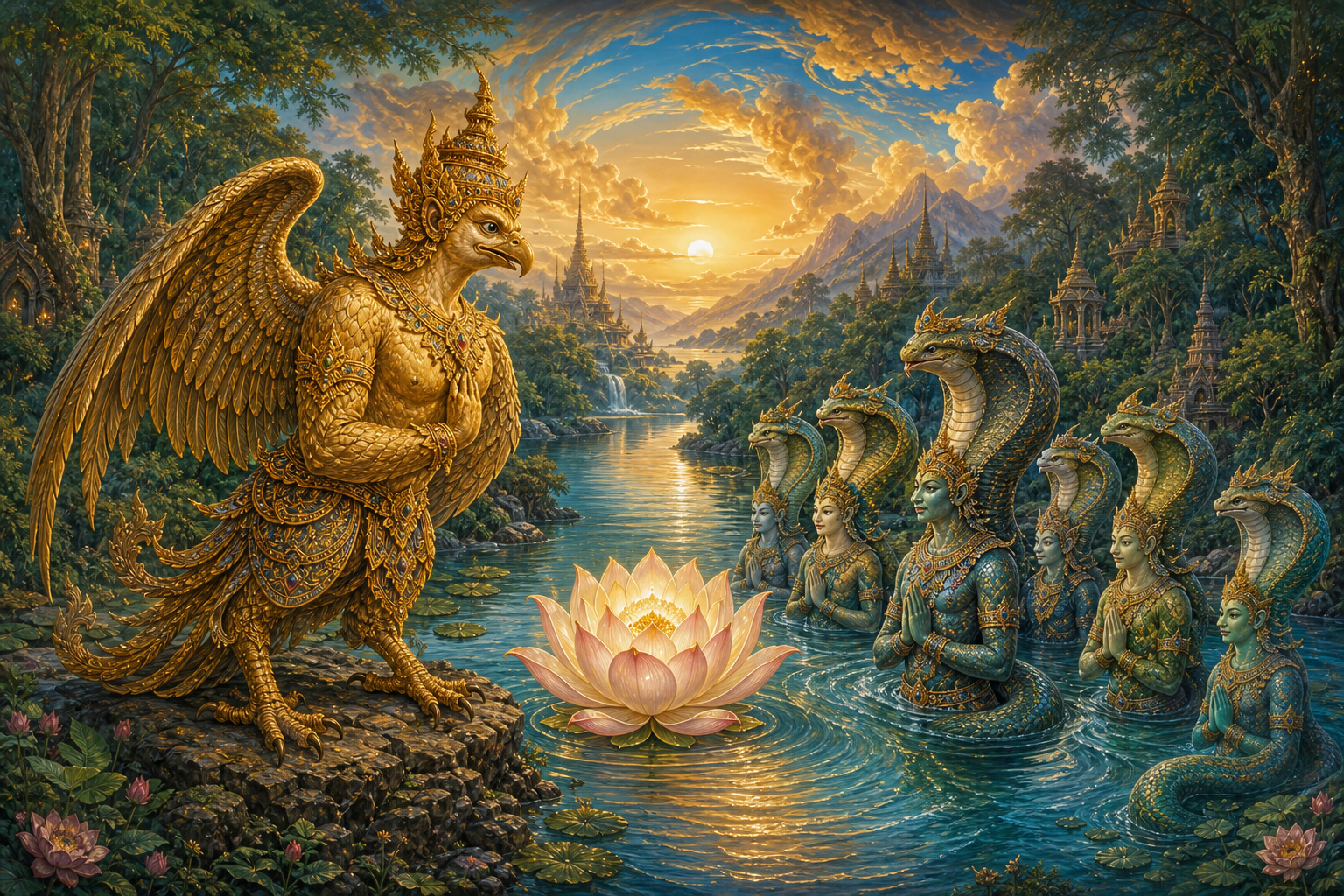
Garuda’s conflict with nagas is among the strongest links between his Hindu and Buddhist representations, but the source cautions against reducing it to a battle between absolute good and absolute evil. In the epic genealogy, Garuda and the nagas are related through their mothers, Vinata and Kadru. Their hostility emerges from a damaged family relationship involving deception and enslavement.
Nagas themselves occupy varied roles. The source points to Shesha or Ananta as Vishnu’s cosmic couch and notes that serpent beings may protect water, fertility, treasure, sacred places or teachings. Buddhist narratives likewise allow nagas to be dangerous, generous, angry or devoted. Garuda imagery showing serpents subdued can signify protection from venom, constriction and concealed danger without requiring the condemnation of every naga.
The deeper continuity is therefore ethical rather than zoological. Serpent power may protect or harm, and the tremendous appetite and force associated with garudas can also become destructive unless governed. Both traditions use these beings to explore how exceptional power is restrained, redirected and placed in the service of a sacred order.
How to compare Garuda traditions responsibly
A responsible comparison begins by asking whether a text or image concerns the individual Garuda, a class of garudas or a locally developed figure such as Dapeng Jinchi Mingwang. Its setting must then be considered: an epic account of filial liberation, a Vaishnava temple image, a Buddhist guardian context and a Chinese literary representation do not make identical claims merely because they share wings and serpents.
Attention to both continuity and difference avoids two equal distortions: isolating traditions so completely that historical transmission disappears, or merging them until their distinctive teachings become invisible. Future study of Garuda imagery across temples, texts and regional practices can build on this balanced approach, treating adaptation as evidence of sustained religious creativity.