
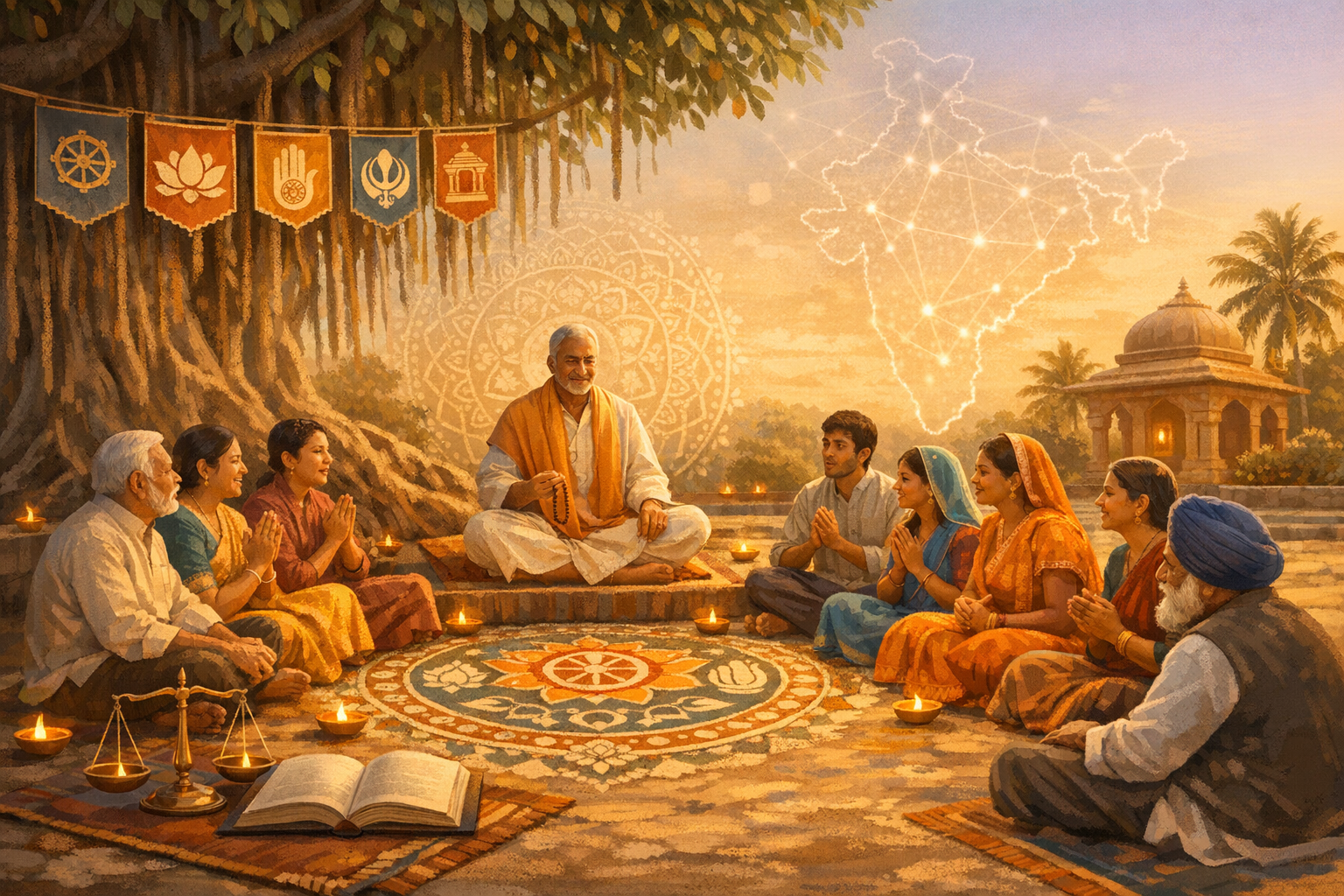
At a press conference in Goa, Advocate Alok Kumar, International President of the Vishwa Hindu Parishad (VHP), attributed the growing momentum of nationwide ‘ghar wapsi’ to the active involvement of saints and the widening spread of Dharmic awareness. The statement highlights a discernible shift: local, community-rooted spiritual leadership is increasingly shaping how families reconnect with ancestral traditions across India. Framed within India’s constitutional guarantees and Dharmic ethics, this moment invites careful analysis of the social processes, legal guardrails, and inclusive norms that sustain a voluntary, dignified return to faith.
In contemporary discourse, ‘ghar wapsi’ is best understood as a voluntary return to one’s ancestral Dharmic heritage and community practices. While often discussed in the context of Hindu traditions, the concept applies more broadly to the Dharmic familyHinduism, Buddhism, Jainism, and Sikhismeach emphasizing freedom of conscience, compassion, and service. Properly practiced, it is not an exercise in proselytization but a reaffirmation of identity, intergenerational memory, and cultural continuity underpinned by informed consent.
The Dharmic frame privileges pluralism, not uniformity. Diverse paths to realizationthrough bhakti, jñana, karma, or dhyanacoexist within a shared civilizational ethos. In this spirit, ‘ghar wapsi’ is meaningful only when it respects personal agency and the right to choose among multiple Dharmic traditions. The result is an integrative cultural renaissance rather than a sectarian realignment, aligning with the longstanding value of sarva-dharma-sambhava and the ideal of Vasudhaiva Kutumbakam.
Saints and seers function as trusted nodes of social and spiritual capital in Indian villages and towns. Their moral authority derives not from institutional power but from lived examplesimplicity, seva, scholarship, and pastoral presence. As Alok Kumar’s observation underscores, these leaders broaden access to rites, teachings, and community dialogue, translating scripture into daily practice and bringing ritual life closer to households that may have drifted from ancestral customs.
On the ground, such leadership often takes the form of open satsangs, kirtans, pravachans, and counseling that address the full arc of a family’s needsfrom samskaras and festival participation to ethical dilemmas and youth mentorship. Villagers commonly note that weekly gatherings restore a sense of collective rhythm; participation in temple clean-ups, charitable drives, and learning circles rebuilds bonds of trust. Many families describe an emotional relief that accompanies re-engagement: a return to the idioms, songs, and festive calendars of childhood that anchor belonging.
A constitutional and legal context is indispensable. Articles 25 to 28 of the Constitution of India guarantee freedom of conscience and the right freely to profess, practice, and propagate religion, subject to public order, morality, and health. Several states have enacted Freedom of Religion Acts (often referred to as anti-conversion laws) to ensure that any change of faith is free of force, fraud, or inducement, and to provide procedures for transparency and record-keeping. Ethical ‘ghar wapsi’ efforts must align with both the letter and spirit of these provisions.
Compliance is not a procedural afterthought; it is foundational. Where state laws require notices or declarations, organizers and participants should follow due process meticulously. Clear documentation, informed consent, and independent grievance redressal mechanisms reduce ambiguity and uphold dignity. Respect for privacy and data protection principles (especially regarding personal religious choices) further guard against social friction and misuse of information.
A robust ethical framework can be articulated through practical guardrails. First, voluntariness must be unequivocalno pressure, material inducements, or implicit threats. Second, informed choice requires patient teaching in the vernacular, with time for reflection and family consultation. Third, genuine pluralism means presenting the Dharmic family’s multiple pathways without disparaging other faiths or internal traditions. Fourth, documentation should be transparent, minimal, and confidential in line with legal requirements.
Fifth, community mediation mechanisms can preempt misunderstandings, especially in socially sensitive contexts. Sixth, support after re-entry is as important as the rite itselfmentorship circles, study groups, and seva networks sustain continuity. Seventh, all efforts must be inclusive across caste, gender, and region, consistent with constitutional equality. Eighth, financial transparency in associated community programs strengthens public confidence. Ninth, child and vulnerable-adult protection norms must be explicit and enforced. Tenth, interfaith civility should be cultivated through dialogue platforms that affirm peace and mutual respect.
Program design benefits from a service-first approach. A typical community pathway might begin with listening sessions that surface local needs, followed by seva initiativeshealth and hygiene camps, environmental stewardship, education support, and skill development. Contextual pedagogy then reconnects families to local festivals, temple arts, and household rituals. Where individuals choose ‘ghar wapsi’, relevant rites are conducted with pastoral care and proper legal compliance. Ongoing accompaniment through study circles, youth clubs, and women’s leadership forums consolidates gains into stable community wellbeing.
Measurement and evaluation (M&E) clarify whether Dharmic awareness is deepening in ways that honor freedom and dignity. Input indicators (e.g., number of vernacular pravachans or mentoring hours), process indicators (e.g., adherence to consent protocols), and outcome indicators (e.g., sustained participation in community service or festival cycles) offer a balanced view. Care is needed to avoid reducing spiritual life to mere counts; qualitative narrativeselders resuming morning japa, youth learning traditional music, families reviving home altarsoften convey the richer texture of cultural renewal.
Dharmic unity strengthens this renewal. In Jain communities, the Anuvrat ethos models ethical self-restraint; in Sikh communities, langar exemplifies radical equality and service; in Buddhist sanghas, karuṇa and mindfulness ground compassionate action; in Hindu settings, the grammar of samskaras and temple festivals sustains continuity. Cross-learning among these traditions enriches practice everywhere, making ‘ghar wapsi’ not a narrowing but a widening of shared civilizational possibilities.
Composite field sketches illuminate typical journeys without exposing identities. In a coastal village, a family revitalizes its connection to local deities after years in urban migration; weekly bhajans become the setting where grandparents pass oral lore to children. In an urban periphery, a youth cohort blends kirtan with environmental seva, associating spiritual life with tangible public good. In an Adivasi hamlet, elders re-embed festival cycles alongside traditional crafts, linking livelihoods with living heritage. Across such settings, the common thread is consent, companionship, and cultural literacy.
Youth engagement deserves special emphasis. Teenagers and young adults frequently report that relatable mentors, inclusive study circles, and service-led initiatives counter the perception that tradition is “only for elders.” Digital literacy offeringsranging from classical music archives to vernacular scripture explainersmeet them where they are, while offline retreats and arts workshops rebuild embodied, communal learning. Such blended pathways often correlate with reduced isolation and stronger prosocial behavior.
Women’s leadership is a second critical lever. Women frequently anchor domestic ritual life and intergenerational transmission. When women convene reading circles, organize food drives, teach devotional music, or steward temple cleanliness and greening initiatives, community participation rises across age groups. Ensuring equitable leadership opportunities therefore does not only advance justice; it measurably improves program durability and breadth.
The coastal context of Goa provides instructive nuances. Plural cultural strands, a strong festival calendar, and rich temple arts ecosystems enable holistic engagementmusic, dance, crafts, and ritual form a continuum that invites participation beyond dogma. Multilingual outreach in Konkani, Marathi, and Hindi improves comprehension, while the proximity of diaspora networks creates opportunities for cultural knowledge exchange without diluting local identity.
Digital platforms amplify reach but require discernment. Clear content standardsno denigration of other faiths, accurate quotation of scripture, and transparency about organizational affiliationsbuild credibility. Privacy-by-design in communication tools protects participants’ identities and choices. Misinformation countermeasures, such as proactive fact-checking and prompt corrections, prevent escalation of rumor into conflict.
Interfaith dialogue mitigates polarization risks. Proactively communicating that ‘ghar wapsi’ centers voluntariness and does not target or demean other communities helps sustain neighborhood harmony. Joint service projectsenvironmental clean-ups, blood donation drives, disaster reliefmodel the Dharmic intuition that righteousness (dharma) is expansive, not exclusive. Where misunderstandings arise, structured mediation led by respected local figures can restore trust.
Governance and training complete the architecture. Volunteer formation should include constitutional literacy (Articles 25–28), state-specific legal procedures, data protection basics, child and vulnerable-adult safeguards, conflict de-escalation skills, and media ethics. A documented code of conduct with accountability mechanisms signals seriousness of purpose. Periodic independent reviews and community feedback loops sustain integrity and iterative improvement.
From a policy perspective, supportive ecosystems matter. Accessible translations of legal requirements, low-cost compliance toolkits for small community groups, and capacity-building for temple committees reduce unintentional breaches. Encouraging research collaborations with universities on cultural transmission, oral histories, and the sociology of ritual can enrich evidence-informed practice without instrumentalizing faith.
Seen through this comprehensive lens, Alok Kumar’s observation from Goa reflects more than a short-term surge. It points to a grassroots Dharmic renaissance animated by saints, sustained by families, and safeguarded by constitutional norms. When initiatives are ethical, inclusive, and service-led, ‘ghar wapsi’ functions as a voluntary homecoming to living heritageone that strengthens social cohesion, deepens pluralism within the Dharmic family, and honors the freedom of conscience that lies at the heart of India’s democracy.
Inspired by this post on Hindu Jagruti Samiti.
