
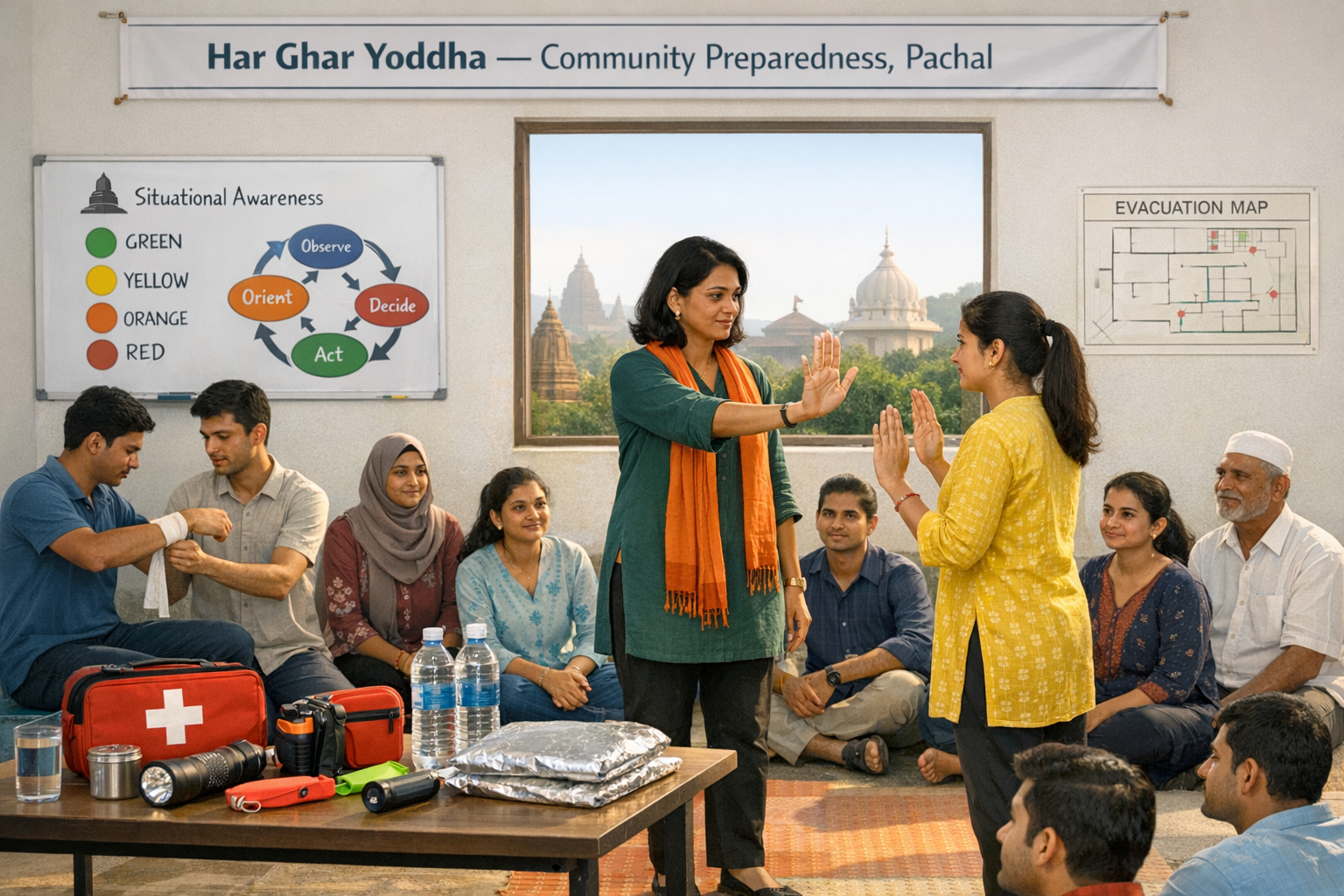
The recent Har Ghar Yoddha initiative organized by Hindu Janajagruti Samiti (HJS) in Pachal, Ratnagiri, drew an enthusiastic response from local youth and families. Framed around the message of applying training not only for personal safety but also for the protection of Deity, Nation, and Dharma, the program emphasized a lawful, ethical, and community-first interpretation of these idealsnamely, stewardship of sacred heritage, commitment to constitutional values, and service rooted in shared dharmic ethics.
Har Ghar Yoddhaliterally, a “warrior in every home”was presented as a civic-preparedness and ethical-service model rather than a call to confrontation. Training modules were designed to build community resilience through non-violent self-defence, disaster readiness, cyber hygiene, first aid, and heritage stewardship, drawing on the common principles of ahimsa, satya, and seva that converge across Hinduism, Buddhism, Jainism, and Sikhism. This dharmic unity was central: participants were encouraged to see safety and service as expressions of compassion, duty, and responsibility to the wider community.
The visible engagement of youth in Pachal signaled a deep appetite for constructive, hands-on learning linked to real-world needs. For many families, the idea that every home can contribute to community safety and harmony felt empowering and practical. Attendees repeatedly noted that the program made complex topicssituational awareness, emergency response, and legal do’s and don’tsaccessible through demonstrations, drills, and contextually relevant scenarios.
Non-violent self-defence and situational awareness formed the foundation. The curriculum introduced evidence-informed frameworks such as Cooper’s Color Codes (from relaxed awareness to heightened alertness) and the OODA loop (Observe–Orient–Decide–Act) to help participants identify risks early, avoid escalation, and prioritize safe exit or de-escalation over physical engagement. When escape was not immediately possible, the emphasis remained on minimal-force, last-resort techniques consistent with lawful self-defence and calibrated strictly to the threat at hand.
Women’s safety received dedicated attention through boundary-setting strategies, bystander intervention techniques, and scenario-based practice that centered consent, dignity, and rapid help-seeking. Facilitators underscored that effective community safety arises from collective vigilance, respectful communication, and inclusive participationprinciples that are as ethical as they are practical.
Recognizing today’s information environment, the program featured cyber hygiene and misinformation management. Participants learned simple, repeatable protocols for verifying sources, pausing before sharing emotionally charged content, and reporting malicious activity. These steps not only protect individuals from cyber harms but also reduce rumor-driven tensions, thereby strengthening inter-community trust and dharmic harmony.
Emergency first aid and disaster readiness were aligned with widely accepted best practices and national guidance. The training covered scene safety, calling for professional help, airway-breathing-circulation (ABC) checks, bleeding control, shock management, and safe patient positioning. For a coastal district like Ratnagiri, the modules also discussed monsoon-related risks, basic evacuation planning, and community coordination. Participants were introduced to incident basics drawn from structured response principles so that volunteers can support authorities effectively without duplicating or disrupting official efforts.
The legal-ethical component was explicit: safety and service must remain within the ambit of law and constitutional morality. Facilitators explained that while Indian law recognizes the right of private defence under defined circumstances, the safest and most responsible path is rapid notification of authorities, clear documentation, and non-interference with police procedures. The program urged the adoption of a community code of conductno vigilantism, zero tolerance for hate, and strict adherence to due process and non-discrimination.
Heritage stewardshipsometimes phrased as temple care or temple defensewas reframed in civic and conservation terms. Activities emphasized lawful measures such as volunteer watch-and-ward, crowd safety during festivals, basic fire safety, anti-theft precautions, and documentation of artifacts in coordination with local committees. Participants were encouraged to respect and, where appropriate, extend courtesy and care to all local places of worshipreflecting the dharmic ethos of mutual respect and the blog’s objective of unity across Hindu, Buddhist, Jain, and Sikh communities.
Effective community safety depends on cooperation. The initiative underscored collaboration with gram panchayats, schools, temple committees, gurdwaras, vihars, derasars, and local police. Clear, pre-agreed protocols for event security, crowd movement, lost-and-found procedures, and grievance redressal reduce confusion and allow volunteers to serve as a positive interface between citizens and authorities.
Beyond technical skills, the program targeted psychosocial benefits. Research on community preparedness links such training to higher self-efficacy, trust, and social cohesion. Suggested outcome indicators included skill retention (e.g., first-aid refreshers), volunteer hours contributed during cultural events, timely reporting of hazards, and participation in periodic drills. These metrics help communities iteratively refine their preparedness without losing sight of the human relationships that make resilience possible.
A distinctive feature of the Pachal sessions was the integrative dharmic framing. Participants explored how metta (loving-kindness) in Buddhism, ahimsa and aparigraha in Jainism, seva and sarbat da bhala in Sikhism, and dharma and daya in Hinduism converge on a shared civic ethic. The result was a unifying vocabulary for community safety: compassion in intent, restraint in action, and responsibility in outcome.
Safeguards were built into the pedagogy: explicit rejection of vigilantism, commitment to non-violence, respect for diversity, and privacy-conscious handling of community information. Gender inclusion, youth leadership, and respectful intergenerational dialogue were embedded as cross-cutting themes to ensure that preparedness is broad-based and sustainable.
Scalability was addressed through a train-the-trainer approach, modular lesson plans, and low-cost practice drills. Microlearning via community gatherings, short video explainers, and scheduled refresher sessions can keep knowledge current. The approach is replicable across Maharashtra’s coastal belt and adaptable to urban settings, provided the legal-ethical framework and inclusive dharmic ethos remain non-negotiable.
In sum, the Har Ghar Yoddha initiative in Pachal, Ratnagiri, channeled youth enthusiasm into structured, lawful, and compassionate community service. By anchoring personal safety in civic cooperation and by interpreting “Deity, Nation, and Dharma” through the lenses of heritage care, constitutional duty, and shared dharmic values, the program offered a constructive model for unity and resilience. The outcome is not merely better readiness, but a stronger social fabricone in which every household participates in safeguarding life, dignity, and the plural spiritual inheritance of the region.
Inspired by this post on Hindu Jagruti Samiti.
