
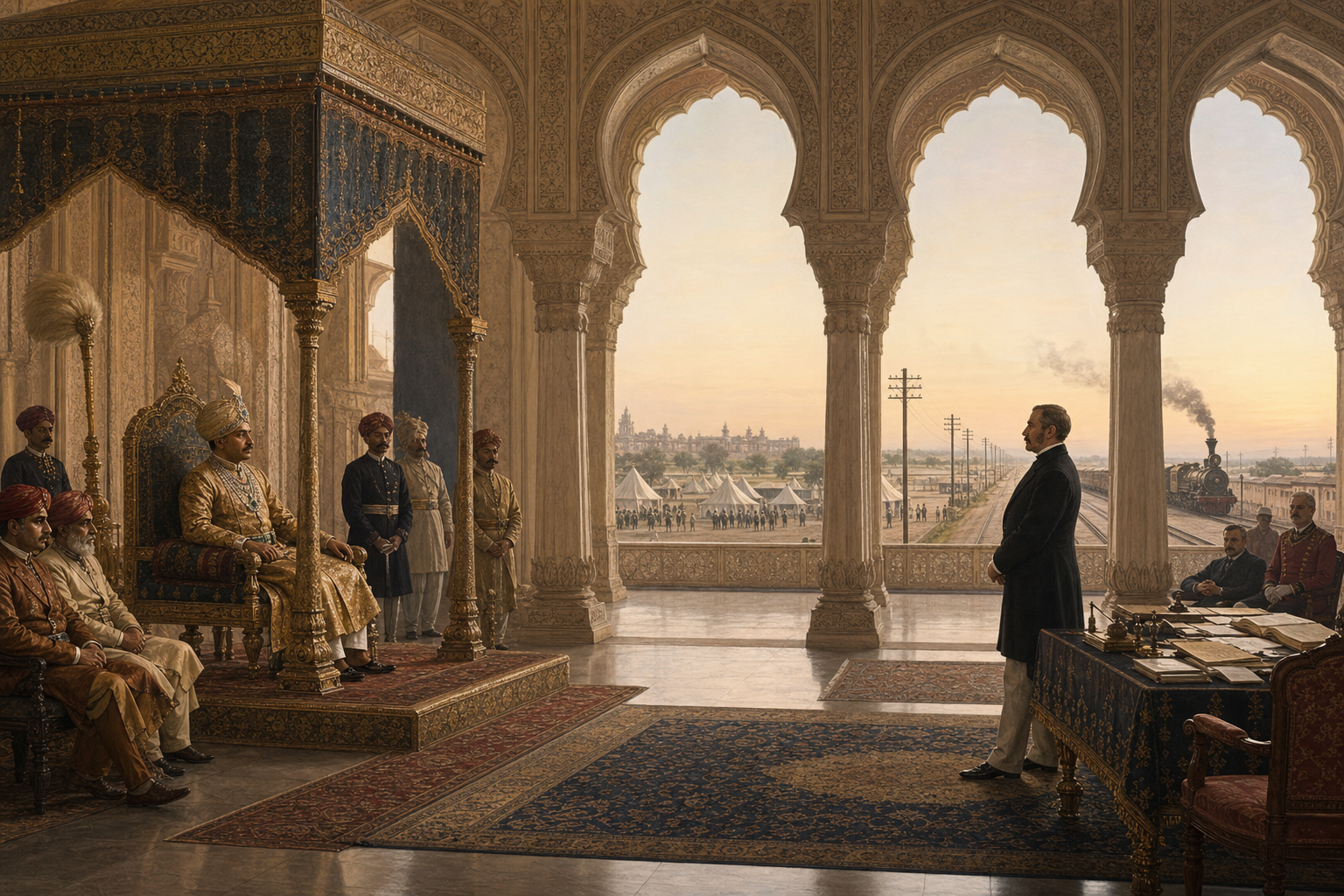
If you have been told that Hyderabad was an independent nation swallowed by India in 1948, the claim sounds simple only because it compresses two centuries into one word. To test it, you need to ask a narrower question: who could make war, conduct diplomacy, authorize succession, control strategic communications, and carry obligations beyond the state’s borders?
Under that test, Hyderabad was not a fully sovereign state during British paramountcy. It was a hereditary princely state with substantial internal autonomy and a court of its own, while decisive external powers sat with the paramount authority. That conclusion neither turns Hyderabad into an ordinary British province nor erases the real constitutional dispute created when paramountcy lapsed in 1947.
Key takeaways
- The victory at Shakarkheda in 1724 established Asaf Jah I’s effective power in the Deccan, but it did not produce a clear constitutional declaration of sovereign independence.
- Hyderabad’s rulers continued seeking imperial recognition of succession long after 1724. That practice carries more weight than later ceremonial claims.
- Under the British subsidiary system, defense, foreign relations, strategic communications, and the financial arrangements supporting British troops were controlled or constrained by the paramount power.
- The lapse of British paramountcy in 1947 created a new constitutional problem. It did not retroactively prove that Hyderabad had enjoyed uninterrupted external sovereignty.
- Hyderabad’s status before 1947 and the justification for Operation Polo in 1948 are related but distinct questions. One cannot be used as a shortcut to answer the other.
Test sovereignty by powers, not by royal appearance

Start by separating internal government from external sovereignty. A ruler may appoint ministers, collect revenue, administer courts, maintain a courtly culture, and issue orders within his territory while another power determines defense and foreign relations. Such a polity has genuine political authority, but it is not necessarily an internationally independent state.
This distinction is essential because Hyderabad was not administered like a district under a British collector. The Nizam and his government exercised substantial authority over domestic affairs. Yet internal autonomy answers only the question of who governed inside Hyderabad. Full sovereignty also requires an answer to who represented the state outside it.
Four practical tests make the position clearer:
- Defense: Could Hyderabad decide independently when to wage war, against whom, and with what military establishment? British troops were stationed in the state, while foreign-trained forces were disbanded or subordinated under the subsidiary arrangement.
- Diplomacy: Could the Nizam maintain an unrestricted foreign policy or enter external commitments without the paramount power? Foreign affairs and strategic communications belonged to the sphere controlled by the British.
- Constitutional recognition: Did succession rest solely on Hyderabad’s own law and authority? The Nizams continued to seek recognition from the Mughal imperial order and its regent even after they had become hereditary rulers in practice.
- Enforcement: What happened when Hyderabad could not meet the obligations of the subsidiary system? Territorial revenues from Berar were redirected from 1853 to support those obligations, with the arrangement later regularized in 1903-1905.
No ceremonial title can overcome this distribution of powers. Nor can the existence of a palace, an army, a revenue system, or a hereditary dynasty settle the matter. Those features demonstrate government. The defense and diplomacy tests determine whether that government was externally sovereign.
Why the events of 1724 do not establish independence
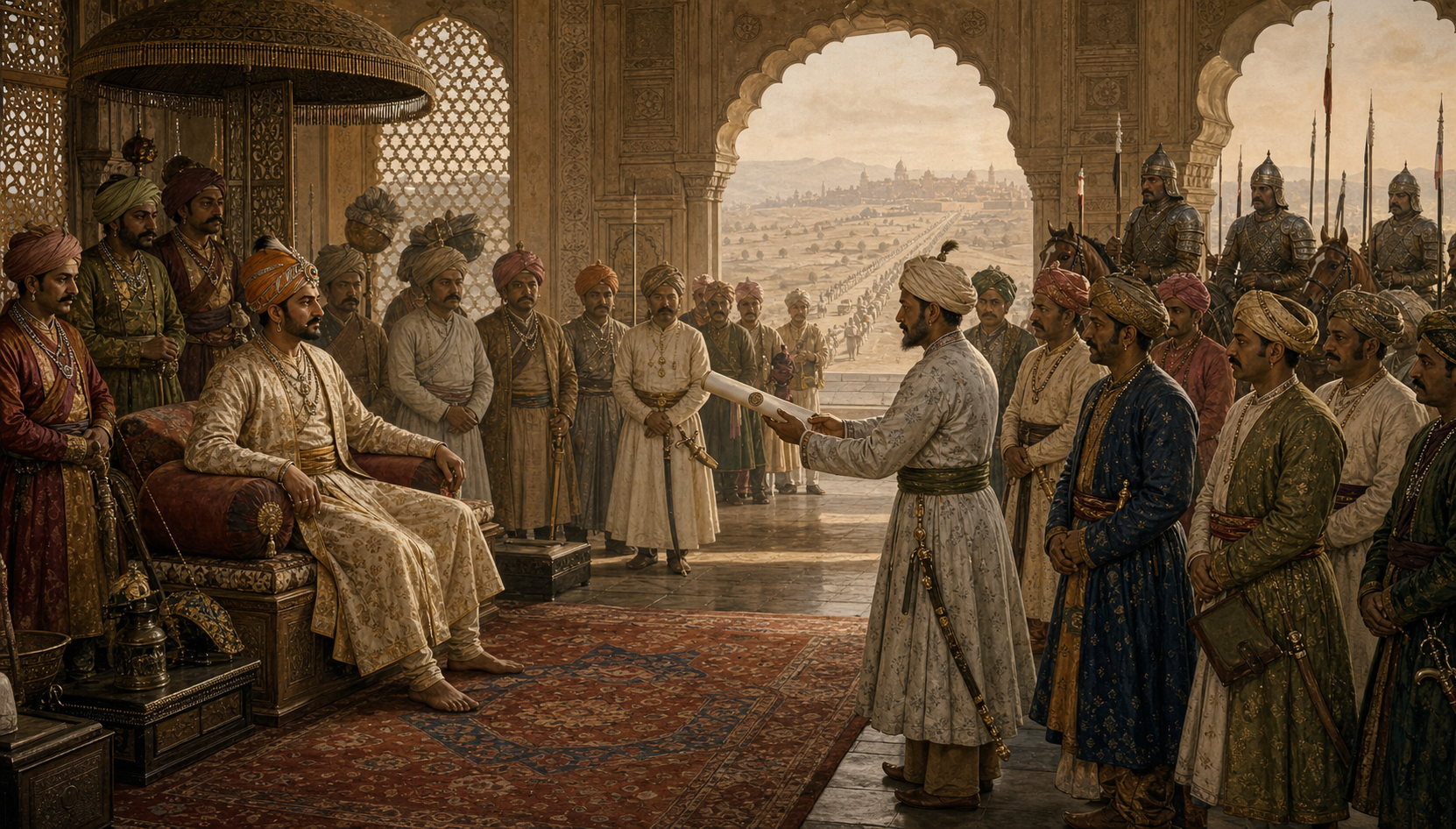
The strongest version of Hyderabad’s independence narrative begins at Shakarkheda in 1724. Asaf Jah I defeated his rival and secured effective control over the Deccan. That was a major transfer of power on the ground, but winning control of a province during imperial decline is not the same as constituting a new sovereign state.
Asaf Jah I continued to present himself as a Rais, or chieftain, rather than adopting the title of Shah or Sultan. The title Nizam itself emerged from the language of governorship and delegated imperial authority. Titles alone are never conclusive, especially in a political culture where rulers could preserve old forms after acquiring new powers. Here, however, the language matched Hyderabad’s continuing constitutional conduct.
The Nizams sought formal recognition of succession from the Mughal emperor or the authority acting for him. As late as 1785, the Nizam sent an agent to the camp of Mahadji Sindhia near Delhi to obtain recognition through the imperial regent. That occurred roughly six decades after Shakarkheda. A dynasty that understood itself as entirely self-authorizing would not ordinarily need such endorsement.
You should therefore distinguish three things that are often collapsed into one: effective independence from day-to-day imperial control, hereditary possession of office, and external legal sovereignty. Hyderabad achieved the first two to a considerable degree. The evidence for the third is much weaker.
This layered arrangement was not unusual in an age of declining empires, powerful regional houses, Maratha influence, and overlapping claims. It becomes misleading only when a modern idea of equal nation-state sovereignty is projected backward onto a ruler who continued to operate within an imperial vocabulary of office and recognition.
British paramountcy replaced the imperial center above Hyderabad

British ascendancy did not suddenly transform a fully independent Hyderabad into a subordinate state. It redirected an existing relationship of external supremacy. By 1804, British power controlled Delhi and effectively occupied the position once exercised through the Mughal regency. Hyderabad’s external dependence increasingly ran through the British rather than the weakened Padshah.
The subsidiary alliance associated with Lord Wellesley gave that relationship material force. British troops provided protection, Hyderabad accepted restrictions on its military and external dealings, and the paramount power assumed control over functions central to international sovereignty. The Nizam consented to the arrangement and benefited from its protective umbrella. Consent, however, does not mean that the powers transferred under an agreement remained fully available to the ruler afterward.
The Berar arrangement makes the hierarchy unusually concrete. From 1853, territorial revenues were assigned to sustain Hyderabad’s subsidiary obligations. The financial settlement was subsequently regularized in 1903-1905. This was more than diplomatic influence: territorial income was placed behind the paramount power’s military guarantees.
When the British Crown replaced East India Company rule in 1858, Hyderabad still did not emerge as a coequal international power. Its dynasty remained in place, and its domestic government retained a large field of action, but the paramount relationship continued. The most accurate description is therefore neither “British province” nor “independent country.” Hyderabad was an internally autonomous princely state under an external paramount power.
A defense alliance by itself would not prove subordination. Fully sovereign states can invite foreign troops or accept treaty limits. Hyderabad’s position rested on a wider and longer pattern: imperial recognition of succession, British control of foreign relations, restrictions on military capacity, control of strategic communications, a permanent Resident, and enforceable financial arrangements supporting the subsidiary force. The constitutional character lies in that pattern, not in any one symbol.
Misgovernment is evidence of practice, not proof of status
Administrative evidence must be used more carefully. Reports from 1812 and 1820 described an acute breakdown of government, including depopulation, necessities reaching famine prices, the absence of effective law or policing, and armed plunder on the roads. By the middle of the nineteenth century, British officials increasingly spoke as if the Governor-General and Resident bore a custodial responsibility for Hyderabad’s population. Richard Temple later described his task in 1867 as securing the realm through decent administration.
These conditions help explain how British paramountcy operated and why interventionist officials believed they possessed both authority and responsibility. They do not independently prove that Hyderabad lacked sovereignty. A sovereign state can be badly governed, while a subordinate state can be well governed. If you use administrative failure as your principal constitutional argument, you weaken the case by confusing legitimacy with legal status.
Colonial judgments also require scrutiny because officials advocating intervention had institutional interests of their own. Use their testimony to examine conditions, the Resident’s role, and the way paramountcy was understood in practice. Do not treat a colonial official’s contempt for a government as a substitute for evidence about who controlled defense, diplomacy, and succession.
What the lapse of paramountcy changed in 1947

The Indian Independence Act ended British paramountcy in 1947. That fact creates the hardest part of the argument: did the disappearance of the paramount power automatically turn every princely state into a fully sovereign international state?
A claim of automatic independence has some force as an argument about a constitutional rupture. The British relationship had ended, and the previous structure could not simply continue under the same name. But describing the event as a restoration of Hyderabad’s sovereignty assumes the very point that must be proved. A power cannot be “restored” without showing that it existed before it was lost.
The Indian Union’s position was that a princely ruler who had not independently controlled defense, diplomacy, communications, or international representation could not acquire a complete international personality merely because Britain withdrew. The Union controlled the former imperial center at Delhi and assumed the external responsibilities of a modern state. Hyderabad, territorially enclosed within India, could not operate politically in a vacuum.
This was a contested transition, and historical precision requires acknowledging the contest. The lapse of paramountcy ended a definite British relationship; it did not provide an agreed mechanism for converting internal autonomy into external statehood. The defensible conclusion is narrower: Hyderabad entered 1947 without the established external attributes of a sovereign state.
Operation Polo concluded on 17 September 1948 and integrated Hyderabad into the Indian Union. That outcome must not be used circularly: India integrated Hyderabad, therefore Hyderabad could never have been sovereign. The pre-1947 case instead rests on the preceding constitutional record. Conversely, establishing Hyderabad’s subordinate status under the British does not, by itself, answer every question about the necessity, conduct, or proportionality of military action in 1948. Those questions require their own evidence.
Acharya Jadunath Sarkar’s 1948 reasoning is most persuasive when understood as a chain of constitutional practice: Hyderabad began as a hereditary Mughal office, continued to seek imperial recognition, passed under British paramountcy, and lacked independent control over the external functions of statehood. It does not need the weaker claim that Hyderabad possessed no government or autonomy of its own.
Five questions to use when the claim appears
- Independent at what date? A claim about Hyderabad in 1724, 1785, 1858, 1947, or 1948 cannot be answered with the same evidence.
- Independent in which domain? Ask separately about domestic administration, defense, diplomacy, communications, succession, and international representation.
- What changed in law and practice? Look for treaties, recognition procedures, stationed forces, territorial assignments, and actual external conduct rather than relying on royal ceremony.
- Is the evidence about status or governance? Disorder and injustice concern legitimacy and administration. They are not automatic proof of constitutional subordination.
- Is the argument skipping from 1724 to 1947? Any account that ignores the subsidiary alliance and more than a century of British paramountcy leaves out the powers that matter most to the sovereignty question.
When you write, teach, or debate this history, use a precise formulation: Hyderabad possessed broad internal autonomy but remained externally subordinate under British paramountcy; its lapse in 1947 opened a disputed transition that ended with integration in 1948. Then examine the justice of that transition as a separate question. Precision prevents dynastic prestige from being mistaken for modern statehood, and it keeps Bharat’s historical case from resting on slogans it does not need.